
If you've ever received a "hold" letter from NYC's Office of Environmental Remediation (OER), you know the sinking feeling. Your project timeline just stretched by weeks: maybe months. Your financing is in limbo. And somewhere in the stack of paperwork, a detail got missed that's now costing you real money.
Here's the thing: E-Designation filings aren't rejected because OER is being difficult. They're rejected because the submission didn't meet very specific technical and administrative requirements that the agency has established through years of case precedent. The good news? Most rejections follow predictable patterns.
After shepherding dozens of E-Designation projects through the EPIC Environment portal, we've identified the five most common reasons filings get bounced back: and more importantly, how to get them right the first time.
1. Your Environmental Professional Credentials Aren't Properly Documented
OER requires that all investigation reports, remedial designs, and certifications be prepared and sealed by a New York State licensed Professional Engineer (PE). Sounds simple, right? Yet we see filings rejected because:
- The PE stamp on the report doesn't match the credentials filed with the state
- The engineer's license has expired or is in "renewal pending" status
- Multiple consultants contributed sections, but the coordinating PE didn't review or seal certain appendices
- The AKRF (Applicant's Qualified Environmental Professional) designation form wasn't submitted or contains outdated insurance information
The fix: Before you even start your soil investigation, verify your environmental consultant's PE credentials are active and current in New York State. Request copies of their E&O insurance certificates and confirm they're filed correctly in EPIC. Double-check that every technical document: including boring logs, lab reports, and remedial work plans: bears the proper stamp and matches the designated AKRF on file.

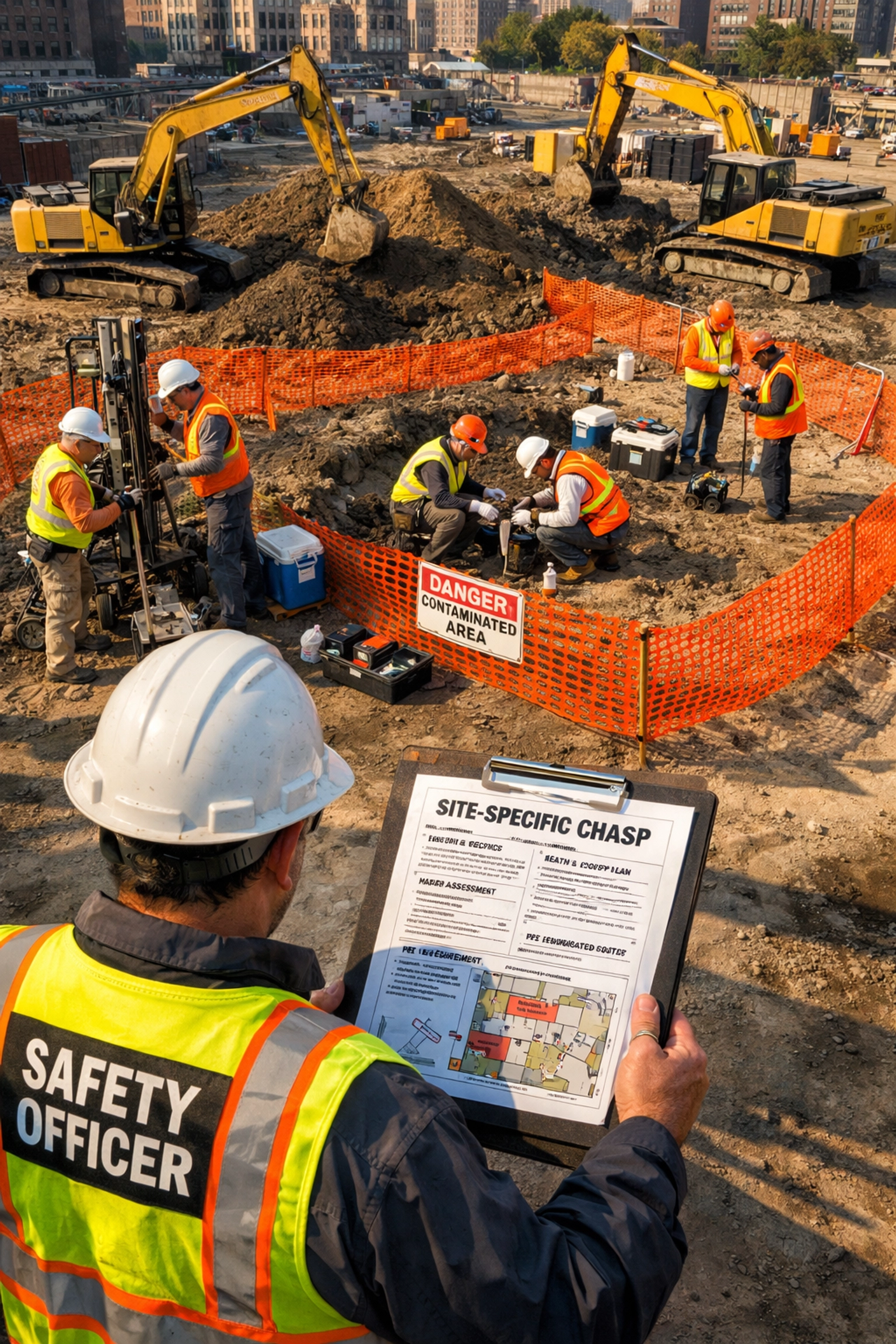
2. Your Construction Health and Safety Plan (CHASP) Is Generic
This is the most frequent reason for hold letters we encounter. Many firms submit boilerplate CHASPs that were clearly copy-pasted from previous projects. OER reviewers can spot these in seconds because they contain:
- Site addresses that don't match the project location
- Contaminant lists that don't align with the Phase II findings
- Generic monitoring protocols that don't address site-specific E-Designation requirements (air quality, noise, or hazardous materials)
- Missing or outdated emergency contact information
- No clear delineation of remedial action areas versus non-impacted construction zones
OER's position is clear: your CHASP must be a living, site-specific document that protects workers and the public based on your actual soil and groundwater data. If your Phase II found petroleum contamination and lead, but your CHASP only addresses VOCs, you're getting a hold letter.
The fix: Your CHASP should be written after: not before: you have complete site characterization. It must include:
- Site-specific health and safety protocols tied directly to detected contaminants
- Real-time air monitoring protocols that reference your E-Designation requirements
- Clear stop-work triggers based on field screening criteria
- Contact information for your site-specific personnel (not your corporate office in another state)
- Detailed maps showing contaminated zones, exclusion areas, and decontamination stations
We typically develop the CHASP in parallel with the Remedial Action Plan (RAP), ensuring they're technically and administratively aligned before submission.
3. You Didn't Adequately Characterize Off-Site Impacts
E-Designation properties often have contamination that extends beyond property lines: into adjacent lots, beneath sidewalks, or toward nearby waterways. OER wants to see that you've evaluated these scenarios and have a plan to address them.
Filings get rejected when:
- Soil borings stop at the property line, even when contaminant gradients suggest off-site migration
- Groundwater flow direction isn't properly established
- There's no discussion of vapor intrusion risk to neighboring buildings
- The remedial design assumes contamination is contained, but no physical barrier (like a subslab depressurization system) is proposed
The fix: During your Phase II, extend your investigation grid to include borings along property boundaries and, where access allows, test adjacent properties. Document groundwater gradients with multiple rounds of monitoring. If off-site impacts are likely, include a contingency plan in your RAP: whether that's additional excavation, institutional controls, or coordination with neighboring property owners.
OER would rather see a conservative approach that acknowledges uncertainty than an overly optimistic plan that ignores obvious data gaps.
4. Your Remedial Action Plan Lacks Engineering Details
Here's where a lot of environmental consultants stumble: they submit a conceptual RAP that describes what will be done, but not how it will be done with sufficient engineering rigor. OER reviewers are looking for construction-level details, not aspirational narratives.
Common deficiencies include:
- No excavation depth calculations or volume estimates tied to analytical data
- Vague language like "contaminated soil will be removed" without specifying removal limits, confirmation sampling protocols, or disposal facility approvals
- Missing details on site restoration, backfill material specifications, or compaction requirements
- No discussion of dewatering needs or groundwater management during excavation
- Insufficient engineering controls for ongoing operations (e.g., vapor barriers, landscaping caps)
The fix: Treat your RAP like a construction document. Include:
- Scaled site plans showing excavation limits with coordinates
- Cross-sections illustrating excavation depths relative to contamination isopleths
- Confirmation sampling grids with rationale for sample density
- Detailed specifications for any engineered controls (e.g., vapor barrier thickness, permeability)
- Contingency protocols if field conditions differ from predictions
If your project involves civil engineering components: grading, utilities, stormwater management: integrating those designs with your environmental remediation from the outset prevents conflicts and ensures OER sees a holistic, feasible plan. This is where Envicon's integrated civil and environmental approach eliminates the back-and-forth between disciplines that often causes delays.
5. You Submitted Incomplete or Inconsistent Documentation
This sounds basic, but it's remarkably common: OER receives packages where documents contradict each other, references are missing, or key forms aren't completed.
Examples we've seen:
- The Phase II report lists 12 soil samples, but only 10 lab reports are included in the appendix
- The remedial budget estimate doesn't align with the scope of work described in the RAP
- The E-Designation (E) designation requires air quality monitoring, but the CHASP and RAP don't mention it
- Cross-references to "Attachment C" that doesn't exist
- Certifications submitted without proper notarization or witnessing
The fix: Before you hit "submit" in EPIC, conduct an internal QA/QC review. We use a standardized checklist that verifies:
- Every sample referenced in the report has a corresponding lab report and chain-of-custody
- All appendices, tables, and figures are present and correctly numbered
- Engineering calculations are shown (not just stated)
- E-Designation requirements from the original BIS are explicitly addressed in your plan
- All forms are complete, signed, sealed, and dated
It's also helpful to have someone who didn't write the documents review them. Fresh eyes catch inconsistencies that the author overlooks.
Why Expertise Matters: The Cost of Delay
Let's be honest: every week your project is on hold costs money. Carrying costs, financing extensions, contractor delays: it adds up fast. But beyond the direct costs, there's a reputational risk. Lenders and investors start questioning your team's competence when filings get bounced repeatedly.
This is where working with a firm that has deep NYC OER experience pays dividends. At Envicon Strategic Solutions, we've navigated the E-Designation process across dozens of projects: from luxury residential conversions to industrial redevelopments. We know what OER reviewers are looking for because we've been on both sides of the table.
Our integrated approach means your environmental investigation, remedial design, and civil engineering plans are coordinated from day one. There's no "handoff" between consultants that creates information gaps. No conflicting grading plans that undermine your soil management strategy. No surprises when it's time to excavate because we designed your foundation to accommodate the remediation.

Getting It Right the First Time
Avoiding a hold letter isn't about luck: it's about preparation, attention to detail, and understanding what OER needs to approve your project. The five reasons we've outlined here account for the vast majority of rejections we see in the field:
- Credential issues with your environmental professional
- Generic, non-site-specific CHASP documents
- Inadequate characterization of off-site impacts
- Insufficient engineering detail in your remedial plan
- Incomplete or inconsistent documentation packages
Fix these, and you're in the top tier of submissions that sail through OER review with minimal comments.
If you're staring at an E-Designation project and want to avoid the hold letter cycle entirely, let's talk. Our team has the technical depth and regulatory experience to get your filings approved the first time: so you can break ground on schedule and on budget.
Need help navigating your E-Designation project? Contact our team for a consultation. We'll review your site conditions, help you develop a bulletproof filing strategy, and keep your project moving forward.
Leave a Reply