Blog

  • Lender-Approved Phase I ESA New York: A Closing-Ready Checklist for Manhattan and Brooklyn Buyers

    Lender-Approved Phase I ESA New York: A Closing-Ready Checklist for Manhattan and Brooklyn Buyers

    Buying commercial real estate in New York is rarely slowed by the purchase agreement alone. Environmental due diligence can become the critical path, especially when your lender reviews the Phase I ESA after the rest of the transaction is already moving.

    A lender-approved Phase I ESA in New York must do more than identify potential contamination. It must follow the right standard, document the right components, address the lender’s reliance requirements, and arrive within the closing schedule.

    That is true for a Manhattan acquisition, a Brooklyn warehouse conversion, a Queens industrial property, or a multifamily redevelopment in the Bronx, Staten Island, or Westchester.

    We do not just deliver reports. We help clear the path to closing.

    What “lender-approved” actually means

    A Phase I ESA can comply with ASTM E1527-21 and EPA’s All Appropriate Inquiries rule without automatically satisfying every lender.

    Those are related, but they are not the same thing.

    ASTM E1527-21 establishes the technical process for evaluating commercial real estate. EPA recognizes ASTM E1527-21 as consistent with the AAI requirements in 40 CFR Part 312. AAI supports certain CERCLA landowner liability protections when the buyer also meets continuing obligations.

    Lender approval is a separate business and contractual decision. A bank, credit union, SBA lender, private credit fund, or institutional lender may add its own requirements, including:

    • Naming the lender as an authorized user.
    • Providing a lender reliance letter.
    • Addressing specific environmental databases or regulatory files.
    • Expanding the vapor or adjacent-property review.
    • Updating the report close to the acquisition date.
    • Evaluating activity and use limitations, institutional controls, or environmental liens.
    • Requiring a Phase II ESA when the report identifies a REC.

    EPA describes AAI as “the process of evaluating a property’s environmental conditions and assessing potential liability for any contamination.” That process protects the buyer’s decision-making. It does not guarantee that a lender will approve the collateral.

    The ASTM E1527-21 checklist for New York buyers

    A closing-ready Phase I ESA should clearly document the following.

    1. Records review

    The Environmental Professional reviews current and historical information about the property and surrounding area. That typically includes:

    • Federal, state, and local environmental databases.
    • Historical aerial photographs.
    • Sanborn fire insurance maps.
    • City directories.
    • Topographic maps.
    • Building department records.
    • Spill, tank, hazardous waste, and cleanup records.
    • Prior environmental reports when available.
    • Regulatory files for adjoining and nearby properties.

    In New York City, site history often changes block by block. A former dry cleaner, auto repair facility, printing operation, manufactured gas use, or petroleum operation may not be obvious from the current building façade.

    For a Phase I ESA lender requirements Brooklyn review, the surrounding industrial history may be just as important as the subject parcel. The same applies to warehouse acquisitions in Queens, commercial corridors in the Bronx, and redevelopment sites in Westchester.

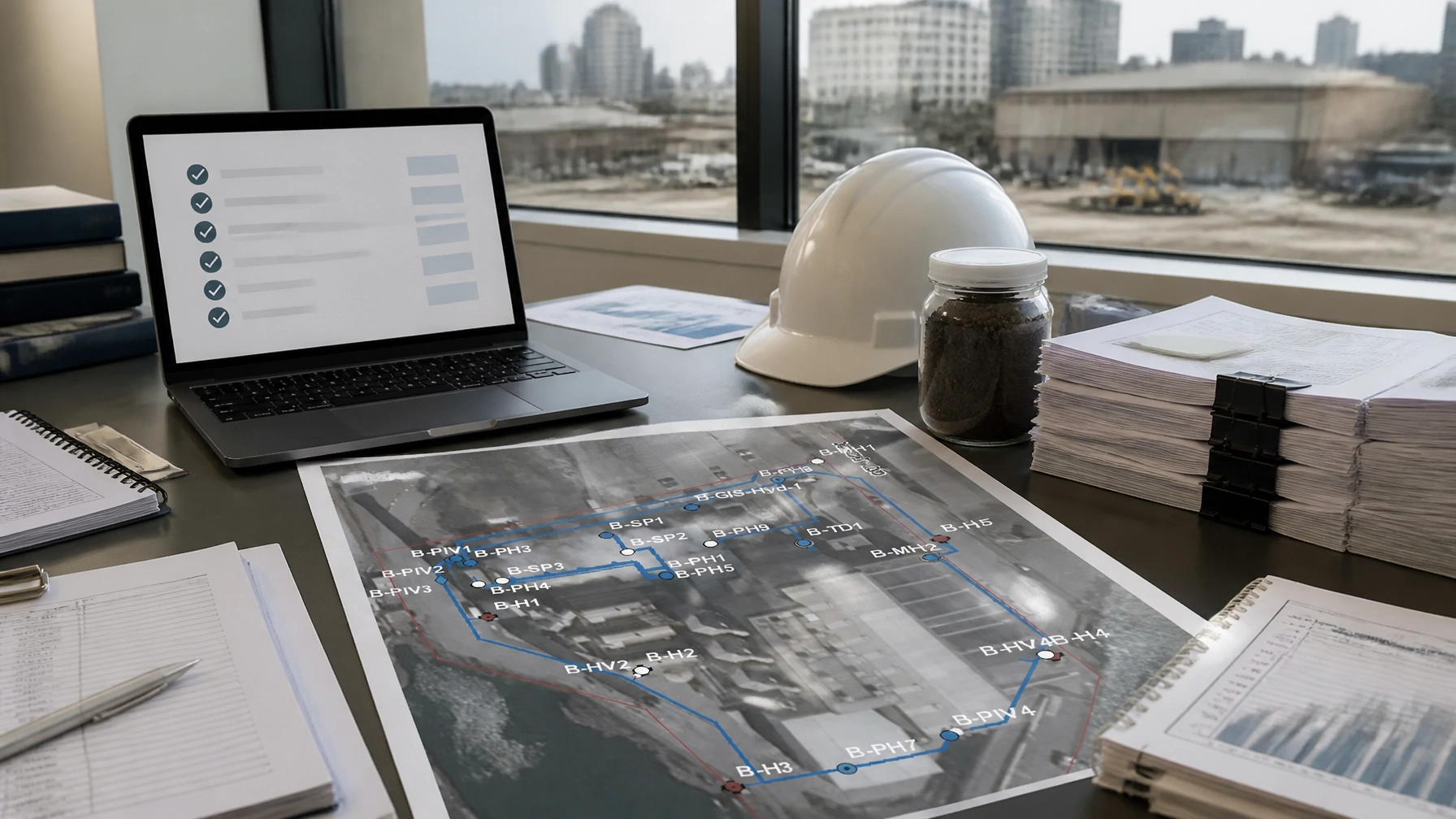
    GIS-style New York urban property map showing parcel boundaries, nearby former industrial uses, utilities, and environmental screening layers

    2. Site reconnaissance

    The site visit is not a formality. The Environmental Professional inspects the property and adjoining properties for evidence that may not appear in records.

    The reconnaissance may identify:

    • Underground or aboveground storage tanks.
    • Floor drains, sumps, pits, or oil-water separators.
    • Chemical storage.
    • Drums, staining, stressed vegetation, or unusual odors.
    • Electrical transformers and potential PCB concerns.
    • Waste handling areas.
    • Vent pipes and fill ports.
    • Cracks or pathways relevant to vapor migration.
    • Conditions on adjoining properties that may affect the subject site.

    A report that relies on old photographs or a limited exterior view may not satisfy a lender’s expectations. Physical access limitations should be documented, not hidden in vague language.

    3. Interviews

    ASTM E1527-21 and AAI require meaningful interviews with current and past owners, operators, occupants, and other knowledgeable parties when appropriate.

    Interviews can reveal:

    • Former operations that were not included in public records.
    • Historic spills or tank removals.
    • Environmental notices.
    • Known fill placement.
    • Prior investigations or remediation.
    • Areas that were inaccessible during the site visit.

    For a lender Phase I ESA in Manhattan, an interview with a building manager may identify a former boiler fuel system or maintenance area. In Brooklyn or Queens, an operator may know that a former tenant used solvents or stored petroleum products.

    The interview record also matters when the lender reviews the report. A report that simply states “no one was available” without explaining the effort made to obtain information may generate questions late in the transaction.

    4. Environmental liens and activity and use limitations

    Environmental cleanup liens are part of the AAI process. Buyers should also provide available title materials and information about recorded restrictions.

    The Phase I should address whether the property has:

    • Environmental cleanup liens.
    • Environmental easements.
    • Deed restrictions.
    • Institutional controls.
    • Engineering controls.
    • Soil or groundwater management obligations.
    • Vapor mitigation requirements.
    • Long-term operation and maintenance obligations.

    These conditions may affect financing, future construction, tenant use, and resale value. They also create a distinction between a property that was cleaned up and a property that remains subject to an ongoing remedy.

    RECs, HRECs, and CRECs: what the lender is reading for

    The conclusions section should classify findings clearly.

    Recognized Environmental Condition

    A REC generally involves the presence or likely presence of hazardous substances or petroleum products due to a release, likely release, or material threat of a future release.

    A REC does not automatically kill a transaction. It does mean the lender may require additional investigation, a cost estimate, a remediation plan, or a purchase agreement adjustment.

    Historical Recognized Environmental Condition

    An HREC refers to a past release that has been addressed to the satisfaction of applicable regulatory requirements, with no current evidence that it remains a REC.

    The report should explain why the condition qualifies as historical. A vague reference to “closed” is not enough for a cautious lender.

    Controlled Recognized Environmental Condition

    A CREC involves contamination that remains in place but is controlled through measures such as a cap, deed restriction, groundwater-use restriction, or vapor mitigation system.

    A CREC may be manageable. It is not the same as a clean site. The lender will want to understand the control, who maintains it, what happens if it fails, and whether the proposed property use is compatible with it.

    Vapor encroachment is now part of the closing conversation

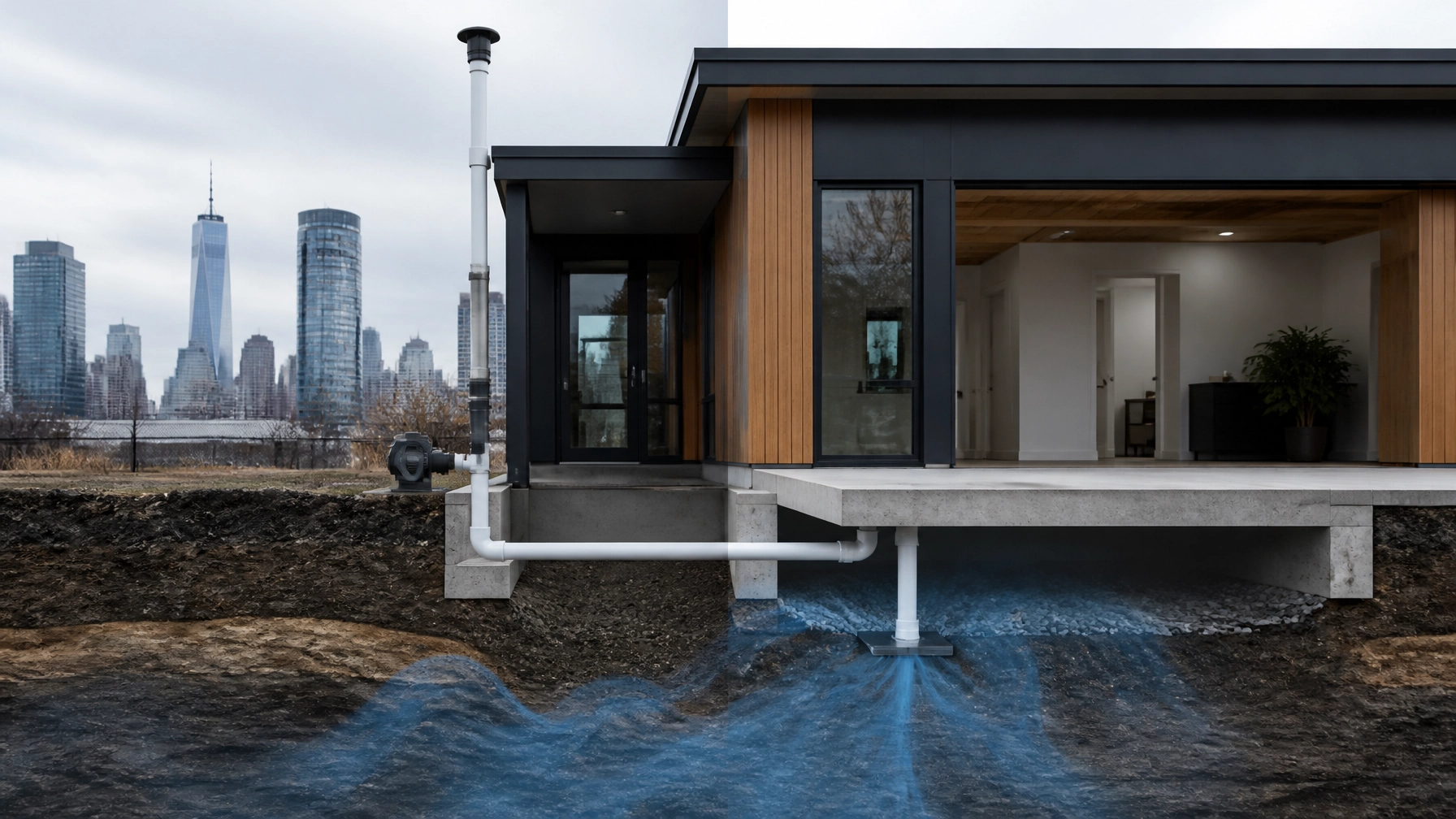
    Vapor risk can move from an adjacent property into a building through soil, groundwater, utility corridors, cracks, joints, or other preferential pathways.

    A Phase I ESA is not a full vapor intrusion investigation. It does, however, need to consider whether site history and surrounding conditions create a potential vapor concern.

    That review may lead to recommendations for:

    • Soil gas sampling.
    • Sub-slab sampling.
    • Indoor air sampling.
    • Groundwater investigation.
    • A vapor intrusion assessment.
    • A mitigation system evaluation.

    Urban subsurface cross-section showing soil layers, groundwater, utility corridors, building slab, and a vapor migration pathway from an adjacent property

    This issue is especially relevant for former dry cleaners, industrial properties, gas stations, and dense urban sites where subsurface pathways connect neighboring parcels.

    The 180-day rule and the closing schedule

    The report date alone does not determine whether a Phase I remains usable.

    Under EPA’s AAI guidance, AAI must be completed or updated within one year before acquisition. Five components must be conducted or updated within 180 days before the acquisition date:

    1. Interviews with current and past owners, operators, and occupants.
    2. Searches for recorded environmental cleanup liens.
    3. Reviews of federal, state, tribal, and local government records.
    4. Visual inspections of the property and adjoining properties.
    5. The Environmental Professional’s declaration.

    A report completed eight months before closing may still be usable, but these components need to be updated. A report older than one year generally cannot be treated as current AAI without a new assessment.

    Do not wait until the lender requests an update. Build the timing into the acquisition schedule.

    A practical sequence looks like this:

    • Week 1: Confirm the property address, lender, intended use, closing date, and user requirements.
    • Week 1: Lock the scope and schedule with the Environmental Professional.
    • Week 1 to 2: Complete records review, interviews, and site reconnaissance.
    • Week 2 to 3: Resolve data gaps and prepare the report.
    • Before closing: Confirm reliance language, report age, lien search timing, and any lender overlay.
    • If a REC is identified: Scope the Phase II ESA quickly enough to support negotiation and financing decisions.

    Commercial closing review with property maps, historical aerial imagery, title documents, and technical environmental report materials

    Common reasons lenders reject or return Phase I reports

    Most lender comments are preventable. Common problems include:

    • The report uses ASTM E1527-13 instead of ASTM E1527-21.
    • The lender is not named as a user or covered by a reliance letter.
    • The report does not identify the dates of the five 180-day components.
    • The site reconnaissance was incomplete or poorly documented.
    • Interviews were omitted without a clear explanation.
    • Environmental liens were not addressed.
    • REC, HREC, and CREC conclusions are unclear.
    • Vapor risk receives no meaningful discussion.
    • Significant data gaps are buried instead of explained.
    • The report does not address lender-specific forms or overlays.
    • The consultant cannot respond quickly when the lender asks a technical question.

    A large national consultant may deliver a technically acceptable report and still leave your attorney, lender, and acquisition team to resolve these issues. Envicon’s approach is different. We coordinate directly with the people who need to rely on the report, provide clear conclusions, and identify the next action instead of handing you a document with no path forward.

    Envicon’s published Phase I track record reports a 100% lender approval rate across more than 350 ASTM E1527-21 assessments. Our team also offers same-business-day scoping, fixed-fee proposals, and priority scheduling for transactions with compressed timelines.

    The closing-ready checklist

    Before ordering or approving a Phase I ESA, confirm that:

    • The scope states ASTM E1527-21 and AAI compliance.
    • A qualified Environmental Professional will sign the report.
    • The lender’s reliance requirements are known before field work begins.
    • The report covers Manhattan, Brooklyn, Queens, the Bronx, Staten Island, or Westchester conditions as applicable.
    • Site reconnaissance includes adjoining properties.
    • Interviews and environmental liens are addressed.
    • RECs, HRECs, CRECs, and data gaps are clearly explained.
    • Vapor encroachment potential is screened.
    • The report and 180-day components align with the closing date.
    • A Phase II path is available if the Phase I identifies a REC.

    Get a Phase I ESA that supports the transaction

    A lender-approved Phase I ESA in New York is not simply a compliance document. It is a decision tool for the buyer, lender, attorney, and development team.

    Envicon Group provides ASTM E1527-21 Phase I ESA services across Manhattan, Brooklyn, Queens, the Bronx, Staten Island, and Westchester. Our NYC environmental consulting team works directly with lenders, counsel, developers, and property owners.

    A clear report protects more than the closing date. It protects the decisions that come after it.

    Sources

    Envicon corporate logo

  • New Jersey PFAS Groundwater Standards: GAC, Ion Exchange, and Treatment Planning for 2026 Sites

    New Jersey PFAS Groundwater Standards: GAC, Ion Exchange, and Treatment Planning for 2026 Sites

    DRAFT

    New Jersey’s June 15, 2026 adoption added a formal groundwater quality standard for GenX and updated the regulatory framework developers, property owners, lenders, and contractors must consider when PFAS affects a site.

    For projects in Jersey City, Newark, Hoboken, Bayonne, Hudson County, Bergen County, and Essex County, PFAS treatment is not a simple equipment purchase. The treatment system must match the groundwater chemistry, flow rate, PFAS profile, discharge pathway, residuals plan, and NJDEP closure strategy.

    The right question is not, “Should we use GAC or ion exchange?”

    The right question is, “What treatment train can reliably meet the applicable standard and support the project’s regulatory endpoint?”

    New Jersey PFAS groundwater standards for 2026

    NJDEP’s Ground Water Quality Standards page identifies the following Class II-A groundwater standards:

    Constituent Groundwater standard Approximate equivalent
    PFOA 0.014 µg/L 14 ppt
    PFOS 0.013 µg/L 13 ppt
    PFNA 0.013 µg/L 13 ppt
    GenX chemicals 0.020 µg/L 20 ppt

    The GenX standard took effect through NJDEP’s June 15, 2026 adoption. NJDEP also lists a GenX practical quantitation level of 0.0075 µg/L.

    A practical quantitation level, or PQL, is the lowest concentration a laboratory can reliably quantify under routine operating conditions. It matters because PFAS decisions often depend on results measured in parts per trillion.

    NJDEP explains that the applicable groundwater standard is generally the higher of the health-based criterion and the corresponding PQL. The actual standard and regulatory pathway remain site-specific.

    Review the official NJDEP Ground Water Quality Standards, the June 15, 2026 GenX adoption, and NJDEP’s PFAS standards and regulations before finalizing a remedial design.

    Analytical requirements changed the front end of site investigation

    Under the amended New Jersey Technical Requirements for Site Remediation, PFNA, PFOS, PFOA, GenX chemicals, and 2,3,7,8-TCDD may be required across relevant media when hazardous substances at an Area of Concern are unknown or poorly documented.

    That can affect:

    • Phase II Environmental Site Assessments

    • Preliminary Assessments and Site Investigations
    • Remedial Investigations
    • Brownfield acquisitions
    • Industrial property transfers
    • Sites with historic firefighting foam use
    • Manufacturing and plating facilities
    • Airports, fire-training areas, and logistics properties
    • Properties with incomplete historical records

    The analytical plan should address more than groundwater alone. PFAS can move through a soil and groundwater pathway, migrate with dissolved groundwater, remain in soil, and create a continuing source after excavation or treatment.

    A defensible program typically evaluates:

    • Soil, groundwater, and, where relevant, soil leachate
    • Upgradient and downgradient conditions
    • Potential source areas
    • Hydraulic gradients and groundwater flow direction
    • Historical uses and PFAS-containing materials
    • Laboratory reporting limits
    • Quality assurance and quality control
    • Sampling equipment and material compatibility
    • Data validation and regulatory comparison

    Envicon’s Phase II ESA service is designed around the question the investigation must answer. Borings and wells should be placed against the recognized environmental conditions, not scattered across a site without a decision framework.

    Treatment selection starts with influent chemistry

    GAC and ion exchange can both remove PFAS. Neither is automatically the correct answer for every New Jersey site.

    Before sizing a system, the design team should understand the influent:

    • PFOS, PFOA, PFNA, GenX, and other detected PFAS
    • Short-chain and long-chain PFAS distribution
    • Total organic carbon, or TOC
    • Dissolved organic carbon
    • pH, alkalinity, hardness, and conductivity
    • Iron, manganese, suspended solids, and turbidity
    • Co-contaminants such as petroleum hydrocarbons or chlorinated solvents
    • Groundwater temperature
    • Design flow and peak flow
    • Expected pumping duration
    • Discharge limits and receiving pathway

    TOC is especially important for GAC because organic matter can compete for adsorption sites. Iron, manganese, and suspended solids can foul media and increase pressure loss. A treatment system that looks adequate on paper may perform poorly if the influent chemistry was not characterized before media selection.

    Flow also drives the design. A short-term excavation dewatering system may require different equipment from a long-term pump-and-treat system with continuous groundwater extraction.

    GAC versus ion exchange for PFAS treatment

    Technical comparison illustration of a granular activated carbon treatment vessel and an ion exchange resin treatment vessel for PFAS groundwater

    Treatment approach Strengths Limitations and design concerns Typical fit
    Granular activated carbon, or GAC Familiar technology, available in multiple grades, effective for many long-chain PFAS, straightforward vessel configuration TOC and co-contaminants can reduce capacity. Short-chain PFAS may break through sooner. Spent carbon requires management. Broad PFAS treatment, polishing, and projects with manageable organic loading
    Ion exchange, or IX Often strong performance at low PFAS concentrations. Can provide high treatment capacity for selected PFAS profiles. Resin selection is chemistry-dependent. Fouling, regeneration, resin disposal, and supplier requirements must be evaluated. Low-concentration groundwater, challenging short-chain PFAS profiles, or sites needing compact treatment
    Foam fractionation Can concentrate PFAS into a smaller residual stream and reduce dissolved mass in appropriate influent conditions Not a universal replacement for polishing. Requires careful evaluation of surfactant behavior, foam stability, concentrate management, and downstream treatment. Higher-concentration PFAS streams or treatment trains where concentration and destruction or off-site management are available
    Combined treatment train Allows pretreatment, primary removal, and polishing to address different PFAS and chemistry issues More equipment, controls, sampling points, residuals, and operating decisions Complex sites, variable influent, strict discharge requirements, or long-term treatment

    The treatment comparison is a planning framework, not a substitute for bench testing, pilot testing, or site-specific design.

    When GAC makes sense

    GAC is often selected because it is widely understood and can be configured in lead-lag vessels. The lead vessel captures most of the contaminant load. The lag vessel provides polishing and a warning point before breakthrough reaches the discharge.

    GAC design must account for:

    • Empty bed contact time
    • Vessel diameter and bed depth
    • Hydraulic loading
    • Influent TOC
    • PFAS chain length
    • Competing contaminants
    • Pressure drop
    • Breakthrough curves
    • Media changeout logistics
    • Spent carbon transportation and disposal or reactivation

    Media replacement should be based on monitoring data and design expectations. A calendar-only changeout schedule may waste media or fail to protect the effluent.

    When ion exchange makes sense

    Ion exchange resin can be effective where low PFAS concentrations, short-chain compounds, or limited space make GAC less attractive. Resin selection must match the PFAS profile and groundwater chemistry.

    The design team should confirm:

    • Resin selectivity
    • Expected capacity
    • Pretreatment requirements
    • Sensitivity to iron, manganese, oil, and suspended solids
    • Regeneration options
    • Spent resin handling
    • Supplier performance data
    • Effluent monitoring frequency

    Ion exchange can reduce treatment-system footprint, but a smaller system is not automatically a lower-risk system. Resin exhaustion can occur quickly if the influent chemistry was underestimated.

    Where foam fractionation fits

    Foam fractionation may be appropriate for selected higher-concentration PFAS streams, especially where PFAS can be concentrated into a smaller residual volume before polishing or off-site management.

    It requires careful planning for:

    • Influent concentration
    • Surfactant behavior
    • Foam stability
    • Concentrate volume
    • Downstream treatment
    • Residual classification
    • Discharge or disposal authorization

    Foam fractionation should not be presented as a universal solution for low-level groundwater. It is a treatment option that must fit the chemistry and the residuals pathway.

    Monitoring, discharge, and residuals are part of the design

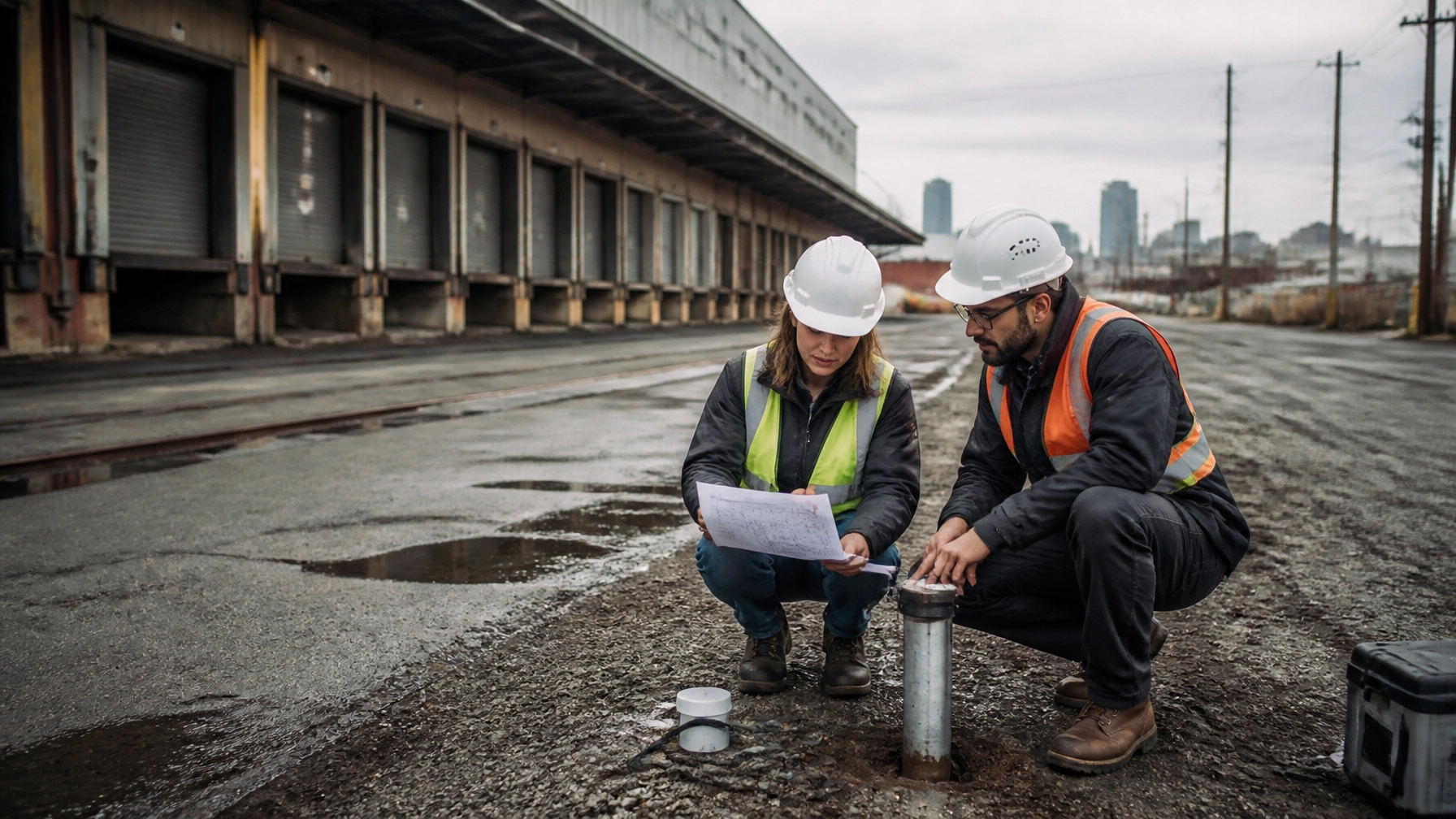
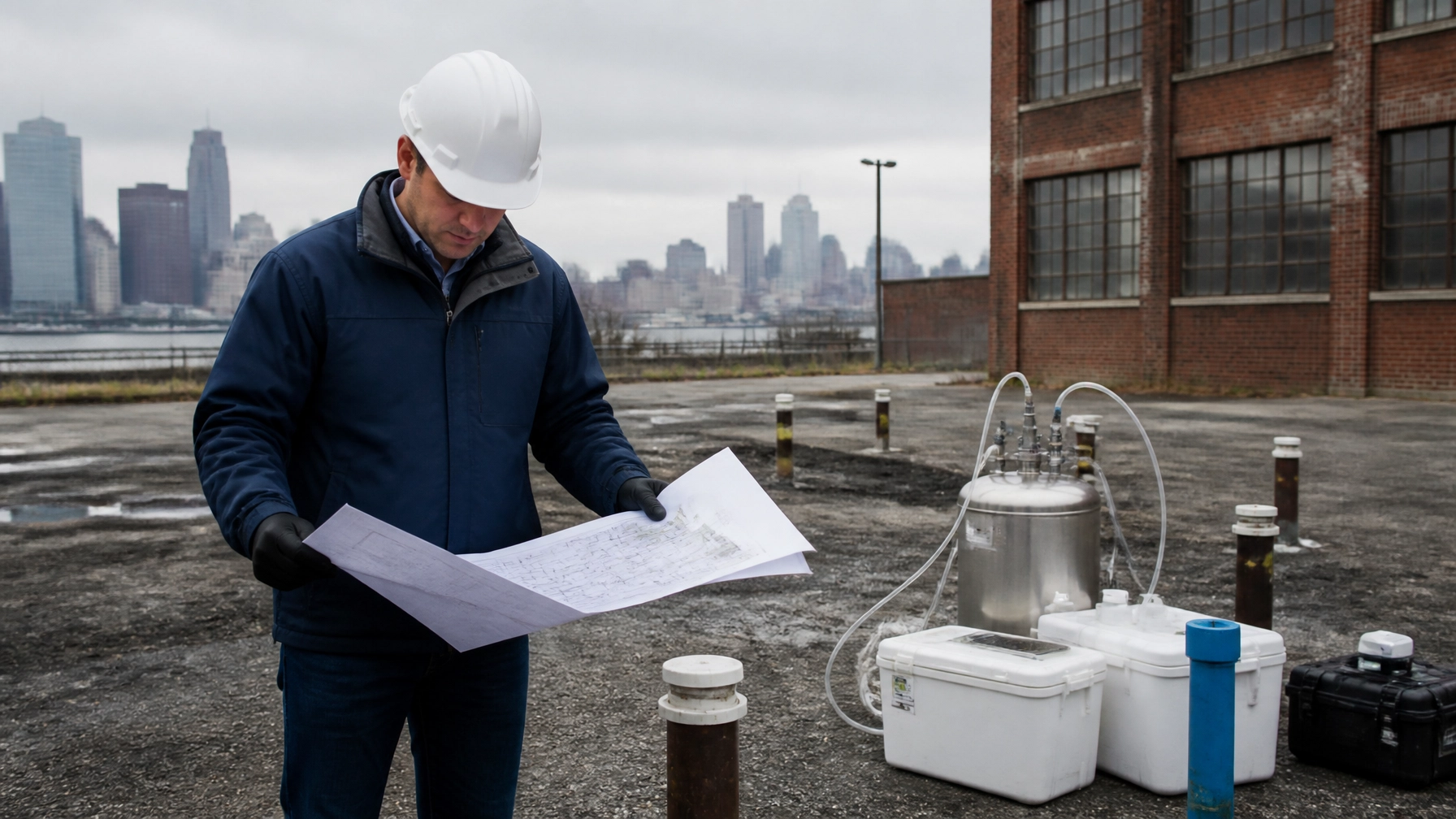
    Environmental professional collecting groundwater samples from a monitoring well at an industrial redevelopment site in Hudson County, New Jersey

    A PFAS treatment system is not complete when the vessels are installed. The project also needs a monitoring and operating plan.

    That plan should define:

    • Influent, interstage, and effluent sampling points
    • PFAS laboratory method and reporting limits
    • Sampling frequency during startup
    • Routine monitoring frequency
    • Trigger levels for media replacement
    • Pressure and flow checks
    • Backup or bypass procedures
    • Residuals characterization
    • Spent GAC or resin shipment documentation
    • Discharge permit requirements
    • NJDEP reporting and communication
    • Confirmation sampling after treatment

    Discharge cannot be assumed. Depending on the project, treated water may require authorization before discharge to a sewer, surface water, or reinfiltration system. A treatment design that ignores the discharge pathway creates a construction and regulatory problem later.

    Envicon’s remediation and brownfield service integrates treatment planning with investigation, remedial design, field oversight, soil and groundwater management, and regulatory closure. For New Jersey cases, NJ LSRP services can carry the regulatory strategy through NJDEP coordination and closure documentation.

    What drives PFAS treatment cost in Jersey City and Newark?

    There is no responsible universal price for “PFAS treatment cost Jersey City” or “PFOA PFOS groundwater remediation Newark.” Site-specific conditions control the budget.

    Major cost drivers include:

    • Number and depth of extraction wells
    • Groundwater flow rate
    • Treatment duration
    • PFAS concentrations and chain-length distribution
    • TOC and co-contaminant loading
    • Pretreatment requirements
    • GAC or resin capacity
    • Pilot testing
    • Equipment rental or purchase
    • Electrical and controls
    • Secondary containment
    • Discharge permitting
    • Sampling and laboratory frequency
    • Media changeout and transportation
    • Residual disposal or regeneration
    • Winterization and site access
    • NJDEP coordination and reporting

    A technically credible estimate should separate capital costs, operating costs, laboratory costs, residuals management, and contingency. It should also identify which assumptions could change the price.

    FAQ

    What is the GenX groundwater standard in New Jersey?

    NJDEP’s June 15, 2026 adoption lists a GenX groundwater quality standard of 0.020 µg/L, or approximately 20 ppt. The listed PQL is 0.0075 µg/L.

    Is GAC always the best PFAS treatment technology?

    No. GAC may be effective for many PFAS profiles, but TOC, short-chain PFAS, co-contaminants, flow, and treatment duration can change the selection. Ion exchange, foam fractionation, or a combined train may be more appropriate.

    Does PFAS testing apply to soil as well as groundwater?

    Potentially. Where contaminants at an Area of Concern are unknown or poorly documented, New Jersey’s Technical Requirements may require PFAS-related analysis across relevant media. The exact scope depends on site history, regulatory program, and professional judgment.

    How often must PFAS treatment media be changed?

    There is no universal interval. Changeout depends on influent concentrations, flow, TOC, media capacity, breakthrough monitoring, and the treatment objective. Lead-lag vessel monitoring is commonly used to manage this decision.

    Can treated PFAS groundwater be discharged to a sewer?

    Not automatically. The discharge pathway must be evaluated and authorized under the applicable requirements. Sewer acceptance, NJPDES requirements, receiving-water limits, and local utility conditions may apply.

    Does Envicon design PFAS remediation systems in Hudson County?

    Envicon supports PFAS assessment, groundwater investigation, remedial design, treatment planning, construction oversight, and regulatory coordination in Jersey City, Hoboken, Bayonne, Newark, Hudson County, Bergen County, and Essex County.

    Next step: design the treatment path before mobilization

    If PFAS is affecting your site, start with the data that controls the remedy. Envicon can help you move from investigation to an actionable treatment and regulatory plan.

    Precision matters at parts-per-trillion concentrations. The right treatment plan protects the project, the schedule, and the path to closure.

    Envicon corporate logo

  • NYC OER Brownfield Incentive Grant: Six-Month Notice of Completion Planning for 2026 Developers

    NYC OER Brownfield Incentive Grant: Six-Month Notice of Completion Planning for 2026 Developers

    DRAFT | Pending approval. Not scheduled or published.

    If NYC OER issues a Voluntary Cleanup Program Notice of Completion for your project, the regulatory work may be finished. The grant work may not be.

    For the NYC Brownfield Incentive Grant, the six months after the Notice of Completion create a critical application window for eligible enrollment grant costs. OER states that BIG enrollment grant applications must be submitted no later than six months after the agency issues the project’s Notice of Completion. The application must include the required documentation, including invoices and manifests when applicable.

    That is a project deadline tied to your site. It is not a universal 2026 calendar deadline. It also does not guarantee an award. Funding remains subject to program rules, available appropriations, application completeness, and OER review.

    This guide explains how developers in Brooklyn, Queens, the Bronx, Manhattan, and Staten Island should plan for the NYC OER Brownfield Incentive Grant before closeout.

    The six-month BIG grant window starts with the Notice of Completion

    The most important date is the date OER issues the project’s Notice of Completion.

    The official NYC OER BIG Grants page states:

    “BIG enrollment grant applications must be submitted no later than 6 months after OER issues the project’s Notice of Completion.”

    The NYC BIG program rule provides additional detail. For qualifying projects, the complete application must be submitted with invoices and applicable manifests within six months of receiving a Notice of Completion or Notice of Satisfaction from OER, or a Certificate of Completion from NYSDEC where the applicable rule allows it.

    Do not wait for the final month.

    A developer should build the grant file before the cleanup reaches final sign-off. Waiting until the Notice of Completion arrives can create avoidable problems:

    • Invoices may not identify the eligible activity clearly.
    • Soil disposal manifests may be incomplete.
    • Vendor registration may not be confirmed.
    • Approved work plans may not match the costs being claimed.
    • Ownership or development information may have changed.
    • Project records may sit with multiple contractors and consultants.

    A Notice of Completion closes one regulatory phase. It starts a grant documentation sprint.

    BIG eligibility is not the same as regulatory closeout

    This distinction matters.

    Regulatory closeout asks whether the approved remedy was completed and whether OER has enough documentation to issue a Notice of Completion.

    BIG grant eligibility asks whether the applicant, property, costs, vendors, timing, insurance, and documentation meet the requirements for reimbursement.

    A site can receive a Notice of Completion and still have a grant application reduced, delayed, or rejected if the submission does not satisfy BIG requirements.

    The grant does not replace:

    • An OER-approved remedial action work plan
    • Required field oversight
    • Confirmation sampling
    • Remedial action reporting
    • Site management planning
    • Institutional or engineering controls
    • Required insurance
    • Regulatory response to OER comments

    The grant also does not guarantee that every project cost qualifies. Envicon helps developers keep these two tracks coordinated. Our NYC brownfield remediation team works from the approved remedy, the project budget, and the documentation requirements at the same time.

    Contained urban brownfield cleanup with excavation, soil staging, and redevelopment context

    What the NYC OER Brownfield Incentive Grant can support

    The BIG program provides different grant categories. The appropriate category depends on the property, project status, development plan, and regulatory pathway.

    Pre-development and due diligence

    Pre-development activities can include items such as:

    • Title search and title insurance
    • Market analysis and feasibility work
    • Concept plans and zoning analysis
    • Pro forma financial analysis
    • Site surveys
    • Community outreach
    • Phase I Environmental Site Assessments

    The NYC Business Pre-Development Design Grant guidance identifies a maximum of $5,000 for qualifying projects and up to $10,000 for certain Preferred Community Development Projects. The applicable grant cap and eligible reimbursement depend on the current program rules.

    Environmental investigation

    Environmental investigation funding may support work used to characterize site conditions, including:

    • Phase II site characterization
    • Soil, groundwater, and soil vapor sampling
    • Laboratory analysis
    • Remedial investigation work plans
    • Phase II and remedial investigation reports

    This is where a clean scope and defensible sampling plan matter. A generic investigation can produce data without creating a usable path to cleanup or redevelopment.

    Approved cleanup work

    For projects enrolled in the NYC Voluntary Cleanup Program, cleanup grants may support eligible work performed under an OER-approved remedial action work plan. Potential activities can include:

    • Soil excavation and disposal
    • Tank removal
    • Backfill and clean fill placement
    • Caps and cover systems
    • Vapor barriers
    • Sub-slab depressurization systems
    • Groundwater remediation
    • Confirmation sampling
    • Site management plans
    • Remedial action reports
    • Field oversight and documentation

    The BIG program rule’s eligible activity provisions control. Do not assume that a cost qualifies simply because it appears on a construction invoice.

    Environmental insurance

    BIG documentation may include eligible environmental insurance expenses, such as pollution legal liability or cleanup cost cap insurance, when the coverage and project circumstances meet program requirements.

    Review the OER insurance fact sheet before purchasing coverage. Insurance should be planned early. It should not be treated as a last-minute attachment to a reimbursement package.

    Technical assistance and community uses

    The program can also support certain technical assistance and community-focused activities. These may relate to:

    • Affordable housing
    • Community facility development
    • Brownfield Opportunity Area planning
    • Community brownfield planning organizations
    • Development of technical and legal documents
    • Project sequencing and scheduling
    • Budgets and reuse plans
    • BIG or BOA application preparation

    Affordable housing and community projects may qualify as Preferred Community Development Projects, but the designation requires documentation. A project’s community benefit should be supported by the development plan, affordability information, letters of interest, or other materials requested by OER.

    Urban New York brownfield redevelopment transitioning into an affordable housing and community project

    Funding availability is a planning issue, not a promise

    The current OER BIG page lists grant categories and maximum amounts. For example, the page identifies maximum amounts for qualifying brownfield projects, Preferred Community Development Projects, and certain bonus grants.

    Those figures should not be treated as an automatic project award.

    The BIG rule states that awards are made within the fiscal year until funds are exhausted. The rule also addresses available appropriations and first-come, first-served distribution. That means developers should confirm current funding status with the BIG Program Administrator before committing to a reimbursement assumption in the project budget.

    Contact the program administrator through the information on the official OER BIG page. Envicon can help organize the technical file, but OER determines program eligibility and award decisions.

    Clean Soil Bank planning belongs in the project budget

    The NYC Clean Soil Bank may help eligible projects identify or manage clean soil resources. For a brownfield developer, the value is practical. Clean fill decisions affect excavation sequencing, import costs, trucking, documentation, and the final site management strategy.

    Do not assume Clean Soil Bank material will be available for your project or that it will automatically qualify as a BIG reimbursement. Confirm current requirements, material suitability, timing, and documentation with OER and the project team.

    Your cleanup plan should answer:

    • What soil volume will the site need?
    • What material specifications apply?
    • When will clean fill arrive?
    • Who will document source, delivery, and placement?
    • Does the approved remedial action work plan address the material?
    • How will clean fill records connect to the final remedial action report?

    Envicon coordinates soil management, waste characterization, disposal documentation, and field oversight so that the funding file reflects what happened in the field.

    Environmental engineer reviewing invoices, laboratory reports, disposal manifests, and closeout records

    Grant-readiness checklist for the six-month window

    Start this checklist before OER issues the Notice of Completion.

    Property and applicant records

    • Confirm the exact property address.
    • Confirm borough, block, and lot numbers.
    • Identify all applicants and ownership interests.
    • Confirm the current development plan.
    • Document affordable housing or community project status, if applicable.
    • Confirm access agreements and property ownership documentation.

    Regulatory records

    • OER VCP enrollment documentation
    • Approved remedial action work plan
    • Approved work plan modifications
    • Field reports and daily logs
    • Community air monitoring records, when applicable
    • Confirmation sampling results
    • Waste characterization data
    • Disposal manifests
    • Remedial action report
    • Site management plan
    • Notice of Completion

    Financial records

    • Itemized invoices
    • Proof of payment, if requested
    • Qualified Vendor information
    • Contractor scopes and statements of work
    • Laboratory invoices
    • Disposal and transportation invoices
    • Insurance premiums and policy records
    • Clean fill and soil movement documentation
    • Cost allocation separating eligible and non-eligible work

    Timing controls

    • Record the date OER issues the Notice of Completion.
    • Calculate the six-month submission deadline.
    • Assign one person to control the application package.
    • Request missing invoices immediately.
    • Resolve vendor or ownership changes before submission.
    • Submit a complete package, not an incomplete placeholder.

    BIG application support for Brooklyn, Queens, and every NYC borough

    The same basic discipline applies whether your project is a Brooklyn industrial conversion, a Queens mixed-use redevelopment, a Bronx community facility, a Manhattan property with an E-Designation, or a Staten Island waterfront site.

    Envicon’s NYC environmental consulting team works across:

    We coordinate the regulatory file, field records, cost documentation, and development schedule. That is the difference between handing over a report and preparing a file that can move.

    Frequently asked questions

    Does a Notice of Completion guarantee BIG funding?

    No. The Notice of Completion starts the six-month application window for applicable enrollment grants. OER still reviews eligibility, costs, documentation, funding availability, and compliance with program requirements.

    What is the BIG grant application deadline after Notice of Completion?

    For applicable enrollment grants, the application must be submitted no later than six months after OER issues the project’s Notice of Completion. The deadline is project-specific. It is not a single fixed 2026 date for every developer.

    Can a project apply for BIG funding before regulatory closeout?

    Some pre-enrollment and environmental investigation grants apply before VCP enrollment or before cleanup. The correct grant category depends on the property and project status. Review the current OER BIG requirements before incurring costs.

    Are affordable housing projects eligible for higher amounts?

    Certain affordable housing and community-supported projects may qualify as Preferred Community Development Projects and may have higher grant limits. OER requires supporting documentation. Eligibility is not automatic.

    Do invoices and manifests need to be submitted?

    The BIG rule requires a complete application with invoices and manifests when applicable for relevant projects. Maintain these records throughout cleanup instead of trying to reconstruct them after closeout.

    Can BIG funding pay for Clean Soil Bank material?

    Do not assume it can. Clean Soil Bank participation and BIG reimbursement are separate questions. Confirm material eligibility, project fit, documentation, and current program guidance with OER.

    Official sources and project support

    Review the NYC OER BIG Grants page, the NYC Voluntary Cleanup Program information, the BIG program rule, and the current BIG enrollment application.

    If your Notice of Completion is approaching, do not wait to organize the reimbursement file.

    Plan the grant file before closeout

    A clean regulatory closeout is important. A grant-ready closeout protects the value of the work after the agency signs off.

    Envicon corporate logo

  • Reserve Study HOA: New Jersey 30-Year Funding Requirements for Condo Boards

    Reserve Study HOA: New Jersey 30-Year Funding Requirements for Condo Boards

    DRAFT

    A New Jersey condo or HOA board cannot manage long-term capital risk with a bank balance and a list of deferred repairs. A compliant reserve study HOA plan connects the building’s physical condition to a 30-year funding strategy.

    That matters in Jersey City, Newark, Hoboken, Bayonne, Bergen County, Hudson County, and Essex County, where aging concrete, masonry, roofs, parking decks, elevators, mechanical systems, and building envelopes can create large capital obligations.

    New Jersey’s reserve study requirements are tied to the state’s Structural Integrity Law framework, including P.L. 2023, c.214, and later amendments under P.L. 2025, c.132. The law establishes statutory requirements. Engineering standards and board governance practices add another layer.

    Your board should review the requirements with association counsel, a qualified reserve specialist, and a New Jersey-licensed professional engineer.

    What New Jersey requires from a reserve study

    Under N.J.S.A. 45:22A-44.2, an association of a planned real estate development must undertake and fund a capital reserve study that evaluates whether reserve funds will cover the anticipated repair and replacement costs of common-area capital assets.

    The study must follow the latest National Reserve Study Standards from the Community Associations Institute, or similar standards from another recognized national organization. It must be performed or overseen by:

    • A credentialed reserve specialist
    • A New Jersey-licensed professional engineer
    • A New Jersey-licensed architect

    The statutory study must include a physical and financial analysis. It must also include a proposed 30-year funding plan.

    The New Jersey Department of Community Affairs reserve study FAQ explains that an association may still need a capital reserve study even when its building is not subject to the separate structural inspection requirement.

    A narrow statutory exception exists for a planned real estate development with less than $25,000 in total common-area capital assets. That exception should not be assumed without reviewing the association’s legal structure, governing documents, and asset inventory with counsel.

    Physical analysis: what the engineer evaluates

    A reserve study is not just a spreadsheet. The funding model is only as reliable as the component information behind it.

    A physical analysis typically identifies the common elements the association must maintain, evaluates their current condition, and estimates the remaining useful life of each component.

    Engineer documenting condominium roof, facade, balcony, and drainage components for a reserve study

    Typical components include:

    • Roofing systems and flashing
    • Exterior walls, masonry, sealants, and waterproofing
    • Balconies, terraces, and podium decks
    • Primary structural elements
    • Parking decks and garage coatings
    • Elevators and related equipment
    • Boilers, chillers, pumps, and central mechanical systems
    • Domestic water and sanitary systems
    • Fire protection systems
    • Asphalt, concrete paving, curbs, and drainage
    • Site lighting, fencing, gates, and retaining walls
    • Clubhouses, pools, fitness areas, and other shared facilities

    The useful-life estimate should reflect actual condition, not just an industry average. A roof with documented maintenance may perform differently from a roof with ponding water and failed flashing. A parking deck with active corrosion requires a different funding schedule from one with sound concrete and recent repairs.

    Financial analysis: from condition to funding

    The financial analysis turns the component inventory into a capital plan. It should account for:

    • Current reserve balance
    • Current annual reserve contributions
    • Anticipated income and expenses
    • Projected repair and replacement costs
    • Inflation assumptions
    • Investment or interest assumptions
    • Timing of major expenditures
    • Cost of future reserve studies and updates
    • Cost of required structural inspections
    • Cost of corrective maintenance identified by those inspections

    The study should show how different contribution levels affect the reserve balance over 30 years.

    Example component and funding table

    The figures below are illustrative. A board should use site-specific quantities, current bids, engineering observations, and documented maintenance history.

    Component Current condition Estimated useful life remaining Projected 2026 cost Planned funding year
    Roof membrane and flashing Fair 8 years $285,000 2034
    Parking deck waterproofing Fair 5 years $420,000 2031
    Exterior masonry and sealants Good to fair 12 years $360,000 2038
    Central boiler replacement Fair 6 years $190,000 2032
    Concrete balcony repairs Condition dependent 3 to 10 years $240,000 2029 to 2036
    Site paving and drainage Fair 10 years $175,000 2036

    The board should not treat these numbers as a simple shopping list. The timing, inflation, sequencing, and interaction between projects matter.

    For example, balcony concrete repairs may need to occur before facade waterproofing. Parking deck work may affect access, drainage, and garage operations. A structural inspection may move a project forward by identifying deterioration that was not visible during an ordinary property walk-through.

    What does “percent funded” mean?

    Percent funded compares the association’s actual reserve position with the amount recommended to meet projected capital obligations under a chosen methodology.

    It is a useful risk indicator, but it is not the same as the statutory 85% funding option.

    A board may have:

    • A high percent-funded position with a major repair approaching
    • A lower percent-funded position with more time to increase contributions
    • A strong current balance but inadequate annual contributions
    • A fully funded plan that still requires careful project timing

    The important question is not simply, “What percentage are we funded?” It is:

    Will the selected 30-year plan maintain a reserve balance that does not fall below zero while covering the association’s expected capital obligations?

    Under N.J.S.A. 45:22A-44.3, an association must obtain a reserve study with a 30-year funding plan designed to provide adequate reserves for common-area repairs and replacements.

    Special assessment risk and the 85% option

    New Jersey’s amended reserve funding framework allows an existing association to fund its reserve account at 85% of one of the funding plans in its most recent reserve study for a limited period.

    That option has conditions. The association must provide a notice to unit owners in 20-point bold font identifying:

    • That the board selected the 85% funding option
    • The year in which a special assessment or loan is anticipated
    • The anticipated amount of that assessment or loan

    A seller must provide the required notice to a buyer before the purchase contract is executed. The option also cannot be used for more than five fiscal years following the effective date of P.L. 2025, c.132.

    The 85% option is not a free pass. It shifts part of the capital burden into the future and may increase lender, buyer, insurance, and owner concerns. Board minutes should document the decision, the supporting reserve study, and counsel’s review.

    Read the official P.L. 2025, c.132 chapter law before adopting a funding policy.

    Reserve study versus structural inspection

    A reserve study and a structural inspection answer different questions.

    New Jersey condominium parking deck and concrete structure being evaluated for primary load-bearing condition

    Scope Primary purpose Typical output
    Reserve study Plan and fund future capital repairs and replacements Component inventory, useful lives, cost projections, 30-year funding plan
    Structural inspection Evaluate the condition of the primary load-bearing system Engineer’s structural condition report and repair recommendations
    Property Condition Assessment Support acquisition, refinancing, or asset management ASTM E2018-style property condition report and capital needs estimate
    Facade inspection Evaluate exterior wall, balcony, or facade conditions Facade condition report, repair priorities, or maintenance recommendations

    The Structural Integrity Law applies to covered residential condominium and cooperative buildings with qualifying primary load-bearing systems. The inspection schedule depends on the building’s certificate of occupancy date and prior inspections.

    The law identifies structural components such as columns, beams, bracing, foundations, and connected balconies. A facade inspection may be broader or narrower depending on the assignment. It is not automatically a substitute for the statutory structural inspection.

    A reserve study also does not replace an engineer’s structural inspection. The two should be coordinated so that identified structural repairs enter the funding plan with realistic costs and timing.

    See Envicon’s NJ structural inspection services for the engineering side of this work.

    What about a PCA?

    A property condition assessment is usually transaction-driven. Lenders, purchasers, and investors use it to understand immediate repair needs, deferred maintenance, and projected capital expenditures.

    A PCA can support a reserve study, but it usually does not provide the same 30-year reserve funding model required for association capital planning.

    For a purchase or refinance in Jersey City, Newark, or Hoboken, a board or owner may need both:

    • A PCA for transaction due diligence
    • A reserve study for long-term association funding

    Combining field observations where appropriate can reduce duplicated site visits and improve consistency between reports.

    A practical board checklist

    Before commissioning or updating a reserve study, gather:

    • Governing documents and maintenance responsibilities
    • Current budget and reserve account statements
    • Prior reserve studies and engineering reports
    • Structural inspection reports
    • Recent repair invoices and warranties
    • Roof, facade, elevator, mechanical, and paving records
    • Insurance loss history and open claims
    • Planned capital projects
    • Current owner assessment schedule

    Then ask the consultant:

    • Who will perform or oversee the study?
    • Is the professional licensed or credentialed for the assignment?
    • Does the report follow current National Reserve Study Standards?
    • Does it include a 30-year funding plan?
    • Are inflation and interest assumptions disclosed?
    • Does it show percent funded and alternative contribution scenarios?
    • Does it coordinate with structural inspection findings?
    • Can the engineer present the results directly to the board?

    Envicon’s reserve study service combines physical component review, useful-life analysis, cost modeling, and board-ready funding scenarios. Our team also works across civil and geotechnical engineering when a capital issue requires additional engineering support.

    Frequently asked questions

    Is a reserve study required for an HOA in New Jersey?

    Many New Jersey planned real estate development associations are subject to the capital reserve study requirements. Condominiums and cooperatives should not assume that an exemption from structural inspection also creates an exemption from reserve planning. Counsel should confirm the association’s status and obligations.

    How often must a New Jersey reserve study be updated?

    The statutory minimum is generally once every five years. Annual financial updates and more frequent reviews may be appropriate when major repairs, inflation, deterioration, or funding changes affect the plan.

    What is a 30-year reserve study in New Jersey?

    It is a capital planning report that projects component repairs and replacements, costs, contributions, and reserve balances over 30 years. The plan should not project a negative reserve balance.

    Does a structural inspection replace a reserve study?

    No. A structural inspection evaluates structural condition. A reserve study evaluates capital needs and funding. The findings should inform one another.

    How much does a reserve study cost in Hudson County?

    Reserve study cost depends on building size, number of components, access, prior documentation, structural complexity, and whether the assignment includes a site visit or financial update. Use Envicon’s cost estimator for an initial project-specific range.

    Should our board consult an attorney?

    Yes. Legal counsel should review statutory applicability, owner notices, governing documents, funding decisions, disclosure obligations, and any special assessment or loan strategy.

    The takeaway for New Jersey condo boards

    A reserve study is not a report to file and forget. It is the operating plan for the building’s next 30 years.

    For boards in Jersey City, Newark, Hoboken, Bayonne, Bergen County, Hudson County, and Essex County, the right process connects field conditions, useful lives, inflation, percent funded, structural findings, and owner assessments in one defensible plan.

    The goal is simple: identify the work early, fund it honestly, and avoid turning predictable capital needs into emergency assessments.

    Sources

    Talk with an Envicon engineer

    Envicon corporate logo

  • Phase I ESA Cost in New York and New Jersey: The Definitive 2026 Pricing and Lender Guide

    Phase I ESA Cost in New York and New Jersey: The Definitive 2026 Pricing and Lender Guide

    If you’re buying, refinancing, or developing commercial property in New York or New Jersey, you’re probably asking one question first: how much does a Phase I ESA cost?

    For 2026 planning, a standard commercial Phase I ESA generally falls between $2,200 and $4,500. A rush Phase I ESA typically ranges from $3,000 to $5,500, depending on the property, transaction deadline, lender requirements, and site history.

    Use Envicon’s Phase I ESA Cost Estimator to get a preliminary property-specific range in under two minutes.

    These are planning ranges, not automatic quotes. A former industrial site in Jersey City with historic fill, underground storage tanks, and a closing next week requires a different scope than a small suburban office property with a clean operating history.

    2026 Phase I ESA pricing at a glance

    Phase I ESA scope Typical planning range Common use
    Standard commercial Phase I ESA $2,200 to $4,500 Acquisition, refinance, lender due diligence
    NYC or complex urban property $3,000 to $5,500+ Industrial history, mixed-use, dense urban sites
    Rush Phase I ESA $3,000 to $5,500 Closing or financing deadline inside two weeks
    Lender overlay or expanded reliance Add $500 to $1,500 SBA, HUD, Fannie Mae, CMBS, or institutional review
    Phase II ESA after a REC Often $8,000 to $25,000+ Soil, groundwater, soil-gas, or vapor investigation

    A property with significant contamination concerns may require a Phase II ESA, remediation planning, or regulatory coordination. Those services are separate from the Phase I scope.

    What a Phase I ESA covers

    A lender-grade Phase I ESA follows ASTM E1527-21 and supports the federal All Appropriate Inquiries process under 40 CFR Part 312.

    The EPA’s AAI guidance identifies the core inquiry activities required to evaluate a property’s environmental conditions and potential liability. A complete Phase I ESA generally includes:

    • Historical aerial photographs, Sanborn maps, city directories, and topographic sources
    • Federal, state, and local environmental database review
    • Review of available regulatory files and spill records
    • Site reconnaissance of the property and adjoining properties
    • Interviews with current owners, operators, occupants, and other knowledgeable parties
    • Review of recognized environmental conditions, or RECs
    • Identification of historical RECs, controlled RECs, and de minimis conditions
    • Evaluation of significant data gaps
    • Environmental Professional conclusions and recommendations
    • Documentation supporting the lender’s reliance on the report

    A Phase I ESA is not a laboratory investigation. It does not normally include soil borings, groundwater wells, soil-gas sampling, indoor air testing, asbestos sampling, mold testing, or lead paint testing unless those services are separately authorized.

    Why Phase I ESA cost varies by property

    The cheapest quote isn’t always the lowest project cost. An under-scoped report can lead to lender rejection, a second site visit, a new report, or an avoidable Phase II investigation.

    1. Property history

    A current office building may have operated on land previously used for manufacturing, metal plating, dry cleaning, printing, fuel storage, or vehicle maintenance.

    Historical industrial uses can trigger additional research and professional analysis. In New York and New Jersey, consultants also routinely evaluate:

    • Historic fill
    • Former manufactured gas plant activity
    • Underground storage tanks
    • Petroleum spills
    • Industrial solvents
    • Brownfield or Superfund proximity
    • Dry cleaner operations
    • Former rail yards and ports
    • E-Designated properties in New York City
    • NJDEP Known Contaminated Sites and case records

    2. Location and urban complexity

    A Phase I ESA in Manhattan, Brooklyn, Newark, or Jersey City may cost more than one for a straightforward suburban property.

    Dense urban sites often involve limited access, adjoining properties with industrial histories, complex regulatory files, multiple occupants, and older structures. A Jersey City Phase I ESA may also require careful consideration of waterfront development, historic fill, former industrial operations, and NJDEP regulatory pathways.

    3. Property size and use

    A small commercial parcel with one building is usually easier to scope than a multi-building industrial campus, mixed-use portfolio, or large redevelopment tract.

    The number of buildings, tenants, adjoining properties, historic uses, and available records affects both research time and site reconnaissance.

    4. Turnaround time

    Standard Phase I ESAs generally take approximately two to three weeks after authorization and site access.

    A rush Phase I ESA can be completed faster when records, interviews, site access, and lender requirements are available immediately. Rush pricing reflects schedule compression, priority field coordination, and faster report production.

    A 48-hour Phase I ESA in NYC should not be treated as the normal standard for a complete ASTM E1527-21 report. A 48-hour schedule may be possible for an initial desktop review, accelerated scoping, or a narrowly defined priority assignment. The complete report still needs the required records review, site reconnaissance, interviews, analysis, and Environmental Professional sign-off.

    Envicon provides priority scheduling for qualified transactions. We confirm the scope and delivery date before work starts.

    What lenders actually review

    Lenders are not only looking for a report with the right title. They’re looking for a defensible document that addresses the property’s environmental risk and follows the required standard.

    A lender may review:

    • Whether the report follows ASTM E1527-21
    • Whether the report supports AAI requirements
    • Whether the site reconnaissance was recent
    • Whether required interviews were completed
    • Whether environmental liens and activity-use limitations were addressed
    • Whether the report identifies RECs clearly
    • Whether the Environmental Professional signed the report
    • Whether the reliance language names the lender correctly
    • Whether the report is still within its validity period
    • Whether the consultant addressed lender-specific forms or conditions

    Under EPA’s AAI framework, certain components must be completed or updated within 180 days before acquisition. The broader inquiry must generally be completed within one year before acquisition.

    Do not order a Phase I ESA months before closing without confirming the lender’s timing requirements. A report may need an update or a new site visit if the transaction is delayed.

    What is usually excluded

    Before comparing quotes, ask what the fee does not include.

    Common exclusions include:

    • Phase II soil or groundwater sampling
    • Soil-gas or sub-slab vapor testing
    • Indoor air sampling
    • Asbestos, lead paint, mold, or radon testing
    • Property condition assessments
    • Wetland delineation
    • Geotechnical borings
    • Surveying
    • Title or legal opinions
    • Detailed environmental lien searches
    • Regulatory agency file retrieval fees
    • Travel outside the stated service area
    • Lender-specific revisions beyond the agreed scope

    A clear proposal should state the included scope, assumptions, schedule, reliance parties, and additional services. That is how you avoid change orders after authorization.

    When a Phase I leads to a Phase II

    A Phase I ESA does not automatically mean the property is contaminated. It identifies environmental conditions that require professional evaluation.

    A Phase II ESA may be appropriate when the Phase I identifies a REC involving:

    • Former underground storage tanks
    • Historic petroleum releases
    • Dry cleaning or solvent use
    • Industrial manufacturing
    • Historic fill
    • Stained soil or stressed vegetation
    • Floor drains, sumps, or waste handling areas
    • Documented spills or regulatory cases
    • Vapor intrusion concerns
    • Known soil or groundwater contamination

    Envicon’s Phase II ESA service uses REC-driven sampling. That means the boring locations, analytes, and laboratory program are tied to the actual concern identified during due diligence.

    The objective is not to collect data for its own sake. It is to determine whether contamination exists, define the exposure, estimate cost, and identify the regulatory path forward.

    Open property records file, historic map, aerial parcel plan, and GIS boundary used during environmental due diligence

    What makes Envicon’s Phase I ESA approach different

    Large consulting firms often sell a national process and assign the work to junior staff who were not involved in the initial pitch.

    Envicon takes a different approach. Our team is senior-led, field-first, and familiar with the New York and New Jersey regulatory landscape. The person scoping the assignment understands what the lender, attorney, developer, and regulator need from the report.

    Our Phase I ESA process includes:

    • Same-business-day scoping for qualified requests
    • Fixed-fee proposals with the scope defined before authorization
    • Site reconnaissance typically within 72 hours of authorization
    • ASTM E1527-21 and AAI-focused reporting
    • Direct coordination with lenders, attorneys, developers, and property owners
    • Clear REC conclusions without unnecessary hedging
    • Phase II recommendations tied to the actual findings
    • Real-time project visibility through Envicon’s technology platform

    Envicon reports a 100% lender approval rate across more than 350 delivered Phase I ESAs, measured by reports accepted by the client’s lender without rejection.

    We don’t sell a report and leave you to interpret it. We give you a clear path from findings to action.

    Phase I ESA cost FAQ

    How much does a Phase I ESA cost in New York City?

    A standard Phase I ESA in NYC commonly ranges from $2,500 to $5,000, with more complex industrial, mixed-use, or rush assignments reaching $5,500 or more.

    How much does a Phase I ESA cost in New Jersey?

    A standard commercial Phase I ESA in New Jersey generally ranges from $2,200 to $4,500. Jersey City, Newark, waterfront, industrial, and rush assignments may fall at the higher end.

    How much does a Phase I ESA cost in Jersey City?

    A typical Jersey City Phase I ESA may range from $2,500 to $5,500, depending on historic industrial use, waterfront conditions, available records, lender requirements, and turnaround time.

    How long does a Phase I ESA take?

    A standard report generally takes two to three weeks after authorization and site access. Priority work may be available for transactions with shorter deadlines.

    Does a Phase I ESA include soil sampling?

    No. Soil, groundwater, soil-gas, and indoor air sampling generally require a separate Phase II ESA or vapor intrusion assessment.

    How long is a Phase I ESA valid?

    AAI requires the inquiry to be conducted or updated within one year before acquisition. Certain components, including the site inspection, interviews, records review, and environmental lien search, must generally be completed or updated within 180 days before acquisition.

    Does the lowest Phase I ESA price provide the best value?

    Not necessarily. Compare the scope, standard, lender reliance language, turnaround, Environmental Professional qualifications, and exclusions. A low quote that does not satisfy the lender can cost more after rework and delay.

    The practical takeaway

    For a commercial property in New York or New Jersey, budget $2,200 to $4,500 for a standard Phase I ESA and $3,000 to $5,500 for rush or more complex work.

    The right price depends on the property, not just the address. Before you authorize a report, confirm:

    • ASTM E1527-21 compliance
    • AAI support under 40 CFR Part 312
    • Site reconnaissance and interview requirements
    • Lender reliance and formatting
    • 180-day timing requirements
    • Environmental lien and activity-use limitation scope
    • Phase II recommendations if a REC is identified
    • What the proposal excludes

    For broader due diligence, visit Envicon’s Environmental Assessment and Investigation services or complete services hub.

    Ready to price your Phase I ESA?

    Envicon corporate logo

  • NYC Local Law 97 Compliance 2026: Linking Building Retrofits, Asbestos, and Construction Environmental Review

    NYC Local Law 97 Compliance 2026: Linking Building Retrofits, Asbestos, and Construction Environmental Review

    For covered buildings in Manhattan, Brooklyn, Queens, the Bronx, and Staten Island, NYC Local Law 97 compliance in 2026 is not just a reporting exercise. It is a building improvement and construction coordination issue.

    Local Law 97 sets greenhouse gas emissions limits for most buildings above 25,000 gross square feet. Owners must report annual emissions, address excess emissions, and plan for increasingly demanding compliance periods. The work needed to reduce emissions can also trigger asbestos surveys, lead-related controls, roof and structural reviews, electrical upgrades, stormwater planning, soil disturbance controls, air monitoring, and construction oversight.

    The right compliance strategy connects those scopes before construction begins.

    What NYC Local Law 97 requires in 2026

    Local Law 97 generally applies to:

    • A single building exceeding 25,000 gross square feet
    • Multiple buildings on the same tax lot exceeding 50,000 gross square feet in total
    • Multiple condominium buildings governed by the same board of managers exceeding 50,000 gross square feet in total

    The law establishes emissions limits based on building characteristics, occupancy or property type, floor area, and reported energy use. Owners should confirm the applicable limit through current NYC Department of Buildings emissions guidance and the applicable provisions of Article 320.

    For the 2026 reporting cycle:

    • The standard report deadline was May 1, 2026.
    • DOB provided an automatic grace period through June 30, 2026.
    • Owners who applied for an extension by June 30 could receive an extended filing deadline of August 29, 2026.
    • The 2026 filing covers calendar-year 2025 emissions.
    • The extension affected filing timing. It did not change the building’s emissions limit or eliminate excess emissions exposure.

    As of September 2026, those 2026 deadlines have passed. Owners should not assume that the same extension structure will apply to a future reporting cycle. Review the latest DOB LL97 processing guidance before relying on any deadline, grace period, or extension.

    “The deadline to submit this year’s LL97 compliance report is May 1, 2026, with an automatic 60-day grace period through June 30, 2026.”
    Source: NYC Department of Buildings LL97 Processing FAQs

    Emissions limits and penalty exposure

    The first LL97 compliance period covers calendar years 2024 through 2029. The building must remain at or below its applicable annual emissions limit for each year.

    If reported emissions exceed the limit, the civil penalty is generally calculated at:

    Excess metric tons of CO₂e × $268

    There is also a separate reporting penalty framework for failing to submit a required report. DOB guidance identifies a potential penalty of $0.50 per square foot per month for a covered building that does not file.

    These penalties make a late compliance review expensive. They also show why a retrofit plan should begin with verified building data, not a generic equipment list.

    A useful review should confirm:

    • Covered building status
    • Gross floor area and tax lot information
    • Energy use by fuel and utility source
    • Portfolio Manager data quality
    • Property type and applicable emissions limit
    • Existing mechanical, electrical, and envelope conditions
    • Required energy conservation measures
    • Potential emissions reductions from each measure
    • Construction, environmental, and permitting constraints

    Why LL97 retrofits can trigger environmental review

    A decarbonization project may involve boilers, heat pumps, refrigerant systems, electrical service, roof work, façade penetrations, insulation, solar equipment, generator changes, and site utility work.

    Each scope can create a separate compliance question.

    Asbestos and lead

    Older NYC buildings may contain asbestos-containing materials in:

    • Pipe insulation and fittings
    • Boiler and mechanical room components
    • Roofing materials
    • Flooring and mastics
    • Window caulk
    • Fireproofing
    • Wall and ceiling materials
    • Electrical equipment and service penetrations

    Local Law 97 does not itself create a universal asbestos survey requirement. However, the retrofit work may disturb regulated materials. NYC renovation work must be evaluated under New York State Industrial Code Rule 56 and applicable NYC Department of Environmental Protection requirements.

    Depending on the scope, the project may require a DEP-certified asbestos investigator, an ACP-5 asbestos assessment, or full asbestos project procedures. DOB permit requirements may also require ACP documentation before the permit is issued. Review the official NYC DOB asbestos abatement requirements and DEP asbestos forms.

    Lead-based paint and lead-containing coatings can also affect disturbance controls, worker protection, waste handling, and air monitoring. A retrofit team should identify these risks before demolition or coring begins.

    Environmental professional inspecting an older NYC mechanical room for asbestos and lead risks during a building retrofit assessment

    Roof and structural conditions

    Rooftop heat pumps, electrical equipment, solar arrays, screening, and new mechanical supports add weight and wind exposure. A roof that can support existing equipment may not support the proposed retrofit without reinforcement.

    The review should consider:

    • Existing roof condition and remaining service life
    • Structural capacity and equipment loading
    • Curb, dunnage, and support conditions
    • Waterproofing penetrations
    • Fall protection and access
    • Drainage and ponding
    • Wind uplift and equipment anchorage
    • Temporary construction loads

    A roof replacement or equipment installation can also expose hidden materials and create sequencing issues. Structural, environmental, and construction teams need to review the same drawings before procurement.

    Electrical and utility work

    Building electrification often requires major electrical upgrades. That may include new service equipment, transformers, switchgear, feeders, distribution panels, and utility coordination.

    Electrical work can affect:

    • Asbestos-containing components
    • Lead-containing coatings
    • Fire-rated assemblies
    • Existing utility corridors
    • Basement and subgrade conditions
    • Emergency power systems
    • Tenant operations
    • Construction sequencing

    For a large building, the electrical scope may be the schedule driver. It should not be treated as a late design detail.

    Stormwater and soil disturbance

    Roof work, new equipment pads, service upgrades, trenching, and utility relocations can disturb soil or alter drainage. In Brooklyn, Queens, the Bronx, and Staten Island, even a constrained urban project may encounter historic fill, undocumented utility lines, contaminated soil, or regulated discharge conditions.

    The project may require:

    • Soil management procedures
    • Excavated material characterization
    • Disposal or reuse documentation
    • Erosion and sediment controls
    • Stormwater pollution prevention measures
    • Dewatering review
    • Utility coordination
    • Air monitoring during excavation
    • Restoration of paved or landscaped areas

    This is where an LL97 retrofit becomes a broader environmental construction project. A building owner should understand the site conditions before issuing a construction package.

    Construction oversight closes the gap between design and compliance

    A retrofit plan can look complete on paper and still fail in the field. Equipment substitutions, unplanned demolition, utility conflicts, contaminated soil, water infiltration, or incomplete asbestos documentation can stop work.

    Field oversight should verify:

    • Work follows the approved environmental and construction plans
    • Required air monitoring occurs during disturbance
    • Contractors use the correct controls and exclusion zones
    • Waste and soil move with proper documentation
    • Changes receive technical review before implementation
    • Roof and structural work matches the approved design
    • Stormwater controls remain functional
    • Closeout records support DOB and owner documentation

    Envicon provides construction oversight and environmental monitoring for projects where regulatory compliance and field execution must stay aligned.

    Our approach is direct. We coordinate with owners, architects, engineers, contractors, attorneys, and agency reviewers. We do not hand you a report and leave you to interpret the consequences.

    LL97 is not the same as an E-designation or ordinary building code

    These requirements often get mixed together.

    Local Law 97

    LL97 regulates building greenhouse gas emissions and annual reporting for covered buildings. It focuses on energy use, emissions limits, reporting, and compliance pathways.

    NYC OER E-designation

    An E-designation is an environmental requirement attached to certain properties through the NYC zoning and land use process. It may address issues such as hazardous materials, air quality, or noise. An E-designation is not automatically created because a building must comply with LL97.

    Envicon’s NYC E-designation services address a different regulatory pathway. The project team must determine whether both programs apply.

    Ordinary building code compliance

    DOB construction permits, structural requirements, electrical rules, fire protection, plumbing, energy code provisions, and zoning requirements remain separate obligations. LL97 compliance does not replace them.

    A successful retrofit coordinates all three layers instead of treating one as a substitute for the others.

    NYC Local Law 97 retrofit compliance checklist

    Use this checklist before finalizing a 2026 retrofit scope:

    • Confirm whether the building is covered under Article 320
    • Verify gross floor area, tax lot, and property type data
    • Confirm the applicable emissions limit
    • Review 2025 energy and emissions data
    • Confirm the status of the 2026 LL97 filing
    • Check whether any extension was properly requested and approved
    • Identify measures required to reduce emissions
    • Review roof capacity and structural conditions
    • Evaluate asbestos and lead risks before disturbance
    • Determine whether an ACP-5 or full asbestos project process applies
    • Review electrical service and utility upgrade requirements
    • Evaluate soil disturbance, historic fill, and groundwater conditions
    • Plan air monitoring and environmental controls
    • Coordinate stormwater and erosion controls
    • Assign field-level construction oversight
    • Maintain records for DOB, contractors, lenders, and future reporting

    How Envicon helps keep the retrofit moving

    Envicon combines environmental assessment, compliance permitting, civil engineering coordination, and construction oversight for complex NYC projects.

    Our environmental assessment services help identify asbestos, lead, soil, groundwater, vapor, and other site conditions before they become construction surprises. Our compliance and permitting team helps connect technical findings to agency requirements and permit documentation.

    We work across Manhattan, Brooklyn, Queens, the Bronx, and Staten Island. The goal is not to create another report. The goal is to create a clear, defensible path from emissions planning to completed construction.

    Frequently asked questions

    Does Local Law 97 require an asbestos survey?

    Not by itself. LL97 regulates building emissions and reporting. However, retrofit work may disturb asbestos-containing materials and trigger Rule 56, NYC DEP, ACP-5, or full asbestos project requirements. The affected work area should be evaluated before construction.

    What was the 2026 LL97 reporting extension?

    For the 2026 reporting cycle covering 2025 emissions, DOB provided an automatic grace period through June 30, 2026. Owners who applied by June 30 could receive an extension to August 29, 2026. The extension changed filing timing, not emissions limits or excess emissions penalties.

    Can a building use renewable energy credits for LL97 compliance?

    Qualifying renewable energy credits may be available for certain LL97 compliance purposes, subject to the law, implementing rules, documentation requirements, and current DOB guidance. Owners should verify eligibility, delivery location, compliance year, limits, and double-counting restrictions before relying on RECs.

    Is an E-designation the same as LL97 compliance?

    No. An E-designation is a separate NYC environmental requirement connected to zoning or land use actions. LL97 addresses building emissions and reporting. A property may have one, both, or neither.

    When should an owner bring in an environmental consultant?

    Bring the environmental consultant in during planning and design, before demolition, procurement, or permit submission. Early review allows the team to identify asbestos, lead, soil, stormwater, air monitoring, and construction sequencing requirements before they affect cost and schedule.

    The takeaway

    NYC Local Law 97 compliance in 2026 is a building performance issue, but the solution is often built in the field.

    Emissions reductions may require roof work, structural review, electrical upgrades, asbestos documentation, lead controls, stormwater planning, soil management, air monitoring, and construction oversight. Treating those issues as separate late-stage tasks creates avoidable delays.

    Treat them as one coordinated project from the beginning.

    Call Envicon now at (917) 764-2171 to discuss your building retrofit and environmental review.

    Get a free quote today.

    Use the project risk screener to identify potential environmental and construction issues.

    Review Envicon’s compliance and permitting services.

    Envicon corporate logo

  • NJ Environmental Due Diligence for Warehouse Acquisition: Phase I ESA, USTs, Historic Fill, and LSRP Risk

    NJ Environmental Due Diligence for Warehouse Acquisition: Phase I ESA, USTs, Historic Fill, and LSRP Risk

    A warehouse acquisition in Newark, Jersey City, Hoboken, Bayonne, Bergen County, or Essex County is not just a building transaction. The property may carry environmental obligations tied to former manufacturing, fuel storage, rail activity, waterfront filling, industrial waste, or regulated operations.

    That is why NJ environmental due diligence for warehouse acquisition must go beyond a generic report. The right process connects the lender’s Phase I requirements with NJDEP obligations, purchase agreement protections, construction planning, and post-closing responsibility.

    A warehouse can look clean and still have:

    • A former underground storage tank beneath a loading yard
    • Historic fill containing petroleum, metals, PAHs, or other contaminants
    • Soil vapor concerns beneath a slab
    • An ISRA trigger that requires LSRP involvement
    • Stormwater permits or compliance obligations
    • Asbestos and lead risks inside an older structure
    • Geotechnical conditions that change the redevelopment budget

    The goal is not to collect reports. The goal is to identify risk early enough to price it, allocate it, and keep the acquisition moving.

    Start with an ASTM E1527-21 Phase I ESA

    The first step for most warehouse acquisitions is an ASTM E1527-21 Phase I Environmental Site Assessment.

    ASTM E1527-21 is recognized by the U.S. Environmental Protection Agency as a method that can satisfy the federal All Appropriate Inquiries rule under 40 CFR Part 312. EPA states that, after the transition period, ASTM E1527-21 became the recognized ASTM standard for commercial and industrial property AAI evaluations.

    A lender-ready Phase I should include:

    • Historical aerial photographs, Sanborn maps, city directories, and topographic records
    • Federal, state, and local environmental database searches
    • Site reconnaissance and interviews with owners, operators, and occupants
    • Review of adjoining properties and potential off-site sources
    • Identification of Recognized Environmental Conditions, Historical RECs, and Controlled RECs
    • Review of activity and use limitations, environmental liens, and institutional controls
    • Clear recommendations for additional investigation

    Some AAI components must be completed or updated within 180 days before acquisition. The report also needs to be completed within the applicable one-year period before closing.

    A Phase I does not include subsurface sampling. It also does not replace asbestos, lead, geotechnical, stormwater, building condition, or regulatory transfer reviews. Those scopes should be added when the property history or transaction requires them.

    When a Phase II ESA becomes necessary

    A Phase II ESA is appropriate when the Phase I identifies a REC or when other transaction facts create a reason to investigate below grade.

    Common triggers at New Jersey warehouses include:

    • Current or former USTs
    • Stained soil, floor drains, or chemical storage
    • Former manufacturing, plating, printing, dry-cleaning, or bulk storage
    • Historic fill or undocumented imported soil
    • Regulatory files showing spills, violations, or unresolved cases
    • Soil vapor or groundwater contamination near occupied buildings
    • Lender requirements for quantified environmental exposure
    • Planned excavation, expansion, grading, or utility work
    • A purchase price that depends on a defensible cleanup estimate

    A targeted Phase II should answer a business question. For example:

    • Is the suspected UST leaking?
    • Is historic fill present beneath the proposed addition?
    • Does groundwater contamination extend beyond the property?
    • Is there a complete vapor intrusion pathway?
    • What will soil disposal cost during construction?
    • Does the site require an LSRP-led remediation path?

    Envicon places borings and monitoring points against the identified Areas of Concern. That produces more useful information than scattering samples across a site without a decision framework.

    USTs can change the closing timeline

    A former fuel tank is one of the most common acquisition risks at industrial properties.

    The diligence team should review:

    • NJDEP UST registration records
    • Tank size, contents, age, and service history
    • Closure, removal, or abandonment documentation
    • Piping locations and dispenser areas
    • Historical spill reports and remediation files
    • Soil and groundwater data from prior work
    • Whether the tank is located below a building, dock, or paved yard

    New Jersey UST closure work must follow applicable NJDEP requirements, including proper system closure, documentation, field observations, and environmental sampling where required. NJDEP provides UST compliance materials through its official UST program resources.

    Do not treat an old closure certificate as proof that the property has no environmental exposure. The certificate may establish that a tank was closed, but it may not resolve contamination outside the excavation or beneath adjacent structures.

    Environmental field engineer inspecting a suspected underground storage tank area near a New Jersey warehouse

    Historic fill is a transaction issue and a construction issue

    Historic fill is common in low-lying and formerly industrial areas of Hudson County, including parts of Jersey City, Hoboken, Bayonne, and nearby waterfront districts.

    It may contain:

    • Ash and cinders
    • Brick and concrete
    • Petroleum-related compounds
    • PAHs
    • Lead and other metals
    • Construction debris
    • Site-specific contaminants tied to prior operations

    NJDEP guidance treats historic fill as a condition that requires careful investigation and management. The NJDEP Preliminary Assessment guidance directs investigators to examine whether fill was placed to raise grade or support prior development. Historic fill mapping can help identify risk, but it should not replace field confirmation.

    For an acquisition, historic fill affects more than environmental liability. It can affect:

    • Excavation and disposal costs
    • Soil reuse options
    • Foundation design
    • Utility trenching
    • Stormwater construction
    • Vapor and groundwater evaluation
    • Cap or engineering control requirements

    Direct-push drilling at an industrial warehouse site showing distinct historic fill and native soil layers

    PFAS, dioxin, and vapor require a site-specific screen

    PFAS should not be added to every analytical program automatically. It should be considered when the property history supports it.

    Potential PFAS indicators include:

    • Aqueous film-forming foam use
    • Firefighting training or emergency response areas
    • Plating or metal-finishing operations
    • Specialty chemical manufacturing
    • Bulk terminals and certain industrial processing operations

    Review current NJDEP PFAS information and guidance when the property history indicates a credible source.

    Dioxin analysis may be appropriate where historical operations involved combustion, chemical manufacturing, pesticide or herbicide production, waste handling, or other activities that could generate dioxin-like compounds. It is not a default warehouse test. The decision should follow the historical record and the identified Areas of Concern.

    Vapor intrusion should be evaluated when volatile contaminants are present in soil or groundwater near an occupied building. NJDEP’s Vapor Intrusion Technical Guidance addresses building surveys, soil gas, sub-slab, indoor air, and mitigation decisions.

    Warehouse acquisition diligence matrix

    Diligence area Primary question Typical trigger Transaction output
    ASTM E1527-21 Phase I What environmental conditions are reasonably apparent? Every commercial acquisition Lender-ready REC opinion
    Phase II ESA Is contamination present and what is the exposure? REC, UST, fill, spill, lender request Sampling results and cost path
    UST review Was fuel or another regulated substance released? Current or former tanks Closure and remediation strategy
    Historic fill What is beneath the pavement or slab? Waterfront, low-lying, industrial history Soil management and cap planning
    PFAS and dioxin Do site operations support targeted analysis? AFFF, plating, combustion, chemical history Site-specific analyte plan
    Vapor Could soil or groundwater affect indoor air? VOCs, chlorinated solvents, petroleum VI pathway determination
    Asbestos and lead Can renovation or demolition proceed safely? Older warehouse construction Survey and abatement scope
    Geotechnical Can the planned redevelopment be built as designed? Addition, heavy storage, new foundations Subsurface design data
    Stormwater Are permits, SWPPP obligations, or drainage upgrades required? Disturbance, expansion, redevelopment Compliance and civil scope
    ISRA and LSRP Does the transaction trigger New Jersey obligations? Qualifying industrial establishment and trigger Applicability review and regulatory path

    Add ISRA and LSRP review before signing

    A warehouse may fall under New Jersey’s Industrial Site Recovery Act depending on the property’s operations, industrial classification, and transaction facts. Do not assume that a standard Phase I answers the ISRA question.

    The acquisition team should determine:

    1. Whether the property is an ISRA industrial establishment.
    2. Whether the transfer or operational change creates a triggering event.
    3. Whether an LSRP must be retained.
    4. Whether a General Information Notice or other NJDEP filing applies.
    5. Whether the seller has an existing remediation case.
    6. Whether a Response Action Outcome, alternate compliance option, remediation certification, or pre-purchase arrangement is appropriate.
    7. Whether financial assurance or post-closing remediation obligations will continue.

    Envicon’s NJ LSRP services connect the investigation, NJDEP communication, remedial planning, and case-closure path. The official NJDEP ISRA guidance should be reviewed with environmental counsel and the project LSRP before closing.

    Protect the buyer in the purchase agreement

    Environmental diligence should change the purchase agreement when risk remains unresolved.

    Common protections include:

    • A defined environmental investigation period
    • Buyer access for borings, tank review, and sampling
    • Seller delivery of all prior reports and regulatory correspondence
    • Representations about tanks, spills, hazardous materials, and permits
    • A right to terminate or renegotiate based on defined findings
    • Escrow or holdback for identified remediation
    • Clear allocation of pre-closing and post-closing obligations
    • Cooperation requirements for NJDEP filings and site access
    • Indemnity language that matches the actual environmental risk
    • A schedule for removing tanks, managing soil, or maintaining controls

    The environmental consultant should communicate directly with counsel, the lender, the broker, and the acquisition team. A report that reaches the buyer after the agreement is signed has limited leverage.

    A practical closing schedule

    For a straightforward warehouse acquisition, plan the work in this order:

    • Days 1 to 2: Confirm address, site access, lender scope, closing date, prior reports, and purchase agreement deadlines.
    • Week 1: Begin records review, database research, interviews, and site reconnaissance.
    • Weeks 2 to 3: Deliver the ASTM E1527-21 Phase I and identify Phase II, UST, vapor, or regulatory needs.
    • Weeks 3 to 6: Complete targeted Phase II work, laboratory analysis, and cost evaluation if required.
    • In parallel: Review ISRA applicability, LSRP status, asbestos, geotechnical, stormwater, and construction implications.
    • Before closing: Finalize lender reliance, purchase agreement protections, remediation responsibility, and post-closing obligations.

    Envicon’s Jersey City environmental consulting team serves Hudson County and nearby markets, including Newark, Hoboken, Bayonne, Bergen County, and Essex County. The advantage is direct coordination. One senior team can connect the Phase I, Phase II, LSRP, soil, vapor, civil, and construction decisions instead of sending the buyer through separate departments.

    Frequently asked questions

    What is the first environmental report needed for a New Jersey warehouse acquisition?

    Most transactions begin with an ASTM E1527-21 Phase I ESA. A separate NJDEP Preliminary Assessment or LSRP review may also be needed when the site has industrial history, known contamination, or an ISRA concern.

    Does every warehouse acquisition require a Phase II ESA?

    No. A Phase II is generally triggered by a REC, UST concern, historic fill, known spill, vapor concern, lender requirement, or planned work that will disturb potentially impacted soil.

    Is historic fill automatically a reason to cancel a warehouse purchase?

    No. Historic fill is a condition that must be characterized and managed. The financial impact depends on contaminant concentrations, fill thickness, planned excavation, disposal requirements, cap conditions, and regulatory obligations.

    Can a Phase I ESA identify asbestos, lead, or structural defects?

    Not as a full building survey. Those conditions require separate scopes. Coordinate asbestos, lead, property condition, geotechnical, and structural inspections with the environmental diligence schedule.

    When should an LSRP be involved?

    Engage an LSRP as soon as ISRA applicability, known contamination, an active NJDEP case, or a required remediation path becomes possible. Waiting until the closing date can limit the available options.

    How much does warehouse environmental due diligence cost?

    The cost depends on acreage, historical operations, site access, suspected tanks, laboratory scope, urgency, and lender requirements. Use Envicon’s cost estimator for an initial project range, then request a fixed scope.

    The takeaway

    A New Jersey warehouse acquisition should not be managed as a Phase I report exercise. The transaction team needs a connected workflow that addresses ASTM E1527-21, Phase II triggers, USTs, historic fill, vapor, PFAS and dioxin where applicable, asbestos, geotechnical conditions, stormwater, ISRA, LSRP obligations, lender requirements, and purchase agreement protections.

    The right diligence process gives you more than a list of findings. It gives you a price, a schedule, a responsible party, and a path to closing.

    Ready to evaluate a warehouse acquisition?

    Envicon corporate logo

  • NJDEP LSRP Services: ISRA Compliance and Property Closing Timeline for Newark and Jersey City

    NJDEP LSRP Services: ISRA Compliance and Property Closing Timeline for Newark and Jersey City

    DRAFT. Not scheduled or published.

    A Newark or Jersey City property sale can move quickly until ISRA enters the transaction. Then the closing timeline depends on the property’s industrial history, NAICS classification, hazardous substance use, existing NJDEP case status, and the closure path accepted for that site.

    The first step is not ordering another generic report. It is determining whether the property is an industrial establishment, whether a triggering event has occurred, and what documentation the buyer, seller, lender, NJDEP, and counsel will require.

    Envicon provides NJDEP LSRP services for industrial properties, brownfields, and active remediation cases throughout Newark, Jersey City, Hoboken, Bayonne, Hudson County, Bergen County, and Essex County.

    What ISRA means for a New Jersey property closing

    The Industrial Site Recovery Act, or ISRA, applies to certain industrial establishments that meet specific operational and historical criteria. A property sale does not automatically make every commercial parcel subject to ISRA.

    The screening usually considers:

    • Whether the site operated on or after December 31, 1983.
    • The facility’s NAICS code and whether that code falls within ISRA coverage.
    • Whether the operation generated, manufactured, refined, transported, treated, stored, handled, or disposed of hazardous substances or hazardous waste.
    • Whether a qualifying event involves closing operations, transferring ownership or operations, bankruptcy, or another statutory trigger.
    • Whether a prior ISRA, Spill Act, UST, or site remediation case already exists.

    A Phase I ESA can identify the historical risk, but it does not replace an ISRA applicability analysis. If the property has operated as a manufacturing facility, chemical plant, metalworking operation, dry cleaner, fuel facility, warehouse, rail property, or similar industrial establishment, screen ISRA early.

    “Our mission is to reduce the number of contaminated sites in New Jersey to ensure the protection of public health and the environment and ready sites for redevelopment.”
    Source: NJDEP Contaminated Site Remediation & Redevelopment Program

    The first deadlines: GIN and LSRP retention

    When a qualifying ISRA trigger occurs, the responsible party generally submits a General Information Notice, or GIN, to NJDEP within five days. The exact trigger and filing obligation should be confirmed against the current rule, the facility’s facts, and transaction documents.

    The party subject to remediation must also retain a New Jersey Licensed Site Remediation Professional. In many ISRA matters, the LSRP retention notification is due within 45 days of the triggering event.

    NJDEP maintains current forms and online submission instructions for:

    • General Information Notices.
    • LSRP retention or dismissal notifications.
    • Preliminary Assessment reports.
    • PA/SI reports.
    • Remedial Investigation reports.
    • Remedial Action Workplans.
    • Remedial Action Reports.
    • Response Action Outcomes.
    • Remedial Action Permits.
    • ISRA Remediation Certifications.

    Review the NJDEP CSRR Forms Library before relying on an older form or legacy filing process. NJDEP updates forms, online services, and technical instructions regularly.

    A missed filing can create a transaction problem before anyone has evaluated the actual environmental risk. That is why the buyer’s attorney, seller’s attorney, lender, and LSRP should be aligned at the start.

    What the LSRP manages

    An LSRP does more than sign a closure document. The LSRP manages the technical and regulatory path from initial screening through case closure.

    Preliminary Assessment

    The Preliminary Assessment, or PA, is a records-based review of site history, operations, permits, spills, storage systems, waste handling, surrounding properties, and potential Areas of Concern.

    The PA may include:

    • Historical aerial photographs and Sanborn maps.
    • Regulatory database and NJDEP file review.
    • Interviews with current and former operators.
    • Review of tanks, process areas, waste storage, drains, sumps, and discharge points.
    • Identification of soil, groundwater, soil gas, indoor air, and surface water concerns.

    A clean PA can narrow the path. It does not guarantee that the site qualifies for a clean closure document.

    Site Investigation

    If the PA identifies Areas of Concern, the LSRP designs a Site Investigation, or SI. The field scope may include soil borings, groundwater monitoring wells, soil gas sampling, indoor air testing, tank closure work, or waste characterization.

    The objective is to determine whether contamination is present and whether it requires additional investigation or remediation. On urban parcels in Newark, Jersey City, Hoboken, and Bayonne, historic fill, petroleum, chlorinated solvents, metals, PCBs, and vapor intrusion can affect the scope.

    Soil cores, monitoring well equipment, and sample vials at an urban New Jersey brownfield investigation

    Remedial Investigation

    A Remedial Investigation, or RI, defines the nature and extent of contamination. The LSRP evaluates horizontal and vertical impacts, contaminant migration, receptors, exposure pathways, groundwater conditions, and the proposed future use.

    The RI is where a transaction team gains a realistic remediation budget and schedule. It is also where a weak consultant can create months of delay by collecting data that does not answer the closure question.

    Envicon connects field investigation, regulatory strategy, remedial design, cost estimating, and construction oversight. That means the report is built around the next decision, not written only to describe the problem.

    Remedial action, RAPs, and long-term controls

    If contamination requires action, the LSRP develops a remedial strategy and, where applicable, a Remedial Action Workplan or related remedial action documentation.

    The remedy may include:

    • Excavation and off-site disposal.
    • Soil treatment or in-situ remediation.
    • Groundwater treatment and monitoring.
    • Clean soil caps or paved engineering controls.
    • Vapor barriers and sub-slab depressurization systems.
    • Institutional controls and deed notices.
    • Classification Exception Areas or well restriction areas.
    • Indoor air controls and monitoring.
    • Soil management plans for redevelopment.

    A Remedial Action Permit, or RAP, may be required for certain ongoing engineering or institutional controls, including groundwater, soil, or indoor air remedies. NJDEP’s current forms library includes separate RAP applications, supplemental LSRP certifications, monitoring plans, and protectiveness certification forms.

    Do not assume that a remedial design automatically allows a closing. The project may need an issued permit, a recorded deed notice, financial assurance, an approved alternate compliance mechanism, or another transaction instrument.

    RAO versus NFA

    Under New Jersey’s current LSRP framework, the primary closure document is the Response Action Outcome, or RAO, issued by the LSRP and filed with NJDEP.

    The older No Further Action, or NFA, letter remains relevant for legacy cases. It is not the standard closure document for every new remediation matter.

    The practical distinction is:

    • RAO: Current LSRP-issued response action outcome for a remediation case.
    • NFA: Legacy NJDEP closure terminology and document used in older cases or specific programs.
    • LNA: Letter of Non-Applicability documenting that ISRA does not apply.
    • Negative Declaration: A statement that the applicable review did not identify contamination requiring remediation, subject to the facts and applicable requirements.
    • ISRA Remediation Certification: A transaction mechanism that may allow a transfer while remaining obligations continue, if the statutory requirements and NJDEP process support it.

    An RAO or NFA may still carry conditions. A deed notice, engineering control, CEA, groundwater monitoring obligation, indoor air control, or biennial certification can continue after the closure document is issued.

    Technical cutaway showing a brownfield remedy with clean cap, vapor barrier, monitoring wells, and engineering controls

    Newark and Jersey City closing timeline

    The table below is a planning framework, not a guaranteed agency schedule. Actual timing depends on site conditions, document availability, laboratory results, access, legal negotiations, NJDEP requirements, and the LSRP’s professional judgment.

    Transaction stage Typical timing Primary action
    Initial ISRA screen 1 to 2 weeks Review operations, NAICS, ownership, hazardous substances, and prior NJDEP cases
    Trigger confirmation Project-specific Counsel and LSRP confirm whether a qualifying ISRA event occurred
    GIN filing Generally within 5 days of the applicable trigger Submit the General Information Notice through the current NJDEP process
    LSRP retention Generally within 45 days Retain the LSRP and submit the retention notification
    PA 2 to 6 weeks Review records, site history, operations, and Areas of Concern
    PA/SI 1 to 3 months Perform field sampling and evaluate contamination
    RI and remedial strategy 3 to 12 months or longer Delineate impacts, evaluate remedies, and prepare required plans
    Remedial action Project-specific Implement excavation, treatment, controls, monitoring, or a combination
    RAO, NFA, LNA, or other pathway Project-specific Complete the closure or transaction instrument supported by the facts
    Post-closure compliance Ongoing where required Maintain controls, monitoring, certifications, permits, and deed restrictions

    The earlier the screen begins, the more options the transaction team has. A property in Jersey City with a planned residential conversion may need a different approach from a Newark industrial property continuing in manufacturing use.

    For local coordination, see Envicon’s Jersey City environmental consulting team. We also serve Hoboken, Bayonne, Bergen County, and Essex County from our regional New Jersey practice.

    When counsel should be involved

    Environmental counsel should be involved before the parties make representations about ISRA status or promise a closing date based on an assumed RAO.

    Counsel should help address:

    • Which party is responsible for GIN and LSRP retention.
    • Whether the transaction is a statutory trigger.
    • Purchase agreement environmental representations.
    • Indemnities, escrows, insurance, and access rights.
    • Remediation Certification language.
    • Deed notices and institutional controls.
    • Allocation of post-closing monitoring obligations.
    • Lender conditions and default remedies.
    • Whether a limited conveyance or alternate compliance option is available.
    • How a legacy NFA or current RAO affects the proposed use.

    The LSRP supplies the technical and regulatory judgment. Counsel allocates legal and contractual risk. These roles should work together, not in sequence after the deal is already negotiated.

    FAQ: NJDEP LSRP and ISRA compliance

    Does every Newark or Jersey City property sale trigger ISRA?

    No. ISRA applicability depends on the property’s industrial establishment status, operations, NAICS classification, hazardous substance history, and the transaction or operational event. A property-specific screen is required.

    Can a Phase I ESA determine ISRA compliance?

    A Phase I ESA can identify historical environmental conditions and potential ISRA concerns. It does not, by itself, determine every statutory applicability or transaction obligation.

    How long does NJDEP case closure take before closing?

    A clean administrative path may take weeks. A site requiring SI, RI, remedial action, controls, or permits can take months or longer. The only reliable schedule comes after reviewing the site history, NJDEP file, transaction structure, and field data.

    Is an NFA still issued for new New Jersey cases?

    Usually, current LSRP cases use an RAO rather than the legacy NFA process. Existing NFAs remain important, especially when they contain continuing controls or monitoring obligations.

    Can a property close before remediation is complete?

    Sometimes. An ISRA Remediation Certification or another approved transaction mechanism may support a transfer while remediation continues. This is fact-specific and requires coordination among the LSRP, NJDEP, counsel, buyer, seller, and lender.

    What happens after an RAO or NFA?

    The owner may still need to maintain engineering controls, comply with deed notices, perform groundwater or indoor air monitoring, submit certifications, preserve access, and notify appropriate parties of control changes.

    The practical takeaway

    For a Newark or Jersey City property sale, ISRA is a transaction issue and an environmental issue. Start with applicability. Confirm the trigger. File the required notice. Retain the LSRP. Build the PA, SI, RI, remedial action, and closure strategy around the actual closing date.

    Envicon gives developers, investors, attorneys, lenders, and public agencies one accountable team for fieldwork, NJDEP coordination, remediation, controls, and case closure. We solve environmental and engineering challenges with precision, speed, and trust.

    Take the next step

    Envicon corporate logo

  • Vapor Intrusion Mitigation Systems: The NYC and NJ Design, Installation, and Closing Guide

    Vapor Intrusion Mitigation Systems: The NYC and NJ Design, Installation, and Closing Guide

    Vapor intrusion mitigation systems protect building occupants when volatile organic compounds, or VOCs, migrate from contaminated soil or groundwater into indoor air.

    For developers, lenders, attorneys, and property owners in New York and New Jersey, the question is not simply whether a system can be installed. The real questions are:

    • What pathway is active?
    • Which regulatory framework applies?
    • What system fits the building?
    • How will performance be verified?
    • What documentation is needed for a closing, permit, or certificate of occupancy?

    A defensible answer requires site-specific investigation, practical design, and direct regulatory coordination. Envicon Group handles that work from assessment through installation oversight, verification, and long-term operation.

    Start with the pathway, not the equipment

    Vapor intrusion begins below grade. VOCs in soil, groundwater, or trapped soil gas can migrate toward a building and enter through:

    • Cracks and joints in concrete slabs
    • Utility penetrations
    • Sumps and floor drains
    • Elevator pits and crawlspaces
    • Foundation walls
    • Construction joints
    • Preferential pathways created by utility trenches and buried conduits

    The investigation should evaluate the entire pathway. A single indoor air sample rarely explains the source by itself.

    Technical cross-section showing VOC migration from groundwater and soil through preferential pathways into a building with sub-slab and indoor air sampling

    A typical vapor intrusion assessment may include:

    1. Historical records and regulatory database review
    2. Groundwater and soil data review
    3. Soil vapor sampling
    4. Sub-slab vapor sampling
    5. Indoor and outdoor air sampling
    6. Crawlspace evaluation
    7. Utility and foundation review
    8. Tracer gas or pressure-field testing
    9. Comparison with applicable regulatory criteria

    For a transaction, this work often builds on the Phase II ESA. For an occupied building, it may require careful sampling around tenants, HVAC systems, operating equipment, and changing building pressures.

    See Envicon’s vapor intrusion assessment service for the full screening, sampling, and reporting scope.

    Soil vapor, sub-slab vapor, indoor air, and crawlspace data answer different questions

    These sample types are related, but they are not interchangeable.

    • Soil vapor helps identify subsurface sources and migration patterns.
    • Sub-slab vapor shows what is present immediately below the building floor.
    • Indoor air measures the potential exposure condition inside the occupied space.
    • Outdoor air provides background context.
    • Crawlspace air may represent a direct exposure pathway where the building lacks a sealed slab.

    Interpretation also depends on building conditions. HVAC operation, weather, barometric pressure, foundation design, and recent construction can change results.

    Tracer gas testing can help identify whether air is moving from below the slab into occupied areas. Pressure measurements can show whether a building is under negative pressure, which can draw subsurface vapors indoors. These tests are especially useful when the chemistry suggests risk but the pathway remains uncertain.

    NYC and NJ use different regulatory tools

    New Jersey vapor intrusion screening

    NJDEP’s Vapor Intrusion Technical Guidance uses a staged process for evaluating potential vapor intrusion.

    The current framework generally considers:

    • Potential receptors and exposure pathways
    • Groundwater, soil gas, and indoor air data
    • Rapid action conditions
    • Vapor Intrusion Screening Levels
    • Indoor Air Rapid Action Levels
    • Mitigation, monitoring, or additional investigation

    NJDEP maintains current screening tables for groundwater, soil gas, and indoor air. Use the Department’s current screening level memorandum rather than relying on an older consultant table.

    For a Jersey City property, this work may also involve historic fill, former industrial operations, underground storage tanks, and dense utility corridors. These conditions can create multiple preferential pathways that a generic checklist will miss. Envicon’s Jersey City environmental consulting team works across these overlapping site conditions.

    New York and NYC vapor intrusion evaluation

    New York projects commonly rely on NYSDOH and NYSDEC guidance. NYSDOH’s soil vapor and indoor air decision matrices compare sub-slab vapor and indoor air concentrations to recommended actions, including:

    • No further action
    • Monitoring
    • Source identification and resampling
    • Mitigation

    NYSDOH has expanded its matrix structure beyond the original chlorinated VOC group to address petroleum-related compounds. Review the NYSDOH soil vapor intrusion updates and the NYSDEC vapor intrusion guidance page for current documents.

    For NYC properties, an E-designation can add another layer. According to the NYC Office of Environmental Remediation, a hazardous-materials E-designation requires investigation and, when contamination is confirmed, an OER-approved Remedial Action Plan before development proceeds. The work must be completed to OER’s satisfaction before occupancy.

    That means vapor intrusion can affect more than environmental reporting. It can affect building permits, construction sequencing, financing, and the certificate of occupancy.

    Comparing vapor intrusion mitigation systems

    The right system depends on the building, contaminant, foundation, soil conditions, occupancy, and regulatory endpoint.

    System Best application Strengths Limitations
    Active sub-slab depressurization Existing slab-on-grade or basement buildings Reliable control, measurable pressure field, adaptable to existing buildings Requires power, fan maintenance, discharge design, and long-term documentation
    Sub-membrane depressurization Crawlspaces or earthen floors Controls vapor below a sealed membrane Requires careful membrane detailing and protection from damage
    Passive vapor barrier and venting New construction or lower-risk conditions Can be integrated into foundation design and converted to active operation Performance depends on design, seals, and site conditions
    Building pressurization or HVAC controls Supplemental or interim control Can reduce inward vapor movement in controlled buildings Not a substitute for source control in every case
    Source remediation Soil or groundwater source areas Can reduce long-term vapor generation May require excavation, treatment, groundwater control, or extended monitoring
    Combined barrier and active system Higher-risk or sensitive-use buildings Adds redundancy and long-term protection Higher installation cost and more complex O&M

    How active systems are designed

    An active sub-slab depressurization system, or SSDS, creates negative pressure beneath the slab. The system captures vapors before they enter the building and routes them through piping to a controlled discharge point.

    A complete design should address:

    • Suction point locations
    • Sub-slab communication and pressure-field extension
    • Piping diameter and routing
    • Manifold configuration
    • Fan type and operating range
    • Electrical supply and controls
    • Pressure monitoring ports
    • Slab cracks, joints, sumps, and penetrations
    • Condensation management
    • Roof discharge location
    • Separation from windows, doors, and HVAC intakes
    • Access for inspection and replacement

    Engineering cutaway showing suction points, sealed slab penetrations, pressure monitoring port, inline fan, and roof exhaust stack

    New construction may allow a vapor barrier, sub-slab aggregate layer, and venting network to be installed before the slab is placed. Existing buildings require more coordination. The team may need to core through finished floors, work around tenants, protect utilities, and maintain building operations.

    A vapor barrier alone is not automatically a complete mitigation strategy. Seams, penetrations, utility entries, and future slab penetrations must remain controlled. The design must also explain what happens if the passive system does not meet performance objectives.

    Installation and verification matter as much as design

    A system can fail because of poor sealing, incorrect fan sizing, blocked piping, damaged membranes, or an exhaust location that allows re-entrainment.

    Envicon’s field oversight typically focuses on:

    • Confirming suction point locations
    • Checking pipe and fitting installation
    • Inspecting slab and membrane seals
    • Verifying fan installation
    • Documenting pressure readings
    • Checking alarms and monitoring ports
    • Coordinating electrical and roofing work
    • Maintaining photo and as-built records

    After installation, the system should be commissioned. Depending on the project, verification may include:

    • Pressure differential measurements
    • Pressure-field extension testing
    • Smoke testing at cracks and joints
    • Fan and alarm checks
    • Indoor and outdoor air sampling
    • Sub-slab sampling
    • Tracer gas testing
    • Review of discharge configuration

    Environmental engineer commissioning a vapor intrusion mitigation system with a smoke tube and differential pressure gauge at a sealed monitoring port

    Commissioning creates the evidence needed to show that the system works. It also identifies problems before a regulator, lender, tenant, or building department does.

    Operation, maintenance, and closing strategy

    Vapor intrusion mitigation systems are not “install and forget” equipment.

    An O&M plan should identify:

    • Who checks the fan
    • How often inspections occur
    • What pressure readings are acceptable
    • How alarms are handled
    • When indoor air or sub-slab sampling occurs
    • How repairs are documented
    • What happens during a power outage or building renovation
    • Who reports results to the regulator

    A system may remain in operation for years. Closing or decommissioning requires more than a clean indoor air result while the fan is running. The project team generally needs to evaluate source conditions, confirm stable results, and obtain regulatory concurrence before changing the control strategy.

    For an NYC E-designation, the system and related documentation may need to remain tied to the OER remedial program until the requirements are satisfied. In New Jersey, long-term controls may involve an institutional control, deed notice, or site management obligation.

    Timing vapor intrusion work around a real estate closing

    If vapor intrusion is identified late in diligence, the transaction can lose weeks while the team investigates, designs, installs, and verifies a system.

    Address the issue early when:

    • A Phase I identifies a recognized environmental condition
    • Historic dry cleaning, manufacturing, fuel use, or chemical storage occurred nearby
    • Groundwater contamination exists beneath or upgradient of the building
    • The property has an NYC E-designation
    • A lender requests vapor intrusion documentation
    • A tenant occupies a basement or slab-on-grade space
    • A prior consultant recommended mitigation without a clear closure path

    The practical sequence is:

    1. Screen the pathway.
    2. Define the data gap.
    3. Collect targeted samples.
    4. Compare results with the applicable NYSDOH, NYSDEC, or NJDEP framework.
    5. Select a site-specific mitigation approach.
    6. Design and install the system.
    7. Verify performance.
    8. Document O&M and regulatory obligations.

    A fast report is useful only when it leads to a clear decision. Envicon combines field investigation, engineering design, construction oversight, and agency coordination so the environmental issue does not sit in a separate queue from the project itself.

    FAQ

    What are vapor intrusion mitigation systems?

    They are engineered controls that prevent or reduce the movement of contaminated soil gas into occupied buildings. Common systems include active sub-slab depressurization, sub-membrane depressurization, vapor barriers, passive venting, and supplemental HVAC controls.

    Is sub-slab depressurization the best system for every building?

    No. SSDS is common and effective, but the correct approach depends on the building foundation, soil conditions, contaminant profile, occupancy, and regulatory requirements.

    What are NJDEP screening levels?

    NJDEP screening levels are comparison values used to evaluate groundwater, soil gas, and indoor air conditions during vapor intrusion investigations. Always use the current NJDEP tables and project-specific regulatory direction.

    How do NYSDOH decision matrices affect a NYC project?

    The matrices help relate sub-slab vapor and indoor air results to recommended actions. On an NYC E-designation project, the findings may also need to be incorporated into an OER-approved Remedial Action Plan and construction documentation.

    Can a vapor intrusion system be turned off after installation?

    Sometimes, but not automatically. The source, indoor air, sub-slab conditions, building use, and long-term monitoring history must support the change. Regulatory approval or concurrence may be required.

    How long does vapor intrusion mitigation take?

    Assessment may take one to three weeks depending on access, sampling conditions, and laboratory turnaround. Design, permitting, installation, and verification can take several additional weeks. Early coordination reduces transaction and construction risk.

    The takeaway

    Vapor intrusion mitigation systems are part of a larger risk-management process. The goal is not to install the most equipment. The goal is to control the pathway, protect occupants, satisfy the applicable regulator, and give the owner a documented path to construction, occupancy, financing, or closing.

    If your property is in NYC, Brooklyn, Jersey City, or elsewhere in the NY/NJ metro area, involve the vapor intrusion team before the issue reaches the closing table.

    Start with Envicon

    Envicon corporate logo

  • New York EIS Timeline 2026: One-Year and Two-Year SEQRA Planning for Manhattan and Brooklyn Projects

    New York EIS Timeline 2026: One-Year and Two-Year SEQRA Planning for Manhattan and Brooklyn Projects

    For developers planning a Manhattan or Brooklyn project, the New York EIS timeline 2026 now has clearer statutory benchmarks. New York’s 2026 SEQRA changes establish a one-year outside period for the lead agency to determine whether an Environmental Impact Statement is required. For qualifying permit or authorization actions, the agency must generally prepare and make the EIS available within two years after determining that a Draft EIS is required.

    Those benchmarks matter. They also require careful interpretation.

    The deadlines do not start when you first purchase a property. They do not guarantee a negative declaration, permit, zoning approval, or construction start. The project still needs a complete technical record, an identified lead agency, defensible environmental screening, public review, and final agency findings.

    Here is how to plan around the updated framework.

    What changed in June 2026?

    The 2026 changes operate through two related tracks:

    • Amendments to ECL § 8-0109, enacted through the state budget process and reflected in the May 29, 2026 statutory revision.
    • Amendments to 6 NYCRR Part 617, which became effective in June 2026, including updated Environmental Assessment Forms and additional disadvantaged community and climate considerations.

    The amended statute states that the responsible agency must make its initial EIS determination “not more than one year from the establishment of a lead agency.”

    For permit or authorization actions, the statute also provides that the agency must prepare and make the EIS available “within two years after the date a draft environmental impact statement is determined to be required,” subject to written extensions under defined circumstances.

    The practical point is simple: agencies and applicants need to track milestone dates precisely. A schedule built around vague phrases such as “SEQRA review is underway” is not sufficient.

    The New York SEQRA timeline at a glance

    Milestone What it means Planning significance
    Application and environmental materials submitted The agency receives the project application and supporting information The agency evaluates jurisdiction, completeness, and SEQRA applicability
    Lead agency established One agency takes primary responsibility for the coordinated review The one-year EIS determination clock is tied to this milestone
    Determination of significance The agency decides whether the project may have a significant environmental impact A negative declaration generally ends the EIS track. A positive declaration requires an EIS
    Draft EIS required The agency determines that an EIS must be prepared The two-year EIS framework applies to qualifying permit or authorization actions
    DEIS prepared, filed, and accepted The Draft EIS is reviewed for scope, content, and adequacy The permit application may not be treated as complete until the DEIS is filed and accepted as satisfactory
    Public review and hearing decision Agencies and the public review the DEIS Comments may require revisions, responses, and additional technical work
    Final EIS and findings The agency evaluates the full record and makes findings Completion of the EIS does not guarantee approval

    Step 1: Application completeness comes first

    A project schedule should begin with the application package, not with the one-year or two-year deadline.

    For a Manhattan or Brooklyn development, the lead agency may need:

    • Project plans and site control information.
    • Zoning, land use, and entitlement details.
    • Site history and existing environmental conditions.
    • Traffic, air, noise, water, stormwater, and infrastructure information.
    • Floodplain and climate resilience information.
    • Disadvantaged community screening.
    • Supporting technical studies and alternatives.

    The 2026 statute includes an important completeness concept. For a permit or authorization action where a DEIS is required, the application is not complete until the Draft EIS has been filed and accepted by the agency as satisfactory with respect to scope, content, and adequacy.

    That does not mean an applicant can submit an incomplete package and start every regulatory clock. Agencies still need enough information to identify the action, determine involved agencies, establish a lead agency, and evaluate environmental significance.

    A poorly defined project creates schedule risk before the formal EIS clock starts.

    Step 2: Establishing the lead agency

    SEQRA review often involves more than one public agency. A Manhattan project may involve NYC Department of City Planning, NYC Department of Buildings, NYCDEP, NYC Parks, or another city entity. A Brooklyn waterfront or infrastructure project may also require coordination with state or federal agencies.

    The lead agency has primary responsibility for determining whether the action may have a significant adverse environmental impact. Other involved agencies provide input, but the lead agency controls the coordinated SEQRA determination.

    The one-year period is tied to the establishment of the lead agency. That date must be documented.

    Your project team should maintain a written record of:

    • The date the lead agency was established.
    • The involved agencies consulted.
    • The materials submitted for review.
    • Agency requests for additional information.
    • Applicant responses and delivery dates.
    • Any written schedule changes or extensions.

    This is one area where direct regulatory coordination matters. A large consultant may produce a report and wait for the next agency letter. Envicon works directly with the project team and reviewing agencies so missing information is identified before it becomes a schedule problem.

    Step 3: The one-year EIS determination

    Within one year after the lead agency is established, the responsible agency must make an initial determination of whether an EIS is required.

    The possible outcomes are:

    • Negative declaration: The agency determines that the action will not have a significant adverse environmental impact, with or without mitigation.
    • Positive declaration: The agency determines that the action may have a significant adverse environmental impact and an EIS is required.

    This is not a one-year approval deadline. It is a determination deadline.

    A positive declaration does not mean the project is prohibited. It means the project requires a more detailed environmental review of impacts, alternatives, mitigation, and public comments.

    A negative declaration does not eliminate every other permit or technical requirement. Stormwater, wetlands, contamination, flood resilience, building code, traffic, air quality, and other reviews may continue.

    DACAT and climate screening now affect the record

    The June 2026 Part 617 amendments make disadvantaged community and climate considerations more explicit in SEQRA review.

    The updated Environmental Assessment Forms ask whether a project is located within or near a designated disadvantaged community, whether the project may affect a disadvantaged community indirectly, and whether the action could cause or increase a disproportionate pollution burden.

    The NYSDEC Environmental Justice Siting Law resources provide the regulatory context for this analysis.

    The Disadvantaged Community Assessment Tool, or DACAT, is a screening resource. It helps identify census tracts with comparatively higher environmental burdens or population vulnerabilities. It is not a substitute for project-specific analysis.

    For Manhattan, Brooklyn, Queens, the Bronx, and Staten Island, DACAT and related mapping should be reviewed alongside:

    • Existing air emission sources.
    • Truck routes and construction traffic.
    • Combined sewer and stormwater conditions.
    • Flood exposure and future climate risks.
    • Heat vulnerability.
    • Soil disturbance and dust controls.
    • Wastewater discharges.
    • Cumulative environmental conditions.

    The same logic applies to projects in Westchester, Nassau, and Suffolk counties. A suburban location does not remove the need for climate or environmental justice screening if the project may affect a designated community.

    The two-year EIS framework

    For actions involving a permit or authorization, the two-year framework begins when the agency determines that a Draft EIS is required.

    The agency must prepare and make the EIS available within two years after that determination, unless it establishes a written extension in consultation with the applicant.

    The extension must be limited to the additional time necessary to complete the EIS. The statute identifies circumstances that may justify an extension, including:

    • Project design changes after scoping that create new significant environmental impacts.
    • Additional actions that could not reasonably have been anticipated during scoping.
    • The applicant’s failure to provide necessary information despite the agency’s good-faith effort.
    • Delays beyond the control of the agency or applicant.

    The two-year period is therefore a planning benchmark, not a guaranteed construction date. A project that changes substantially after scoping may need additional analysis. A project team that delays responses can also create avoidable schedule exposure.

    New York environmental review planning session with GIS overlays, agency boundaries, flood zones, and project impact layers

    Public review can change the schedule

    After the DEIS is filed, the agency determines whether to hold a public hearing.

    Under ECL § 8-0109:

    • If a hearing is held, it must generally begin within 60 days after the DEIS is filed.
    • If the project is not withdrawn, the EIS is generally prepared within 45 days after the hearing closes.
    • If no hearing is held, the agency generally prepares and makes the EIS available within 60 days after the DEIS is filed.

    These periods coordinate with the broader environmental review process. Public comments may identify technical gaps, alternative designs, construction impacts, or community concerns that require a response.

    That is why an EIS schedule must include more than report production. It must include comment tracking, technical revisions, agency coordination, and findings support.

    How to build a workable Manhattan or Brooklyn schedule

    Before committing to a closing date, financing milestone, or construction start, create a project-specific SEQRA schedule that identifies:

    1. The proposed action and all involved agencies.
    2. The expected lead agency and designation date.
    3. The application materials required for initial review.
    4. The EAF and DACAT screening path.
    5. The likely significance determination.
    6. The scoping and DEIS preparation sequence.
    7. Public review, hearing, and comment periods.
    8. Potential extensions and their documentation.
    9. Related permits that will run concurrently.
    10. The final findings and approval path.

    Envicon supports this work through compliance and permitting services, Phase I Environmental Site Assessments, and direct regional coordination through our New York City environmental consulting team.

    We also support projects across Manhattan, Brooklyn, Queens, the Bronx, and Staten Island, as well as Westchester, Nassau, and Suffolk County.

    The takeaway

    New York’s 2026 SEQRA amendments create clearer time markers, but they do not turn environmental review into an automatic approval process.

    The one-year period governs the lead agency’s determination of whether an EIS is needed. The two-year period generally governs preparation and availability of the EIS after a DEIS is determined to be required for a permit or authorization action. Completeness, scoping, public review, DACAT, climate analysis, agency comments, and project changes still control the practical schedule.

    The projects that move fastest are not the ones that ignore the review. They are the ones that define the action early, build a complete technical record, identify the right lead agency, and respond directly to the issues regulators and communities will examine.

    Frequently Asked Questions

    Does the one-year SEQRA period start when a developer submits an application?

    Not necessarily. The one-year EIS determination period is tied to the establishment of the lead agency. The project still needs a defined action, involved agency coordination, and sufficient information for the agency to conduct its review.

    Does the two-year period guarantee that a project will be approved?

    No. It is a statutory framework for preparing and making the EIS available for qualifying permit or authorization actions. The agency must still complete public review, make findings, and decide whether to approve, modify, or deny the action.

    What happens if the lead agency determines that an EIS is not required?

    The agency may issue a negative declaration. That generally ends the EIS track, but other permits, environmental requirements, and technical conditions may continue.

    What is DACAT?

    DACAT is the Disadvantaged Community Assessment Tool. It helps screen environmental burden and population vulnerability in designated disadvantaged communities. It does not replace project-specific technical analysis or community input.

    Do June 2026 SEQRA changes apply to pending projects?

    Applicability depends on the project’s procedural status and whether the agency had already made a determination regarding the need for an EIS. Review the current statute, Part 617, and agency guidance before relying on an older schedule.

    Can the two-year EIS deadline be extended?

    Yes, in defined circumstances. The extension must be established in writing, in consultation with the applicant, and limited to the additional time necessary to complete the EIS.

    Plan your SEQRA timeline with a team that knows the agencies

    Envicon Group helps developers, attorneys, architects, contractors, and public agencies build defensible environmental review schedules across New York and New Jersey.

    Envicon corporate logo