
The electric vehicle revolution isn't coming: it's already here, and property owners who aren't preparing for EV infrastructure are about to get left behind. Between new 2026 National Electrical Code mandates, evolving state regulations, and tenant expectations that now include charging access as a standard amenity, the question isn't whether to electrify your property. It's how to do it right the first time without blowing your budget or hitting regulatory roadblocks.
Here's what actually matters for property owners navigating EV readiness in 2026, stripped of the marketing fluff and focused on the engineering and compliance realities that determine whether your project moves forward or stalls out.
The 2026 Code Change That Changes Everything
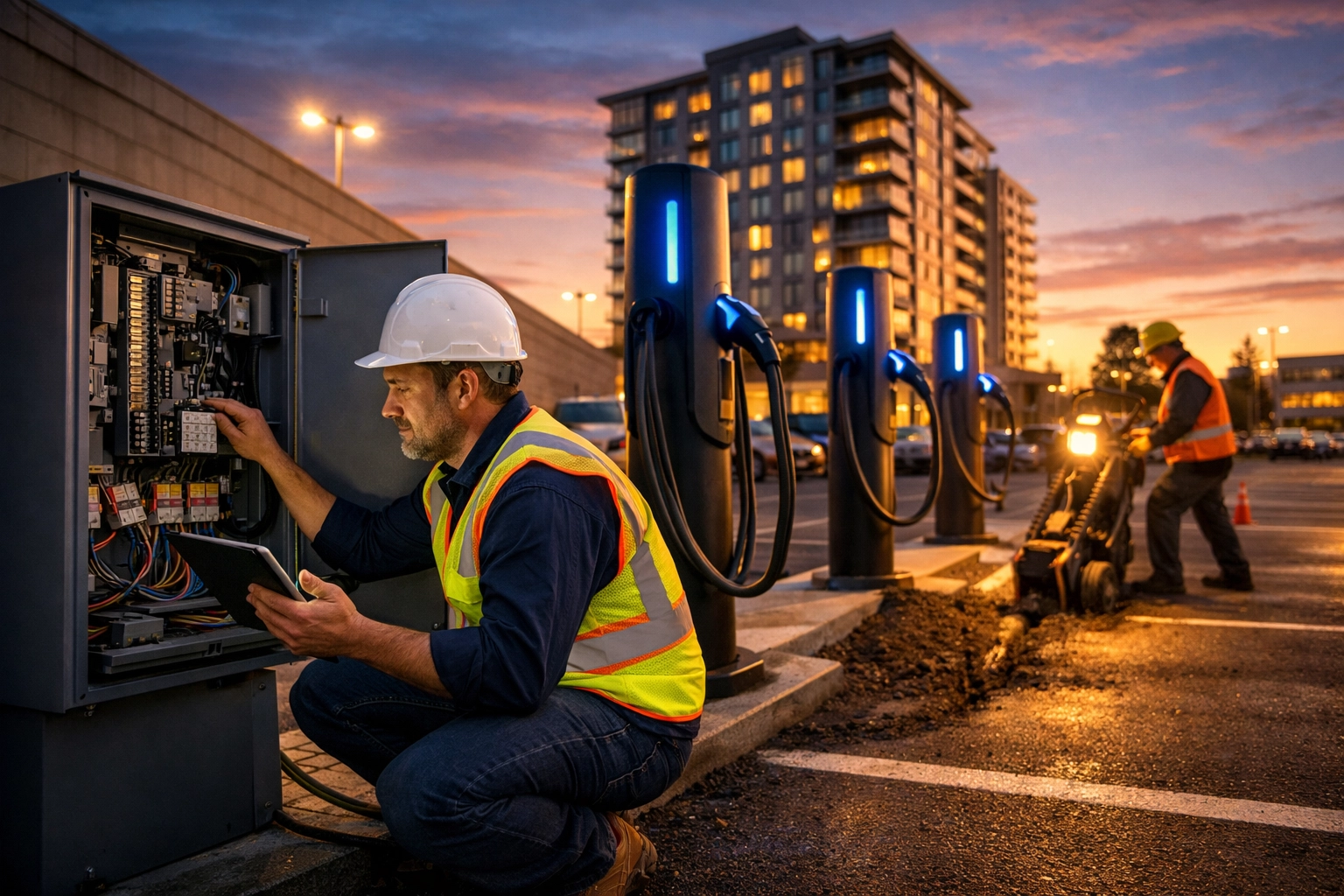
Let's start with the bombshell: the 2026 National Electrical Code now mandates that "permanently installed electric vehicle power transfer system equipment shall be installed by qualified persons." Translation? Licensed electricians only. No DIY installations. No cutting corners with unqualified contractors.
This isn't just a technical requirement: it's a liability and insurance issue. Property owners who ignore this mandate expose themselves to:
- Code violations that can halt occupancy permits
- Insurance claim denials if electrical failures occur
- Personal injury liability if installations cause accidents
- Costly rework when building inspectors flag non-compliant installations
The upside? Working with licensed professionals from day one means your installation gets done right, passes inspection the first time, and protects you from downstream headaches. Just make sure whoever you hire understands the integrated civil and environmental considerations, not just the electrical work.
Site Assessment: More Than Just Counting Electrical Panels
Most property owners start with the obvious question: "Do we have enough electrical capacity?" That's important, but it's only one piece of the puzzle. A comprehensive EV readiness assessment needs to evaluate:
Electrical Infrastructure
- Existing service size and panel capacity
- Current electrical load and available headroom
- Distance from panels to parking areas
- Trenching requirements and subsurface obstacles
- Transformer upgrade needs
Civil and Site Conditions
- Subsurface utilities that impact trenching routes
- Soil stability for charging station foundations
- Drainage implications of new hardscape installations
- ADA-compliant pathways to charging stations
- Traffic flow and parking layout modifications
Environmental Considerations
- Soil disturbance permits for excavation work
- Stormwater management impacts from impervious surfaces
- Historic fill or contamination in trenching corridors
- Erosion and sediment controls during construction
This is where integrated civil-environmental firms have a massive advantage. We've seen projects delayed by months because electrical contractors started trenching without environmental clearances, hit contaminated fill, and triggered remediation requirements that could have been anticipated with proper upfront assessment.
The Regulatory Compliance Maze
Beyond the NEC updates, property owners face a tangled web of overlapping requirements that vary by jurisdiction. Here's what you're navigating:
- Authority Having Jurisdiction (AHJ) requirements for plan formatting, technical specifications, and code compliance documentation
- Electrical and building permits with different timelines and review processes
- National Fire Protection Association (NFPA) standards for installation safety
- Local zoning ordinances that may restrict charging station locations or require conditional use permits
- Parking ordinances that dictate ADA-compliant space ratios and accessibility
- U.S. Access Board guidelines for accessible EV charging design
In New York and New Jersey specifically, you're also dealing with state-level energy codes, utility interconnection agreements, and potential public access requirements if your property receives certain incentives or falls within specific zoning designations.
The cost of non-compliance isn't just fines: it's project delays that push timelines by months while you circle back for amended permits or redesigns.
Multi-Family and Commercial Property Challenges
If you own or manage multi-family residential or commercial properties, the complexity multiplies. "Right to charge" laws in many states limit your ability to prohibit tenant-requested installations, but you retain authority to establish:
- Licensed installer requirements
- Safety and design standards
- Cost-sharing arrangements
- Enforcement protocols for misuse
For HOAs and condo associations, the key is getting ahead of resident requests with a clear policy framework. Conduct resident surveys to gauge EV ownership and charging interest. Complete electrical capacity assessments before individual unit owners start submitting installation requests. Establish pricing models: resident-paid, amenity, or hybrid: that align with your community's financial structure.
Some municipalities now require charging stations on private property to be accessible to the public if you receive grant funding or tax incentives. Read the fine print before you accept that check, because ongoing public access brings operational, liability, and maintenance obligations you need to budget for.
The Financial Equation: Incentives and ROI
Here's the good news: EV infrastructure installations can pencil out financially with the right incentive stacking and long-term planning.
Federal Tax Credits
Property owners installing residential EV charging equipment can claim a 30% tax credit up to $1,000, covering the charging port, essential components, and installation labor. Equipment must be placed in service by June 30, 2026 to qualify. Additional credits are available for associated energy storage systems.
Property Value Enhancement
Multiple studies show properties with EV charging infrastructure command higher rents, attract longer-term tenants, and sell at premiums compared to comparable properties without charging access. In competitive markets like New York and New Jersey, charging infrastructure is rapidly shifting from "nice to have" to "must have" for Class A properties.
Utility Incentive Programs
Many regional utilities offer rebates and reduced rates for commercial EV charging installations, particularly for projects that incorporate demand management or off-peak charging incentives.

Implementation Roadmap: Phased Approach
Smart property owners aren't trying to boil the ocean on day one. A phased implementation strategy minimizes upfront capital requirements while establishing the infrastructure backbone for future expansion:
Phase 1 (Weeks 1-4): Assessment and Planning
- Conduct electrical capacity and site civil assessments
- Complete environmental due diligence for trenching corridors
- Survey residents or tenants for EV ownership and charging interest
- Preliminary layout and cost estimation
- Secure environmental clearances where needed
Phase 2 (Weeks 3-6): Regulatory and Financial
- Submit permit applications to all relevant authorities
- Finalize utility interconnection agreements
- Apply for available incentive programs
- Establish access rules and pricing models
- Design enforcement protocols
Phase 3 (Weeks 6-12): Construction and Commissioning
- Install electrical infrastructure with licensed contractors
- Complete civil work (trenching, foundations, paving)
- Install charging equipment and network connectivity
- Final inspections and certificate of occupancy amendments
- User onboarding and operational rollout
This timeline assumes no major subsurface surprises or regulatory delays. Properties with contaminated soil, limited electrical capacity requiring service upgrades, or complex permitting jurisdictions should add 8-12 weeks to this baseline.
The Integrated Advantage
Here's what separates projects that move smoothly from those that become costly, delayed headaches: integrated civil and environmental expertise from day one.
Electrical contractors know electrical systems. Civil engineers understand site work and utilities. Environmental professionals handle regulatory compliance and subsurface conditions. But EV charging installations require all three disciplines working in sync, not sequentially.
When you bring in separate firms for each scope, you're playing project manager trying to coordinate handoffs between contractors who each think their piece is the priority. Trenching starts before environmental clearances. Foundation work conflicts with utility locations. Stormwater designs don't account for new impervious surfaces.
Integrated firms like Envicon Strategic Solutions assess all three angles simultaneously: electrical, civil, and environmental: identifying conflicts and optimization opportunities before shovels hit the ground. That means fewer change orders, faster permitting, and installations that come in on time and on budget.
Your Next Move
The EV charging wave is here. Property owners who move strategically in 2026 will capture premium tenants, qualify for expiring incentives, and future-proof their assets for the inevitable expansion of electric vehicle adoption. Those who wait will play catch-up at higher costs with fewer incentive dollars available.
Start with a comprehensive site assessment that evaluates electrical capacity, civil constraints, and environmental clearances as integrated factors, not isolated checklists. Engage licensed professionals who understand 2026 code requirements and local regulatory nuances. Build in operational flexibility for future expansion as EV adoption accelerates.
The infrastructure decisions you make today will determine whether your property leads the market or scrambles to keep pace. Choose wisely, and reach out to firms with integrated civil-environmental expertise who can deliver turnkey solutions rather than piecemeal band-aids.
Because in 2026, EV readiness isn't just about installing chargers: it's about strategic infrastructure planning that positions your property for the next decade of tenant expectations and regulatory requirements.
Leave a Reply