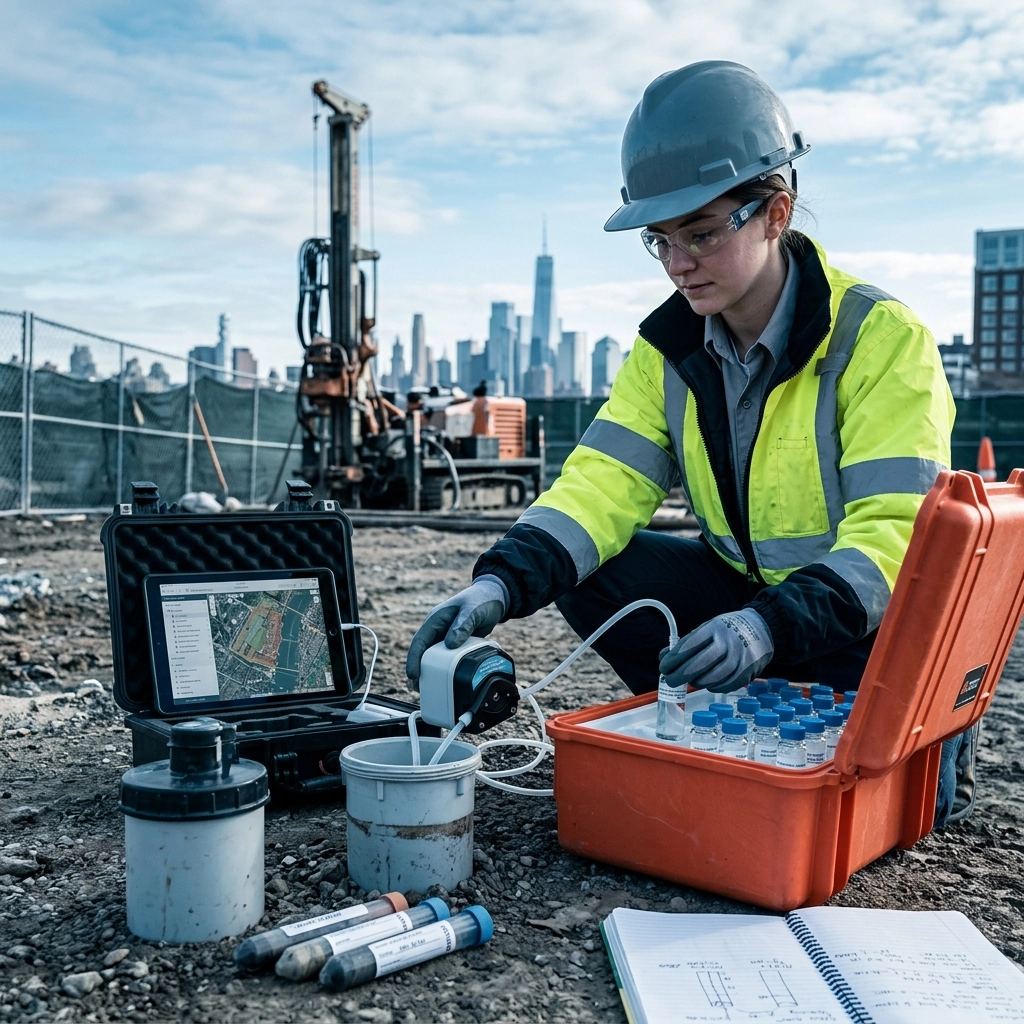
It’s 7:30 AM on a Tuesday in Long Island City. Your excavator is idling, the trucks are lined up, and your concrete pour is scheduled for tomorrow. Then, a black sedan pulls up. A city inspector steps out, looks at the dust billowing over the fence, and walks straight to the site super. Ten minutes later, you have a Stop-Work Order (SWO) taped to the gate.
For a developer, that piece of paper is a financial heart attack. Every day your site is dark, you’re bleeding carry costs, testing your lender’s patience, and missing your market window. Most consultants will tell you they did their job because they wrote a 400-page Remedial Action Plan (RAP) that sits in a three-ring binder in the job trailer.
At Envicon Group, we know that the binder doesn't keep the site open. Field-level QA/QC and aggressive construction oversight do. If your environmental consultant spends more time in front of a laptop than they do standing next to your excavation crew, you aren't buying protection: you’re buying a paper shield that will disintegrate the moment a regulator walks on-site.
The Gap Between the Plan and the Excavator Bucket
The biggest mistake we see in NYC and New Jersey development is the disconnect between the "office engineer" and the "field reality." A national firm might assign a junior staffer to your site who has never spoken to a contractor in their life. They follow a checklist, take their samples, and leave.
When the contractor decides to stockpile "clean" fill next to a pile of contaminated urban fill to save space, that junior staffer might not notice: or worse, they won't feel empowered to stop it. Then, the regulator shows up, sees the cross-contamination, and shuts you down.
Field-first monitoring means having a PE-led team that understands the mechanics of construction. We don’t just watch; we coordinate. We look at the site through the eyes of the regulator and the contractor simultaneously. We ensure that the soil and groundwater management protocols aren't just suggestions: they are the operational law of the site.

Air Monitoring: More Than Just a Beeping Sensor
In dense urban environments like Hudson County or Manhattan, air monitoring is your first line of defense against community complaints and agency intervention. If the community smells "petroleum" or sees a cloud of dust, they call 311. Once that call is logged, you are on the radar.
Many firms treat Community Air Monitoring Programs (CAMP) as a "set it and forget it" task. They set up the telemetry, wait for an alarm to go off on their phone, and then tell the contractor to slow down. By then, it’s too late. The neighborhood has already seen the dust, and the inspector is already on his way.
Our approach is proactive. We monitor the work before the alarm triggers. If we see a dry day with high winds and an excavator hitting a pocket of fine-grained silt, we’re calling for the water truck before the dust even leaves the bucket. We coordinate with the site super to adjust the pace of work or change the excavation sequence based on real-time field observations. This isn't just compliance; it's air-tight risk management.

Contractor Coordination: The Art of Field Alignment
"Collaboration" is a buzzword most big firms use in their pitch decks. In the field, it means something very different. It means being able to stand in the mud at 7:00 AM and talk to a foreman in a way that respects his schedule while enforcing environmental limits.
Contractors want to move dirt. They are paid for speed. If your environmental consultant is viewed as an "obstacle" or a "nark," the contractor will find ways to work around them. That’s when mistakes happen.
At Envicon, we position ourselves as the "path clearers." We tell the contractor: "We are here to make sure you don't get shut down." When we see an issue: whether it's improper silt fencing or a lack of liner under a stockpile: we don’t just write it in a report for you to read next week. We resolve it on the spot.
We take ownership of the outcome. If a project stalls because of an environmental oversight, we consider that our failure. That’s the difference between a consultant who sells "services" and a partner who sells "cleared paths."

Why "Big Box" Firms Fail the Field Test
When you hire a national firm with 10,000 employees, you’re paying for a massive overhead structure. To maintain their margins, they have to send the least experienced (and least expensive) people to the field. These junior staffers often lack the "field-sense" to spot a problem before it becomes a violation.
Furthermore, big firms are built on a culture of "defensive reporting." They write reports designed to protect themselves from liability, often at the expense of your project’s timeline. If they find an issue, their first instinct is to document it and distance themselves.
Envicon Group is family-owned and operated. We’ve spent 20 years building direct relationships with reviewers at the NYC OER, NYSDEC, and NJDEP. We know how they think, and we know what they’re looking for during a site visit. When we are on-site, we aren’t just monitoring; we are representing your interests to the agencies. Our presence tells the regulator that the site is under professional, competent control.

Soil Borings and Subsurface Surprises
The most common cause of a Stop-Work Order during the early phases of construction is the "unforeseen condition." You’re digging for a foundation and hit an abandoned UST (Underground Storage Tank) or a pocket of heavily impacted soil that wasn't caught in the Phase II.
A field-first firm handles this with precision and speed. Because we are already on-site for construction oversight, we can immediately characterize the find, notify the necessary agencies (like the NYSDEC Spill Hotline if required), and develop a management plan within hours: not days.
We don't wait for a weekly meeting to discuss it. We move. We coordinate the sampling and laboratory analysis on an expedited basis, adjust the soil disposal manifests, and keep the machines moving in another area of the site while the issue is resolved.

The Takeaway: Trust the Boots, Not Just the Suits
A Stop-Work Order is rarely the result of a bad plan. It is almost always the result of bad execution or a lack of field-level vigilance. If you want to keep your project on track, you need more than a report. You need a team that takes full responsibility for the site conditions from the moment the fence goes up until the final Certificate of Occupancy is issued.
The Envicon Difference:
- Proactive vs. Reactive: We stop violations before they happen by coordinating daily with your contractors.
- Expert Presence: You don't get a junior staffer; you get a field-tested professional who understands the "why" behind the regulations.
- Agency Fluency: We speak the language of NYC OER, NYSDEC, and NJDEP, ensuring that our field oversight meets: and exceeds: their expectations.
- Zero Fluff: We don't write reports to protect our hides. We provide clean, actionable documentation that moves your project forward.
At the end of the day, your site is either buildable or it isn't. We exist to make sure it stays buildable. We don't just deliver services; we help transform underused and contaminated properties into thriving assets by staying in the mud, not just in the trailer.
Is your current consultant sitting behind a desk while your site is at risk? Let’s talk about a field-first approach that actually protects your investment.
Summary for Project Managers
- Field-level QA/QC is the only way to catch cross-contamination and dust issues before regulators do.
- Air monitoring (CAMP) should be used as an early-warning system, not just a compliance log.
- Contractor coordination requires an environmental partner who understands construction logic and can speak the language of the trades.
- Stop-Work Orders are avoidable through aggressive oversight and real-time problem-solving on the ground.
- Envicon Group provides PE-led construction oversight that focuses on outcomes, not just output.
Leave a Reply