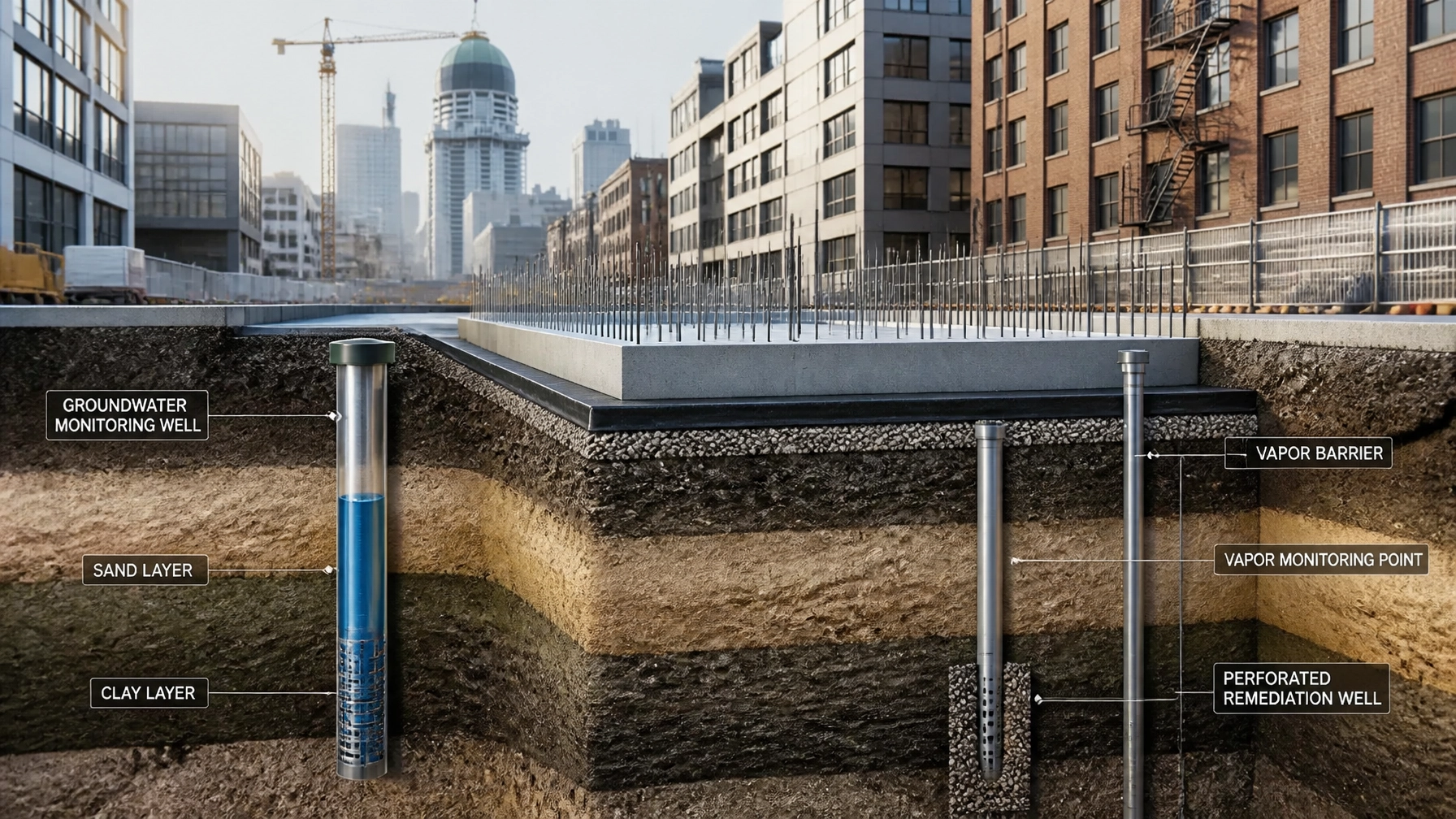
If you are developing in New Jersey, you already know the story: the best sites are often the messiest ones. Former industrial hubs, old gas stations, and abandoned factories sit in prime locations with one massive obstacle standing in the way: contamination.
For years, the high cost of remediation has killed projects before they could even break ground. But the landscape has changed. Under the NJEDA Brownfields Redevelopment Incentive (BRI) Program, the state isn't just asking you to clean up these sites; they are offering to foot a massive portion of the bill.
We aren’t talking about small change. We are talking about tax credits that cover up to 80% of your remediation costs, capped at as much as $12 million per project. If you are building solar on a closed landfill, that number can hit 100%.
But here is the catch: the state doesn’t hand out checks for just showing up. The application process is rigorous, the eligibility rules are strict, and if you don’t have your numbers: and your strategy: locked in early, you will leave millions on the table.
What is the NJ Brownfield Tax Credit?
The BRI Program, administered by the New Jersey Economic Development Authority (NJEDA), is a project-based, transferable tax credit. It was designed to bridge the "financing gap": the difference between what a project costs to build on a contaminated site versus a clean one.
Unlike older reimbursement programs that were plagued by delays, the BRI is a one-time credit issued in the tax year the remediation is completed. Even better, it’s transferable. If you don’t have a massive New Jersey corporate tax liability to offset, you can sell these credits for cash: typically at 75% to 85% of their face value: to help fund your next phase of development.

The Math: How Much Can You Actually Get?
The amount of the credit depends on two things: where your project is located and what you are building. The program categorizes New Jersey sites into two tiers to determine the "enhanced" benefit levels.
- In a Government-Restricted Municipality (GRM) or Qualified Incentive Tract (QIT): You are eligible for a tax credit equal to up to 80% of eligible remediation costs, with a maximum award of $12 million.
- Elsewhere in New Jersey: You are eligible for up to 60% of eligible remediation costs, with a maximum award of $8 million.
- Solar on Closed Landfills: This is the gold mine. If you are installing a solar panel array on a closed sanitary landfill, the credit can cover 100% of eligible remediation costs, up to the $8M or $12M cap.
For most developers in urban centers like Newark, Jersey City, or Paterson, you are likely sitting in an 80% zone. On a $5 million remediation job, that’s a $4 million credit. Even after selling it at a discount, that’s over $3 million back in your pocket.
Who is Eligible? (The "Non-Responsible Party" Rule)
This is where many developers trip up. To qualify for the NJ Brownfield Tax Credit, the applicant must demonstrate to the NJDEP that they are a "non-responsible party."
In plain English: you cannot be the one who caused the contamination. You cannot be the corporate successor to the entity that dumped the chemicals. You need to be a "clean" buyer who is taking on the burden of a "dirty" site.
Additionally, you must:
- Be in good standing with the NJ Department of Labor and the Department of the Treasury.
- Obtain a letter of support from the local governing body.
- Prove that the project is not economically feasible without the tax credit (the "financing gap" test).
One hard "no" from the NJEDA: Cannabis businesses are currently ineligible. If you are planning a cultivation facility, don't waste your application fee.

What Costs Actually Count?
The state is specific about what they will "pay" for. You can’t just throw every site expense into the bucket. The BRI covers "eligible remediation costs," which typically include:
- Investigation & Remediation: Soil borings, groundwater sampling, and the actual removal or treatment of contaminated media.
- Building Abatement: Asbestos assessment and removal, PCB abatement, and handling contaminated wood or lead-based paint.
- Demolition: If the building needs to come down to get to the contamination, those costs are often eligible.
- Hazardous Materials Disposal: The high cost of trucking "hot" soil to a licensed facility.
What doesn't count? Acquisition costs, financing fees, legal fees, and the cost of the "vertical" construction itself. This is why having a firm that understands Soil and Groundwater Management is critical: you need to categorize every dollar correctly from day one.
The Two Biggest Hurdles: Prevailing Wage and the Gap
The BRI Program isn't free money; it comes with strings. The two most significant are the prevailing wage requirement and the financing gap analysis.
- Prevailing Wage: Every worker on the remediation and the subsequent redevelopment project must be paid prevailing wage. This requirement stays in effect until two years after the tax credit is issued. For residential or commercial building services, that requirement can stretch to 10 years. You have to run the numbers: does the 80% tax credit outweigh the increased labor costs of a prevailing wage job? Usually, on a contaminated site, the answer is a resounding yes, but you need an engineer who can model both scenarios.
- The Financing Gap: For projects over $5 million (outside of Trenton, Paterson, or Atlantic City), you have to prove you need the money. The NJEDA will look at your internal rate of return (IRR) and your pro forma. If the project is wildly profitable without the credit, they may deny it.

Strategy: How Envicon Maximizes Your ROI
Most consultants will hand you a Phase II Environmental Site Assessment and tell you it’s going to cost $2 million to clean up. They stop there.
At Envicon, we look at the tax credit as a core component of the engineering design. We don’t just deliver reports; we sell cleared paths. Here is how our approach differs from the big-box firms:
- Integrated Civil and Environmental: Because we handle Civil and Site Engineering alongside remediation, we design your grading, drainage, and utility plans to minimize soil disturbance and maximize the "eligible" portions of the demolition and excavation.
- Agency-First Mindset: We sit at the table with the NJDEP daily. We know how they view specific remedial strategies, which helps us ensure your Remedial Design is both compliant and optimized for the BRI application.
- Real-Time Data for the Gap: We provide the precise, field-verified data you need to back up your financing gap claims. When the NJEDA asks why your remediation costs are so high, we point to the soil borings and the Site Investigation data, not a generic estimate.
The Takeaway
The NJ Brownfield Tax Credit is the most powerful tool in a New Jersey developer's belt, but it is not a "set it and forget it" incentive. It requires a field-first engineering partner who understands the intersection of regulatory compliance, construction costs, and financial incentives.
If you are sitting on a site with historical fill, old tanks, or industrial baggage, don't just write a check for the cleanup. Let the state pay for it.
Ready to unlock the value of your site?
Stop letting environmental "unknowns" stall your project. Whether you need a Phase I ESA to start the clock or a full-scale Brownfield Redevelopment strategy, we are ready to move.
Contact Envicon Group Today to see if your project qualifies for the NJ BRI Program.

Leave a Reply