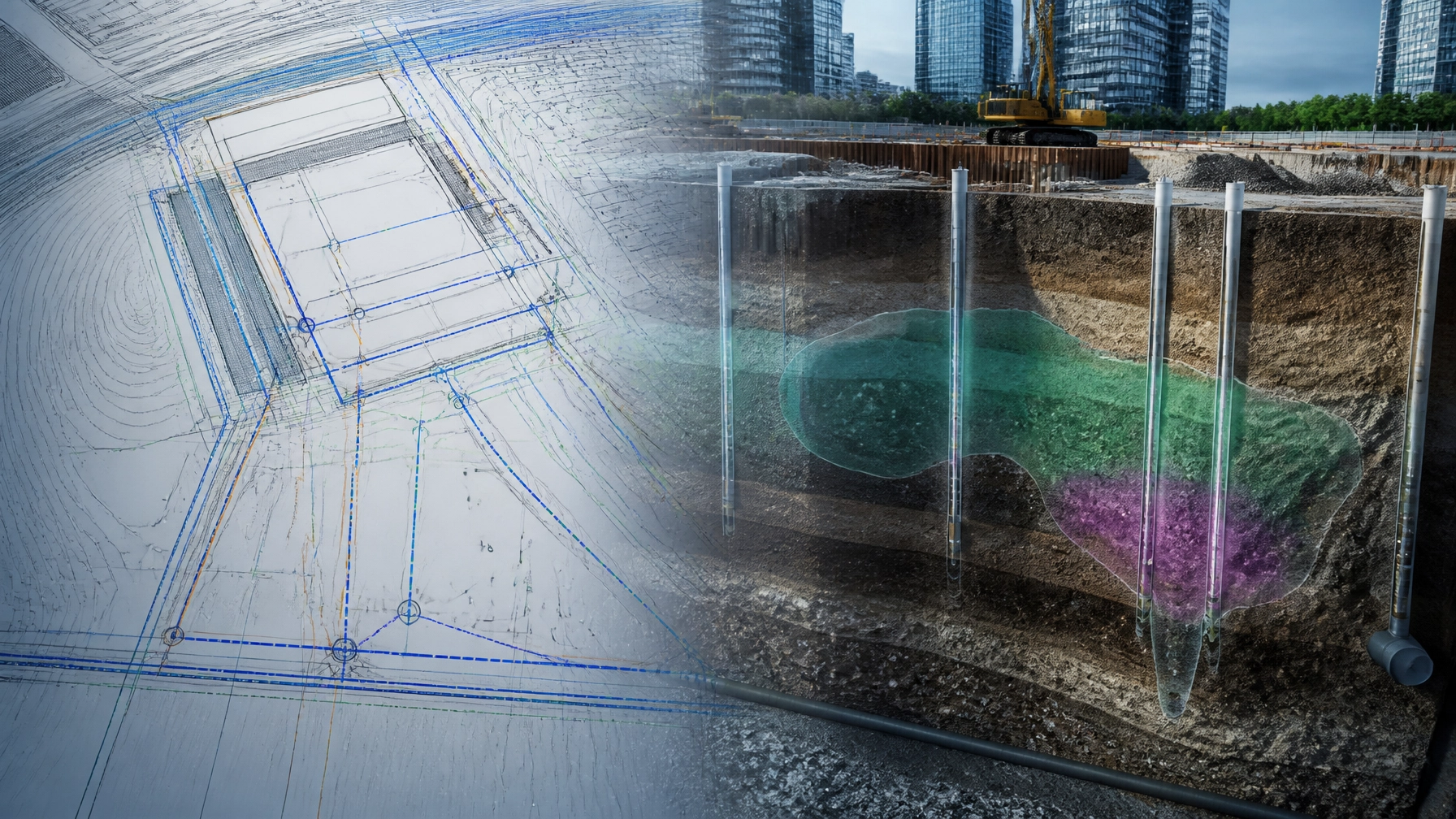
You’ve seen it happen. You’re six months into a high-stakes redevelopment project in Jersey City or Brooklyn. Your environmental consultant hands you a Remedial Action Plan (RAP) that clears the site for construction. Then, your civil engineer submits a grading and drainage plan that: completely inadvertently: requires excavating right through the clean-fill cap the environmental team just designed.
Suddenly, the "all clear" turns into a six-figure change order. The environmental guy blames the civil guy for not checking the cap depth. The civil guy blames the environmental guy for not providing the CAD files. You, the developer, are left holding the bill while your project sits in a regulatory queue.
At Envicon Group, we call the solution to this mess the Civil-Environmental Handshake. It’s the intentional, technical, and early-stage coordination between remediation strategy and site design. When these two disciplines don't talk, your project loses money. When they shake hands, you unlock the full potential of your site.
The Hidden Cost of the "Big Box" Silo
When you hire a large national firm, you’re often hiring two different departments that barely know each other exists. The environmental team is focused on Phase I & Phase II Site Assessments and regulatory checkboxes. The civil team is focused on pipe slopes and parking lot grades.
Because they operate in silos, they produce "defensive" reports designed to protect the consultant’s liability rather than move your project forward. This lack of coordination leads to:
- Redundant Earthwork: Excavating soil twice because the remediation plan didn't account for the utility corridor depth.
- Permit Conflicts: Finding out the Stormwater Management (SWPPP) design conflicts with the groundwater monitoring well network.
- Budget Creep: Constant change orders as one discipline "discovers" what the other has been doing for months.
We don't sell reports; we sell cleared paths. And a cleared path requires one team that sees the whole board.

Why Unified Site Design is a Non-Negotiable
In the NY/NJ market, space is a luxury. You are often building on sites with historical contamination, tight property lines, and aggressive regulatory oversight from the NJDEP or NYC OER. You cannot afford the "wait and see" approach.
1. Remediation That Informs Grading
A smart environmental strategy uses the site’s natural topography and the proposed civil grading to minimize soil disposal costs. If we know you need to cut three feet for a foundation, we design the remediation to use that excavated material as onsite fill where permitted, rather than shipping it to a landfill at $100 a ton.
2. Stormwater Systems That Respect the Cap
If your site has a sub-slab depressurization system (SSDS) or an engineered cap to manage vapor intrusion, your Civil & Site Engineering must be surgical. We design drainage systems that move water away from the building without puncturing the environmental barriers that keep your site compliant.
3. Utility Corridors as Remedial Trenches
On some sites, we can actually coordinate utility installation to serve as a remedial action. By strategically placing utility trenches, we can remove localized "hot spots" of contamination during the infrastructure phase. This "one-and-done" approach is only possible when your environmental and civil teams are sitting at the same table.

The Regional Fluency Factor: NYC & NJ
Navigating the regulatory landscape in our backyard isn't just about knowing the law; it’s about knowing the people. Whether it’s NYC OER, NYSDEC, or NJDEP, these agencies want to see a cohesive plan.
When we submit a permit application, the reviewer knows that our civil drawings and environmental reports are perfectly aligned. There’s no "black box" coordination. We work directly with architects, construction managers, and attorneys to ensure everyone is pulling in the same direction. This regional fluency is built from 20 years of working these jurisdictions daily: not from a satellite office in another state.
The Envicon Difference: One Team, No Excuses
Most consultants hand you a report and leave you to figure out what it means for your contractor. Envicon gives you more. We provide value-add work that actually gets you to the next step.
- Senior-Level Execution: You talk to the Principal Engineer who wrote the report and designed the site. No hand-offs to junior staff who have never stepped foot on your property.
- Tech-Powered Transparency: Our proprietary Environmental Dashboard gives you real-time visibility into your project’s schedule, budget, and field activity. You’ll see the "handshake" happening in real-time.
- Field-First Mindset: We’re the firm that’s on-site at 7 AM, talking to the excavator operator and the regulator. We don't just identify problems; we resolve them with precision and urgency.

Summary: Stop Paying for Miscommunication
The "Civil-Environmental Handshake" isn't a buzzword; it’s a business strategy. By integrating these two critical phases of development, you:
- Reduce carry costs by shortening the permitting and remediation timeline.
- Eliminate change orders caused by conflicting designs.
- Protect your investment with documentation that holds up under lender and regulatory scrutiny.
If your current consultant is handing you reports that don't talk to your site plan, you’re paying for a gap that could swallow your profit margin. It’s time to switch to a team that takes ownership of the entire outcome.
Ready to clear the path for your next project?
Contact Envicon Group today to discuss how our integrated civil and environmental solutions can move your project from "stalled" to "start."
Leave a Reply