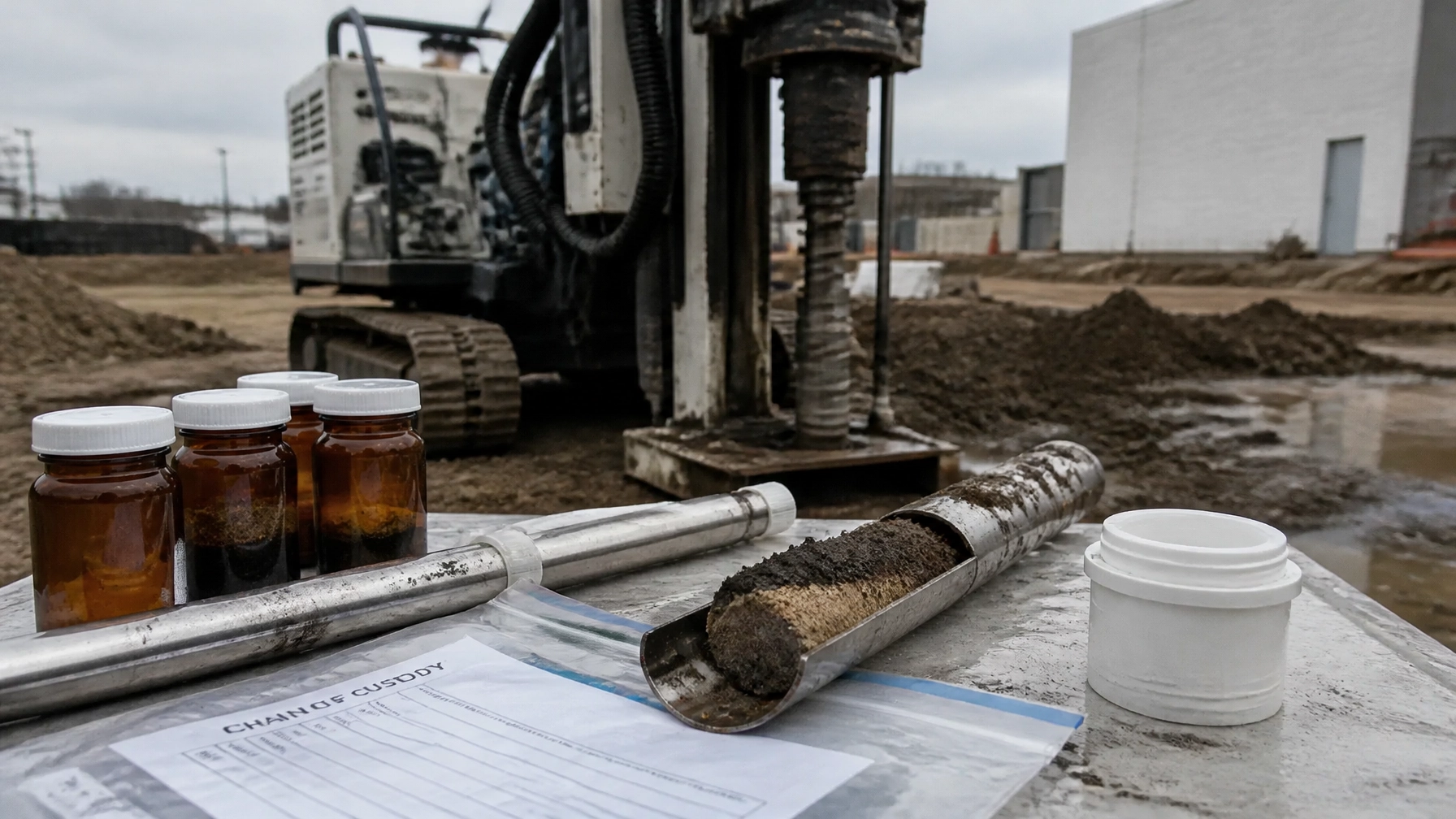
A Phase II Environmental Site Assessment answers the question a Phase I ESA cannot: is contamination actually present, where is it located, and how could it affect your project?
For developers, investors, contractors, and lenders in New Jersey, that answer directly affects acquisition decisions, financing, design, permitting, and construction risk.
A poorly scoped investigation can miss a plume and uncover it during excavation. An oversized investigation can consume budget without producing information that moves the project forward. The right Phase II ESA is neither minimal nor excessive. It is built around the site’s history, geology, likely contaminants, regulatory requirements, and development plan.
What a Phase II ESA Does
A Phase I ESA identifies recognized environmental conditions (RECs), historical uses, potential release areas, and other reasons to investigate further. A Phase II ESA uses field sampling and laboratory analysis to confirm or rule out those concerns.
In New Jersey, the investigation should follow a clear conceptual site model:
- What contaminants may be present?
- Which environmental media could be affected?
- Where did the release likely occur?
- How could contamination migrate?
- Could people, buildings, utilities, groundwater, or nearby properties be impacted?
- What data will support the next project decision?
NJDEP’s Technical Requirements for Site Remediation require site investigations to collect enough data to evaluate potentially contaminated areas of concern, with sampling biased toward suspected locations of greatest contamination both horizontally and vertically. See N.J.A.C. 7:26E, particularly the requirements for soil, groundwater, vapor intrusion, and quality assurance.
That means a Phase II ESA should not rely on a generic grid or a standard number of borings. The sampling plan must reflect actual site conditions.
Typical Phase II ESA Scope in New Jersey
Soil Borings and Soil Sampling
Soil borings provide direct evidence of subsurface conditions. Depending on the site, drilling may use direct-push, hollow-stem auger, or another method suited to access, geology, pavement, and target depth.
Samples are typically collected from:
- Former or current underground storage tank areas
- Loading docks and chemical storage areas
- Floor drains, sumps, pits, and process areas
- Waste storage or disposal areas
- Areas of staining, odors, stressed vegetation, or fill
- Locations where historical operations suggest a release
- Upgradient and downgradient locations for comparison
The boring logs should document soil and fill characteristics, odors, staining, field screening results, groundwater observations, and sample depths. Composite soil samples generally aren’t appropriate for site investigation sampling under NJDEP requirements. Discrete samples provide better information about vertical and horizontal conditions.
Groundwater Monitoring Wells
If the Phase I, soil data, or site history indicates a potential groundwater concern, the investigation may require temporary or permanent monitoring wells.
The purpose is not simply to collect a water sample. A useful groundwater program should help determine:
- Depth to groundwater
- Groundwater flow direction
- Hydrogeologic conditions
- Whether a dissolved plume exists
- Whether contamination is moving on or off the property
- Whether nearby receptors or buildings could be affected
NJDEP’s rules require groundwater investigations to characterize hydrogeology, determine groundwater flow direction, evaluate contaminant fate and transport, and delineate the horizontal and vertical extent of contamination when standards are exceeded.
A few wells placed without regard to groundwater flow or the suspected source area may produce laboratory data but fail to define the problem.
Soil Vapor and Vapor Intrusion Sampling
Volatile organic compounds (VOCs) can migrate through soil gas and enter buildings through cracks, utility corridors, floor drains, sumps, and other preferential pathways. This is known as vapor intrusion.
Soil vapor or sub-slab sampling may be appropriate when:
- VOCs or petroleum-related compounds are present
- Groundwater contamination is near a building
- A new building is planned over or near an impacted area
- The site has a history of dry cleaning, manufacturing, fuel storage, or solvent use
- There are basements, crawl spaces, or slab-on-grade structures
- Subsurface utilities could create migration pathways
NJDEP’s current rules identify vapor intrusion investigation triggers based on contamination type, distance from buildings, soil gas results, indoor air results, and other site conditions. Initial vapor intrusion samples may include sub-slab, indoor air, and ambient air, depending on the lines of evidence.
Vapor sampling also requires careful field controls. Canister-based collection, proper purging, ambient air samples, weather documentation, and avoidance of cross-contamination are not optional details. They determine whether the results are defensible.

Laboratory Analysis
The analytical list should come from the site history and conceptual site model.
Common Phase II analytes include:
- VOCs
- SVOCs
- Petroleum hydrocarbons
- PCBs
- Metals
- Pesticides, where historically relevant
- PFAS, where required or supported by site history
- Dioxins or furans for certain industrial or fill conditions
NJDEP requires appropriate analytical methods, quality assurance and quality control procedures, chain-of-custody documentation, and laboratory data deliverables. The selected laboratory must have applicable certifications and sufficient analytical sensitivity for the project’s data quality objectives.
A cheaper laboratory panel is not a savings if the reporting limits are too high to compare results against applicable NJDEP standards.
What Changed for PFAS in 2026?
On June 15, 2026, NJDEP formally adopted site remediation standards for PFNA, PFOA, PFOS, and GenX. The same rule adoption also amended the Technical Requirements for Site Remediation to require analysis for PFNA, PFOA, PFOS, GenX chemicals, and 2,3,7,8-tetrachlorodibenzo-p-dioxin when contaminants are unknown or not well documented.
TCDD is a dioxin, not a PFAS compound. It is included in the amended analyte requirements because NJDEP treats these substances as important potential indicators at sites where the contaminant profile is incomplete.
The NJDEP June 15, 2026 announcement explains that the adopted standards formalize interim standards that had been in place for several PFAS compounds. The amended N.J.A.C. 7:26E rule identifies the broader analytical requirements for sites where contamination is unknown or poorly documented.
For your project, PFAS scope may depend on:
- Firefighting foam use or training
- Airports, fire stations, and emergency response areas
- Plating, coating, or manufacturing operations
- Landfills and wastewater-related uses
- Industrial facilities with incomplete records
- Suspected impacts to groundwater or drinking water resources
PFAS sampling also requires specialized field protocols to limit cross-contamination. Materials such as certain waterproof clothing, treated equipment, and inappropriate plastics can interfere with sampling. These requirements can increase both field and laboratory costs.
Phase II Environmental Site Assessment NJ Cost Range
For typical NJ and NYC-area projects, a Phase II ESA commonly ranges from $10,000 to $50,000 or more.
That range is broad because the scope can vary significantly. A limited investigation at a small commercial property is not comparable to a multi-acre industrial site with historic fill, several contaminant source areas, groundwater impacts, vapor concerns, and PFAS analysis.
Major cost drivers include:
- Site acreage and physical layout
- Number and depth of soil borings
- Number of temporary or permanent monitoring wells
- Drilling method and access conditions
- Pavement or difficult subsurface materials
- Number of samples and environmental media
- VOC, SVOC, metals, PFAS, PCB, or dioxin analysis
- Soil vapor, sub-slab, indoor air, or ambient air sampling
- Rush laboratory turnaround
- Utility clearance and permitting
- Data validation and reporting requirements
- Need for NJDEP or LSRP coordination
- Whether the work must support remediation or construction planning
The key question is not, “How much does a Phase II cost?” It is, “What information does the project need before the next decision?”
A proposal should separate fieldwork, laboratory analysis, reporting, regulatory coordination, and optional additional investigation. That makes it easier to compare bids and identify where a scope is either missing critical work or adding unnecessary tasks.
Geotechnical Investigation Costs NJ
A geotechnical investigation is related to a Phase II ESA but serves a different purpose.
Environmental testing evaluates contamination and exposure pathways. Geotechnical testing evaluates how the ground will perform under foundations, slabs, pavement, utilities, retaining walls, and other improvements.
In New Jersey, geotechnical investigation costs generally range from $5,000 to $25,000 for standard commercial sites. Larger or technically complex projects can exceed that range.
Common cost drivers include:
- Number and depth of borings
- Standard Penetration Testing (SPT)
- Rock coring
- Groundwater observations
- Test pits or difficult access
- Foundation loads and building height
- Pavement and subgrade testing
- Laboratory testing such as Atterberg limits, grain size, moisture, and compaction
- Compressible soils, fill, shallow bedrock, or variable geology
- Site constraints in dense Hudson County, Newark, Jersey City, or other urban areas
Environmental and geotechnical drilling can sometimes be coordinated. Shared mobilization may reduce costs, but the scopes cannot simply be merged without review. Environmental borings must be located around suspected source areas and completed using appropriate decontamination and sampling procedures. Geotechnical borings are usually located to support structural and civil design.
Coordination works when the team plans it before mobilization.

How to Avoid Both Under-Scoping and Over-Scoping
Before approving a Phase II proposal, ask for clear answers to these questions:
- Which Phase I RECs does each boring or well address?
- Why were the sample locations selected?
- What contaminant list is included, and why?
- Is PFAS required, recommended, or excluded?
- How will groundwater flow direction be evaluated?
- Is soil vapor or indoor air sampling necessary?
- What happens if an initial sample exceeds a standard?
- Which work is included in the base fee, and which work is optional?
- Can environmental and geotechnical drilling be coordinated?
- Will the report support the lender, design team, NJDEP, or LSRP?
At Envicon Group, we don’t apply a template scope to a New Jersey site. We review the history, geology, planned construction, regulatory endpoint, and business deadline together.
Our team works directly with developers, attorneys, contractors, architects, lenders, LSRPs, and agencies. You get clear documentation, direct communication, and a practical path from findings to action: not a report that leaves the next decision to you.
We’ve spent 20 years working across New York and New Jersey. That field experience matters when the site has historic fill, shallow groundwater, buried infrastructure, or a contaminant profile that doesn’t fit a standard checklist.
The Takeaway
A Phase II ESA should be precise enough to find the problem and practical enough to support the project.
In New Jersey, realistic Phase II budgets often fall between $10,000 and $50,000+, while standard commercial geotechnical investigations commonly range from $5,000 to $25,000. The final cost depends on the number of borings and wells, sample depths, analytical requirements, site access, hydrogeology, vapor conditions, PFAS considerations, and the level of regulatory documentation required.
Under-scope the work, and you may discover contamination during construction. Over-scope it, and you may pay for data that does not change the decision.
The right investigation removes uncertainty before it becomes a change order.
Plan Your NJ Site Investigation
- Call Envicon Group now at (917) 764-2171
- Use our project risk screener
- Use our proprietary cost estimator
Precision, speed, and trust turn environmental uncertainty into a buildable path.
Leave a Reply