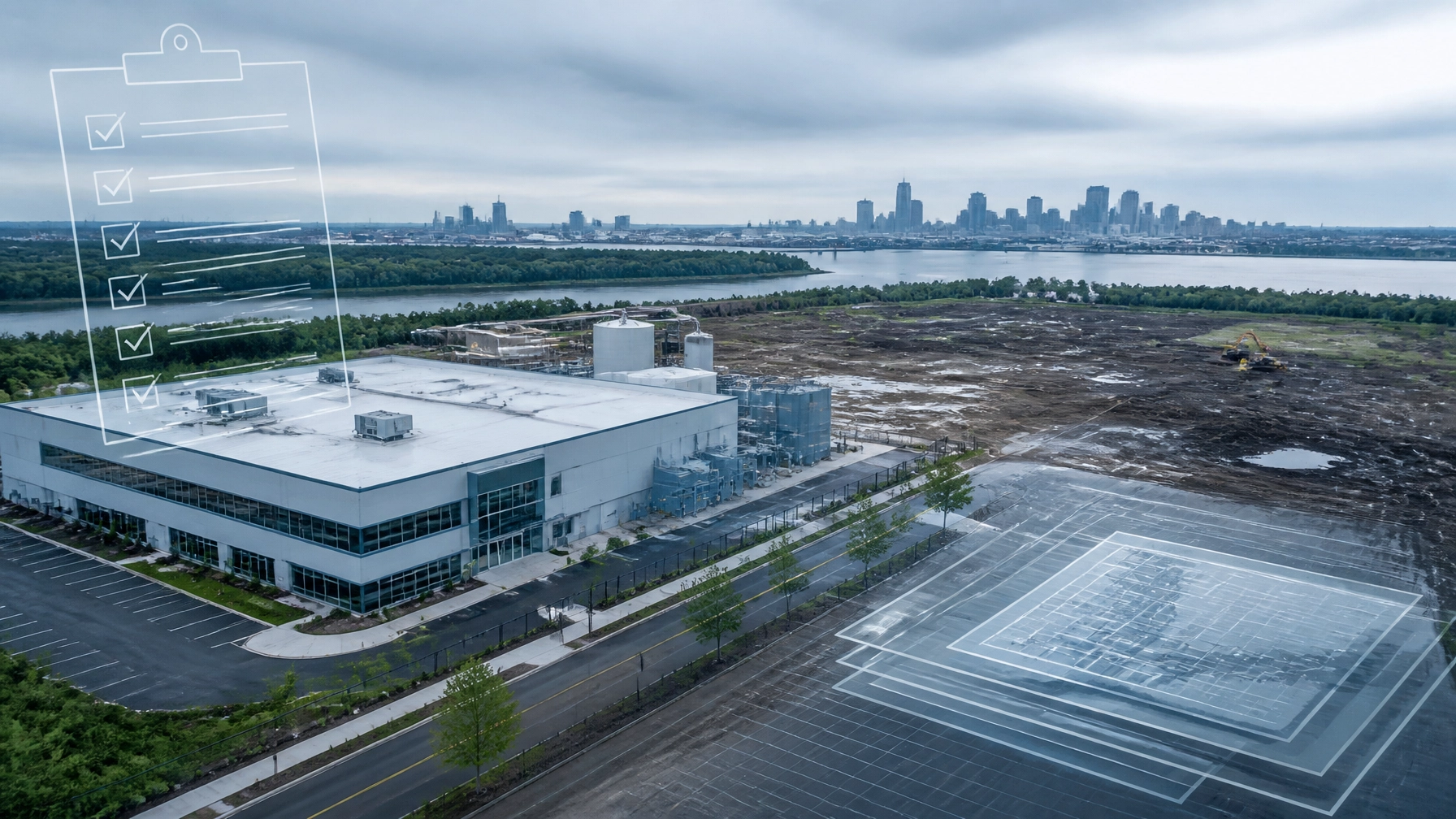
For New Jersey developers, property investors, attorneys, and corporate counsel, the most important ISRA deadline may arrive before closing.
Under the Industrial Site Recovery Act, or ISRA, an owner or operator of a covered industrial establishment must address environmental obligations when operations close or ownership or operations transfer. The first deadline is immediate: a General Information Notice (GIN) must be submitted to the New Jersey Department of Environmental Protection within five calendar days of the triggering event.
That is a short window. Missing it can compound regulatory exposure, disrupt a transaction, and create avoidable problems with lenders, buyers, and project schedules.
The second major deadline follows quickly. The responsible party must retain a Licensed Site Remediation Professional (LSRP) within 45 days of the ISRA trigger date and notify NJDEP as required.
Here’s how the ISRA process works in 2026, and where developers and their advisors need to focus.
What Is ISRA Compliance in New Jersey?
ISRA applies to certain industrial establishments identified through specific North American Industry Classification System (NAICS) codes.
The law requires owners and operators of covered facilities to investigate and, where necessary, remediate environmental contamination connected with the site or its operations. The obligation can arise when a business shuts down, changes ownership, transfers operations, or undergoes certain corporate or asset transactions.
NJDEP summarizes the purpose of ISRA directly:
“ISRA requires owners of facilities with specific industrial classifications to investigate and remediate prior to property transfers when the business ceases operations or is sold.”
The first step is determining whether the facility’s current or historical operations fall under an ISRA-listed NAICS code. That review should happen during due diligence: not after a purchase agreement is signed.
Review NJDEP’s ISRA guidance and explore Envicon’s environmental assessment services before the transaction timeline becomes compressed.

The 5-Day GIN Clock: The Deadline That Creates Immediate Risk
N.J.A.C. 7:26B-3.2 requires an owner or operator to submit a completed GIN within five calendar days after an ISRA triggering event occurs.
Calendar days matter. Do not assume the rule means five business days.
The clock also may start earlier than expected. Many transaction teams mistakenly use the closing date as the trigger. In practice, the trigger can occur when a binding agreement is executed or when operations cease: whichever event occurs first under the applicable rule.
The GIN requirement can apply after events including:
- The close of operations or the public release of a decision to close operations
- Execution of an agreement to transfer ownership or operations
- Signing an agreement of sale
- Execution of a 99-year or longer lease
- Corporate dissolution
- A change in operations that changes the facility’s primary NAICS classification from an ISRA-subject code to a non-subject code
- Exercise of an option to purchase
- Sale or transfer of more than 50% of a facility’s assets within a five-year period
- A merger or consolidation involving the facility’s owner or operator
- A change in the person holding the controlling interest
- Certain partnership-interest transfers that reduce assets available for remediation
- Receivership, liquidation, insolvency, or specified bankruptcy events
The controlling regulation provides the practical standard: the GIN must identify the site, owner, operator, applicable NAICS codes, triggering transaction, proposed closing or transfer date, authorized agent, and other required information.
A late or incomplete filing does not make the underlying obligation disappear. It can create a record of noncompliance while the transaction is already moving forward.
What to do when a trigger may have occurred
If you believe an ISRA trigger has occurred, take these steps immediately:
- Identify the exact date and event that started the clock.
- Confirm whether the facility’s NAICS code is subject to ISRA.
- Gather ownership, operator, transaction, and site-identification information.
- Prepare and submit the GIN within five calendar days.
- Engage environmental counsel and an LSRP early.
- Coordinate the regulatory timeline with the purchase agreement and closing conditions.
Do not wait for the parties to finalize every business term before evaluating the environmental trigger. The GIN deadline may already be running.
Read the full requirements in N.J.A.C. 7:26B-3.2.
The 45-Day LSRP Requirement
After the ISRA triggering event, the responsible party must retain an LSRP within 45 days of the trigger date and provide NJDEP with the required retention and remediation information.
NJDEP treats the ISRA trigger as the date remediation is initiated for purposes of this timeline. That means the 45-day period does not begin when the buyer takes possession or when construction starts. It begins with the qualifying closure, transfer, ownership, or corporate event.
The LSRP becomes the technical professional responsible for directing the site remediation process. That work may include:
- Preliminary Assessment and preparation of a Preliminary Assessment Report
- Identification and evaluation of Areas of Concern
- Site Investigation involving soil, groundwater, soil vapor, or other media
- Remedial Investigation to define the nature and extent of contamination
- Development of a Remedial Action Workplan
- Remedial design and implementation oversight
- Regulatory submissions and NJDEP coordination
- Documentation supporting a Remedial Action Outcome
Once an LSRP is retained, the LSRP must also complete the applicable notification requirements through NJDEP’s system. The retention process, scope of remediation, and site status should align with the transaction strategy from the beginning.
The right LSRP does more than check a regulatory box. The LSRP should understand the property’s development plan, financing structure, construction schedule, soil-management needs, and likely regulatory endpoints.
That alignment is critical for environmental due diligence for developers in New Jersey. A technically correct investigation can still fail to support the project if it arrives too late, leaves key data gaps, or does not address the buyer’s intended use.

What Happens After the GIN?
The GIN starts the formal ISRA process. It does not resolve the environmental condition of the site.
The next steps depend on the facility’s history, prior investigations, recognized environmental conditions, and current site conditions.
1. Preliminary Assessment
The LSRP reviews historical records, regulatory databases, site operations, chemical use, storage areas, waste handling, underground storage tanks, and other potential Areas of Concern.
The goal is to determine whether further investigation is necessary.
2. Site Investigation
If the Preliminary Assessment identifies potential concerns, the LSRP may conduct soil borings, groundwater sampling, soil-vapor testing, or targeted investigations around tanks, process areas, drains, loading areas, and waste-storage locations.
The data must be compared with applicable New Jersey remediation standards and screening levels.
3. Remedial Investigation
Where contamination is identified, the LSRP defines its nature and extent. This is where a site moves from suspicion to an actionable technical model.
The investigation should answer practical questions:
- What contaminants are present?
- Where are they located?
- Have they migrated?
- Are soil vapor or groundwater pathways affecting the proposed development?
- What controls or remedial actions will NJDEP require?
- Can construction proceed while remediation continues?
4. Remedial Action and Closure
The remedy may include excavation, off-site disposal, engineered caps, institutional controls, groundwater treatment, vapor mitigation, or a combination of measures.
The final objective is an appropriate regulatory closure document, often a Remedial Action Outcome (RAO) issued by the LSRP when the remediation meets applicable requirements.
In some transactions, a buyer and seller may structure a closing before all remediation is complete. That approach requires careful documentation, allocation of responsibility, and: where applicable: financial assurance such as a Remediation Funding Source.
NJDEP provides additional information on remediation funding sources and ISRA forms and certifications.

Why Early LSRP Coordination Protects the Deal
The five-day GIN deadline is a filing issue. The larger business risk is failing to connect the filing with the actual transaction and remediation plan.
A late environmental review can affect:
- Closing conditions
- Lender approval
- Escrow requirements
- Construction mobilization
- Soil export and disposal costs
- Vapor mitigation design
- Property valuation
- Representations and warranties
- Indemnity negotiations
- Long-term liability allocation
This is where a field-first, regulator-facing approach matters.
Envicon Group works with developers, investors, attorneys, contractors, architects, and public agencies across New Jersey and New York. We coordinate environmental due diligence, LSRP-led remediation, regulatory submissions, soil management, civil design, and construction oversight as one connected process.
You should not have to call one consultant for the report, another for the regulator, and a third for field execution. Our team stays involved from the first review through project close.
That means:
- Direct access to experienced professionals
- Clear deliverables built around the next project decision
- Coordination with NJDEP, counsel, lenders, contractors, and design teams
- Practical investigation and remediation strategies
- Transparent communication about schedule, budget, and risk
- Real-time visibility into project status and field activity
Collaboration is not a buzzword: it’s how the work gets done.
ISRA Compliance Checklist for 2026
If your New Jersey facility may be subject to ISRA, confirm the following:
- Is the facility associated with an ISRA-listed NAICS code?
- Has operations ceased or will operations cease?
- Has a sale, lease, asset transfer, merger, or change in controlling interest occurred?
- Has more than 50% of the facility’s assets been transferred within the applicable five-year period?
- What is the actual trigger date?
- Has the GIN been submitted within five calendar days?
- Has an LSRP been retained within 45 days?
- Have the PA, SI, and potential RI requirements been evaluated?
- Does the transaction require a Remedial Action Workplan, remediation certification, or funding source?
- Are environmental conditions coordinated with the construction and financing schedule?
If the answer to any of these questions is unclear, address it before the uncertainty reaches the closing table.
The Takeaway
ISRA compliance in New Jersey begins with timing.
A listed NAICS code and a qualifying closure, transfer, ownership change, or corporate event can start a five-calendar-day GIN deadline. Within 45 days of the trigger, the responsible party must retain an LSRP and move the remediation process forward.
The safest strategy is not to wait for the deadline. Identify the trigger early, confirm applicability, file accurately, and involve an LSRP who understands both NJDEP rules and the development plan for the property.
Envicon Group helps turn regulatory uncertainty into a clear path toward a clean, buildable, compliant asset.
Move Your New Jersey Project Forward
Leave a Reply