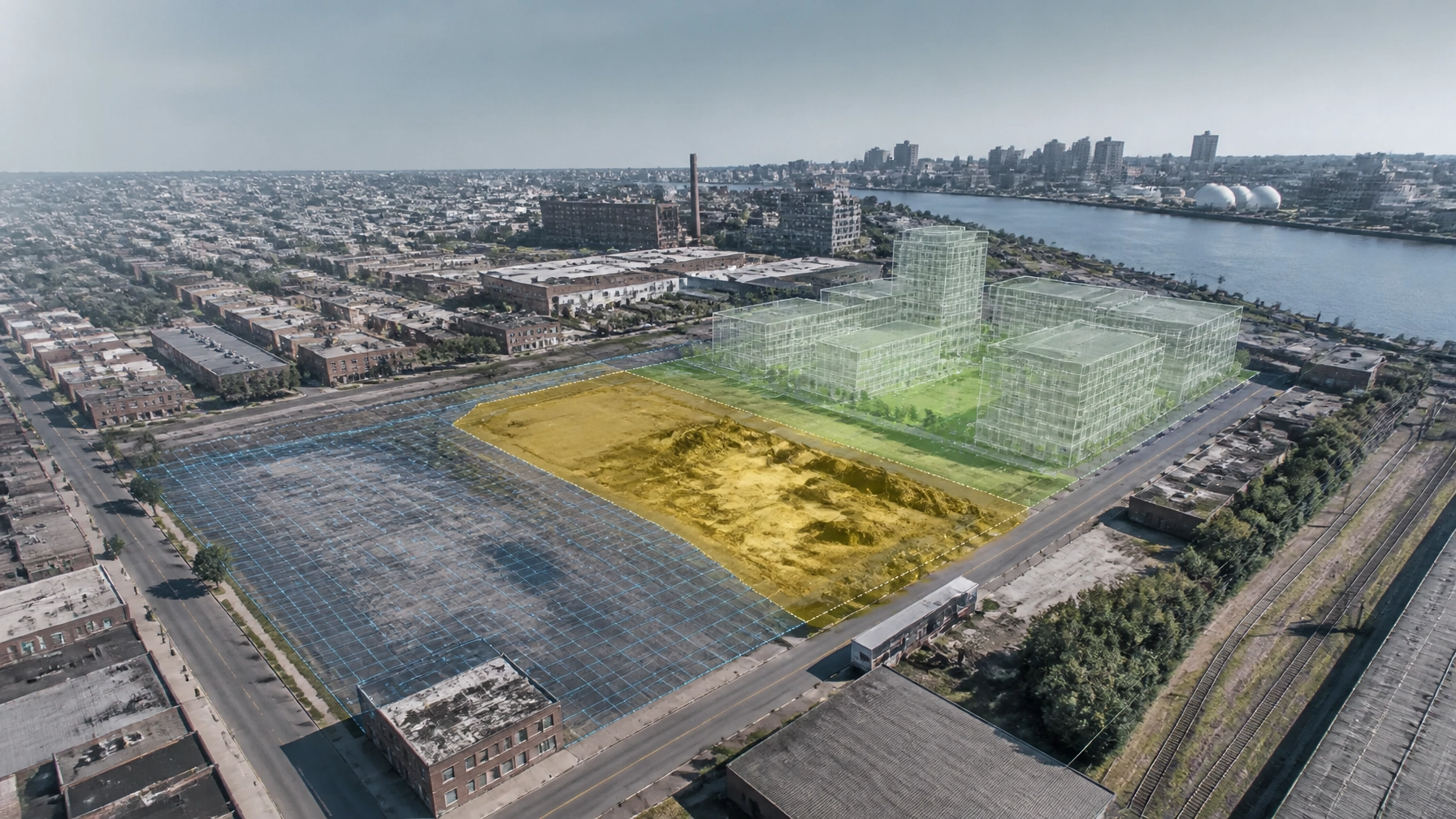
A contaminated property in New York City doesn’t have to remain a liability on your balance sheet. With the right strategy, it can become a cleaner, more valuable, and more financeable development asset.
The NYC Office of Environmental Remediation’s Voluntary Cleanup Program: commonly called the NYC OER VCP: offers more than a compliance pathway. It can help developers and investors obtain liability protection, access grant funding, reduce soil management costs, satisfy environmental requirements, and create a clearer path to construction.
For owners, lenders, attorneys, and community stakeholders, the central question is not simply, “How do we clean up this site?”
It’s:
“How do we turn environmental uncertainty into a documented path toward value?”
What the NYC OER VCP Does
The City Voluntary Cleanup Program is managed by the NYC Office of Environmental Remediation. It provides a structured process for investigating and cleaning up vacant, underused, and environmentally challenged properties throughout New York City.
The program is often a fit for sites with:
- Contaminated fill or historic industrial use
- Localized petroleum impacts
- Hazardous materials E-designations
- Light to moderate contamination
- Environmental conditions that could delay financing, permitting, or construction
The VCP is not designed for every property. Sites that qualify as Class 2 hazardous waste sites on the NYSDEC registry may require a different regulatory path, including consideration of the New York State Brownfield Cleanup Program.
That distinction matters. Choosing the wrong program can create avoidable delays, duplicated investigations, and uncertainty for the project team. A site-specific screening should happen before you commit to a cleanup strategy.
Envicon supports that early decision-making through environmental assessments, site investigation, regulatory coordination, and brownfield redevelopment planning.
VCP Benefits: Liability Closure, Funding, and Cost Control
The value of the NYC OER VCP comes from how its benefits work together. Liability protection alone is important. So are grants and soil cost savings. Together, they can materially improve a project’s risk profile.
1. Liability protection for owners and successors
Once a property enrolls in the VCP, NYSDEC states that it has no plan to require additional investigation or remedial action beyond the remedy approved through OER, provided the project complies with the VCP agreement.
After successful completion, the City provides additional protection through an OER Notice of Completion. The protection applies to the contamination addressed under the program and includes standard reopener conditions, such as the discovery of new or previously unknown contamination.
The protection can also be assigned to successors and assigns that acquire, develop, or occupy the property, provided they follow the program requirements.
That distinction is important for transactions. A buyer or lender doesn’t just want to know that cleanup work occurred. They want documentation that explains what was investigated, what remedy was implemented, what obligations remain, and how future parties can rely on the completed process.
A defensible VCP file can help transform an environmental issue from an open-ended liability into a managed and documented condition.
2. BIG Grants for qualifying brownfield projects
The NYC Brownfield Incentive Grant, or BIG Grant, program can help fund work from early due diligence through cleanup.
According to NYC OER’s BIG Grant guidance, qualifying projects may receive grants for:
- Pre-development activities
- Environmental investigations
- OER-approved remedial work
- Affordable housing and other community-supported projects
- Certain bonus categories, including resilience and deeper cleanup outcomes
Grant amounts vary by project category. Qualifying brownfield projects may receive up to $25,000 through the standard grant structure. Preferred Community Development Projects may qualify for $35,000 or $50,000 cleanup grants, depending on the project and affordability structure. Additional bonus grants may also apply.
The practical lesson is straightforward: don’t wait until the cleanup is complete to ask about funding. Grant eligibility, qualified vendors, insurance requirements, application timing, and eligible activities should be built into the project plan from the beginning.
Funding is not automatic. It requires the right documentation and coordination.

3. Clean Soil Bank savings
Soil can become one of the largest cost variables on an urban redevelopment site. Excavation volumes, disposal classifications, trucking distances, import requirements, and timing all affect the budget.
VCP projects may use the NYC Clean Soil Bank to dispose of surplus clean soil at no charge, other than trucking costs between sites. VCP projects may also receive clean soil at no cost when suitable material is available.
That can reduce both disposal and import expenses. It can also make the civil design and earthwork plan more efficient.
But soil must be properly characterized and managed. The project team needs to coordinate sampling, documentation, staging, transportation, and receiving-site requirements. A soil plan that ignores construction sequencing can create field problems even when the regulatory concept is sound.
Envicon integrates soil disposal certification, soil management, environmental monitoring, and civil coordination so the remedy works in the real construction schedule: not only on paper.
4. Hazardous waste fee exemption
VCP sites that generate hazardous waste during remediation may qualify for an exemption from New York State hazardous waste taxes and fees. NYC OER identifies potential savings of up to $157 per ton.
The savings can be significant on projects involving large excavation volumes. However, classification and eligibility must be handled carefully. Waste characterization, manifests, disposal facilities, and regulatory records all need to align.
This is where early planning pays off. The team should understand the likely soil profiles before excavation begins, identify disposal pathways, and avoid treating waste management as a last-minute trucking exercise.
The Enrollment Process: Start With the Right Documents
To enroll a property in the NYC OER VCP, the project team submits:
- A Remedial Investigation Report, or RIR
- A Remedial Action Work Plan, or RAWP
- A VCP application
- A VCP agreement
- The $1,000 enrollment fee
As outlined in NYC OER’s enrollment instructions, the project team develops the RIR and RAWP in consultation with OER technical staff. New project applications are submitted through the EPIC Environment portal.
The quality of the initial package matters. A report that merely catalogs contamination may satisfy a narrow reporting obligation, but it won’t necessarily answer the questions a developer, lender, attorney, or construction manager needs answered:
- What is the nature and extent of the contamination?
- Which exposure pathways matter?
- What remedy supports the proposed use?
- How will the remedy affect excavation and construction?
- What will the cleanup cost?
- What documentation will support closure?
- What conditions will remain after completion?
A strong RIR and RAWP connect environmental findings to the project’s development plan. That is the difference between producing a report and creating a path forward.
E-Designation: Compliance Is Not the Same as Closure
Many NYC development sites carry an environmental E-designation related to hazardous materials, air quality, or noise. These designations can affect building permits, construction requirements, and certificates of occupancy.
For hazardous materials E-designations, the project generally requires an OER-approved investigation and remedial action plan. The cleanup must address the environmental conditions tied to the designation and the proposed development.
VCP enrollment can provide a broader framework for satisfying those requirements while also creating access to liability protection, grants, soil resources, and fee exemptions.
The goal is not simply to complete a sampling program. The goal is to obtain the certifications needed to remove the environmental obstacle from the development process.
In practical terms, E-designation removal or satisfaction requires OER certification that:
- The approved remedy is complete
- The site has reached its full zoning development potential
- All applicable air, noise, and hazardous materials requirements have been satisfied
Until those requirements are addressed, environmental conditions can continue to affect permitting and occupancy. Developers should coordinate OER requirements with the architect, civil engineer, construction manager, attorney, and lender from the start.

Why Field-First Execution Matters
A VCP strategy can look complete in a regulatory matrix and still fail in the field.
Unexpected soil conditions appear. Utility conflicts change excavation limits. Contractors need clear soil handling instructions. Air monitoring results affect work sequencing. A proposed remedy may need to adjust to actual site conditions without losing regulatory control.
That requires direct coordination: not a chain of subcontractors and junior staff passing information between departments.
Envicon is a family-owned, New York and New Jersey-based firm with 20 years of experience in environmental consulting, civil engineering, and construction oversight. We work directly with developers, attorneys, architects, contractors, and public agencies to keep decisions moving.
Our approach is different from the large-firm model:
- Senior professionals stay involved from investigation through closeout.
- Deliverables focus on decisions and next steps, not unnecessary volume.
- Field observations connect directly to design and regulatory actions.
- Project reporting gives clients visibility into schedule, budget, deliverables, and field activity.
- Pricing and scope are discussed clearly before surprises become change orders.
- Local knowledge reflects daily work with NYC OER, NYSDEC, NJ DEP, and other regional agencies.
Collaboration is not a buzzword: it’s how we work.
A Better Way to Evaluate a Brownfield Opportunity
Before acquiring or repositioning a contaminated NYC property, ask whether your team has answered these questions:
- Is the NYC OER VCP the appropriate regulatory pathway?
- Does the property have an E-designation or restrictive declaration?
- What investigation is necessary to define the remedy?
- Could the project qualify for BIG Grant funding?
- Can the Clean Soil Bank reduce soil costs?
- Could hazardous waste fee exemptions apply?
- What documentation will the lender require?
- How will cleanup activities affect the civil design and construction schedule?
- What must OER certify before the site reaches full development potential?
If those answers are unclear, the environmental risk is not yet under control.
The right consultant should help you evaluate the opportunity, not just document the problem. At Envicon, we provide strategic brownfield redevelopment support, regulatory guidance, investigation, remedial design, construction oversight, and closeout documentation under one accountable team.
The Takeaway
The NYC OER Voluntary Cleanup Program can do more than bring a contaminated property into compliance. Used strategically, it can help:
- Close environmental liability
- Improve lender and investor confidence
- Unlock grant funding
- Reduce soil disposal and import costs
- Satisfy E-designation requirements
- Support community and affordable housing goals
- Move an underused property toward its full development potential
A brownfield is not defined only by what happened on the site. Its future depends on whether the environmental conditions are understood, managed, documented, and resolved.
Envicon helps turn that uncertainty into a cleared path: so your site can move from contaminated and underused to fundable, buildable, and productive.
Ready to Evaluate Your NYC Brownfield Strategy?
If you’re considering VCP enrollment, E-designation satisfaction, or a brownfield acquisition, bring your project team in early. Envicon can help you identify the regulatory path, estimate the work, coordinate with OER, and build a cleanup strategy that supports the development: not delays it.
Leave a Reply