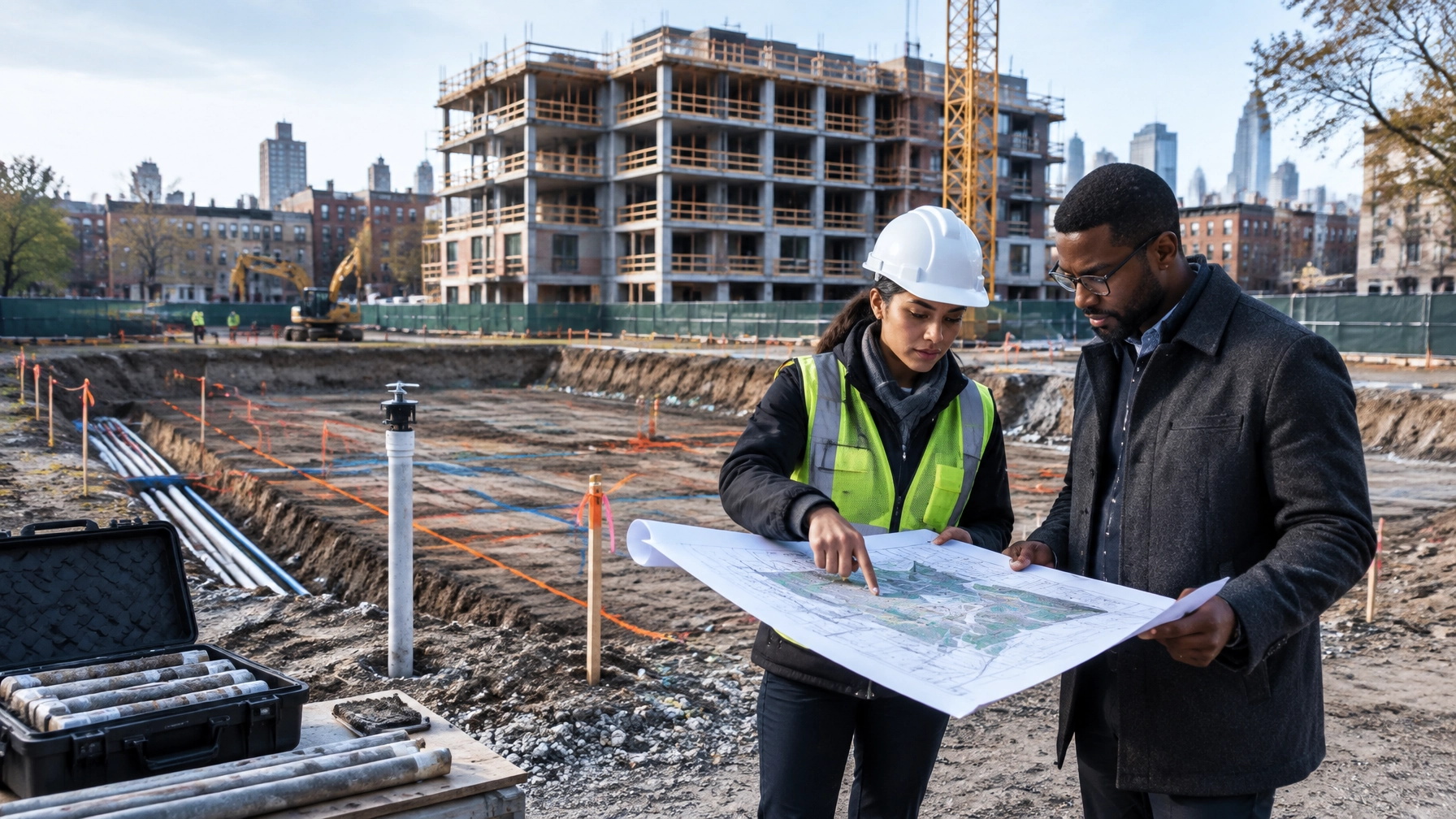
New York’s SEQRA reforms took effect on May 26, 2026. They create a potential exemption for certain multifamily housing projects classified as “qualified housing actions.”
That does not mean every NYC housing project qualifies. It means developers now have a defined screening path.
The project still needs the right unit count, zoning, site history, infrastructure, environmental documentation, and agency confirmation. A SEQRA exemption also does not erase hazardous materials obligations, E-Designation requirements, construction controls, or lender due diligence.
For developers planning multifamily housing in Manhattan, Brooklyn, Queens, the Bronx, or Staten Island, the first question is not simply, “Do we have enough units?”
The real question is:
Can we document that the entire project fits the exemption criteria before the environmental review path becomes a schedule problem?
“Projects that meet these criteria are potentially eligible for an exemption from SEQRA/CEQR subject to HPD’s approval.”
Source: NYC Department of Housing Preservation and Development
What the NYC multifamily SEQRA exemption does
A qualified housing action may be treated as exempt from SEQRA and CEQR when it satisfies the applicable criteria.
That can eliminate the need for an Environmental Assessment Statement and avoid a longer environmental review process. It does not eliminate the need to comply with:
- NYC zoning and building requirements
- NYC Department of Buildings approvals
- NYC Department of Environmental Protection requirements
- Hazardous materials controls
- E-Designation obligations, where applicable
- Flood and climate resilience requirements
- Federal environmental review tied to HUD or other funding
- Lender, investor, and counsel due diligence
- Construction-phase environmental controls
HPD’s current guidance identifies the core NYC screening criteria. Developers should review the official HPD Environmental Review guidance and the NYC Qualified Action Guidance for Housing Actions before relying on the exemption.
NYC unit and nonresidential thresholds
The 2026 framework uses incremental project scope. Existing units and proposed units should not be blended casually. Your environmental consultant, land-use counsel, architect, and lead agency need to agree on what the action creates.
At a high level, NYC projects are screened against these thresholds:
- Up to 250 incremental dwelling units in low-density zoning districts.
- Up to 500 incremental dwelling units in medium- and high-density zoning districts.
- No more than 50,000 incremental gross square feet of nonresidential, nonindustrial use.
- No industrial floor area facilitated by the action.
- No project located in an M2 or M3 zoning district under HPD’s stated criteria.
The 250-unit and 500-unit limits are not a planning shortcut. A project at 249 units still needs to satisfy every other criterion. A 300-unit project in a low-density district cannot become eligible simply because the site has an existing building.
The project team should prepare a clear area and unit matrix showing:
- Existing dwelling units
- New dwelling units
- Replacement or demolished units
- Incremental units created by the action
- Residential gross floor area
- Community facility and commercial floor area
- Industrial floor area, if any
- Zoning district and applicable height controls
That matrix becomes part of the qualification record.
Previously disturbed site: the key eligibility issue
The site must generally qualify as a previously disturbed site.
For NYC housing actions, HPD describes a site that was substantially altered by an occupied, formerly occupied, or demolished building, or by another improvement or use, at least two years before submission of the HPD funding application.
The site also cannot:
- Be currently used for agriculture
- Have been used for agriculture during the immediately preceding two years
- Have been used for agriculture during three of the preceding five years
- Be located within a Coastal Erosion Hazard Area
A vacant parcel is not automatically a previously disturbed site. A site with old pavement is not automatically eligible either. The lead agency may need evidence showing the nature, timing, and extent of prior disturbance.
For a previously disturbed site in Queens, Brooklyn, or the Bronx, gather:
- Historic aerial photographs
- Sanborn maps and city directories
- Demolition and building permit records
- Property tax and assessment records
- Prior site plans
- Utility and paving records
- Historical occupancy information
- Photographs showing prior improvements
- Documentation of agricultural use history
- Coastal hazard mapping
The standard is fact-specific. Do not describe a parcel as eligible before the lead agency confirms the record.

Public water and sewer must be documented
Public or community water and sewer connections are an important part of the state-level qualified housing framework. For typical NYC multifamily development, the project should document how the building will connect to existing DEP systems.
Review:
- Existing water service
- Existing sewer service
- Proposed connection points
- Capacity and connection requirements
- Any private wells or septic systems
- Combined sewer or stormwater considerations
- Whether utility upgrades are required before occupancy
A public water and sewer connection does not resolve environmental risk. It addresses one eligibility screen. The development still needs a site-specific Phase I ESA and a hazardous materials strategy.
For projects in Westchester, Nassau, or Suffolk County, the infrastructure analysis may be more complex. Municipal systems, private wells, septic systems, and local approval requirements vary. Do not apply the NYC framework mechanically outside the five boroughs.
Phase I ESA and AAI certification
A qualified housing action may be exempt from SEQRA and CEQR while still requiring environmental due diligence.
A current Phase I Environmental Site Assessment should evaluate:
- Recognized environmental conditions
- Historic industrial and commercial uses
- Underground storage tanks
- Petroleum releases
- Dry cleaning and solvent use
- Historic fill
- Manufacturing operations
- Spills and regulatory cases
- Vapor intrusion concerns
- Adjacent-property sources
- Existing E-Designations
- Data gaps and limitations
Where a lender, investor, acquisition agreement, or liability protection strategy requires All Appropriate Inquiries, the Phase I should follow ASTM E1527-21 and applicable federal requirements under 40 CFR Part 312.
AAI certification and NYC environmental review are related but not identical. An AAI-compliant Phase I can support a transaction and liability analysis. It does not automatically satisfy every HPD, OER, lender, or agency requirement.
If the Phase I identifies a REC, the next step may include:
- Phase II soil sampling
- Groundwater investigation
- Soil vapor or sub-slab sampling
- UST testing or removal
- Waste characterization
- Vapor mitigation design
- Remedial planning
- NYC OER coordination
The objective is not to create a defensive report. It is to identify the condition early enough to price it, design around it, and keep the project moving.
Hazardous materials and E-Designation
NYC’s hazardous materials requirements do not disappear because a project is treated as a qualified action.
Depending on the site and action, the project may require a Phase I ESA, subsurface testing, remedial measures, or an E-Designation. The 2025 CEQR Technical Manual hazardous materials chapter explains the City’s current approach to hazardous materials review and E-Designations.
An E-Designation can establish enforceable requirements for:
- Phase I and Phase II investigations
- Soil, groundwater, and soil vapor testing
- Remediation
- Vapor barriers or sub-slab depressurization systems
- Construction health and safety planning
- Air monitoring
- NYC OER review and sign-off
Developers should check the current zoning map, historical CEQR documents, and property records before finalizing the environmental scope.
If an E-Designation already exists, treat it as a project obligation. Do not assume it is outdated because the property changed ownership or the proposed use changed.
Envicon’s NYC environmental consultant team works directly with developers, architects, attorneys, contractors, NYC OER, NYC DEP, and other reviewing agencies. That coordination matters because a report sitting in isolation does not resolve an E-Designation.

DAC and climate screening still belongs in the early plan
A SEQRA exemption is not a reason to skip climate and environmental justice screening.
Review whether the project is located in or near:
- A disadvantaged community
- A flood hazard area
- A storm surge zone
- A heat-vulnerability area
- A coastal resilience planning area
- A community with cumulative air quality burdens
- An area with limited open space or infrastructure capacity
The exemption may change the formal environmental review path. It does not change the site’s physical conditions or the developer’s responsibility to design a safe, resilient building.
Flood elevation, stormwater, drainage, utility capacity, indoor air, ventilation, and construction controls can still affect cost and schedule. The project team should screen these issues before acquisition or final design.
Construction obligations continue after qualification
Once the project moves into construction, environmental obligations become field obligations.
Depending on the site, the construction plan may need to address:
- Soil handling and disposal
- Imported fill documentation
- Dust and odor control
- Community air monitoring
- Worker protection
- Excavation water and dewatering
- Vapor barrier installation
- Cap or engineering control installation
- Spill prevention
- Waste manifests
- Confirmation sampling
- Agency inspections
- Construction closeout documentation

This is where many projects lose time. The environmental report is complete, but no one owns the field coordination. The contractor encounters unexpected fill. The vapor barrier detail changes. The agency requests documentation that was never assigned.
A field-first consultant keeps the environmental scope connected to construction.
NYC multifamily SEQRA exemption qualification checklist
Before presenting a project for agency confirmation, assemble:
- Zoning district and height-control documentation
- Incremental dwelling unit calculation
- Nonresidential gross floor area calculation
- Confirmation that no industrial floor area is facilitated
- M2 and M3 zoning screen
- Previously disturbed site documentation
- Agricultural use history
- Coastal Erosion Hazard Area screen
- Public water and sewer documentation
- Flood and climate hazard screen
- Current Phase I ESA
- ASTM and AAI requirements, where applicable
- E-Designation search and review
- Phase II scope, if the Phase I identifies RECs
- Hazardous materials and construction controls
- HPD, NYC OER, or lead-agency confirmation
- Separate federal review screen if public funding is involved
What developers should do next
Do not build your schedule around an assumed exemption.
Start with the site history, zoning, unit program, utility connections, and environmental records. Then have the lead agency confirm the pathway.
The best time to identify a disqualifying condition is before you commit to the acquisition timeline, financing structure, or construction start.
Envicon can help you move from a qualification question to a documented path forward. We provide Phase I and Phase II ESAs, E-Designation support, brownfield remediation, hazardous materials planning, agency coordination, and construction oversight across NYC, Westchester, Nassau, and Suffolk County.
A faster review path only helps when the project is properly screened from the start.
Frequently Asked Questions
Does every NYC multifamily project qualify for the 2026 SEQRA exemption?
No. The project must satisfy all applicable criteria, including unit limits, zoning restrictions, nonresidential floor area limits, previously disturbed site requirements, and environmental conditions. HPD or the appropriate lead agency must confirm the exemption pathway.
Does a SEQRA exemption eliminate the need for a Phase I ESA?
No. NYC housing guidance continues to address hazardous materials and environmental standards for projects that qualify for the exemption. A Phase I ESA may also be required by lenders, investors, counsel, HPD, OER, or an existing E-Designation.
What does “previously disturbed site” mean?
At a high level, it means the site was substantially altered by a building, demolished building, improvement, or prior use at least two years before the relevant application. The project team must document the site history, and the lead agency makes the final determination.
Can a project in an M2 or M3 district qualify?
HPD’s current NYC guidance excludes projects located in M2 or M3 zoning districts. A project also cannot facilitate industrial floor area under the stated criteria.
Does the exemption eliminate E-Designation requirements?
No. Existing or newly imposed E-Designation requirements may still require investigation, remediation, vapor controls, air monitoring, or OER approval.
Should developers screen DAC and climate risks if the project is exempt?
Yes. Flood, heat, stormwater, environmental justice, and infrastructure conditions can affect design, permitting, financing, and construction even when a formal SEQRA or CEQR review is not required.
Ready to verify your site?
- Get a free quote today
- Call Envicon at (917) 764-2171
- Use the project risk screener
- Review Envicon’s Phase I ESA service
- Learn about NYC environmental consulting
- Explore remediation and brownfield services

Leave a Reply