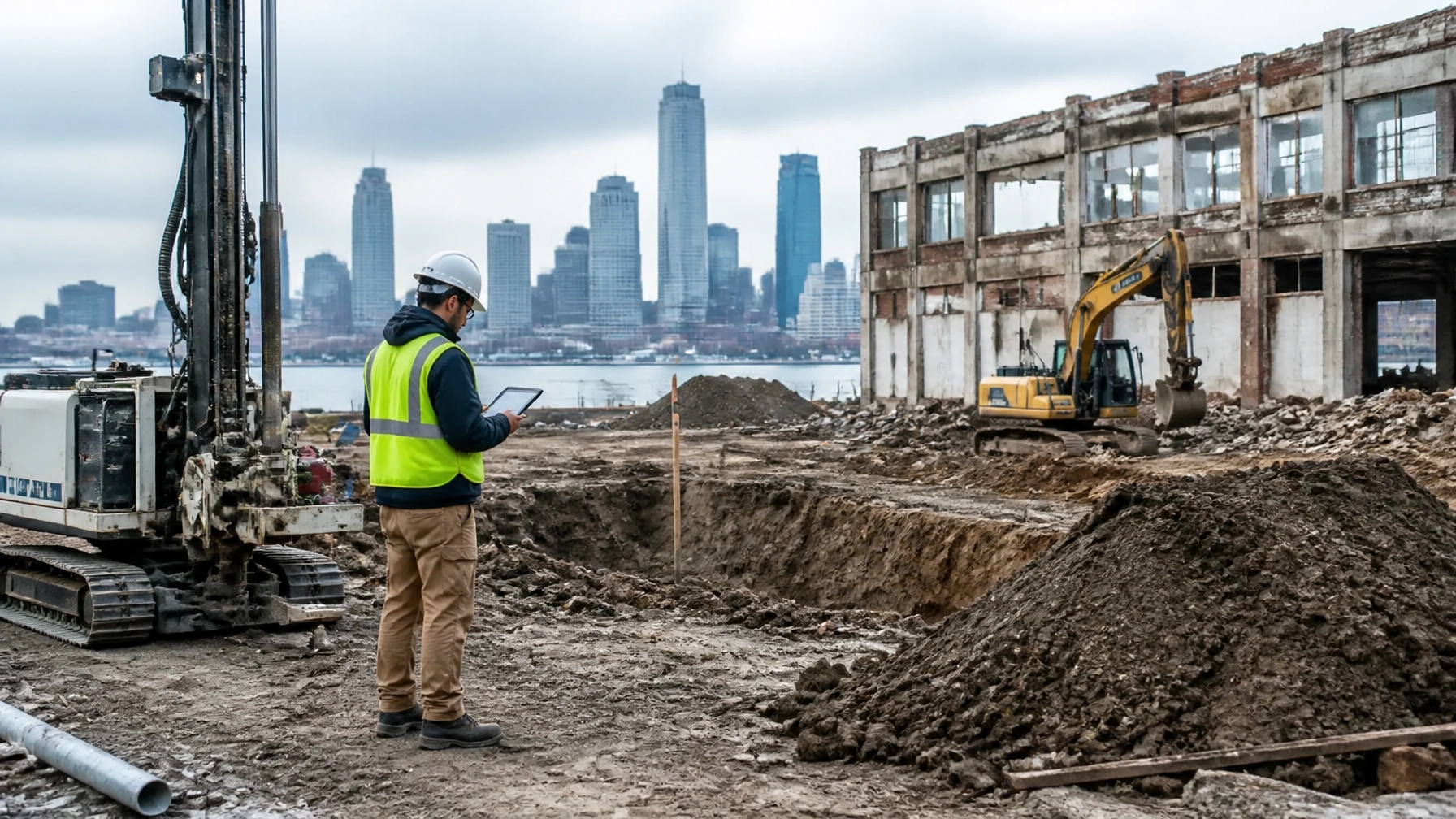
A multifamily acquisition in Jersey City, Hoboken, Bayonne, Newark, Bergen County, Hudson County, or Essex County can look straightforward on the surface. The building may be occupied. The zoning may support residential use. The lender may already have a property condition report.
That does not answer the environmental questions that can affect your closing, financing, construction budget, or future liability.
A defensible NJ environmental due diligence multifamily acquisition strategy coordinates the Phase I ESA, Phase II investigation, NJDEP screening, ISRA review, building surveys, and construction planning before you commit to the deal.
The objective is not to produce another report. It is to know what you are buying and what it will take to move the property forward.
Why multifamily acquisitions in Hudson County require more than a standard Phase I
A Phase I Environmental Site Assessment under ASTM E1527-21 is the starting point for commercial real estate due diligence. It reviews historical records, regulatory databases, site conditions, interviews, and recognized environmental conditions, or RECs.
For a former industrial, warehouse, auto, dry-cleaning, utility, or manufacturing property, a Phase I may identify concerns involving:
- Historic fill used to raise low-lying land.
- Former or active underground storage tanks.
- Petroleum, chlorinated solvents, metals, PCBs, or other hazardous substances.
- Soil vapor and potential vapor intrusion.
- Active or incomplete NJDEP remediation cases.
- Industrial operations that may trigger ISRA.
- Contamination that could affect excavation, dewatering, or disposal.
The Phase I should answer a practical question: What needs to happen next before the lender, buyer, attorney, and development team can make a decision?
Envicon’s Phase I ESA service is structured around that decision. We review the transaction driver, lender requirements, proposed redevelopment, and closing date before recommending a scope.
ISRA due diligence in Hudson County
The Industrial Site Recovery Act applies to qualifying industrial establishments. A multifamily property is not automatically subject to ISRA simply because it is being converted to apartments. The key issue is often the property’s prior use and whether the site meets the definition of an industrial establishment.
A prior industrial use may involve operations within covered Standard Industrial Classification categories and the generation, handling, storage, treatment, or disposal of hazardous substances or hazardous waste.
An ISRA due diligence Hudson County review should address:
- Whether the prior or current use qualifies as an industrial establishment.
- Whether the transaction is a transfer of ownership or operations.
- Whether a General Information Notice is required.
- Whether a Negative Declaration, Remedial Action Workplan, remediation agreement, certification, or other pathway applies.
- Whether an existing NFA, RAO, deed notice, or remedial action permit covers the entire site.
- Whether the proposed residential redevelopment changes the regulatory analysis.
- Whether remediation funding or financial assurance is required.
Under the NJDEP Industrial Site Recovery Act statute, qualifying transfers require the parties to address remediation obligations through the applicable statutory process. That does not mean every transaction must wait for a full cleanup. It means the closing path must be identified and documented.
This is where an LSRP needs to be involved early. A general environmental consultant may identify contamination. An NJDEP LSRP can evaluate the regulatory pathway, prepare the required submissions, coordinate with NJDEP, and issue an RAO when the remediation supports that outcome.
For an NJDEP LSRP apartment property purchase, do not wait until the purchase agreement is signed to determine whether an LSRP is needed.
Historic fill is a budget issue, not just a soil description
Historic fill is common in older waterfront and urban redevelopment areas. It may contain brick, ash, coal, cinders, glass, construction debris, petroleum impacts, and metals. It may also vary significantly across the parcel.
That matters when you plan to build an apartment building with:
- A deep basement.
- Structured parking.
- New foundations.
- Utility corridors.
- Stormwater facilities.
- Elevator pits.
- Below-grade waterproofing.
- Extensive grading or soil export.
The phrase historic fill apartment development Newark often signals a construction and disposal risk. The same applies across Jersey City, Hoboken, Bayonne, and older industrial sections of Bergen, Hudson, and Essex Counties.
Historic fill can affect:
- Soil excavation quantities.
- Clean fill and disposal requirements.
- Cap and cover design.
- Soil management plans.
- Worker protection.
- Groundwater investigation.
- Vapor evaluation.
- Construction sequencing.
- Final regulatory controls.
NJDEP’s Historic Fill Guidance provides a framework for investigating and managing historic fill at sites undergoing remediation. The LSRP should determine whether the fill is a source of contamination, a regulated medium, or a material that can remain in place under an engineered control.
The answer should be reflected in the acquisition model before closing.

When a Phase II ESA is necessary
A Phase II ESA should resolve specific questions raised by the Phase I. It should not be a generic grid of borings selected without regard to the property’s history.
A targeted Phase II ESA multifamily Jersey City scope may include:
- Soil borings in former tank, loading, process, or waste storage areas.
- Groundwater sampling where the water table, contamination history, or construction plans warrant it.
- Soil vapor or sub-slab sampling near former dry cleaners, service stations, industrial operations, or solvent users.
- Field screening with a photoionization detector.
- Temporary or permanent monitoring wells.
- Laboratory analysis for petroleum, VOCs, SVOCs, metals, PCBs, PFAS, or other site-specific contaminants.
- Utility clearance and ground-penetrating radar before drilling.
- Data validation and comparison with applicable NJDEP standards.
PFAS should be evaluated at sites undergoing remediation. Testing depends on the site history, suspected sources, media, and professional evaluation. Dioxin is not a universal default analyte. It should be considered when site history or other evidence suggests a potential source.
The scope should also match the planned development. A shallow soil investigation may not answer the question if the project includes a two-level cellar and extensive dewatering.
Envicon’s Phase II ESA service connects the sampling plan to the RECs, lender questions, purchase-price negotiations, and construction design. The deliverable should state whether the data supports closure, further delineation, remediation, or a defined cost and schedule contingency.
USTs, vapor, asbestos, and lead
Older multifamily and mixed-use properties often carry building-related risks that a Phase I does not fully resolve.
Underground storage tanks may be present even when no tank appears on a current site plan. Tank records, historical fire insurance maps, former fuel systems, fill ports, vent lines, abandoned piping, and staining can guide a UST screen.

Soil vapor is another critical pathway. Contamination beneath a building or adjacent property can migrate through soil gas and enter occupied space. The need for vapor sampling or mitigation depends on contaminants, geology, building conditions, utilities, and the proposed design.
Asbestos and lead require separate building surveys. They are not replaced by a Phase I or Phase II ESA. If the acquisition includes demolition, renovation, or substantial interior work, include:
- Asbestos inspection and bulk sampling.
- Lead-based paint evaluation.
- Lead in dust or construction materials where appropriate.
- Hazardous building material review.
- Pre-demolition specifications and contractor controls.
A coordinated team keeps these scopes on one schedule instead of allowing each consultant to discover the same transaction deadline separately.
Dewatering and SWPPP can change the construction budget
Many Hudson County apartment projects excavate below the groundwater table. That can turn an environmental issue into a permit, treatment, and schedule issue.
Before closing, estimate:
- Excavation depth and footprint.
- Seasonal groundwater conditions.
- Expected pumping rate and duration.
- Discharge location.
- Potential contaminants in groundwater.
- Treatment requirements.
- Disposal or discharge costs.
- Temporary discharge and water allocation permits.
NJDEP’s construction-related dewatering guidance states that requirements are site and project specific. It addresses well permits, water allocation thresholds, and temporary dewatering permits. For example, pumping rates above 70 gallons per minute can trigger regulation, while diversion exceeding 100,000 gallons per day may require a different permit pathway depending on duration and conditions.
A construction SWPPP and stormwater compliance scope should be coordinated with the civil design, erosion and sediment controls, soil management plan, and construction schedule.

Acquisition protections to address before signing
Environmental diligence is most useful before the purchase agreement becomes difficult to change.
Your attorney should consider protections such as:
- Seller representations about known contamination, tanks, regulatory notices, and prior environmental reports.
- Access rights for Phase II sampling and building surveys.
- A termination right if results exceed agreed thresholds.
- Purchase-price adjustment procedures.
- Escrow or holdback for defined environmental costs.
- Indemnity language tied to known conditions.
- Responsibility for pre-closing discharges and regulatory obligations.
- Closing conditions tied to ISRA documentation or NJDEP approvals.
- Cooperation requirements for LSRP access and submissions.
- A mechanism for allocating soil export, dewatering, vapor mitigation, and cap costs.
Technical diligence does not replace legal advice. It gives counsel and the acquisition team facts they can use.
A practical NJ multifamily diligence workflow
| Stage | Core action | Transaction decision |
|---|---|---|
| 1. Deal intake | Review address, prior uses, development plan, lender scope, and closing date | Set the right diligence level |
| 2. Phase I and regulatory screen | Complete ASTM E1527-21 review, NJDEP file search, ISRA screen, and historic-use analysis | Identify RECs and regulatory triggers |
| 3. Field planning | Select borings, vapor points, UST screening, building surveys, and utility clearance | Confirm the Phase II answers the actual risk |
| 4. Phase II investigation | Collect soil, groundwater, and soil-gas data with NJDEP-compatible methods | Quantify contamination and cost exposure |
| 5. LSRP and permit review | Evaluate PA/SI, RAO, ISRA, vapor, dewatering, and SWPPP pathways | Establish the closing and redevelopment path |
| 6. Contract and underwriting | Convert findings into contingencies, escrow, schedule, and budget | Decide whether to proceed, renegotiate, or exit |
| 7. Closing and implementation | Complete required documents and carry the plan into construction | Keep the project moving after acquisition |
Closing timeline: start earlier than you think
A standard Phase I may fit inside a normal diligence period. A coordinated Phase I, Phase II, ISRA, LSRP, building survey, and lender review may not.
A practical sequence is:
- Weeks 1 to 2: Phase I, records review, transaction screen, and lender coordination.
- Weeks 2 to 4: Phase II planning, utility clearance, drilling, sampling, and building surveys.
- Weeks 4 to 6: Laboratory results, data interpretation, cost model, and purchase agreement strategy.
- Weeks 6 and beyond: LSRP submissions, remediation planning, dewatering design, permit coordination, or closing documentation.
For a known contaminated site subject to direct oversight, NJDEP’s Pre-Purchase Administrative Consent Order guidance states that the agreement must be fully executed before closing. The guidance recommends allowing at least two months for the process in many cases.
The takeaway is simple: environmental diligence belongs at the front of the acquisition timeline, not in the final week before closing.
The Envicon approach
Large consultants often separate the Phase I, Phase II, LSRP, civil, and construction scopes across departments. You receive multiple reports, multiple project managers, and no single person accountable for the transaction path.
Envicon brings the work together. Our New Jersey team works from our Jersey City office and Hudson County location, with direct access to senior engineers and LSRPs. We connect the findings to your lender, attorney, architect, contractor, and closing schedule.
That is the difference between buying a report and buying clarity.
Request an acquisition risk review
If you are evaluating an apartment or mixed-use property in Jersey City, Hoboken, Bayonne, Newark, Bergen County, Hudson County, or Essex County, send us the address, prior use, proposed redevelopment, lender requirements, and target closing date.
- Request an acquisition risk review and free quote
- Call Envicon at (917) 764-2171
- Use the project risk screener
The right diligence process does more than identify contamination. It gives you a defensible path to price the risk, protect the transaction, and transform an environmentally challenged property into a buildable asset.

Leave a Reply