DRAFT FOR APPROVAL. Not scheduled or published.
As of September 2026, New York Brownfield Cleanup Program teams need to treat field documentation as a regulatory deliverable, not a project afterthought.
The December 31, 2025 amendments to 6 NYCRR Part 375 added a daily reporting requirement for field activities performed under an approved work plan. The practical message is clear. If the field record is incomplete, the Final Engineering Report becomes harder to defend. If the Final Engineering Report is incomplete, Certificate of Completion readiness suffers.
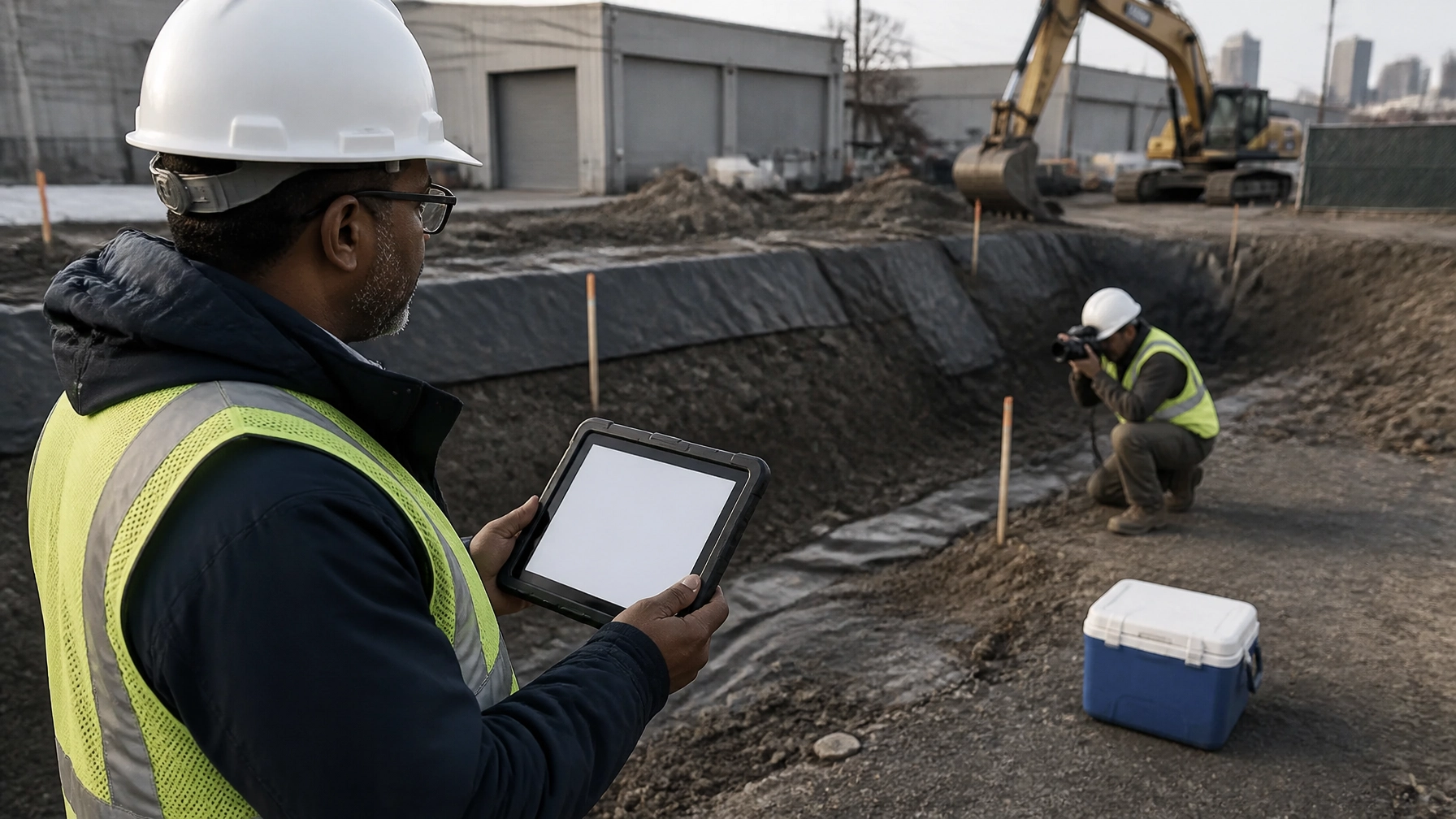
For projects in NYC, Westchester, Nassau, and Suffolk County, an NYSDEC Part 375 daily field report should establish what happened, where it happened, who observed it, what samples or materials moved, and whether the work stayed within the approved design.
The field record should answer those questions while the work is happening. Reconstructing them months later is slower, more expensive, and less credible.
What changed under the December 31, 2025 Part 375 amendments?
NYSDEC adopted revised environmental remediation regulations effective December 31, 2025. The amendments apply across several state remediation programs, including the Brownfield Cleanup Program.
One important change appears in Part 375-1.6(a). Daily reports must be submitted for field activities completed under an approved work plan. NYSDEC’s rulemaking materials explain that the requirement is intended to improve supervision and produce the documentation needed for the Final Engineering Report during field work.
The daily report is not simply an internal contractor log. It supports the official project record and gives NYSDEC and the New York State Department of Health timely information about field conditions, community air monitoring, deviations, and remedy implementation.
Review the official materials:
- NYSDEC environmental remediation regulatory revisions
- Final 6 NYCRR Part 375 rule text
- NYSDEC December 31, 2025 public notice
- NYSDEC Brownfield Cleanup Program
The regulation does not make every field condition a violation. It does make undocumented field work a problem.
What an NYSDEC Part 375 daily field report should document
A useful daily report should be specific enough that a QEP can rely on it when preparing the FER. It should also allow a regulator, lender, attorney, or future property owner to understand the work without guessing.
At minimum, the report should address:
- Project name, BCP site number, location, and reporting date
- Names and roles of the QEP, field engineer, contractor, subcontractors, and visitors
- Weather and site conditions that affected the work
- Approved work plan, RAWP, design drawing, or specification being followed
- Work areas, excavation grids, boring locations, monitoring points, or structure identifiers
- Equipment and personnel on site
- Excavation limits, depths, quantities, and material handling activities
- Soil stockpile locations and segregation controls
- Dewatering, treatment, discharge, or temporary containment activities
- Community air monitoring results and corrective actions
- Samples collected, including sample IDs, locations, depths, and collection times
- Laboratory, cooler, and chain-of-custody information
- Waste profiles, manifests, truck tickets, disposal facilities, and load quantities
- Photographs with time, location, direction, and subject
- Deviations from the approved plan
- Open issues, notifications, decisions, and next steps
- Sign-off by the responsible field professional
A report that says “excavation continued” is not enough. A defensible entry identifies the area excavated, the approximate limits, the soil observed, the material disposition, the confirmation samples collected, and whether the work matched the approved plan.

Build a real-time NYSDEC field deviation log
Field deviations are normal on complex brownfield sites. Utilities appear where drawings show nothing. Foundations extend beyond historic plans. Excavation limits change when contamination extends farther than expected. Imported fill does not always match the anticipated material.
The issue is not whether the site changes. The issue is whether the project team records the change and evaluates its effect.
A NYSDEC field deviation log should be maintained alongside the daily reports. Each entry should include:
-
Date and exact location
Identify the grid, elevation, structure, boring, excavation area, or monitoring point. -
Approved condition
Reference the drawing, work plan section, specification, or RAWP requirement. -
Observed condition
State what the field team actually encountered. -
Immediate response
Record whether work stopped, continued under controls, or moved to another area. -
Technical evaluation
Explain whether the condition affects cleanup objectives, engineering controls, exposure pathways, or schedule. -
Notification and decision path
Identify who was notified, when, and what direction was given. -
Supporting evidence
Link photographs, survey data, field screening, laboratory results, RFIs, sketches, or revised drawings. -
Final disposition
Document the approved corrective action, design change, additional sampling, or rationale for leaving the work as installed.
The deviation log should not be a place to hide problems. It should be the project’s decision trail.
A short, timely entry is more useful than a polished explanation written at the end of the job. The QEP should review open deviations before they become buried under subsequent work.
Connect photos, samples, manifests, and maps
Traceability is where many otherwise competent project records become difficult to defend.
A photograph should connect to a location and a field activity. A sample should connect to a sample plan, a specific location, and a laboratory result. A manifest should connect to a soil stockpile, load, destination, and disposal approval.
Use consistent identifiers across the full record:
- Excavation area: EX-03
- Stockpile: SP-02
- Confirmation sample: EX03-FL-04
- Photograph: EX03-2026-09-08-017
- Waste profile: WP-02
- Manifest: M-2026-0912
The naming convention matters less than consistency. The same identifier should appear in the daily report, photo log, sample table, map, laboratory package, waste record, and FER appendix.
This is where digital dashboards and GIS workflows can improve control. A field team can capture the record once, associate it with a mapped location, and make the information available to the QEP and project manager in real time.
That is different from receiving a monthly PDF after the field decision has already been made.
QEP certification and complete, accurate project data
The QEP’s role is not to repeat the contractor’s narrative. The QEP must determine whether the documentation supports the FER and whether the record accurately describes the remedy as implemented.
For COC readiness, the project file should allow the QEP to confirm:
- The work followed the approved work plan and remedial design
- Deviations were identified and evaluated
- Required notifications and approvals were documented
- Sampling and analytical data are complete and traceable
- Engineering controls were installed as designed or properly revised
- Institutional control records match the completed remedy
- Waste and soil movement records support the reported quantities
- Community air monitoring and other compliance records are included
- The FER describes the actual completed work, not the original plan
- The supporting data demonstrates achievement of the remedial objectives
The QEP or New York licensed professional engineer should not be forced to certify a project record that depends on assumptions.
A certification is only as strong as the underlying documentation. The goal is not to create more paperwork. The goal is to create a complete and accurate record that can withstand NYSDEC review.
Engineering controls and institutional control records
Many BCP sites do not end with excavation alone. They may include caps, barriers, vapor mitigation systems, groundwater monitoring, site management plans, environmental easements, or use restrictions.
Those controls need their own documentation trail.
For engineering controls, retain:
- Approved design drawings
- Material certifications
- Installation records
- Survey data and elevations
- Inspection reports
- Testing and commissioning records
- As-built drawings
- Photographs before concealment
- Repair or corrective action records
For institutional controls, retain:
- Environmental easements or declarations
- Site Management Plan requirements
- Operations and maintenance procedures
- Monitoring schedules
- Annual certification records
- Access and inspection documentation
- Future soil disturbance procedures
- Vapor mitigation operation records, where applicable
The record should show not only that a control was installed, but also how the control will remain effective after the construction team leaves.

BCP and Part 375 are not the same as NYC OER VCP
Program selection affects the documentation standard.
A site enrolled in the NYSDEC Brownfield Cleanup Program follows the BCP and Part 375 framework. The COC path is tied to NYSDEC approval of the Final Engineering Report and satisfaction of the applicable remedial requirements.
A site proceeding through the NYC Office of Environmental Remediation Voluntary Cleanup Program follows a different agency process, with different forms, milestones, and closure documents. NYC OER requirements may overlap with Part 375 concepts, but they should not be treated as interchangeable.
Private transaction reporting is different again. A buyer, lender, insurer, or attorney may request a Phase I ESA, Phase II ESA, vapor assessment, reliance letter, or remediation risk opinion. Those deliverables support a transaction. They do not replace the regulatory record required for a NYSDEC BCP COC.
This distinction matters in NYC, where a single project may involve NYSDEC, NYC OER, NYC Department of Buildings, NYC Department of Environmental Protection, and lender requirements. The project team should identify the governing program before field work begins.
For NYC projects, see Envicon’s environmental consultant services. Envicon also supports projects in Westchester County, Nassau County, and Suffolk County.
Field-report checklist for September 2026 implementation
Use this checklist before the next field mobilization:
- Confirm the project’s regulatory program and approved work plan
- Assign responsibility for daily report preparation and review
- Establish consistent location, sample, photograph, and manifest identifiers
- Create a live deviation log
- Define the notification process for unexpected conditions
- Link field photographs to locations and activities
- Reconcile sample IDs with laboratory reports and chain-of-custody forms
- Reconcile soil quantities with stockpile records and manifests
- Track engineering control installation before concealment
- Maintain current as-built drawings
- Review open issues with the QEP before closeout
- Map each FER section to supporting field records
- Audit the COC package before submission
If the project team cannot produce this record now, it will not become easier at FER closeout.
How Envicon supports defensible brownfield documentation
Envicon provides PE-supervised remediation and construction oversight for complex New York and New Jersey projects. Our field engineers document remedial excavation, CAMP activities, soil management, sampling, deviations, and construction conditions as the work proceeds.
Our remediation and brownfield services connect field oversight with remedial design, engineering controls, waste management, confirmation sampling, and regulatory closeout. Our construction oversight team produces daily field reports, photo logs, QA/QC records, nonconformance tracking, and certification-ready closeout packages.
The advantage is direct accountability. You do not receive a report from a distant project queue and then spend weeks reconstructing what happened on site. You get a field-first team that works with your QEP, contractor, attorney, architect, and agency contacts from the beginning.
The takeaway
The December 31, 2025 Part 375 amendments make contemporaneous field documentation central to New York BCP closeout.
A defensible COC record depends on more than laboratory results. It depends on a connected chain of evidence:
- Daily field reports
- Real-time deviation entries
- Photo and sample traceability
- Soil and manifest records
- Engineering control documentation
- Institutional control records
- QEP review and certification
- A FER that accurately describes the remedy as built
Do not wait until the FER is due to discover that the field record is incomplete.
Request a remediation documentation audit
Request a remediation documentation audit to identify gaps in daily reports, deviation logs, sample traceability, engineering control records, and COC closeout documentation.
Call Envicon at (917) 764-2171 to speak with a project engineer.
Request a consultation for your NYC, Westchester, Nassau, or Suffolk County brownfield project.

Leave a Reply