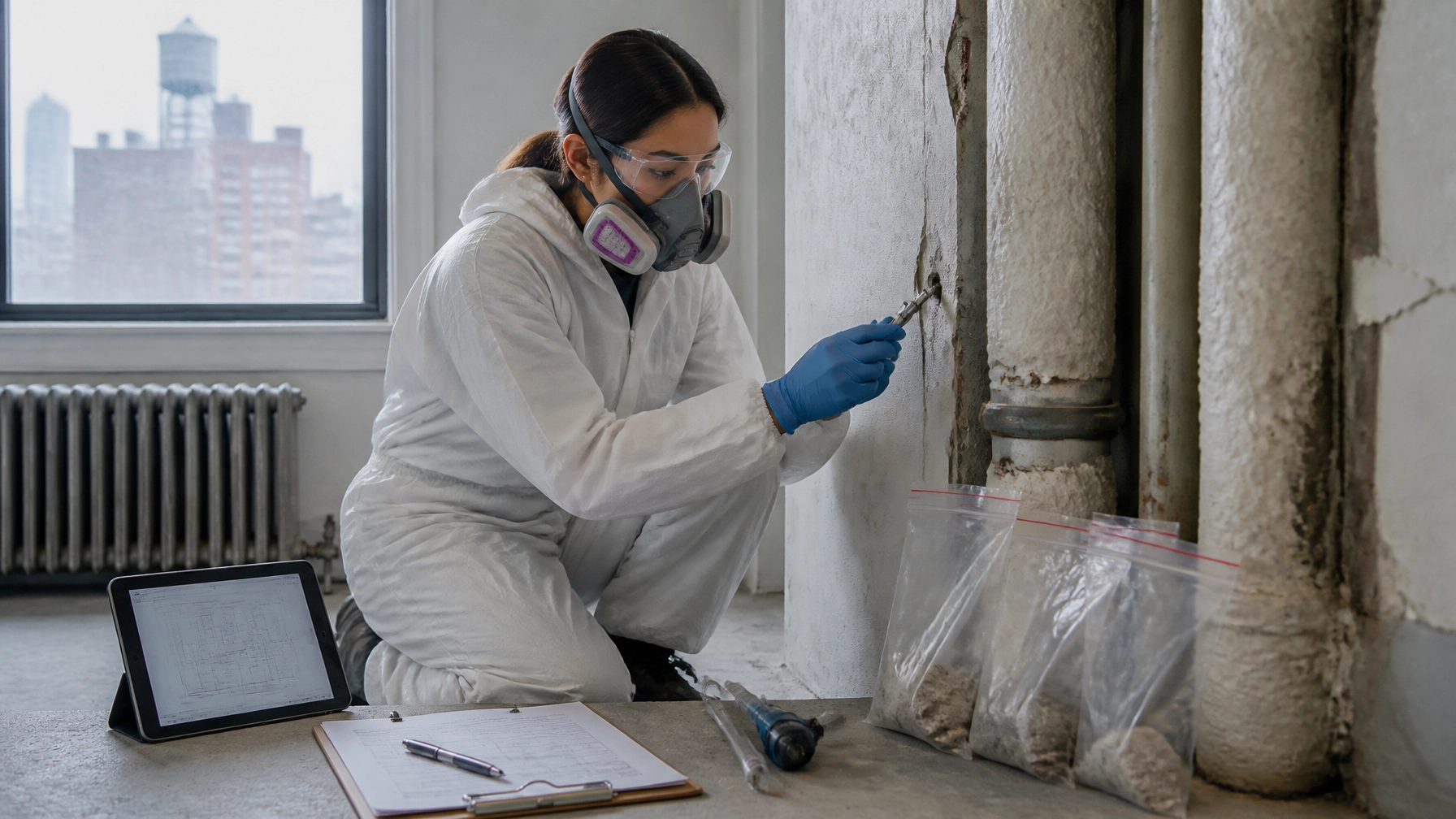
A commercial property closing in New York City can move quickly until asbestos documentation stops the permit or lender process.
An asbestos inspection in NYC is not the same as a Phase I ESA, a property condition assessment, or a general building walkthrough. Before renovation or demolition, the inspection must address the materials that construction will disturb. The work must also align with NYSDOL Industrial Code Rule 56, NYC Department of Environmental Protection requirements, and NYC Department of Buildings permit procedures.
For buyers, owners, lenders, and counsel, the objective is simple: identify asbestos risk early, document it correctly, and prevent a closing or construction schedule from depending on an incomplete survey.
“Building owners are responsible for having a DEP-certified asbestos investigator perform an asbestos survey.”
Source: NYC DEP asbestos abatement forms and filing instructions
What Rule 56 requires before renovation or demolition
New York State Industrial Code Rule 56, codified at 12 NYCRR Part 56, requires an asbestos survey before building demolition, renovation, remodeling, or repair work that may disturb suspect materials.
The survey should be performed by a properly certified asbestos inspector. In New York City, the owner also needs a DEP-certified asbestos investigator, commonly called a CAI, to prepare the documentation used in the city filing process.
Do not rely on building age alone. NYC DOB identifies a limited exemption from DEP asbestos certification for certain alterations in buildings constructed after April 1, 1987. Known asbestos-containing material must still be properly handled if the work will disturb it. Confirm the exemption with the project’s certified investigator and design team before relying on it.
Rule 56 requires the survey to cover the building or the portion of the building affected by the work. A quick visual review of accessible finishes is not enough when demolition plans include walls, ceilings, pipe chases, mechanical rooms, roofing, flooring, or concealed assemblies.
What the inspector evaluates
A compliant survey identifies suspect materials, divides them into homogeneous areas, collects representative bulk samples, and documents the results.
A homogeneous area is a material or material system that appears consistent in color, texture, installation method, and installation period. Common examples include:
- Plaster or sprayed fireproofing
- Pipe, boiler, tank, and duct insulation
- Floor tile and mastic
- Ceiling tile
- Wallboard and joint compound
- Roofing materials
- Window caulk and glazing
- Exterior siding
- Fireproofing and fire-stopping materials
The inspector should document where each homogeneous area occurs, whether it will be disturbed, and whether it is assumed to contain asbestos or supported by laboratory results.
Bulk sampling and laboratory analysis
Bulk samples should follow EPA and AHERA protocols, as required under Rule 56. NYSDOL guidance generally expects:
- Three, five, or seven samples for friable surfacing materials, depending on the area size
- Three samples for most homogeneous areas of thermal system insulation
- At least two samples for miscellaneous and nonfriable suspect materials when the inspector is relying on sampling to rebut the asbestos assumption
Samples should be analyzed by a laboratory that meets applicable NYS ELAP requirements. Multi-layered systems must be addressed as systems. Sampling only the visible top layer can leave the underlying material unresolved.
If the inspector cannot obtain sufficient representative samples, the material may need to remain classified as assumed asbestos-containing material.
Inaccessible spaces create real closing risk
An asbestos survey should identify inaccessible or not readily accessible areas, such as:
- Sealed wall cavities
- Above hard ceilings
- Pipe chases
- Interstitial floors
- Mechanical shafts
- Below fixed equipment
- Areas blocked by active tenants or stored materials
The inspector should not open an assembly without proper authorization, safe access, and coordination with the project team. However, an inaccessible area cannot simply disappear from the risk discussion.
For an acquisition, the report should state:
- What area was inaccessible
- Why it could not be inspected
- Whether the area will be disturbed
- Whether additional investigation is recommended
- What contingency should be carried in the construction budget
That information matters to lenders and buyers. A survey with undocumented limitations can lead to a change in scope after closing, a contractor stop-work event, or a larger abatement budget.

ACP-5, ACP-7, and the NYC permit relationship
The inspection is only the first step. NYC DEP and DOB use different forms for different project conditions.
ACP-5
An ACP-5 Asbestos Assessment Report is used when:
- The affected area is free of asbestos-containing material
- ACM is present but will not be disturbed
- The work is a minor project
- The investigator must document the asbestos condition for a DOB application
For a full building demolition, NYC DOB requires an ACP-5 with item 8(d) checked, stating that the entire building is free of ACM, except for limited A-TRU or emergency procedures.
ACP-7
An ACP-7 Asbestos Project Notification is required when the work will disturb more than 25 linear feet or more than 10 square feet of ACM. The owner or authorized agent must file it through NYC DEP’s Asbestos Reporting and Tracking System at least one week before work begins.
If the project scope, contractor, quantity, location, or dates change, an ACP-8 amendment may be required. Complex or phased projects may also trigger review by the Asbestos Technical Review Unit, or A-TRU.
NYC DOB requires the applicant to indicate the asbestos status on the permit application. As the NYC DOB asbestos project requirements explain, the permit path depends on whether the work is exempt, covered by an ACP-5, or requires abatement and completion documentation.
Abatement, air monitoring, and clearance
If the survey identifies ACM that construction will disturb, the owner must use a NYSDOL-licensed asbestos abatement contractor.
NYC DOB also identifies the need for an independent air-monitoring firm when abatement is required. Air monitoring helps document that controls are working during the project. After abatement, the project must pass required visual inspection and clearance procedures before the area is released for subsequent construction.
Depending on the project, closeout documentation may include:
- Clearance air monitoring results
- ACP-20 conditional completion
- ACP-21 asbestos project completion
- ACP-15 project monitor reporting
- Updated ACP-5 documentation for areas outside the abatement scope
The sequence matters. Abatement, air monitoring, clearance, DEP filing, and DOB sign-off should be built into the construction schedule before the closing date.

An asbestos survey is not a Phase I ESA or PCA
Commercial buyers often assume that one due diligence report covers every environmental and building risk. It does not.
| Scope | Primary purpose | Does it replace an asbestos survey? |
|---|---|---|
| Phase I ESA under ASTM E1527-21 | Identifies recognized environmental conditions related to hazardous substances and petroleum | No |
| Phase II ESA | Tests soil, groundwater, soil vapor, or indoor air when a REC requires investigation | No |
| ASTM E2018 Property Condition Assessment | Evaluates physical building systems, deferred maintenance, and capital needs | No |
| Asbestos survey | Identifies ACM that may be disturbed by renovation or demolition | No |
| Lead survey | Evaluates lead-based paint or lead hazards under the applicable scope | No |
| Mold assessment | Evaluates moisture conditions and fungal growth | No |
A Phase I ESA may recommend an asbestos survey as a business environmental risk or construction concern. A PCA may note visible suspect materials. Neither document provides the Rule 56 sampling, ACP-5, ACP-7, or permit documentation required for asbestos work.
Envicon coordinates these scopes when the project needs them, but we keep the conclusions separate. That is how you give lenders, counsel, contractors, and regulators a clear record.
Permit-readiness checklist for NYC commercial properties
Before submitting renovation or demolition documents, confirm that the project team has:
- Defined the exact renovation or demolition limits
- Reviewed drawings for walls, ceilings, floors, shafts, mechanical systems, and exterior work
- Retained a qualified asbestos inspector and NYC DEP-certified investigator
- Identified homogeneous areas and inaccessible spaces
- Collected representative bulk samples
- Used a compliant laboratory and documented chain of custody
- Determined whether ACM will be disturbed
- Prepared ACP-5 or ACP-7 documentation
- Confirmed whether A-TRU review or a variance applies
- Selected a NYSDOL-licensed abatement contractor
- Selected an independent air-monitoring firm
- Scheduled clearance and closeout documentation
- Coordinated asbestos records with the lender, attorney, architect, and general contractor
Manhattan, Brooklyn, Queens, the Bronx, Staten Island, and Westchester
The same core requirements apply across New York City, but project conditions vary by building type and borough.
Older commercial buildings in Manhattan may contain layered plaster, fireproofing, pipe insulation, and multiple renovation generations. Brooklyn warehouse conversions often require careful review of roofing, floor tile, boiler rooms, and concealed utilities. Queens demolition and industrial redevelopment projects may involve extensive mechanical and exterior materials. The Bronx and Staten Island projects can combine older building stock with phased redevelopment. Westchester projects remain subject to New York State requirements, even though NYC DEP and DOB forms do not apply outside the city.
Envicon supports asbestos and environmental due diligence across Manhattan, Brooklyn, Queens, the Bronx, Staten Island, and Westchester County.
Frequently asked questions
Is an asbestos inspection required before renovation in NYC?
In most cases, yes. The owner must determine whether the planned work will disturb ACM and satisfy applicable NYSDOL, NYC DEP, and DOB requirements before work begins.
Does a Phase I ESA include asbestos?
No. A Phase I ESA under ASTM E1527-21 is not an asbestos survey. Request a separate asbestos scope when renovation or demolition will disturb building materials.
What is the difference between ACP-5 and ACP-7?
ACP-5 documents the asbestos assessment for non-project, minor, or no-disturbance conditions. ACP-7 notifies NYC DEP of an asbestos project that exceeds the regulated quantity thresholds.
Can a lender require an asbestos survey before closing?
Yes. A lender may require the survey when the property will be renovated, demolished, refinanced with planned capital work, or used as collateral with known environmental or building-material concerns.
What happens if inaccessible areas were not sampled?
The report should identify the limitation and explain whether additional access, sampling, or an asbestos contingency is needed. Do not assume an inaccessible area is asbestos-free.
The Envicon approach
An asbestos inspection should not become a report that sits in a deal folder. It should answer the practical questions:
- Can the planned work proceed?
- What must be abated?
- Which forms are required?
- What will the lender need?
- What does the contractor need before mobilization?
- What remains uncertain?
Envicon provides asbestos and lead survey support as part of a broader environmental assessment practice. For NYC projects, our environmental consulting team coordinates with owners, lenders, attorneys, architects, contractors, DEP, and DOB.
Ready to clear the asbestos question before closing?
- Call now: (917) 764-2171
- Get a free quote today
- Use the project risk screener
- View our complete list of services
The goal is not to produce another document. It is to give your project a defensible path from inspection to permit, closing, and construction.

Leave a Reply