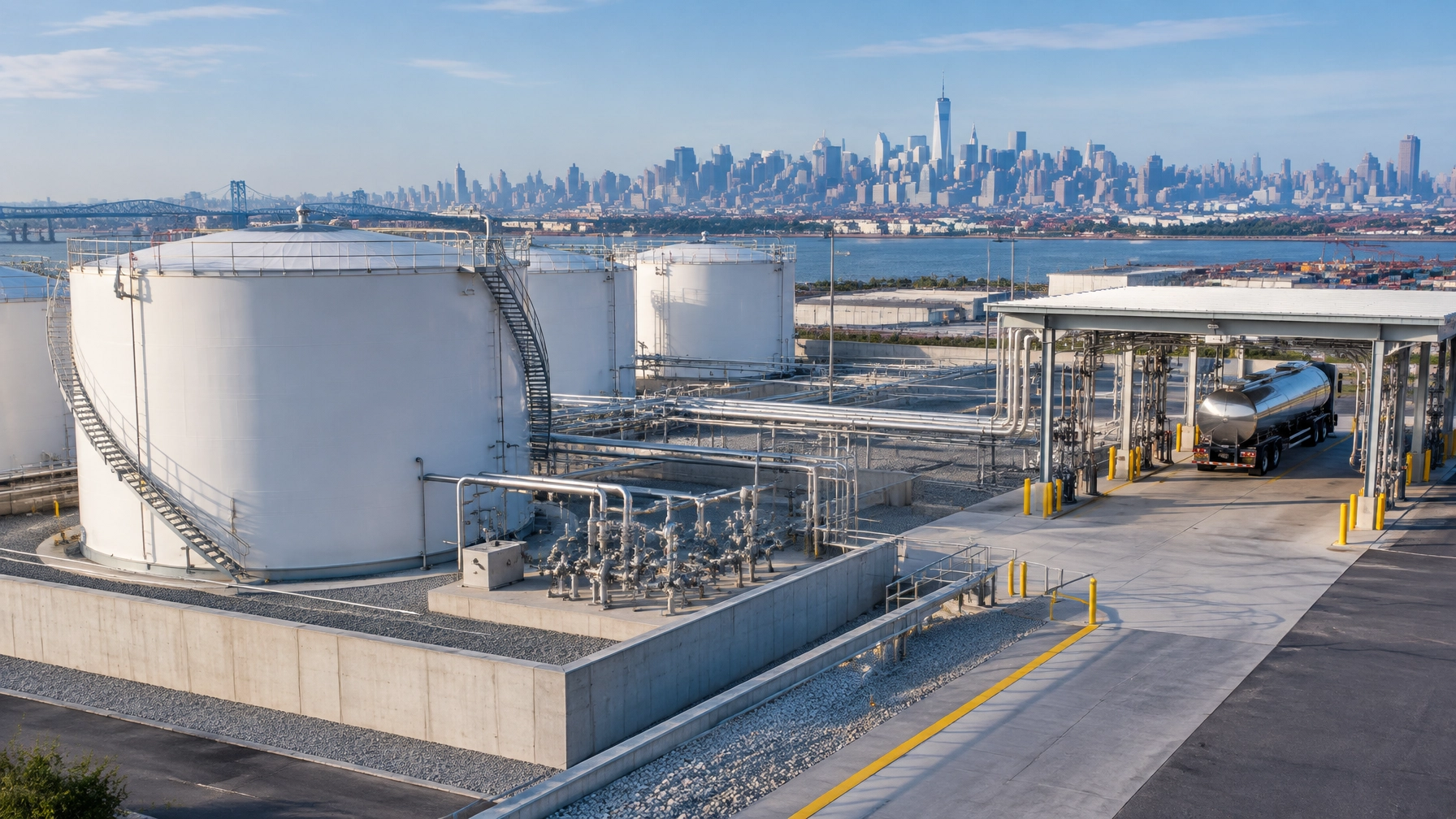
A facility in Newark, Elizabeth, Jersey City, or Long Island can cross the federal SPCC threshold without adding a new building or changing its primary operation. One tank, a new loading area, or a change in drainage can create a compliance issue that appears during an EPA inspection, lender review, or property transaction.
The governing rule is the federal Spill Prevention, Control, and Countermeasure rule under 40 CFR Part 112. It applies to certain non-transportation facilities that store, transfer, use, or consume oil and could reasonably discharge oil to navigable waters or adjoining shorelines.
An SPCC plan is not a desk exercise. It must match the tanks, piping, containment, drainage, operating procedures, and inspection records that exist in the field.
Who needs an SPCC plan in 2026?
A facility generally needs an SPCC plan when all of the following conditions apply:
- It is a non-transportation-related facility.
- It stores oil in containers with a capacity of 55 gallons or more.
- Its total aboveground oil storage capacity exceeds 1,320 gallons, or its completely buried oil storage capacity exceeds 42,000 gallons.
- There is a reasonable expectation that an oil discharge could reach navigable waters or adjoining shorelines.
The term “oil” covers more than gasoline and diesel. It can include petroleum products, lubricating oil, hydraulic oil, used oil, transformer oil, animal fats, vegetable oils, and certain synthetic oils.
The threshold is based on total storage capacity, not the amount in the tanks on the day of an inspection. A facility with three 500-gallon tanks has 1,500 gallons of aboveground capacity, even if two tanks are nearly empty.
New Jersey-specific guidance also highlights an important practical point. A facility with 1,320 gallons or less may still need an SPCC plan if one aboveground container exceeds 660 gallons. A 750-gallon tank can create an SPCC obligation even when the facility remains below the aggregate 1,320-gallon threshold.
For a site-specific determination, review the EPA SPCC program guidance and consult a qualified environmental professional.
SPCC plan versus a stormwater plan
An SPCC plan and a Stormwater Pollution Prevention Plan serve different purposes.
An SPCC plan addresses oil spill prevention under 40 CFR Part 112. It focuses on:
- Oil storage containers and tanks
- Piping, valves, and transfer equipment
- Secondary containment
- Loading and unloading areas
- Spill response procedures
- Inspection and testing
- Employee training
- Management approval and accountability
A stormwater plan addresses pollutants carried by stormwater under an applicable NPDES or state stormwater permit. It may cover sediment, waste, chemicals, oil, exposed materials, and runoff controls.
A facility may need both plans. One does not replace the other.
The plans can cross-reference shared procedures, but the compliance records must still demonstrate that each program is being implemented. A stormwater inspection log does not automatically prove that the facility completed the tank integrity inspections required by its SPCC plan.
Why PE certification matters
Facilities with more than 10,000 gallons of oil storage generally need a plan certified by a licensed Professional Engineer.
The PE must certify that the plan has been prepared in accordance with good engineering practices and that the facility has adequate spill prevention and containment measures. The certification is not a rubber stamp. The engineer is putting a professional license behind the accuracy of the plan.
Certain qualified facilities with 10,000 gallons or less may self-certify if they meet the requirements in 40 CFR 112.6. Qualified facilities fall into Tier I or Tier II categories based on storage configuration, tank size, and discharge history.
Self-certification does not eliminate the need for field verification. A self-certified plan still needs accurate tank counts, current site conditions, appropriate containment, inspection procedures, and employee training.
At Envicon, our SPCC plan services are built around the facility that exists, not a generic template. Our PE-led team reviews the plan against field conditions, identifies gaps, and gives facility managers a practical path to correction.

What EPA and NJDEP look for in the field
A plan can look complete on paper and still fail a site inspection. Inspectors typically compare the written plan against visible conditions and available records.
1. Secondary containment
For bulk storage containers, the containment system must be capable of containing the contents of the largest single container, plus appropriate freeboard for precipitation where outdoor storage is involved.
Inspectors may look for:
- Cracks or open joints in concrete containment
- Failed sealants
- Unsealed drains
- Containment walls that are too low
- Rainwater accumulation
- Valves that allow an uncontrolled discharge
- Piping that bypasses the containment area
- Spill pans or berms that do not match the plan
Containment also matters at oil transfer and loading areas. A tank may have adequate containment while the truck connection point drains directly toward a catch basin.
2. Loading and unloading areas
The SPCC plan should identify where oil is transferred and explain how releases are prevented and controlled.
Review the condition of:
- Transfer hoses
- Flanges and couplings
- Shutoff valves
- Drainage controls
- Wheel stops and curbing
- Emergency shutdown equipment
- Spill kits
- Tanker staging areas
The written procedure should identify who controls the transfer, who watches the connection, and what happens if a hose fails or a valve does not close.
3. Inspection and integrity testing
Bulk storage containers require regular inspection and testing in accordance with written procedures and recognized industry standards.
For many facilities, the inspection program includes:
- Monthly visual inspections
- Corrosion checks
- Leak detection
- Foundation and support review
- Piping and valve inspection
- Containment condition review
- Periodic integrity testing when appropriate
Inspection and test records must be signed and retained for at least three years. A spreadsheet with dates but no findings, initials, corrective actions, or follow-up may not demonstrate that the program is working.

4. Personnel training
Oil-handling personnel need training on discharge prevention, equipment operation, spill response, notification procedures, and cleanup responsibilities.
The plan should identify:
- Who receives training
- What subjects the training covers
- How often training occurs
- Where sign-in records are stored
- Who is responsible for discharge prevention at the facility
The designated responsible person must have enough authority to implement the plan and obtain the resources needed to correct deficiencies.
When must an SPCC plan be amended?
The facility owner or operator must amend the plan when a material change affects the potential for an oil discharge. Common triggers include:
- Installing or removing a tank
- Increasing storage capacity
- Adding a new oil transfer point
- Relocating equipment
- Modifying drainage
- Changing containment structures
- Changing facility operations
- Acquiring a property with undocumented tanks or piping
- Revising emergency contacts or response procedures
- Experiencing a reportable discharge
The plan must also be reviewed at least once every five years. The review should confirm that the plan still reflects the facility’s current equipment, operations, containment, personnel, and procedures.
A five-year review is not simply a new signature date. If the site has changed, the plan needs to change with it.
Significant discharge history can create additional reporting and amendment obligations. These include a discharge of more than 1,000 gallons in a single event or two discharges of more than 42 gallons each within a 12-month period.
Facility manager self-audit checklist
Before an EPA, NJDEP, lender, or buyer reviews your facility, confirm the following:
- Total aboveground oil capacity has been recalculated.
- Completely buried oil capacity has been identified.
- Every container of 55 gallons or more appears in the plan.
- Tank locations match the site diagram.
- Loading and unloading areas appear in the plan.
- Secondary containment is intact and free of uncontrolled drains.
- Outdoor containment has adequate freeboard.
- Monthly inspection records are complete and signed.
- Integrity testing is documented where appropriate.
- Spill kits and emergency equipment are present.
- Oil-handling personnel have current training records.
- Emergency contacts are current.
- The plan has management approval.
- The five-year review date is tracked.
- Material facility changes have been evaluated.
SPCC compliance and New Jersey development risk
For developers, an SPCC review is part of broader environmental due diligence for developers in New Jersey. A current plan is useful, but the absence of a plan, incomplete records, or visible containment failures can signal historical release risk.
That matters on industrial properties in Newark, Elizabeth, Jersey City, and Hudson County. It also matters when a redevelopment site contains old tanks, former manufacturing areas, or imported fill.
SPCC compliance does not resolve NJDEP historic fill. Historic fill is a separate site condition that may require investigation, soil management, and oversight by an NJDEP LSRP. However, a field review can help separate current operational controls from legacy contamination and identify where the two risks overlap.
That distinction can affect purchase agreements, cleanup budgets, lender conditions, and construction sequencing.
The Envicon approach
A compliant SPCC plan should help your facility operate better. It should not sit in a binder while the actual tanks, drains, and transfer areas tell a different story.
Envicon combines PE-certified plan preparation with field verification, practical inspection procedures, and direct regulatory coordination. We do not fill gaps with template language. We document what is on site, identify what needs to change, and give your team records that hold up under scrutiny.
The goal is simple: prevent releases, prove control, and keep your facility moving.
Takeaway
The 1,320-gallon and 42,000-gallon thresholds are only the starting point. A defensible SPCC program also requires accurate inventories, PE certification or valid self-certification, functioning secondary containment, documented inspections, integrity testing, personnel training, five-year reviews, and timely amendments.
If the plan does not match the facility, it is not protecting the facility.
Need an SPCC plan review?
- Call Envicon now at (917) 764-2171
- View our complete list of environmental and engineering services
- Use our proprietary project risk screener

Leave a Reply