In New Jersey, land is limited, expensive, and often burdened by past industrial use. If you're underwriting a deal in Newark, Jersey City, Paterson, Elizabeth, or along the state’s older industrial corridors, you’re not just evaluating dirt. You’re evaluating environmental risk, timing risk, and access to capital.
That’s exactly why NJ Brownfield Tax Credits for real estate development matter so much right now. For the right project, these credits can help bridge a financing gap, improve deal economics, and unlock capital that would otherwise stay tied up in remediation. Under the state’s brownfield incentive structure, eligible projects may recover a meaningful share of cleanup costs, which can directly change how a site pencils out. You can review the program framework through the New Jersey Economic Development Authority and redevelopment requirements through the NJDEP site remediation program.
At Envicon, we help clients look at contaminated real estate the way lenders, investors, and public agencies do: through risk, documentation, and timing. When the environmental strategy is aligned with the capital strategy, a brownfield stops being a drag on value and starts becoming a path to redevelopment momentum.
The New Math: Up to $12 Million in Recoverable Costs
Let’s get straight to the numbers, because that’s what moves the needle for your investors. In September 2024, New Jersey upped the ante. The state recognized that if we want to solve the housing crisis and drive economic growth, we have to make it profitable to fix "broken" land.
The annual cap for the Brownfield Tax Credit program is now a steady $50 million, but the individual project caps have seen a massive jump.
- In Government-Restricted Municipalities (GRMs): You can now recover up to 80% of your remediation costs, with a cap of $12 million per project. This is a significant increase from the previous $8 million limit.
- Solar on Landfills: If you are looking at a "Brightfield" project: putting solar arrays on closed sanitary landfills: the state will cover 100% of remediation costs, also capped at $12 million.
- Other Areas: Even outside the high-priority zones, the cap has moved from $4 million to $8 million.
For a developer, this isn't just a "nice to have" incentive. This is the difference between a project that pencils out and one that stays a vacant lot for another twenty years.

Why Transferable Credits Matter to Real Estate Capital
One of the biggest questions we hear is simple: What if I can’t use the tax credit myself?
That’s where the structure matters. In many cases, NJ Brownfield tax credits are transferable, which means the credit may be sold instead of used directly against your own tax liability. For real estate developers, investors, and project sponsors, that can create a real source of liquidity rather than a benefit that sits idle on paper. The New Jersey Economic Development Authority provides current program details and eligibility guidance at njeda.gov.
This matters because brownfield tax credits can support real estate capital stacks in a very practical way:
- They can reduce the amount of equity your team needs to keep tied up in remediation.
- They can improve lender confidence by showing a defined path to cost recovery.
- They can create a future cash event if the credit is transferred after issuance.
- They can help move funds back into hard costs, vertical construction, or carry costs.
As we often tell clients, “a transferable credit isn’t just a tax benefit; it’s a capital planning tool.” If you structure the environmental work properly from the beginning, the cleanup strategy can support the financing strategy instead of fighting it.
The Compliance Side That Protects Your Capital
You don’t access brownfield incentive value just by identifying contamination. You access it by documenting the work correctly and closing out the remediation path under New Jersey rules. That’s where the NJDEP site remediation program and the LSRP process come into play. If you need the regulatory framework, start with the NJDEP Site Remediation Program.
For owners and developers, this is not just an environmental box to check. It directly affects capital planning. If the remedial investigation, cost backup, and closeout documentation are weak, the tax credit side of the project gets weaker too.
We look at this through a business lens:
- Your remediation scope has to be defensible.
- Your costs have to be documented in a way that stands up to review.
- Your project schedule has to support both regulatory milestones and financing milestones.
- Your environmental consultant, LSRP, legal team, and capital partners need to work from the same playbook.
A lot of firms stop at technical compliance. We don’t. We build the environmental record in a way that helps support the larger redevelopment story. That’s a better approach for lenders, better for investors, and better for keeping your project moving.

What Developers Need to Underwrite Early
If your goal is to use NJ Brownfield Tax Credits to support real estate capital, you need to underwrite the program early, not after design is underway. That’s where many deals lose time.
The main issues usually come down to a few practical items:
- Financing gap support: Some projects need to show that the deal is not feasible without the incentive support. That means your numbers have to be organized early.
- Eligible cost tracking: Cleanup costs, investigation costs, and related documentation need to be tracked cleanly from the start.
- Schedule alignment: Environmental milestones, redevelopment approvals, and capital deadlines need to line up.
- Local support and project positioning: Municipal backing still matters. So does presenting the project as a real redevelopment win, not just a cleanup file.
As we tell clients, “the best time to plan for a brownfield tax credit is before the first scope gets approved.” That’s how you avoid rework, protect your budget, and keep the project credible with capital partners.
How Envicon Flips the Script on Traditional Consulting
Most big-box environmental firms treat remediation as a slow, linear process: Sample. Report. Wait. Repeat. They get paid by the hour, so they aren't exactly incentivized to move at the speed of a real estate deal.
Envicon is different. We operate at the intersection of Environmental Law and aggressive project management. Here is why our clients are ditching the "Big Consultants" for the Envicon approach:
- We Understand the "Gap": We don't just give you a technical report. We help your team articulate the "financing gap" required for the tax credit application. We speak the language of IRR and NPV just as well as we speak the language of parts-per-billion.
- Precision Remediation: We use advanced GIS mapping and site assessment to pinpoint contamination. Why remediate five acres when the data shows you only need to treat two? We save you money on the front end, which makes your tax credit application even more attractive.
- LSRP Accountability: Our LSRPs are focused on the "Response Action Outcome" (RAO) from day one. We don't get bogged down in "analysis paralysis." We move toward closure so you can move toward your tax credit issuance.
- Speed to Market: In New Jersey real estate, time is more than money: it's everything. Our team is structured to be responsive and adaptable. When a regulatory change happens (like the September 2024 update), we don't hold a committee meeting; we update our clients' strategies immediately.
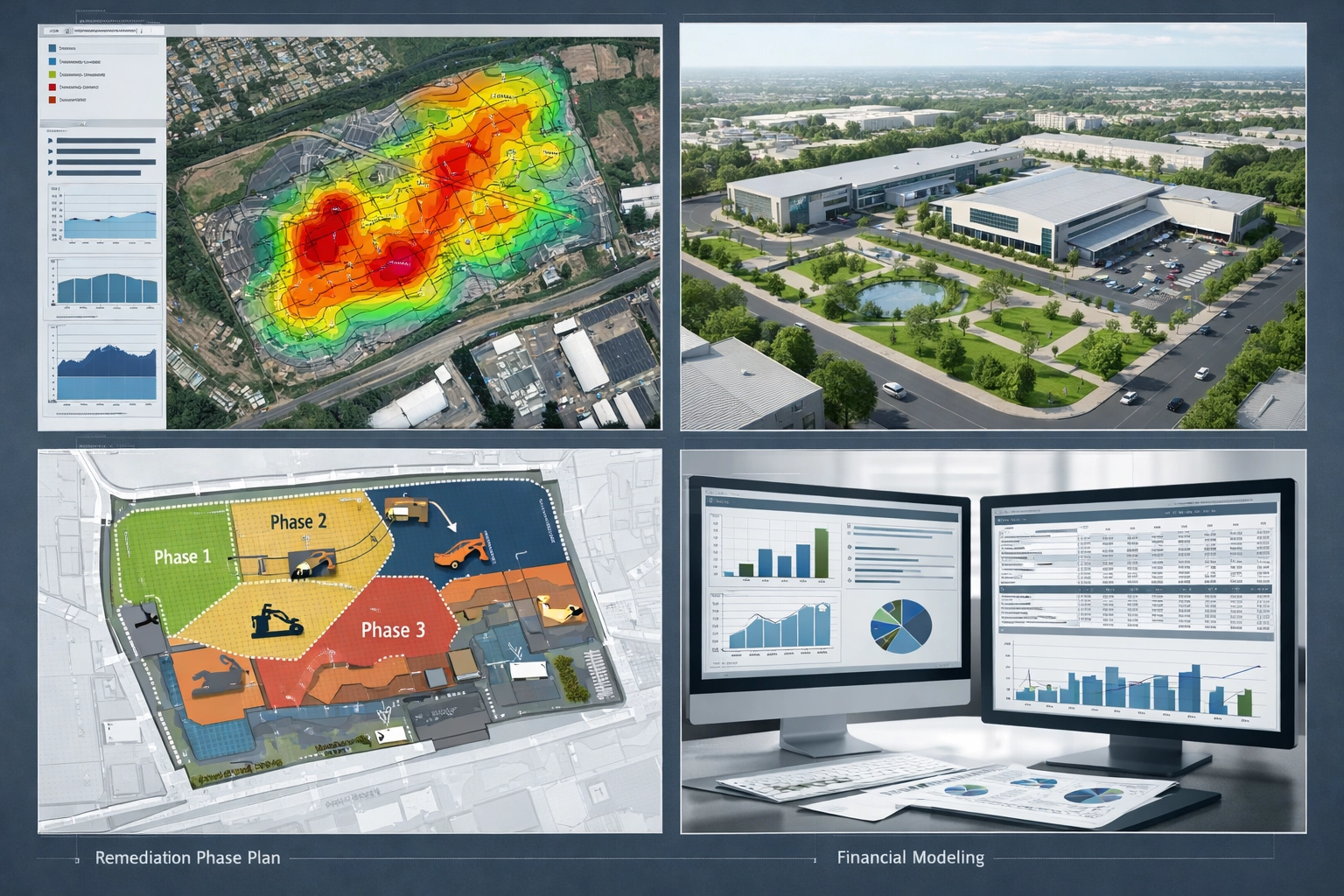
Integrated redevelopment planning image showing how environmental data, remediation strategy, and capital planning work together on brownfield sites.
Summary: Your Competitive Advantage
The New Jersey Brownfield Tax Credit program is a powerful tool, but it is not a "set it and forget it" solution. It requires a visionary approach to redevelopment: one that sees the hidden capital in contaminated soil.
Key Takeaways for Developers:
- Max Credits: Up to $12M or 80-100% of costs in key zones.
- Liquidity: Credits are transferable and can be sold for cash.
- Compliance: Strict adherence to NJDEP LSRP rules and green standards is non-negotiable.
- Urgency: The $50M annual pool is competitive; early and accurate applications win.
Don't let a "dirty" site scare you off a great deal. With the right strategy, those remediation costs aren't expenses: they are an investment in a future tax credit.
If you are looking at a site in Hudson County, Newark, or any of New Jersey’s industrial corridors, let’s talk. We can help you navigate the due diligence and build a roadmap to unlocking that capital.
Ready to turn your liability into an asset? Contact Envicon today and let’s look at the numbers together. Our team of experts is ready to help you navigate the complexities of NJ Brownfield Tax Credits and NJDEP compliance with precision and speed.
Footer (Contact Envicon Group)
Envicon Group
Site-civil • Geotechnical • Environmental (NY/NJ)
Web: https://wp.envicongroup.com/
Contact: https://wp.envicongroup.com/contact
Leave a Reply