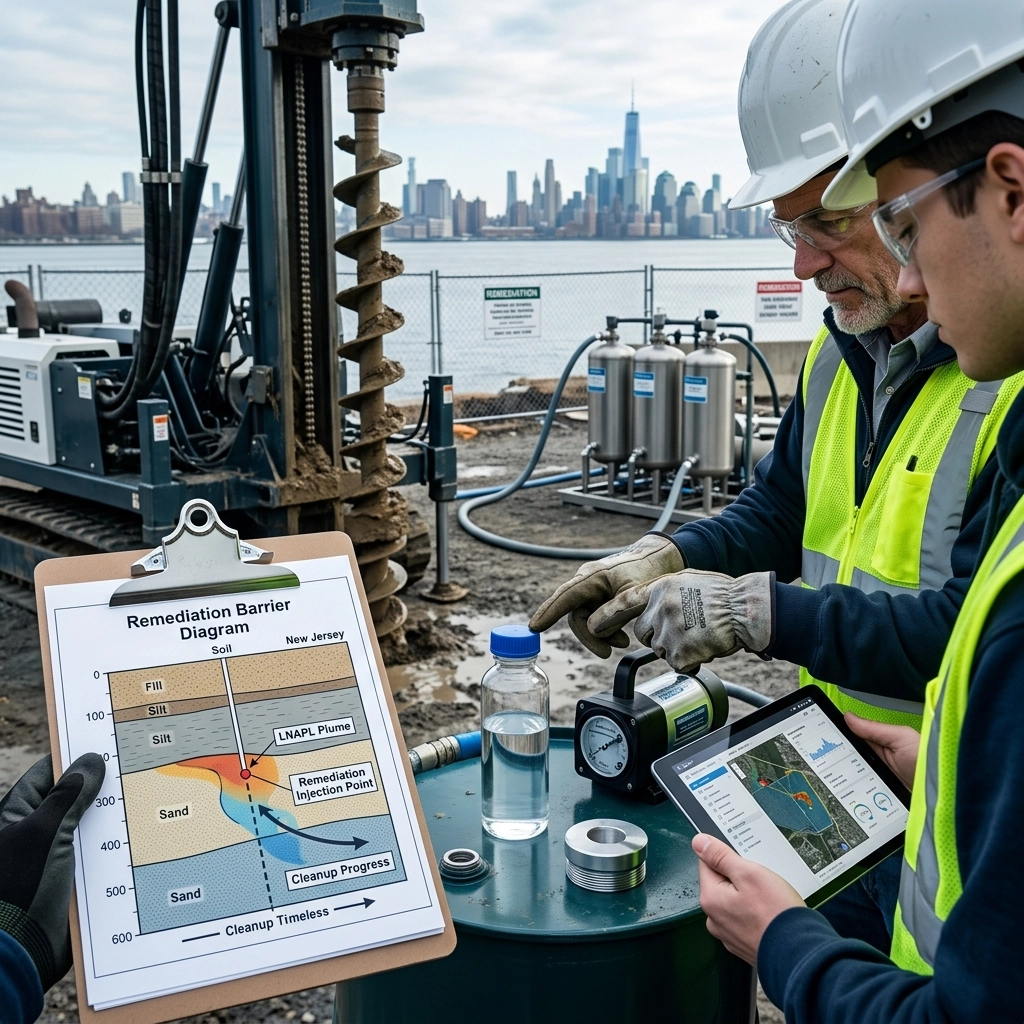
If you are a developer, lender, or property owner in New Jersey, you already know that the Licensed Site Remediation Professional (LSRP) program is the engine that drives your project toward a Response Action Outcome (RAO). But as of early 2026, the rules governing that engine have undergone a major tune-up.
The NJDEP has recently rolled out significant updates to the Remedial Action Permit (RAP) program and tightened the screws on remediation standards. These aren't just administrative tweaks; they are fundamental shifts that will dictate how fast you can close on a property, how much your cleanup will cost, and how long your site remains "under the thumb" of regulatory oversight.
At Envicon, we don't just read the guidance: we live it. As a -licensed professional-led, field-first firm, we see these changes through the lens of a contractor who needs to move dirt and a developer who needs to hit a closing date. Here is what you need to know about the current NJDEP landscape and how to keep your timeline from unraveling.
The RAP Revolution: One Permit to Rule Them All
The most substantial procedural change hit the books on February 17, 2026. The NJDEP released updated Remedial Action Permit (RAP) forms and instructions that effectively ended the era of fragmented permitting.
In the past, you might have had a soil permit, a separate groundwater permit, and perhaps another layer for vapor intrusion. This created a mountain of paperwork, varying expiration dates, and a fee schedule that felt like death by a thousand cuts. The new framework consolidates soil, groundwater, and indoor air permits into a single Combined RAP.
Why This Matters for Your Timeline
On the surface, consolidation sounds like a win for efficiency: and it can be. However, the transition period is where most projects stumble.
- Simplified Biennial Evaluations: By grouping media into one permit, the biennial protectiveness evaluations are now synchronized. You aren't filing reports every six months for different issues; you’re doing it once.
- Modifications vs. New Applications: When your site conditions change, the NJDEP now prefers modifications over entirely new applications. This is designed to streamline the process, but it requires an LSRP who knows how to navigate the new forms without triggering a "deficiency" notice that puts you back at the bottom of the pile.
At Envicon, we’ve seen big-box firms struggle with this transition, treating the new forms like the old ones. We take a different approach. We look at the Combined RAP as a strategic tool to front-load the regulatory heavy lifting so your long-term compliance is a "set it and forget it" situation, not a recurring nightmare.

The Bar Just Got Higher: Stricter Remediation Standards
While the permitting process is trying to get leaner, the technical standards are getting meaner. Effective August 4, 2025, the NJDEP updated the Soil Remediation Standards (N.J.A.C. 7:26D) and Ground Water Quality Standards (N.J.A.C. 7:26I).
Perhaps more critically for urban redevelopment, the agency lowered the Groundwater Screening Levels for the vapor intrusion pathway as of February 7, 2025.
The Financial and Schedule Impact
If you did your due diligence in 2024 and thought you had a "clean" site, you might be in for a rude awakening in 2026.
- Re-evaluating "Old" Data: Contaminant levels that were once below the threshold may now exceed the new, stricter standards. This means more sampling, more characterization, and potentially more remediation.
- Vapor Intrusion Hurdles: With lower screening levels, more sites are being pushed into active vapor mitigation. Installing a sub-slab depressurization system isn't just a cost issue; it’s a construction scheduling issue. If your consultant isn't talking to your architect and foundation contractor early, you’re going to have a conflict in the field.
"The technical threshold is a moving target," says one industry insider. "If your consultant is just checking boxes from a 2023 playbook, you’re building on a foundation of regulatory sand."

SRRA 2.0: Clarification or Complication?
The 2025 regulatory adoptions implementing SRRA 2.0 have brought much-needed clarity: but also more responsibility: to the LSRP program. There are now stricter obligations regarding discharge reporting and the documentation of remediation funding sources.
The NJDEP is no longer playing games with how contamination is documented. If an LSRP discovers a discharge, the reporting clock starts immediately. For developers, this means you need an LSRP who is "regulator-facing": someone who understands how to present data to the NJDEP in a way that is honest, accurate, and protective of the project’s interests.
The 45-Day Transition Rule
If you are switching LSRPs: perhaps moving away from a slow-moving national firm to a more agile partner like Envicon: you need to be aware of the 45-day transition requirement. The NJDEP now has a strict window for LSRP arrangement changes. If this isn't managed precisely, your permit status could lapse, halting work on-site and potentially triggering fines.
The Envicon Difference: Sitting at the Table, Not in a Queue
When you hire a massive national environmental firm, your project often becomes a number in a spreadsheet. Your "LSRP of record" might be in an office three states away, and the person actually doing the work is a junior staffer who has never stepped foot on your site.
Envicon operates differently. We are PE-led and field-first.
Why Clients Switch to Envicon:
- Regulator-Facing Leadership: We don't just mail reports and hope for the best. We have direct relationships with reviewers. We sit at the table with the NJDEP to hash out solutions before the formal submittal.
- Precision Over Paperwork: Big firms write 500-page reports to protect themselves from liability (CYA). Envicon produces lean, high-impact documentation designed to get you an RAO. We don't sell reports; we sell cleared paths.
- Contractor-Adjacent Mindset: We understand that every day an excavator sits idle is money out of your pocket. Our team is on-site, coordinating with your construction manager to ensure remediation doesn't stop the build.

Action Items for NJ Developers in 2026
If you have an active project in New Jersey, here is your immediate checklist:
- Audit Your Permits: Have your LSRP review all existing RAPs. Determine if an administrative combination under the new framework will save you time and money on your next biennial certification.
- Re-Screen Your Data: Check your 2023-2024 soil and groundwater data against the August 2025 standards. Don't wait for a lender to flag an "outdated" report during the closing process.
- Verify Your Funding Source: Ensure your remediation funding source (RFS) documentation is compliant with the SRRA 2.0 clarifications. The NJDEP is auditing these more frequently.
- Assess Your LSRP Relationship: Is your consultant proactive, or are they waiting for you to call them? If you aren't getting ahead of these updates, you are falling behind.
Summary: Navigate the Shift with Precision
The NJDEP’s modernization of the RAP program and the tightening of remediation standards are designed to protect the environment, but they place a significant burden on the development community. Between the consolidated permits and the stricter vapor intrusion levels, the margin for error has vanished.
At Envicon, we believe that integrity is about delivering the truth and never cutting corners. But we also believe that speed and precision are not mutually exclusive. We help transform underused and contaminated properties into thriving assets by staying ahead of the regulatory curve.
Don't let a "cheap" or "slow" report become your most expensive mistake. If your current consultant is giving you more questions than answers, it’s time for a different approach.
Ready to clear the path for your next project? Contact Envicon today to discuss how we can streamline your NJDEP compliance.
Key Takeaways
- Combined RAPs are now the standard for soil, water, and air: simplify your reporting now.
- Stricter 2025 standards may require new remediation strategies for existing projects.
- The 45-day LSRP transition rule is a critical deadline for project continuity.
- Envicon's PE-led approach ensures you are "regulator-facing," getting you to the table faster than the big-box firms.
Sources:
- NJDEP Remedial Action Permit Program Updates – Feb 2026
- NJDEP Soil and Ground Water Quality Standards – August 2025 Adoption
- SRRA 2.0 Implementation Guidelines

Leave a Reply