In the high-stakes world of New York City real estate development, what you can’t see is often more dangerous than what you can. You’ve likely managed the obvious hurdles: zoning variances, foundation challenges, and the rising costs of materials. But beneath the surface of many NYC sites lies a "silent" liability that can stall a project in its tracks or, worse, resurface years after you’ve exited the deal.
Vapor intrusion (VI): the migration of volatile organic compounds (VOCs) from contaminated soil or groundwater into the indoor air of a building: has become a primary focus for regulators like the New York City Office of Environmental Remediation (OER) and the New York State Department of Environmental Conservation (NYSDEC).
With the 2024 updates to the New York State Department of Health (NYSDOH) guidance, the goalposts have moved. If you are developing in the five boroughs, relying on old environmental reports is no longer a viable strategy. At Envicon Group, we don’t just deliver a report that tells you there’s a problem; we provide the path to clearing it so you can build, lease, and sell with total confidence.
The "E" Designation: More Than Just a Flag
If your tax lot has an "E" Designation for Air Quality, Noise, or: most critically: Hazardous Materials, you are already in the system. The NYC OER oversees these designations to ensure that redevelopment doesn't expose future occupants to environmental hazards.
An E-designation isn't a project killer, but it is a project "staller" if handled by a consultant who doesn't know the nuances of the OER’s Reviewer expectations. We see it constantly: developers hire a "big-box" national firm that treats an NYC OER submittal like a standard Phase I in middle America. The result? Months of back-and-forth, rejected Remedial Action Plans (RAPs), and mounting carry costs.
We work directly with OER officials. We know the reviewers by name, and we understand exactly what they need to see in a Remedial Investigation Report (RIR) to issue that Notice to Proceed. We don’t guess; we align your project with the regulatory finish line from Day 1.

Why 2024 Changed the Game for NYC Liability
For years, vapor intrusion focused heavily on "dry cleaner" chemicals like Tetrachloroethene (PCE) and Trichloroethene (TCE). If your site didn’t have a history of dry cleaning or heavy industrial degreasing, many consultants gave you a pass.
That changed in February 2024. The NYSDOH expanded its guidance to include 13 petroleum-related VOCs across new decision matrices. This includes common compounds like Xylene, Heptane, and Hexane: chemicals found at almost every former gas station or auto repair shop in Brooklyn, Queens, and the Bronx.
What does this mean for you? Sites that were "cleared" five or ten years ago might now fail the current standards. If you’re purchasing a site based on an outdated Phase I, you are walking into a liability trap. We help our clients re-evaluate these sites through the lens of the latest matrices to ensure that a lender doesn't pull the rug out from under the deal during the final stages of due diligence.
The Envicon Approach to Vapor Analysis
When we step onto a site, we aren't just checking boxes. We are looking for the most efficient way to prove your site is safe or to design a mitigation strategy that doesn't blow your construction budget.
Vapor analysis requires precision. We utilize sub-slab vapor points, indoor air sampling, and ambient air controls to create a 3D understanding of how air moves through your specific footprint.

Visual: A close-up of environmental sampling equipment, specifically well caps and sample vials, used for precise vapor intrusion testing on a New York City development site.
Our field teams are led by PEs who understand that a sample vial is more than just glass and air: it’s the evidence needed to secure your Certificate of Occupancy. We use high-volume sampling and preferential pathway identification to ensure that if there is a risk, we find it before the building is sealed.
Mitigation Strategies: Passive vs. Active
If vapor intrusion is detected, the solution isn't always a massive, expensive mechanical system. We specialize in tailoring mitigation to the specific needs of the building and the long-term liability goals of the developer.
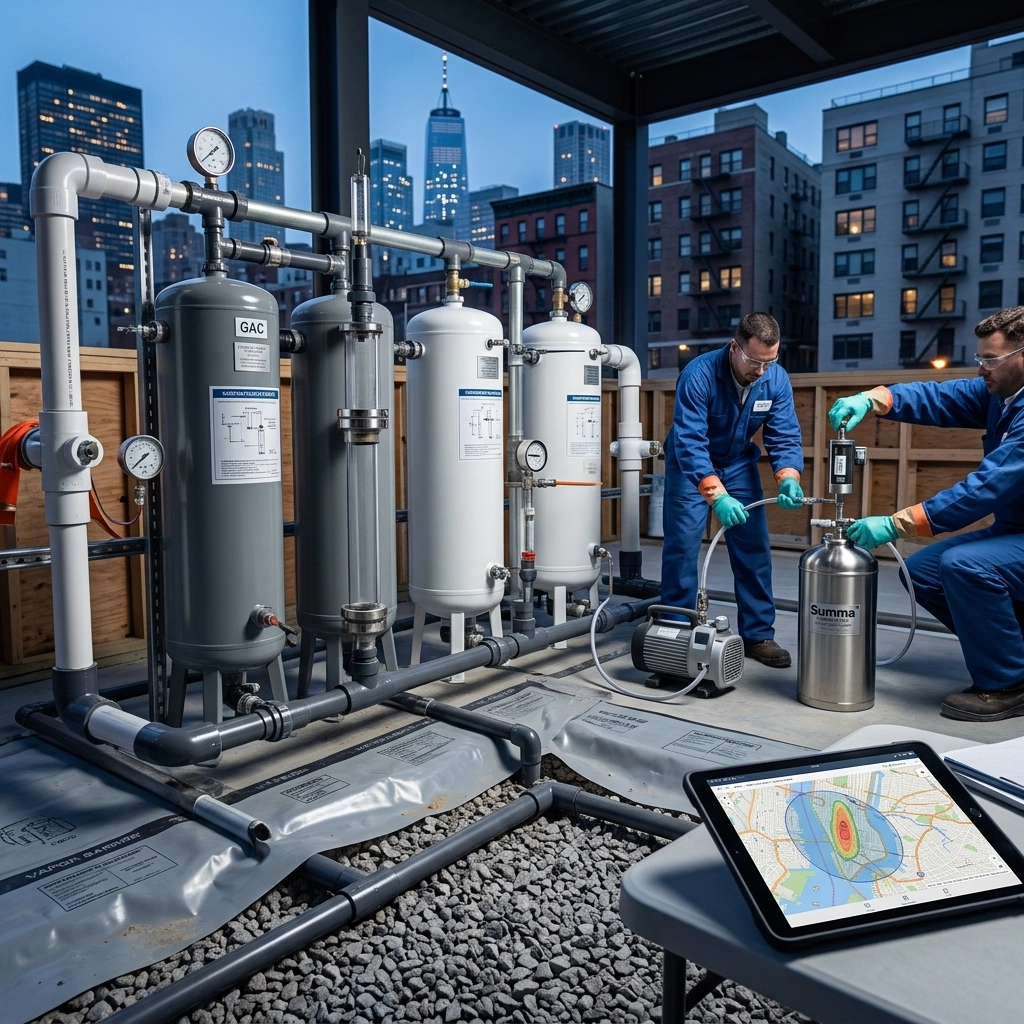
- Vapor Barriers: Not all plastic sheets are created equal. We specify high-performance chemical-resistant membranes that act as the first line of defense.
- Sub-Slab Depressurization Systems (SSDS): This is the gold standard for mitigation. By creating a vacuum beneath the slab, we vent vapors safely above the roofline.
- Aerated Flooring: For new construction, systems like Cupolex or similar aerated forms provide a continuous void space. This is often more cost-effective than traditional perforated pipe systems and offers superior venting performance.
- Institutional & Engineering Controls: Sometimes, the best "mitigation" is a combination of site-specific design and legal filings (Deed Restrictions) that manage risk without unnecessary hardware.
The difference with Envicon is that we design for buildability. We coordinate with your structural engineer and your plumber to ensure our vent stacks don't interfere with your luxury finishes or your mechanical penthouse.
Avoiding the "Long-Tail" Liability
The biggest risk for a developer isn't the cost of the SSDS; it's the 20-year liability of a tenant claim. If a building's indoor air quality isn't documented correctly during construction, you are vulnerable to future litigation.
A "defensive" report from a large national firm often includes so many caveats and "limitations" that it offers you zero protection. They protect their firm, not your project. At Envicon, we provide clean, actionable documentation. We stand behind our work, providing the specific certifications that lenders and future buyers require to feel safe taking over the asset.
"A report that says 'more study is needed' is a failure of leadership. Our job is to give the client a 'Yes' or a 'No' and the exact cost to get to 'Closed.'" : Jason Pancoast, CEO, Envicon Group.
The Envicon Difference: Why Switch from "Big-Box"?
Most of our clients come to us after being burned by a large national environmental firm. You know the story: you talk to a polished Senior Partner during the pitch, but once the contract is signed, your project is handed off to a junior staffer who has never set foot on a NYC construction site.
When a problem arises in the field: say, a vapor barrier gets punctured during a rebar install: the big firm takes three days to return an email. In that time, you’ve lost thousands in contractor standby time.
At Envicon:
- Direct Access: You have the cell phone number of the lead engineer.
- Regional Fluency: We know the NYC OER and NYSDEC reviewers. We speak their language and understand their "unwritten" rules.
- Speed to Market: We don’t sell reports; we sell cleared paths. We move at the speed of construction, not the speed of a corporate bureaucracy.
- Transparent Pricing: No change-order games. We scope accurately because we’ve done this in NYC for 20 years.

Summary & Key Takeaways
Vapor intrusion is an evolving challenge that requires more than just a standard environmental assessment. To protect your investment and ensure a smooth exit, remember:
- Audit Early: Check for E-designations and previous petroleum use before you sign the PSA.
- Update Your Data: 2024 NYSDOH guidance means old "clean" reports are potentially obsolete.
- Mitigate Smart: Don't over-engineer. Use passive systems and high-performance barriers where possible to reduce long-term O&M costs.
- Own the Documentation: Ensure your consultant provides clear, regulator-approved closure letters, not just "summary of findings."
Don't let subsurface vapors cloud your project's future. Whether you are navigating an OER E-designation or need a strategy to satisfy a skeptical lender, we are here to clear the path.
Is your current environmental consultant holding up your foundation pour with "pending" reports? Switch to a firm that moves as fast as your GC. Contact Envicon Group today for a review of your current Vapor Management Plan.
Envicon Group: Precision. Speed. Trust.
We specialize in turning complex, environmentally challenged sites into clean, buildable, and compliant assets across NYC and NJ.
Leave a Reply