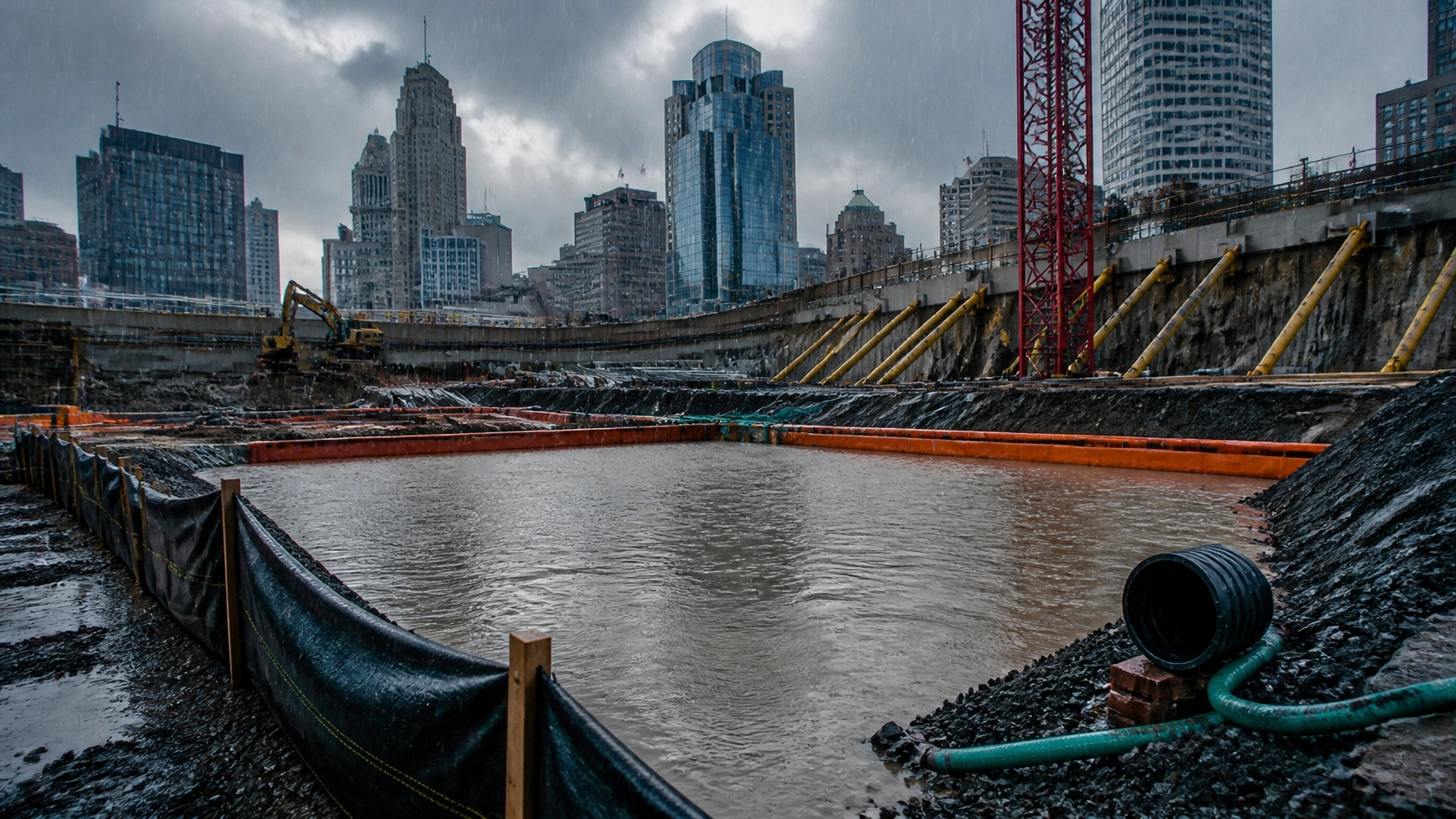
It’s 7:00 AM on a Tuesday in Hudson County, and it’s pouring. You’re standing on the edge of your job site, watching a plume of silty, brown water bypass a flimsy silt fence and head straight for the municipal storm drain. Behind you, a local inspector is already stepping out of their truck with a clipboard and a camera.
You look at the Stormwater Pollution Prevention Plan (SWPPP) your national consultant handed you three months ago. It’s 150 pages of boilerplate text, generic diagrams, and "best management practices" (BMPs) that seem to describe a flat field in the Midwest, not a tight, high-stakes urban redevelopment project in New Jersey or New York City.
This is the SWPPP Trap.
At Envicon Group, we see it constantly. Developers hire a "big box" firm because the name is recognizable, only to receive a cookie-cutter plan that looks good in a binder but fails the moment the first shovel hits the dirt. In our world, a SWPPP isn't just a regulatory checkbox; it’s the insurance policy that keeps your project moving. When that policy is written by someone in a satellite office who has never walked your site, you aren’t just buying a bad report: you’re buying a stop-work order.
The Anatomy of a "Cookie-Cutter" Failure
When a large national firm handles your stormwater permitting, they often apply a one-size-fits-all playbook. They use the same templates for a suburban warehouse in Ohio as they do for a complex brownfield site in Brooklyn.
The problem? NYC and NJ don't play by generic rules.
A generic SWPPP often fails because it ignores the specific soil strata of the Northeast, the extreme density of our urban environments, and the hair-trigger sensitivity of local regulators like the NJDEP and NYSDEC.
Why Templates Kill Timelines:
- Irrelevant BMPs: Your plan might call for a massive sediment basin that your site physically doesn't have room for.
- Static Logic: The plan assumes a "typical" rain event, ignoring the flash-flooding reality of the 2026 climate landscape.
- Zero Field Context: The person who wrote the plan didn't account for the existing utility corridor or the specific slope of your neighbor’s lot, leading to runoff where you least expect it.
The High Cost of Being "Generic"
In 2026, the regulatory landscape in New York and New Jersey has shifted from "compliance-focused" to "enforcement-heavy." If your stormwater controls fail, the financial impact is immediate and compounding.
1. Daily Fines That Stride Into the Thousands
Under the Clean Water Act and local state regulations, fines for stormwater violations are no longer a slap on the wrist. In New York, fines for operating with a deficient SWPPP or without proper permit coverage start at thousands of dollars per day.
In NYC, the Stormwater Penalty Schedule is even more direct:
- 1st Offense: $2,500
- 2nd Offense: $5,000
- 3rd Offense: $7,500
These local fines are often tacked on top of state and federal penalties. If your consultant wrote a report for CYA (Cover Your Assets) instead of a path to closure, you’re the one holding the check.
2. The Stop-Work Order Death Spiral
The fine is often the cheapest part of a violation. The real killer is the stop-work order. Every day your machines are silent, your carrying costs are ticking. Lenders lose patience, market timing shifts, and your subcontractors start looking at other jobs. A "cheap" $3,000 templated SWPPP can easily lead to a $100,000 construction delay.
New Rules for 2026: NJPACT and NYC Thresholds
If you haven't updated your approach to stormwater in the last 12 months, you are likely already out of compliance.
In New Jersey, the NJPACT / REAL rules (Resilient Environments and Landscapes) effective January 20, 2026, have fundamentally changed the definition of "major development." Now, the simple reconstruction of more than 0.25 acre of existing impervious surface (like a parking lot) triggers full compliance with updated stormwater standards. You can no longer just "patch and pave" without a robust, engineered plan.
In NYC, the threshold for permit coverage has dropped to just 20,000 square feet of soil disturbance. If you’re building on a small urban lot, you are now under the same microscope as a massive infrastructure project.

The Envicon Difference: Engineering for the Field, Not the File
At Envicon, we don't do "templates." We are PE-led and field-first. When you hire us for Compliance & Permitting, you aren't getting a junior staffer’s best guess. You’re getting a senior engineer who knows your regulator’s reviewer by name.
1. Precision Over Boilerplate
We design SWPPPs that actually work within the constraints of your site. If space is tight, we engineer vertical filtration or enhanced chemical flocculants rather than suggesting a sediment pond that will never fit. Our plans are "permit-ready" because they are built on actual site conditions, not optimistic assumptions.
2. Real-Time Transparency
Most consultants hand you a PDF and walk away. Envicon provides real-time environmental dashboards. Our field teams use proprietary technology to log inspections, track BMP maintenance, and provide you with a live view of your site’s compliance status. If a storm is coming, you’ll know exactly which controls need attention before the clouds break.
3. Direct Agency Coordination
At a national firm, regulatory coordination is a black box. At Envicon, we sit at the table with NYC OER, NYSDEC, and NJDEP. We align with your architects and construction managers to ensure the SWPPP isn't an obstacle to your foundation design: it's an integrated part of it.

Case Study: Rescuing the Stalled Warehouse
A client recently came to us with a warehouse redevelopment in Brooklyn that had been stalled for six months. Their previous "big-box" consultant couldn't navigate the NYC DEP's hydrologic modeling requirements. The project was racking up thousands in carrying costs while the permit sat in a queue.
We stepped in, redesigned the stormwater management system to match the actual site grade, and secured the permit in just five weeks. We didn't just deliver a report; we cleared the path so they could start pouring concrete.
Summary: Don't Let Your SWPPP Be a Trap
A Stormwater Pollution Prevention Plan should be a roadmap, not a liability. If your current consultant is giving you 50 pages of fluff and 0 minutes of field time, you’re at risk.
The Key Takeaways:
- Templates are dangerous: Local NYC/NJ rules are too complex for one-size-fits-all plans.
- Fines are compounding: Expect $2,500-$7,500 per offense in NYC, plus daily state penalties.
- 2026 is a new era: NJPACT and new NYC thresholds mean more projects require professional SWPPPs than ever before.
- Speed and Trust matter: You need an engineer who picks up the phone and stands on your site at 7 AM.
Stop paying big-firm overhead for junior-staff execution. If you need a SWPPP that holds up under regulatory scrutiny and keeps your project moving, contact Envicon Group today. We don't just deliver services: we help transform contaminated or challenging sites into thriving assets.

Leave a Reply