If you’re developing in New Jersey, you already know the regulatory landscape is a moving target. But the update that hit in May 2021 wasn’t just a minor adjustment: it was a fundamental shift in how the state handles vapor intrusion (VI).
What used to be "guidance" is now codified law. The NJDEP’s 2021 amendments to the Remediation Standards (N.J.A.C. 7:26D) converted vapor intrusion screening levels into enforceable remediation standards. For developers, attorneys, and LSRPs, this means the margin for error has disappeared. If you aren't hitting these numbers, you aren't in compliance: period.
At Envicon, we don't just hand you a report and wish you luck. We navigate these technical shifts to ensure your project stays on schedule and under budget. Here is exactly what the 2021 standards mean for your next build and how to avoid the common pitfalls of the new regime.
From Guidance to Law: Why This Shift Matters
Historically, vapor intrusion was managed through the Vapor Intrusion Technical Guidance (VITG). It provided "screening levels" (VISLs) and "indoor air screening levels" (IASLs). While these were treated as the industry standard, they weren't technically codified regulations. They were benchmarks used to guide decision-making.
That changed on May 17, 2021. The NJDEP formally adopted indoor air remediation standards for the vapor intrusion pathway.
The immediate fallout:
- Enforceability: Failing to meet an indoor air standard is now a direct regulatory violation, not just a recommendation for further study.
- The Order of Magnitude Rule: While there was a six-month phase-in period, any new standard that is more stringent than the old guidance by an "order of magnitude" (a factor of 10) applied immediately.
- Re-Opening Closed Cases: If a previously "closed" site has contaminants that now exceed the new standards by an order of magnitude, the NJDEP can technically re-open the case.
If you’re working with a big-box firm that is still quoting the 2018 guidance values, you’re already behind. You need an LSRP who understands the NJDEP LSRP framework as it stands today, not as it was three years ago.
The Numeric Reality: Compound Changes
The 2021 update didn't just change the status of the numbers; it changed the numbers themselves. Some contaminants became harder to manage, while others saw their thresholds relaxed.
For example, 1,1-dichloroethene (1,1-DCE) saw its indoor air standard revised for both residential and non-residential exposures. Across the board, the NJDEP updated toxicological data for dozens of compounds.
- Stricter Standards: Four groundwater contaminants and six soil gas contaminants became more stringent or newly regulated.
- Relaxed Standards: Twelve groundwater and twelve soil gas contaminants saw their screening levels increase (become less stringent).
This isn't just trivia. If your Phase II Site Investigation was conducted under the old numbers, your "clean" site might now be a "contaminated" one. At Envicon, we use our real-time project dashboards to cross-reference your site data against the latest regulatory tables instantly. We don't wait for a monthly report to tell you there’s a problem.

The Sampling Trap: VITG 5.0 and Footprint Density
Perhaps the most significant "hidden" cost of the new standards comes from the proposed updates to the Vapor Intrusion Technical Guidance (VITG 5.0). While the standards (the numbers) are law, the guidance (how you collect the data) is also evolving to match.
For large footprints: think the massive industrial warehouses currently dominating the New Jersey landscape: the required density for sub-slab soil-gas (SSSG) sampling is skyrocketing.
- Old Guidance: A 250,000 sq. ft. warehouse might have required 8 to 10 sub-slab samples.
- New Proposed Guidance: That same building could now require over 150 samples to be considered compliant.
This is where the "big firm" model fails you. They will simply bill you for 150 samples and the hundreds of man-hours required to collect them. At Envicon, we look for the "cleared path." We evaluate the Conceptual Site Model (CSM) to determine if we can use Alternative Remediation Standards (ARS) or site-specific data to reduce the need for exhaustive, "carpet-bomb" sampling.
SSDS: Active vs. Passive Systems
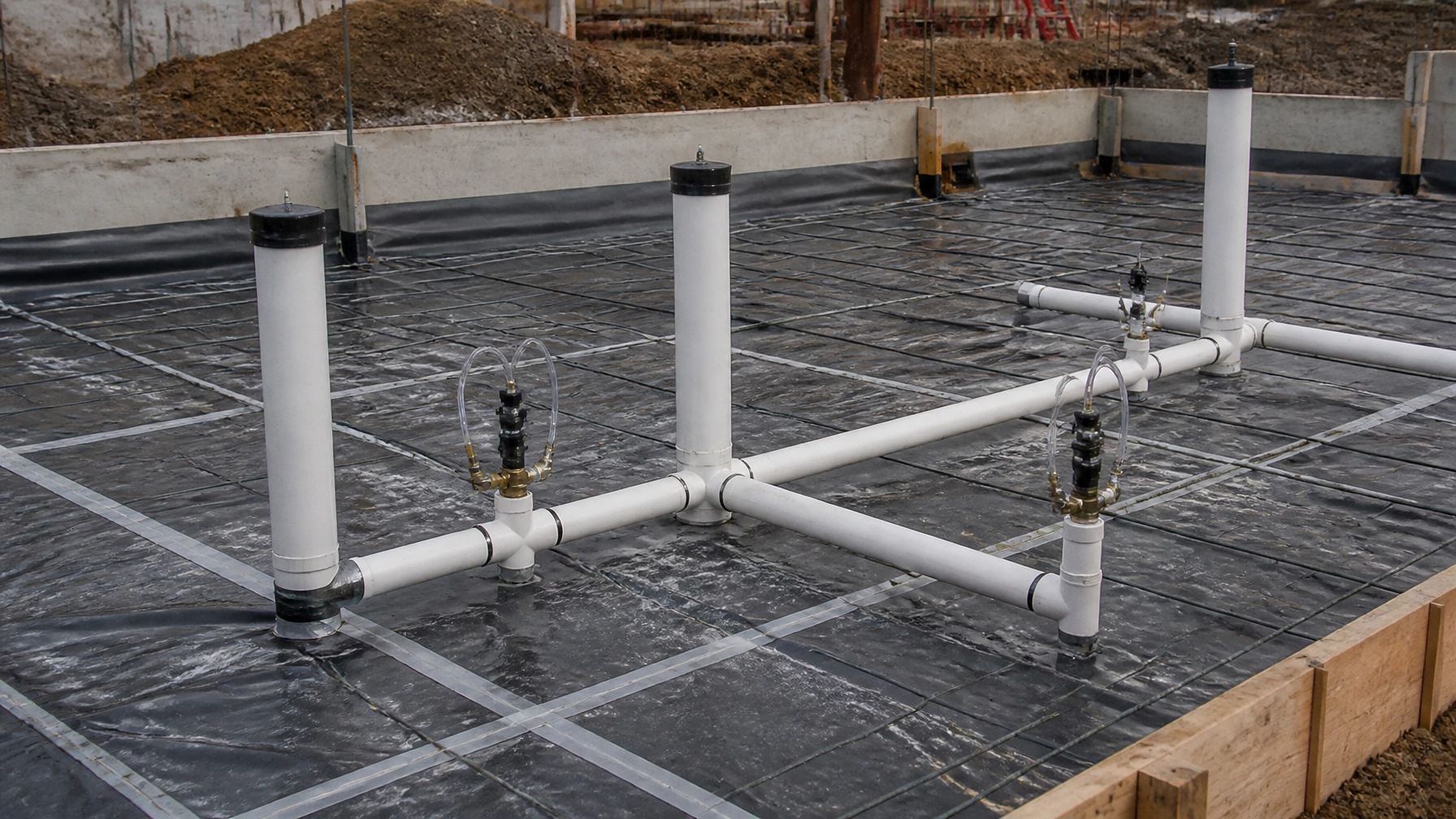
When vapor intrusion is a confirmed risk, you have to mitigate. This usually involves a Sub-Slab Depressurization System (SSDS).
The 2021 standards make the design of these systems even more critical. There is a common misconception that you can just "throw down a vapor barrier" and be done with it. Under the new rules, if your indoor air exceeds the standards, a passive barrier alone is rarely enough.

The Envicon Approach to Mitigation:
- Precision Design: We don't over-engineer. Many firms will spec an active system with high-horsepower fans when a well-designed passive system with a site-specific ARS would satisfy the LSRP and the NJDEP.
- Vapor Barriers as Insurance: We treat vapor barriers not just as a checkbox, but as a critical engineering control that must be documented with field-level QA/QC.
- Communication: We sit at the table with your architects and MEP engineers. If the SSDS piping interferes with your utility layout, we solve it in the field, not through three weeks of "coordination meetings."
Alternative Remediation Standards (ARS): Your Secret Weapon
The 2021 rule formally expanded the Alternative Remediation Standards (ARS) framework to include the vapor intrusion pathway. This is a game-changer for high-value sites.
Instead of being bound by the "default" NJDEP numbers, an ARS allows us to calculate a site-specific standard based on your building's actual characteristics: like air exchange rates, foundation thickness, and specific soil conditions.
Why use an ARS?
- It can eliminate the need for expensive active mitigation systems.
- It can move a project from "remediation required" to "compliance achieved."
- It provides a technically defensible path to a Response Action Outcome (RAO).
Most consultants are too scared to propose an ARS because it requires more work and a deeper understanding of the toxicology. At Envicon, we see an ARS as a tool to unlock your site’s potential. We don't sell reports; we sell the cleared path to your RAO.

The Envicon Difference
When you're dealing with vapor intrusion in NJ, you aren't just fighting chemistry; you're fighting the clock. Every week your project sits in a "coordination queue" at a national firm is a week of carrying costs you’ll never get back.
- LSRP Access: You talk to the person signing your documents. No middle managers.
- Field-First Mentality: We know how NJ soil and groundwater behave because we’re on the sites daily, from Hudson County to the Shore.
- Zero Jargon: We’ll tell you exactly what the 2021 standards mean for your bottom line, without hiding behind a 500-page report.
Summary Checklist for Developers:
- Re-evaluate old data: Does your 2019 Phase II meet the 2021 codified standards?
- Check compound specifics: Are you dealing with 1,1-DCE or other updated VOCs?
- Audit your footprint: If you're building over 50,000 sq. ft., is your sampling plan updated for the new density requirements?
- Consult an LSRP early: Mitigation is 10x cheaper to install during construction than it is to retrofit.
Don't let vapor intrusion stall your project. Contact Envicon Group today to review your site data and ensure you're compliant with the latest NJDEP standards.
Leave a Reply