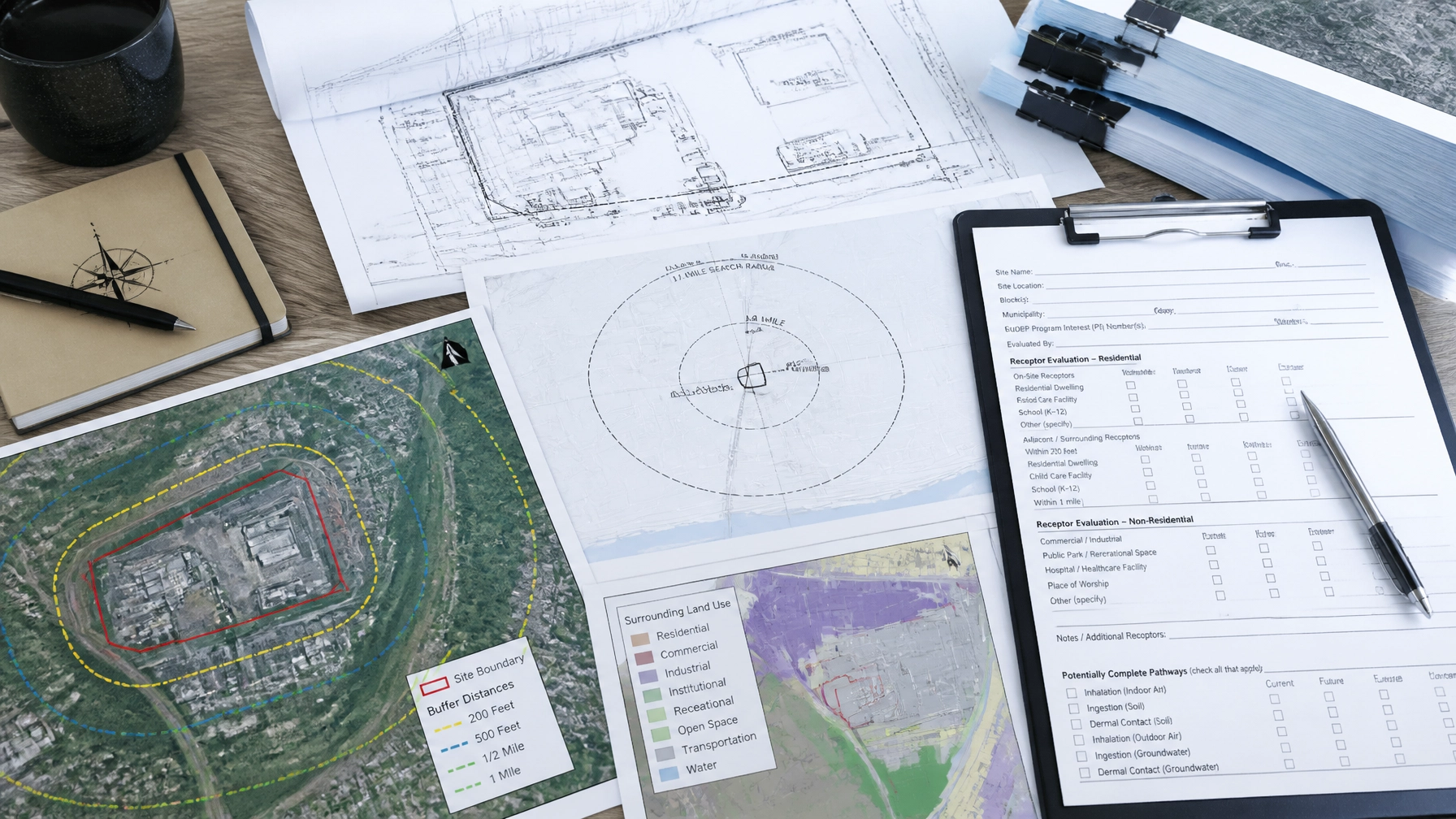
If you’re developing property in New Jersey, you’ve likely heard your LSRP mention the "Receptor Evaluation" (RE) form. To the uninitiated, it looks like just another piece of NJDEP paperwork. To an experienced developer or project manager, however, the RE form is the most critical document in the early phase of a project.
It isn't just a compliance checkbox. The Receptor Evaluation is the primary tool NJDEP uses to determine the level of "threat" your site poses to the public and the environment. Missing a deadline or mishandling the data on this form doesn't just result in a fine; it can fundamentally shift your project from a standard cleanup into an Immediate Environmental Concern (IEC) status, which brings construction to a grinding halt.
At Envicon, we don’t treat the RE as a standalone report. We treat it as the roadmap for your site investigation and remediation strategy.
The One-Year Clock: NJDEP Receptor Evaluation Form Submission Deadlines
The most important thing to know about the Receptor Evaluation is that it has a hard deadline. Under N.J.A.C. 7:26E-1.12(c), the initial Receptor Evaluation form is due no later than one year after the earliest "requirement to remediate."
What triggers that one-year clock? It’s usually one of three things:
- The discovery of a discharge (e.g., a failed tank test or a contaminated soil sample).
- An ISRA-triggering event (like the sale of an industrial business).
- The issuance of a court order or NJDEP directive.
If your consultant is sitting on your data and misses this window, you’re not just late: you’re out of compliance with a Regulatory Timeframe. In New Jersey’s LSRP program, missing regulatory timeframes puts you on the fast track to Direct Oversight, where the NJDEP takes the wheel, chooses your remedy, and potentially hits you with penalties of up to $20,000 per day.

Why the RE is the Foundation of Your Schedule
The Receptor Evaluation forces an LSRP to look beyond the property lines. It asks: Who or what is at risk? The answers to these questions dictate the scope and speed of your entire project.
1. Potable Well Searches
The RE requires a 2,000-foot well search. If your site has groundwater contamination and there are potable wells within that radius, you are no longer in a "monitor-and-wait" scenario. You are now looking at high-priority sampling and potential point-of-entry treatment systems (POETS).
2. Vapor Intrusion (VI)
If your site has volatile organic compounds (VOCs) and there are occupied buildings nearby, the RE triggers a Vapor Intrusion investigation. This can mean installing sub-slab depressurization systems in neighboring properties: a massive logistical and financial hurdle if not planned for in your initial remediation design.
3. Ecological Receptors
Is there a wetland or a stream adjacent to your site? The RE identifies these sensitive areas. If contaminants are migrating toward them, your "simple" soil cleanup just became an ecological risk assessment with significantly higher cleanup standards.
By identifying these "receptors" early, we can build a remediation schedule that accounts for these variables. Big-box firms often wait until the last minute to fill out the RE form, only to "discover" a sensitive receptor that blows the budget and the timeline six months into the project. We do the work upfront so there are no surprises.
Milestone Updates: SI, RI, and RA
The Receptor Evaluation is not a "one-and-done" document. NJDEP requires that it be updated and resubmitted with every major milestone report:
- Site Investigation (SI) Report
- Remedial Investigation (RI) Report
- Remedial Action (RA) Report
Each update confirms that no new receptors have appeared (like a new daycare opening next door) and that your remediation is successfully protecting the receptors you already identified.

The Envicon Difference: Direct Leadership vs. The Black Box
When you hire a national firm, the person filling out your RE form is likely a junior staffer in a satellite office who has never stepped foot on your site. They’re looking at a map and a database, checking boxes to protect their firm’s liability.
At Envicon, we operate differently:
- PE-Led Strategy: Your Receptor Evaluation is handled by the same professionals who sit at the table with the NJDEP. We understand the nuances of the "Receptor Evaluation FAQ" and how to navigate complex VI or well-search issues without over-complicating the project.
- Real-Time Visibility: Most firms hand you a PDF report once a month. Through our digital solutions, our clients have real-time access to project dashboards. You’ll know exactly where we are with the RE well search and when the form is ready for submittal: no "black box" coordination.
- Regulator Fluency: We know the reviewers at the NJDEP. We know what they’re looking for in an RE update, which means cleaner submittals and a faster path to your Response Action Outcome (RAO).

Summary: Don't Let a Form Stall Your Project
The Receptor Evaluation is the "brain" of your New Jersey remediation project. It defines the risks, dictates the urgency, and sets the schedule.
- Initial Deadline: 1 year from the "requirement to remediate."
- Ongoing Updates: Required at SI, RI, and RA milestones.
- Impact: Missing receptors leads to IECs and construction delays.
- Risk: Missing deadlines leads to fines and NJDEP Direct Oversight.
If your current consultant treats the RE form as an afterthought, you’re sitting on a ticking clock. You need a partner who sees the cleared path, not just the report.
Take Ownership of Your Schedule
Don't wait for a "deficiency letter" from the state. Let’s look at your site, identify your receptors, and build a schedule that keeps your project moving.
Contact Envicon Group today to ensure your Receptor Evaluation and NJDEP filings are on track.
Leave a Reply