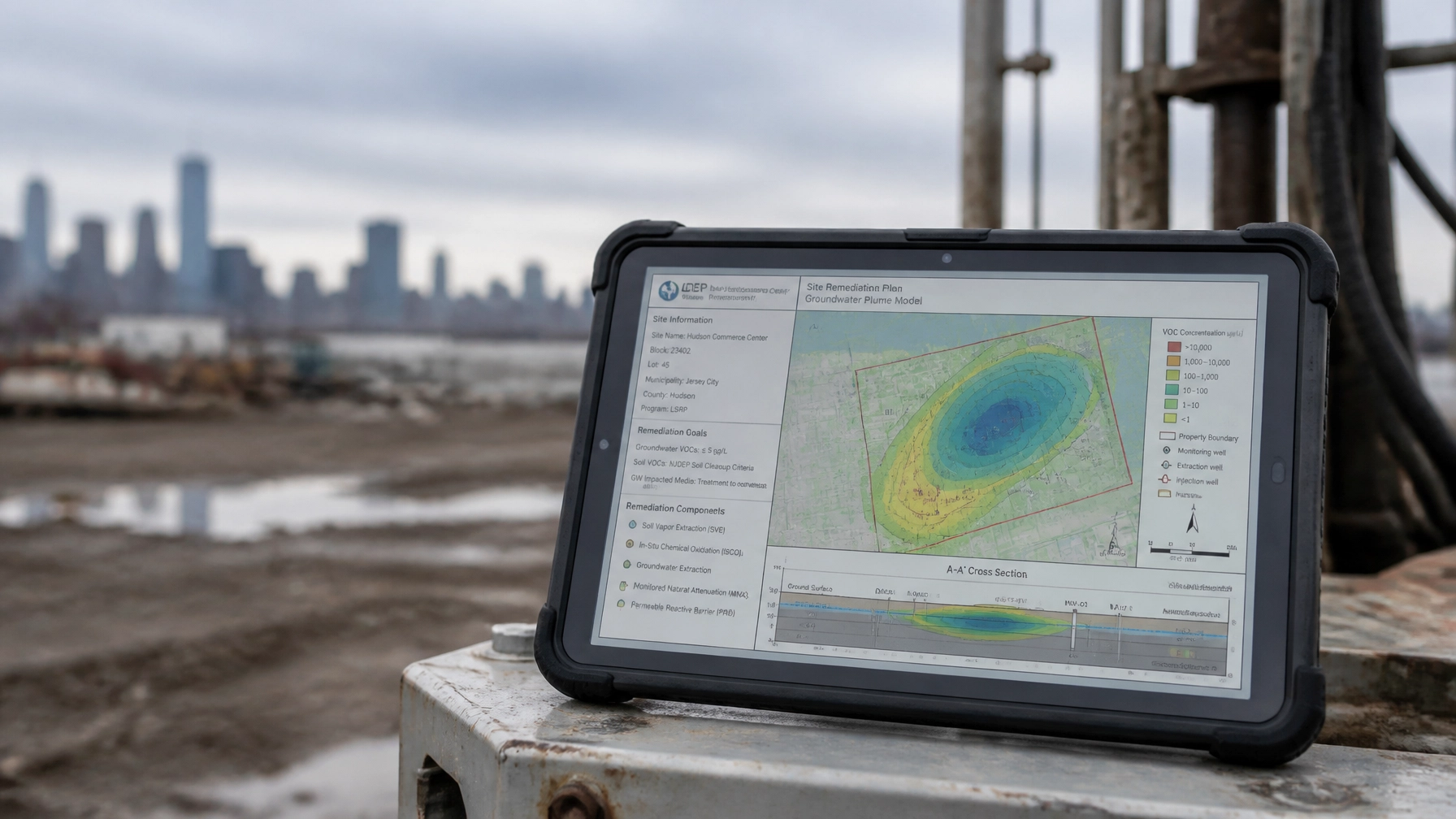
If you’re a real estate developer in New Jersey, you’ve likely felt the weight of a project hanging on a single signature. That signature belongs to your Licensed Site Remediation Professional (LSRP). Since the enactment of the Site Remediation Reform Act (SRRA), the balance of power in New Jersey’s environmental landscape shifted from the state to the private sector.
But here is the reality many developers learn too late: not all LSRP oversight in NJ is created equal.
When you hire a big-box national firm, the person signing your Response Action Outcome (RAO) is often three levels of management removed from your site. They are reading notes from a junior field tech they’ve never met, and they’re making defensive, conservative decisions to protect their firm’s liability: not to move your project forward.
At Envicon Group, we believe the relationship between a developer and an LSRP shouldn’t be a "black box" bureaucracy. It should be a direct line of communication. In this deep dive, we’re breaking down the technical requirements of the NJDEP site remediation program and why direct access to your LSRP is the only way to keep a high-stakes project on track.
What is NJ LSRP Oversight for Property Developers?
To understand the value of the relationship, you first have to understand the role. Under the NJDEP site remediation program, the LSRP essentially acts as the "deputized" agent of the state. They have the authority to oversee the remediation of contaminated sites without the NJDEP looking over their shoulder at every single step: unless the project triggers "direct oversight."
For a developer, this is a double-edged sword. On one hand, you have more control over your timeline. On the other, the LSRP bears the professional responsibility for ensuring the site meets all NJDEP Technical Requirements for Site Remediation (N.J.A.C. 7:26E).
The LSRP oversight process for contaminated property redevelopment typically follows a rigid four-stage pipeline:
- Preliminary Assessment (PA): The deep dive into historical records to identify Areas of Concern (AOCs).
- Site Investigation (SI): Sampling those AOCs to determine if a discharge occurred.
- Remedial Investigation (RI): Mapping the horizontal and vertical extent of the contamination.
- Remedial Action (RA): The actual cleanup: whether it’s a "dig and haul," a cap, or an in-situ treatment.

LSRP vs. NJDEP Direct Oversight for Site Cleanup
One of the biggest risks for any New Jersey developer is falling into "Direct Oversight." This happens when mandatory timeframes are missed or when a site has specific, highly sensitive contaminants (like certain chromate or PCB sites) that the NJDEP decides they need to manage personally.
When you are in the NJDEP site remediation program under the guidance of an LSRP, you have flexibility. You can choose a remedial strategy that fits your end-use, whether that’s a restricted use with a Deed Notice or an unrestricted use cleanup.
Once you fall into NJDEP direct oversight, that flexibility vanishes. The Department dictates the remedy, the timeline, and the cost. Avoiding NJDEP direct department oversight with LSRP guidance is perhaps the most critical financial service an environmental consultant can provide. If your consultant misses a "Regulatory Timeframe" by even a day because your report was stuck in their "internal quality review" queue for three weeks, you could lose control of your site's destiny.
The Technical Reality: Why Direct Access Matters
Most consultants hand you a report and leave you to figure out what it means for your pro forma. But environmental data is not a static set of numbers; it’s a roadmap.
Take Vapor Intrusion (VI), for example. In the NJDEP Vapor Intrusion Technical Guidance, the thresholds are razor-thin. If your LSRP is actually on-site, seeing the soil strata and the building’s foundation personally, they can often identify "preferential pathways" that a junior staffer might miss.

When you have direct access to the professional signing the documents, you can have a technical conversation at 7:00 AM about whether a sub-slab depressurization system is truly necessary or if a more targeted sampling plan can prove the risk is negligible. At Envicon, we don't sell reports; we sell cleared paths. That means our LSRPs are in the field, not just in the boardroom.
The RAO vs. NFA: Knowing the Difference
For developers who have been in the game for decades, you might still be asking for a "No Further Action" (NFA) letter. But the difference between NJDEP NFA and LSRP RAO for developers is more than just an acronym change.
The NFA was a state-issued letter that essentially said, "The government is satisfied." The RAO is a document issued by the LSRP. Because the LSRP’s license is on the line with every RAO they issue, they have to be precise.
A "Conditional RAO" might allow you to close on your construction loan and get vertical, provided you have a Remedial Action Permit (RAP) in place. This is where the developer/LSRP relationship is most tested. Your lender needs to see a clear path to closure, and your LSRP needs to provide the technical documentation to satisfy that lender’s environmental counsel.
If your LSRP is an anonymous face at a firm with 10,000 employees, getting them to jump on a call with your lender's attorney is a nightmare of "billable hour" negotiations. At Envicon, we treat your lender’s questions as our own hurdles to clear.
The Envicon Advantage: Technology Over Paperwork
At big firms, regulatory coordination is a black box. You don't know who’s talking to your reviewer at the NJDEP or when. We’ve changed that dynamic by building proprietary technology that gives our clients a real-time view of their project's status.

Instead of waiting for a monthly PDF that is already outdated, our developers use digital dashboards to track:
- Mandatory and Regulatory Timeframes: Ensuring we never trigger direct oversight.
- Remediation Funding Source (RFS) status: Keeping your financial assurance compliant.
- Sampling heatmaps: Seeing exactly where the "hot spots" are in real-time.
This transparency allows for faster decision-making. If we find a localized spill during a site investigation under NJ LSRP oversight, we don’t wait two weeks to write a memo. We show you the data, we discuss the remedial options, and we move.
Managing the "Disposal Surprise"
Nothing kills a developer’s budget faster than a soil disposal surprise. Whether you’re dealing with NJDEP Historic Fill or localized contaminants, soil management is a logistics game disguised as an engineering problem.
By integrating our civil engineering and environmental teams, Envicon provides LSRP consulting for brownfield redevelopment in New Jersey that accounts for the "dirt" from day one. We don't just tell you the soil is contaminated; we build a management plan that minimizes export, maximizes on-site reuse where permitted, and ensures every yard is tracked with the precision required by the NJDEP.

Summary: A Partnership Built on Results
The NJDEP site remediation program is complex, but it shouldn't be an obstacle. Choosing the right LSRP means choosing a partner who understands that every week of delay is a week of carrying costs and market risk.
At Envicon Group, we’ve spent 20 years perfecting the balance of technical depth and developer-focused urgency. We sit at the table with the regulators so you don't have to wait in a queue.
Key Takeaways for Developers:
- Direct Access is Mandatory: Your LSRP should be accessible, field-ready, and capable of explaining technical risks in business terms.
- Timeframes are Non-Negotiable: Missing a deadline can trigger NJDEP Direct Oversight, stripping you of project control.
- Tech is the Great Equalizer: Use real-time data to make decisions faster and keep lenders confident.
- The RAO is the Goal: Every action taken on-site should be a strategic step toward the Response Action Outcome.
Ready to clear the path for your next project? At Envicon Group, we don’t just deliver reports: we deliver outcomes. Contact us today to discuss your site’s specific challenges.
Leave a Reply