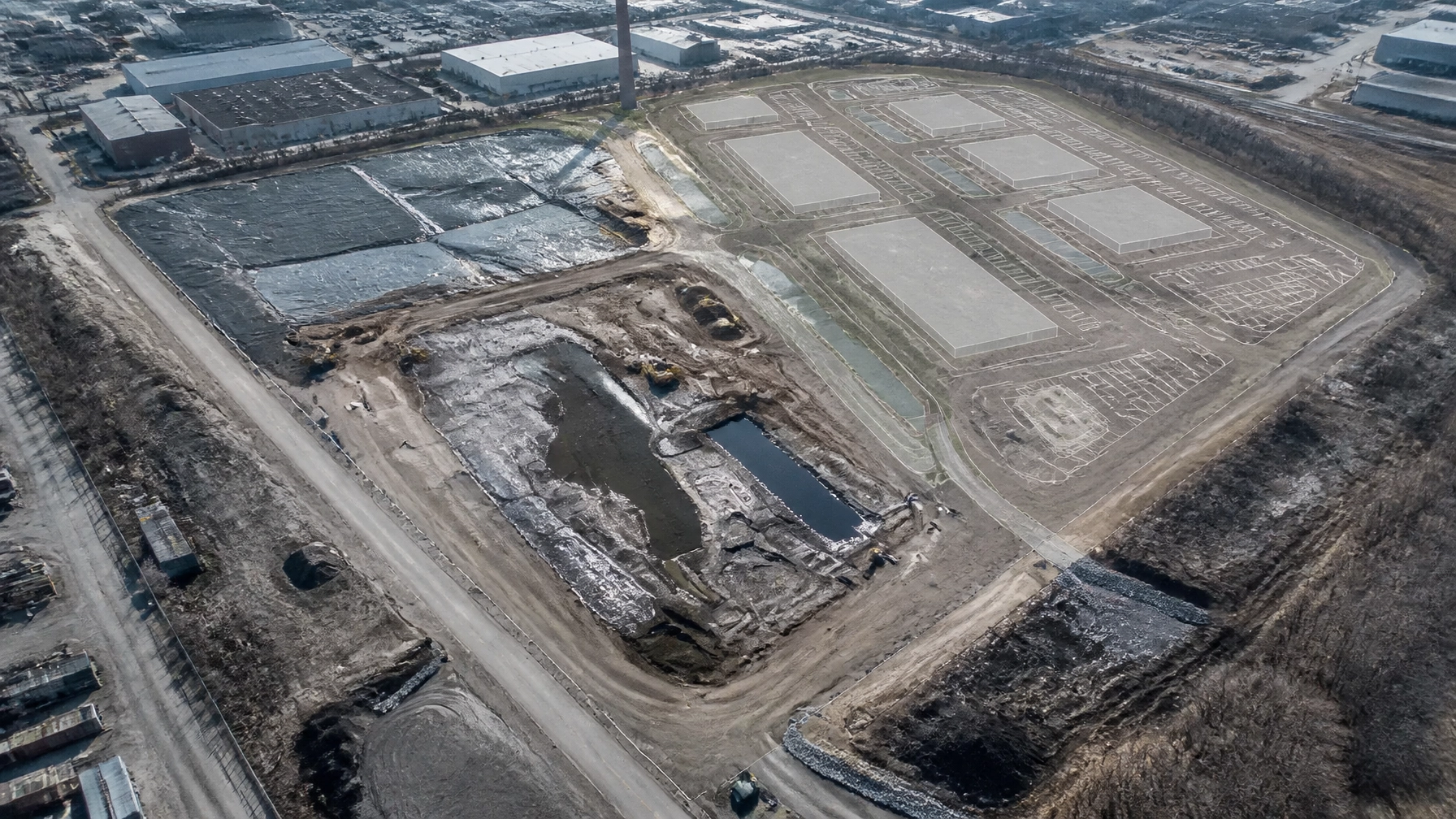
New Jersey’s Brownfields Redevelopment Incentive Program is not accepting new applications today. That does not mean the opportunity has disappeared. It means the program is being rebuilt.
Following legislation signed on September 4, 2024: P.L. 2024, c.061: the New Jersey Economic Development Authority is developing new implementing rules. NJEDA expects those rules to be released in 2026, after which a new application will be posted.
For developers, investors, and municipal redevelopment agencies, the practical message is simple:
The time to prepare for the NJ Brownfield Tax Credit is before the application opens: not after.
Your project’s remedial cost documentation, regulatory position, financing gap, municipal support, and LSRP record will determine whether you can move quickly when the rules drop.
What is changing with the NJ Brownfield Tax Credit?
The existing Brownfields Redevelopment Incentive Program provides a one-time, transferable tax credit tied primarily to eligible remediation costs. The program is designed to make contaminated and underutilized properties financially viable for redevelopment.
Historically, qualified projects could receive tax credits covering a substantial portion of eligible remediation costs: up to 75% under prior program structures, subject to statutory and per-site caps. The amended framework outlined by NJEDA provides:
- Up to 80% of remediation costs, capped at $12 million, for projects in a Qualified Incentive Tract or Government-Restricted Municipality.
- Up to 60% of remediation costs, capped at $8 million, for other eligible brownfield projects.
- Up to 100% of certain remediation and capping costs for solar projects on closed sanitary landfills, subject to location-based caps.
- Transferable credits that may be sold or assigned, subject to program requirements.
The controlling details will come from the final rules and application materials. Until NJEDA publishes them, developers should treat the current program page and signed legislation as the governing roadmap: not as a substitute for final program guidance.
NJEDA’s official notice confirms that the NJ Brownfield Tax Credit program is currently closed to new applications and that new rules are expected in 2026. Review the NJEDA Brownfields Redevelopment Incentive Program page for updates.
A4914 could broaden the opportunity for residential redevelopment
Separate from the 2024 legislation, A4914 was introduced in the New Jersey Legislature on May 7, 2026. It remains proposed legislation, not enacted law.
As introduced, A4914 would expand the NJ Brownfield Tax Credit framework to include certain residential redevelopment projects constructed on remediated brownfield sites.
The bill would also:
- Increase the total program authorization from $100 million to $250 million over the program period.
- Allow up to $150 million in credits for residential redevelopment projects.
- Create separate applications for remediation projects and residential redevelopment projects.
- Require qualifying residential projects to be located within:
- Two miles of a public rail or light rail stop, or
- One mile of a public bus stop.
- Require primarily multifamily projects to include specific bedroom-unit proportions.
- Require at least 20% affordable housing for qualifying residential projects.
- Maintain municipal support, prevailing wage, reporting, and compliance requirements.
The bill’s transit and affordability provisions could materially affect project planning in places such as Hudson County, Newark, Elizabeth, Paterson, Trenton, and other transit-connected redevelopment markets.
But do not underwrite a project as if A4914 has already passed. The bill may change, stall, or be replaced. Use it as a signal of where state policy may be headed.
For residential developers, the signal is clear: site selection, transit access, unit mix, affordability strategy, and remediation sequencing may need to be evaluated together.

Position your project before the application window opens
NJEDA applications are not built around a general statement that a site is contaminated. They require evidence.
The stronger your technical and financial record, the easier it will be to show that your project meets the program’s requirements and can advance without months of reconstruction.
1. Build an eligible remedial cost file
Start separating eligible remediation costs from general development costs now.
Your cost file should be organized by work category and supported by source documentation, including:
- Preliminary assessment and site investigation costs.
- Soil, groundwater, and vapor investigation.
- Remedial investigation and remedial action work.
- Excavation, transportation, treatment, disposal, and reuse of soil.
- Groundwater treatment and discharge management.
- Demolition, asbestos abatement, and contaminated building material removal.
- Engineering controls, caps, vapor mitigation, and related remedial infrastructure.
- Contractor invoices, purchase orders, change orders, disposal manifests, and payment records.
- Labor and subcontractor documentation.
The objective is not to create a larger number. It is to create a defensible number.
Under the amended statutory framework, final credit certification requires evidence of actual remediation costs. Those costs must be supported by appropriate professionals, including a certified public accountant and an LSRP for work governed by New Jersey’s Site Remediation Reform Act.
A clean cost file protects the credit calculation and gives lenders, equity partners, municipal officials, and counsel a clearer view of the project’s real economics.
2. Confirm your ISRA position
If your property involves an industrial establishment, the Industrial Site Recovery Act may affect the transaction, closure, transfer, or redevelopment schedule.
When ISRA applies, NJDEP guidance identifies key obligations such as:
- Filing a General Information Notice within the applicable five-day timeframe after an ISRA trigger.
- Retaining an LSRP and notifying NJDEP within the applicable 45-day timeframe.
- Establishing a Remediation Funding Source when required.
- Completing investigation and remediation under the applicable NJDEP rules and technical requirements.
NJDEP’s Contaminated Site Remediation and Redevelopment Program provides current forms, guidance, and regulatory resources. The exact requirements depend on the facility, transaction structure, operations, and site history.
Do not wait until the tax-credit application to resolve an ISRA question. A missed notice, incomplete financial assurance package, or unclear responsible-party position can create delays that have nothing to do with construction.
3. Put the LSRP record in order
New Jersey’s LSRP system places responsibility for site remediation with a licensed professional, subject to NJDEP oversight and audit.
That makes the LSRP record central to both regulatory closure and tax-credit readiness.
Your project team should be able to quickly identify:
- Areas of concern and the basis for each investigation.
- Historical site operations and potential contaminant sources.
- Current and future land-use assumptions.
- Remedial investigation findings.
- Soil, groundwater, vapor, and receptor evaluations.
- Engineering and institutional controls.
- Remedial action permits and ongoing obligations.
- Status of the Response Action Outcome, if issued.
- Remaining conditions that could affect redevelopment.
An RAO is not just a closing document. It is evidence that the remediation was completed in accordance with applicable requirements. For a tax-credit application, it also helps demonstrate that the environmental work is complete, documented, and connected to a viable redevelopment plan.

Municipal support and project economics will matter
The NJEDA program requires a letter of support from the governing body of the municipality. That requirement makes early coordination essential.
Municipal redevelopment agencies should not be brought in after the technical plan and financing package are already fixed. The strongest projects connect:
- The municipality’s redevelopment objectives.
- Existing zoning and redevelopment plans.
- Public-health and environmental benefits.
- Transit access and infrastructure capacity.
- Affordable housing or community-use goals.
- The project’s financing gap.
- A realistic remediation and construction schedule.
NJEDA also expects applicants to demonstrate that the project is not economically feasible without the tax credit under applicable program criteria. That requires more than a simple pro forma shortfall.
You should be prepared to show:
- Total remediation costs.
- Total project costs.
- Developer equity.
- Debt and investor capital.
- Grants or other incentives.
- Reasonable return assumptions.
- Remaining financing gap.
- The effect of the credit on project feasibility.
The numbers need to match across the environmental report, cost estimate, redevelopment agreement, lender materials, and application. If each document tells a different story, reviewers will notice.
Why preparation should start with one accountable team
Brownfield redevelopment crosses environmental, civil, regulatory, construction, financial, and municipal workstreams. When those workstreams sit with separate firms that do not coordinate closely, the project owner becomes the integration manager.
That is where many projects lose time.
Envicon works across remediation and brownfield support, NJ LSRP services, civil engineering, compliance, and construction oversight. Our role is not to hand over a report and leave you to interpret it.
We help connect site conditions to an actionable redevelopment path:
- What contamination exists?
- What remediation is required?
- What costs are potentially eligible?
- What work has already started?
- What must be documented before the rules reopen?
- Does ISRA apply?
- What does the LSRP need to certify?
- What will the municipality, lender, and NJEDA need to see?
- What could create a delay or disqualify the project?
That coordination is especially important because the program may use rolling applications, but demand could exceed available credits. The current statutory framework includes annual limits, and higher per-project awards may increase competition for available funding.
A practical 2026 readiness checklist
Before the NJ Brownfield Tax Credit application reopens, confirm that your team has:
- Completed or updated Phase I and Phase II environmental assessments.
- Identified all known areas of concern.
- Confirmed whether ISRA applies.
- Retained an LSRP where required.
- Organized remedial cost records and supporting invoices.
- Documented soil, groundwater, vapor, demolition, and disposal activities.
- Confirmed the project’s current remedial status.
- Reviewed RAO, permit, and engineering-control requirements.
- Evaluated Qualified Incentive Tract or Government-Restricted Municipality status.
- Built a financing-gap analysis.
- Coordinated with the municipality on a support letter.
- Tested the redevelopment plan against possible A4914 requirements if residential use is contemplated.
- Assigned one accountable team to manage technical, regulatory, and application coordination.
The window is reopening: but readiness determines who captures it
The NJ Brownfield Tax Credit can help convert a contaminated or underused property into a financeable, buildable asset. But the credit will not fix an incomplete investigation, unsupported remediation budget, unresolved ISRA issue, or disconnected project team.
The developers best positioned for 2026 will be the ones preparing now.
At Envicon, we solve environmental and engineering challenges with precision, speed, and trust. We do not just deliver services. We help clear the path between a difficult site and its next productive use.
If your New Jersey project may depend on the next Brownfields Redevelopment Incentive Program rules, start building the record today.
Take the next step
- Call Envicon now to discuss your brownfield redevelopment project.
- Use our proprietary project risk screener to identify potential environmental and regulatory obstacles.
- View Envicon’s complete list of services for remediation, LSRP support, civil engineering, compliance, and construction oversight.
Leave a Reply