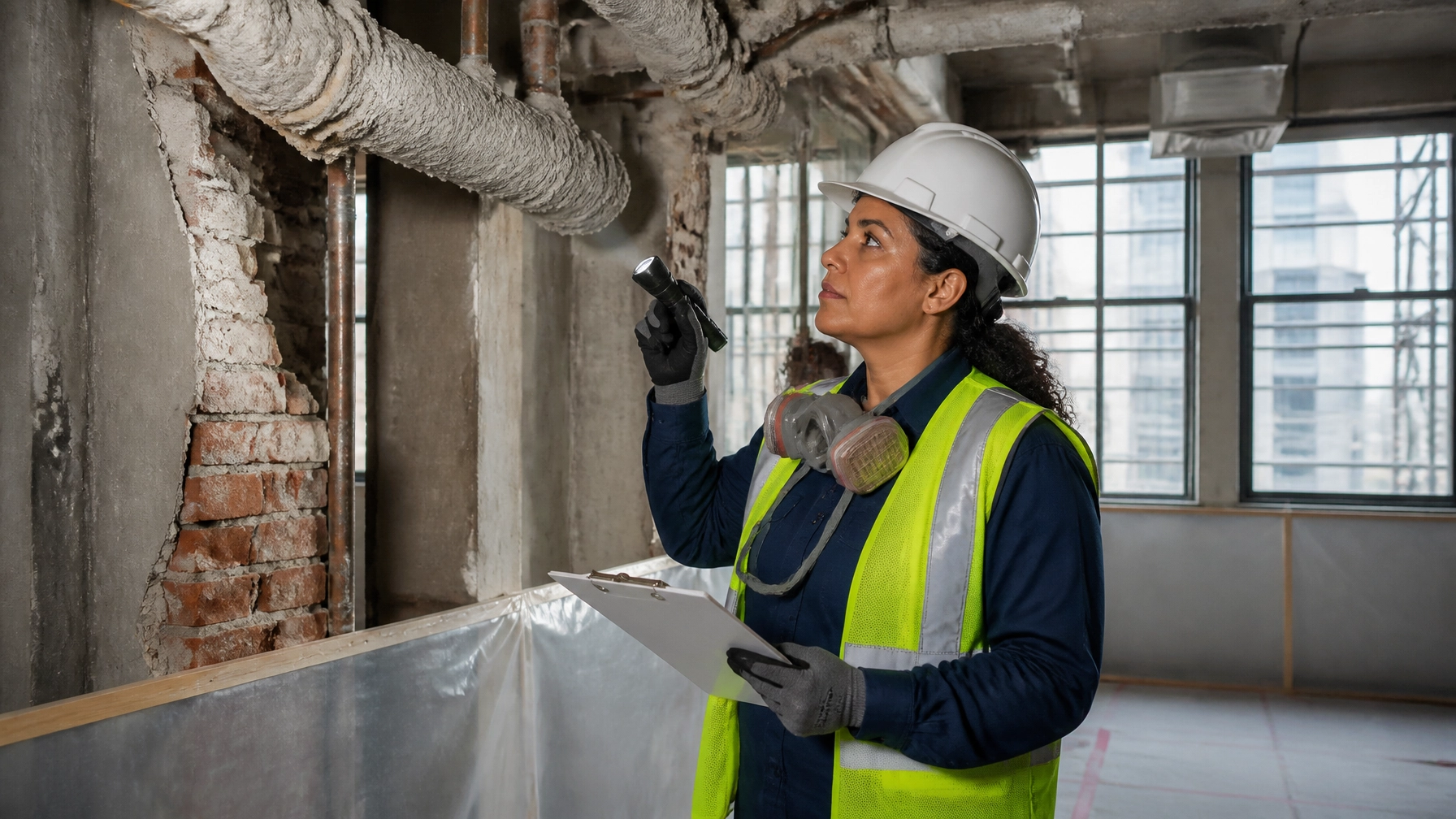
A renovation schedule can move quickly until asbestos documentation stops it.
In New York City, most renovation, alteration, repair, and demolition projects require an asbestos survey before work begins. The requirement applies across Manhattan, Brooklyn, Queens, the Bronx, and Staten Island. It also applies regardless of whether the building is residential, commercial, industrial, institutional, or vacant.
The governing framework is New York State Industrial Code Rule 56, codified at 12 NYCRR Part 56. NYC Department of Environmental Protection (DEP) and Department of Buildings (DOB) filings then determine whether the project can proceed.
For owners, developers, contractors, and design professionals, the practical rule is straightforward:
Complete the asbestos survey before disturbing building materials or expecting the related DOB permit to move forward.
When is an NYC asbestos survey required before renovation?
Under Industrial Code Rule 56, an asbestos survey is required before work that may disturb building materials, including:
- Renovation
- Remodeling
- Repair
- Alteration
- Selective demolition
- Full building demolition
- Plumbing, mechanical, electrical, and structural work
- Façade, roof, and interior work that may disturb suspect materials
The survey must cover the building or the specific portion affected by the proposed work. It should identify asbestos-containing material (ACM), presumed asbestos-containing material (PACM), and other suspect materials that could be disturbed.
Common materials requiring evaluation include:
- Thermal system insulation on pipes, boilers, and ducts
- Sprayed or troweled fireproofing
- Floor tile, mastic, and leveling compounds
- Plaster, textured coatings, and joint compound
- Roofing felts and flashing
- Caulks, sealants, and glazing compounds
- Cement board and transite materials
- Window and door components
- Electrical and mechanical equipment insulation
A building’s construction date does not eliminate the need to evaluate the work area. If the owner does not obtain a compliant survey, the affected materials generally must be treated as asbestos-containing until properly characterized.
The New York State Department of Labor asbestos survey guidance explains the owner’s responsibility to obtain the survey before demolition, renovation, remodeling, or repair work.
Who can perform the survey?
An NYC asbestos survey is not a general visual walkthrough performed by a building superintendent or construction manager. The work must be completed by appropriately certified asbestos professionals.
The certified asbestos inspector is responsible for:
- Reviewing available building plans, specifications, maintenance records, and prior asbestos documentation.
- Conducting a thorough visual inspection of the affected areas.
- Identifying suspect ACM and PACM.
- Collecting representative samples where appropriate.
- Coordinating laboratory analysis through an appropriately accredited laboratory.
- Documenting material locations, quantities, conditions, and sampling results.
- Determining whether the planned scope will disturb asbestos.
- Preparing the required NYC asbestos documentation.
In New York City, the investigator responsible for the ACP-5 must be DEP-certified. The survey must also satisfy the technical requirements of New York State Industrial Code Rule 56 and applicable federal OSHA and EPA requirements.
The inspector’s role is different from the abatement contractor’s role. The inspector evaluates and documents the materials. A licensed asbestos abatement contractor performs regulated removal, enclosure, encapsulation, or other asbestos work when the survey shows that ACM will be disturbed.
That distinction matters. Hiring the wrong party at the beginning can create rejected filings, duplicated sampling, and delays between the environmental investigation and the construction permit.

What is the ACP-5 form?
The ACP-5 Asbestos Assessment Report is the primary NYC form used to document the asbestos assessment for many renovation and demolition applications.
A DEP-certified asbestos investigator prepares, signs, and seals the ACP-5 when the assessment determines that:
- The affected building or work area is free of ACM;
- ACM is present but will not be disturbed by the proposed work; or
- The quantity of ACM falls within the applicable minor-project criteria.
The ACP-5 connects the field investigation to the city permitting process. It gives DEP and DOB a documented basis for determining whether the proposed work can proceed without a full asbestos abatement project.
For a full building demolition, the NYC DEP states that DOB will issue the demolition permit based on an ACP-5 with Box 8d checked, indicating that the entire building is free of asbestos-containing material.
That is an important distinction. An ACP-5 for a limited renovation area does not automatically clear the entire building for demolition. The form must match the scope of the DOB application and the actual work planned.
Owners should confirm that the following information aligns across the survey, ACP-5, DOB application, and construction documents:
- Property address and borough
- Building identification number
- Floors and rooms included in the work
- Demolition or alteration scope
- Material locations and quantities
- Whether ACM will be disturbed
- Whether the filing covers the full building or only a portion
A scope mismatch can create a technical objection even when the underlying survey is sound.
What happens when asbestos will be disturbed?
If the survey identifies ACM that the renovation or demolition will disturb, the work becomes an asbestos project under NYC requirements.
For projects involving more than 25 linear feet or 10 square feet of ACM, NYC DEP identifies the work as an asbestos project requiring an ACP-7 Asbestos Project Notification. The building owner or authorized agent must file the notification through the Asbestos Reporting and Tracking System (ARTS).
The ACP-7 filing typically identifies:
- The asbestos abatement contractor
- The air-monitoring company
- The project location
- ACM type, quantity, and location
- Planned start and completion dates
- Work methods
- Containment and decontamination procedures
- Whether the project triggers additional technical review
NYC DEP states that an ACP-7 should generally be submitted at least one week before the start of the asbestos work. More complex projects may require significantly more lead time.
Some projects trigger review by the Asbestos Technical Review Unit (A-TRU). Examples can include work affecting corridors, stairs, elevators, fire doors, fire stopping, risers, fire alarm components, or other building life-safety systems.
When A-TRU review applies, the project may require a Registered Design Professional to prepare a sealed Workplace Safety Plan. DEP recommends submitting that material several weeks before the planned start date.
This is where asbestos coordination must connect with the DOB construction schedule. The asbestos filing, abatement sequence, tenant protection plan, life-safety measures, and DOB work application must describe the same project.
ACP-20, ACP-21, and project completion
The ACP-20 Asbestos Project Conditional Completion form documents conditional completion of an asbestos project. The ACP-21 Asbestos Project Completion form documents final project completion after the required procedures and clearance activities.
These forms are important project records, but they do not replace the ACP-5 for a full building demolition permit.
NYC DEP specifically states that DOB will not accept an ACP-20 or ACP-21 as the basis for issuing a full building demolition permit when an ACP-5 showing the building is asbestos-free is required.
The typical sequence is:
- Conduct the Rule 56-compliant asbestos survey.
- Prepare and file the ACP-5 when the project qualifies as non-asbestos, no-disturbance, or minor work.
- If ACM will be disturbed, file the ACP-7 and obtain the necessary asbestos project approvals.
- Complete abatement under the approved work plan.
- Perform final cleaning and clearance air monitoring.
- File the required project monitor and completion documentation.
- Coordinate final DOB sign-off and project closeout.
For larger or phased projects, the filing strategy should be established before contractors mobilize. A project that requires simultaneous demolition and abatement may also require an A-TRU permit or a variance. Work requiring a variance cannot begin before DEP approval.

Penalties for non-compliance across the five boroughs
The rules do not change by borough. A project in Queens is subject to the same state Industrial Code Rule 56 framework as a project in Manhattan, Brooklyn, the Bronx, or Staten Island.
Proceeding without the required survey or filing can result in:
- DOB or DEP stop-work orders
- Notices of violation
- Rejected or delayed permit applications
- Re-mobilization and re-sampling costs
- Contractor schedule claims
- Environmental Control Board penalties
- NYSDOL enforcement
- Additional exposure under OSHA or EPA requirements
- Delays to financing, closing, or construction turnover
NYC asbestos violations can carry civil penalties that reach thousands of dollars per violation. The applicable amount depends on the specific violation, enforcement authority, prior history, and project circumstances. Inaccurate or incomplete filings can create additional exposure, particularly when the submitted documentation does not match field conditions.
The NYC DEP asbestos rules and regulations and DEP abatement form instructions should be reviewed for the current filing requirements.
NYC renovation asbestos survey checklist
Before submitting a DOB application or scheduling demolition, confirm that you have:
- A survey performed by a qualified, certified asbestos inspector
- A scope that covers every area affected by the proposed work
- Laboratory results for suspect materials requiring analysis
- A current ACP-5, when applicable
- An ACP-7 notification if the work will disturb regulated quantities of ACM
- A licensed asbestos abatement contractor, when required
- An independent air-monitoring firm, when required
- A-TRU or variance review, when triggered
- Consistent information across the survey, ACP forms, DOB filing, and construction plans
- Copies of required documents available at the job site
The objective is not simply to obtain a form. It is to establish a defensible path from investigation to permit to construction.
Keep your project moving with the right asbestos team
At Envicon Group, we coordinate environmental requirements with the realities of NYC construction schedules. Our team helps owners, developers, attorneys, contractors, and design professionals identify asbestos obligations early, define the affected work areas, and organize the documentation needed for the next approval.
We bring a field-first approach to environmental compliance. That means direct communication, clear deliverables, and practical coordination between the investigator, abatement contractor, air monitor, architect, engineer, and DOB filing team.
A complete asbestos survey is not a box to check after the project is designed. It is an early decision point that protects your schedule and your asset.
Take the next step
- Call Envicon Group at (917) 764-2171
- Book a free consultation
- Use the risk screener tool
- Review Envicon’s environmental assessment services
The right survey does more than identify asbestos. It clears the path to safe, compliant construction.

Leave a Reply