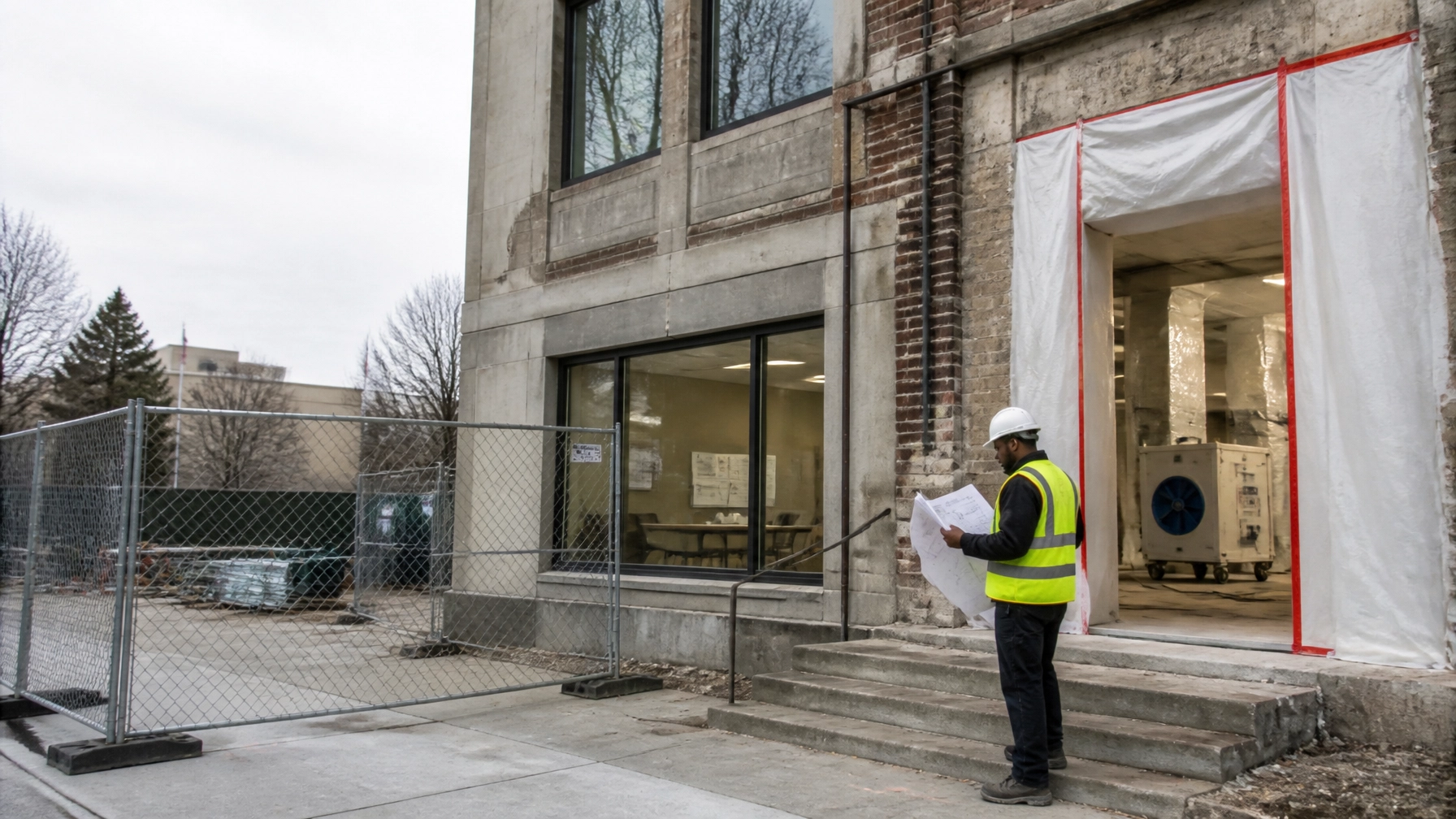
A demolition or renovation permit in New Jersey can be delayed before construction begins if the permit package does not address asbestos correctly.
For projects involving public buildings, municipal facilities, educational facilities, daycares, and nurseries, N.J.A.C. 5:23-8.6 establishes how asbestos documentation must coordinate with the construction permit. The rule requires an architect or engineer certification, an asbestos assessment when disturbance is possible, and abatement before affected work proceeds.
That makes the NJ asbestos survey for a demolition permit more than a standalone inspection. It becomes part of the permit strategy.
At Envicon Group, we help owners, architects, contractors, municipalities, and attorneys coordinate environmental requirements with the actual construction schedule. The goal is straightforward: resolve the asbestos issue before it becomes a stop-work issue.
“An architect/engineer certification concerning whether asbestos will be disturbed and to what extent it will be disturbed” must be provided before the permit is issued. : N.J.A.C. 5:23-8.6
What N.J.A.C. 5:23-8.6 Requires
Under N.J.A.C. 5:23-8.6, when an owner or authorized representative submits a construction permit application for repair, renovation, or demolition work, the construction official must receive information about potential asbestos disturbance.
The first requirement is a certification.
Architect or engineer certification
For projects that require an architect or engineer, the design professional must certify:
- Whether asbestos-containing material may be disturbed
- The extent of the anticipated disturbance
- Whether the proposed work involves materials, surfaces, or systems that may contain asbestos
If the project does not require an architect or engineer, the contractor undertaking the work provides the certification instead.
This certification should be based on the actual scope of work: not a generic statement attached to the permit application. Wall demolition, mechanical replacement, flooring removal, ceiling work, pipe insulation removal, and utility penetrations can all affect the answer.
A vague certification creates problems later. If the contractor discovers suspect material after the permit is issued, the municipality may require a work stoppage, additional sampling, revised plans, or a new abatement permit.
When an Asbestos Assessment Is Required
If the certification states that asbestos may become disturbed, the next step is an asbestos assessment.
The assessment must be prepared by one of the following:
- The New Jersey Department of Health
- A county or local health department
- A private business authorized by the New Jersey Department of Health
A qualified private asbestos inspector may perform the survey when properly accredited under the applicable EPA Model Accreditation Program requirements.
The assessment identifies suspect asbestos-containing materials, their locations, conditions, quantities, and the planned method of disturbance. Sampling typically involves representative bulk samples analyzed by polarized light microscopy, with additional analysis where required by applicable rules or project conditions.
The survey should be completed before the permit application is finalized whenever possible. That gives the architect, engineer, owner, and contractor time to incorporate the findings into the drawings and specifications.

What Happens If the Survey Finds Asbestos?
The presence of asbestos does not automatically stop a project. The issue is whether the planned work will disturb the material and whether that disturbance requires regulated abatement.
If the assessment indicates that asbestos hazard abatement is necessary, N.J.A.C. 5:23-8.6 requires the affected work to comply with the Asbestos Hazard Abatement Subcode.
The work that would disturb the asbestos cannot proceed until:
- The required abatement is complete; or
- The asbestos-containing material no longer presents a hazard because the approved scope or control method has changed.
The construction official may issue a partial permit for work that clearly will not disturb or interfere with the asbestos abatement work. This can help maintain progress on a complex project, but the partial permit must be carefully limited.
For example, site preparation or work in an unaffected area may proceed while abatement plans are reviewed. Demolition of a wall containing suspect fireproofing cannot.
NJ Asbestos Survey for Demolition Permits
Demolition requires additional coordination.
Under N.J.A.C. 5:23-8.18, buildings undergoing partial demolition: or buildings that will be reoccupied by people who are not wearing appropriate respiratory protection: must have friable asbestos and asbestos-containing material that will become friable during demolition properly removed.
Two permits may be involved:
- A construction permit for asbestos abatement under N.J.A.C. 5:23-8.5
- A demolition permit under the general Uniform Construction Code requirements
The demolition permit does not replace the asbestos abatement permit. Both requirements must be addressed when the project scope triggers them.
The demolition sequence should therefore be planned in this order:
- Complete the asbestos survey and hazard assessment
- Identify ACM that demolition will disturb
- Prepare abatement plans and specifications
- Select a New Jersey-licensed asbestos contractor
- Obtain the asbestos abatement permit
- Complete required notifications
- Perform abatement and clearance monitoring
- Obtain authorization to proceed with demolition
This is why an asbestos survey should happen during design and preconstruction: not after the demolition contractor arrives with equipment.
Licensed Contractor Requirements in New Jersey
New Jersey requires asbestos abatement work to be performed by a contractor licensed through the Department of Labor and Workforce Development, subject to applicable exemptions.
The contractor’s responsibilities include more than removing material. The contractor must also maintain the required work practices, containment, equipment, worker permits, waste handling procedures, and project records.
Under the New Jersey Asbestos Control and Licensing Act, contracts for regulated asbestos work must specify that the work will be performed by licensed contractors and subcontractors.
Before awarding the work, the owner and project team should verify:
- The contractor’s current New Jersey asbestos license
- The license type and scope
- Valid worker and supervisor permits
- Insurance and required project documentation
- Waste hauler and disposal arrangements
- Required notifications to state and federal agencies
A low bid from an unqualified contractor is not a cost-saving measure. It transfers risk to the owner, delays the permit, and can create liability for the architect, construction manager, and municipal project team.
NJ DCA Asbestos Safety Monitoring Requirements
The term “NJ DCA asbestos safety monitoring” generally refers to monitoring requirements administered under the New Jersey Department of Community Affairs’ Asbestos Hazard Abatement Subcode.
The subcode applies directly to asbestos abatement projects in:
- Public buildings
- Educational facilities
- Municipal facilities
- State and county facilities
- Daycare centers and nurseries
- Certain private buildings containing educational facilities
The New Jersey DCA Asbestos Hazard Abatement program states that educational facilities and public buildings undergoing asbestos abatement must be monitored by an authorized Asbestos Safety Control Monitoring firm, commonly called an ASCM.
“Any educational facility or public building that undergoes an asbestos abatement must be monitored by an authorized Asbestos Safety Control Monitoring (ASCM) firm.” : New Jersey Department of Community Affairs
The ASCM is hired by the building owner. Its certified Asbestos Safety Technician, or AST, continuously monitors and inspects the abatement work while it is underway.
Monitoring can include:
- Pre-commencement inspection
- Verification of containment and decontamination systems
- Review of worker permits
- Observation of waste handling
- Air monitoring
- Pressure differential monitoring
- Progress inspections
- Clean-up inspection
- Final visual inspection
- Clearance documentation
- Daily logs and final reporting
The DCA maintains a current list of authorized ASCM firms. Project teams should verify the firm’s authorization before including it in the permit application.
Air Monitoring, Clearance, and Reoccupancy
Air monitoring is not a paperwork exercise. It determines whether the containment system is working and whether the building or work area can safely move to the next phase.
The Asbestos Hazard Abatement Subcode establishes requirements for:
- Air sampling during abatement
- Laboratory analysis
- Clearance testing
- Pressure differential monitoring
- Visual inspection
- Removal of critical barriers
- Certificate of Completion
- Reoccupancy
For projects under the subcode, the asbestos safety technician must remain involved from preparation of the work area through final inspection. If the contractor fails to correct a deficiency, the technician can direct that work stop and notify the enforcing agency.
The project should not schedule reconstruction, demolition, or reoccupancy based only on the contractor’s statement that removal is complete. The required clearance process must support the transition.
NJDEP and NESHAP Notifications
New Jersey asbestos compliance also involves the NJDEP asbestos management requirements and federal NESHAP requirements under 40 C.F.R. Part 61, Subpart M.
For many commercial, public, and industrial renovation projects, written notification is required at least 10 days before regulated asbestos-containing material is disturbed. NJDEP identifies common RACM thresholds as:
- 260 linear feet on pipes
- 160 square feet on other facility components
- 35 cubic feet where length or area cannot be measured before removal
These thresholds do not eliminate the need for a building survey. They determine whether additional notification and disposal requirements apply.
Asbestos waste must be properly wetted, packaged, labeled, transported, and disposed of at an authorized facility. The project team should identify the registered waste hauler and disposal facility before abatement begins.
A Practical Permit Coordination Checklist
Before submitting a New Jersey renovation or demolition permit, confirm that the project file includes:
- An architect/engineer asbestos disturbance certification
- A contractor certification when no architect or engineer is required
- A qualified asbestos survey or hazard assessment
- A clear description of ACM to be disturbed
- Abatement plans and specifications, where required
- The licensed asbestos contractor’s information
- ASCM information for applicable public or educational facilities
- Required DCA, NJDOL, NJDOH, NJDEP, and EPA notifications
- Waste hauler and disposal documentation
- Air monitoring and clearance procedures
- A schedule that separates abatement from demolition or reconstruction
Local construction departments may have additional submission procedures or forms. Confirm the requirements with the construction official and relevant health authority before filing.
How Envicon Keeps NJ Projects Moving
Asbestos compliance sits between design, permitting, construction, and public safety. That is where projects often lose time.
Envicon coordinates the environmental scope with the permit path. We work directly with owners, architects, engineers, contractors, attorneys, municipalities, and regulators to identify what the project needs before the field crew mobilizes.
Our approach includes:
- Service-specific asbestos surveys and hazard assessments
- Permit package coordination
- Architect and engineer certification support
- Licensed contractor coordination
- ASCM and air monitoring coordination
- NJDEP and agency notification support
- Field oversight and documentation
- Clear closeout records for the next construction phase
You do not need another report that sits in a project folder. You need a documented path from survey to permit to safe construction.
Final Takeaway
For a New Jersey demolition or renovation project, asbestos compliance begins before the permit is issued.
N.J.A.C. 5:23-8.6 requires the project team to disclose whether asbestos may be disturbed, obtain an appropriate assessment when necessary, and complete required abatement before affected work proceeds. Public and educational facilities also require authorized DCA monitoring through an ASCM firm.
The safest and most efficient strategy is to coordinate the asbestos survey, permit documents, contractor licensing, monitoring, notifications, and clearance requirements as one project workflow.
Envicon Group helps turn that workflow into a cleared path.
Start Your NJ Asbestos Permit Review
If your demolition or renovation permit is pending: or your scope has changed after the survey: bring us in before the issue reaches the construction official.

Leave a Reply