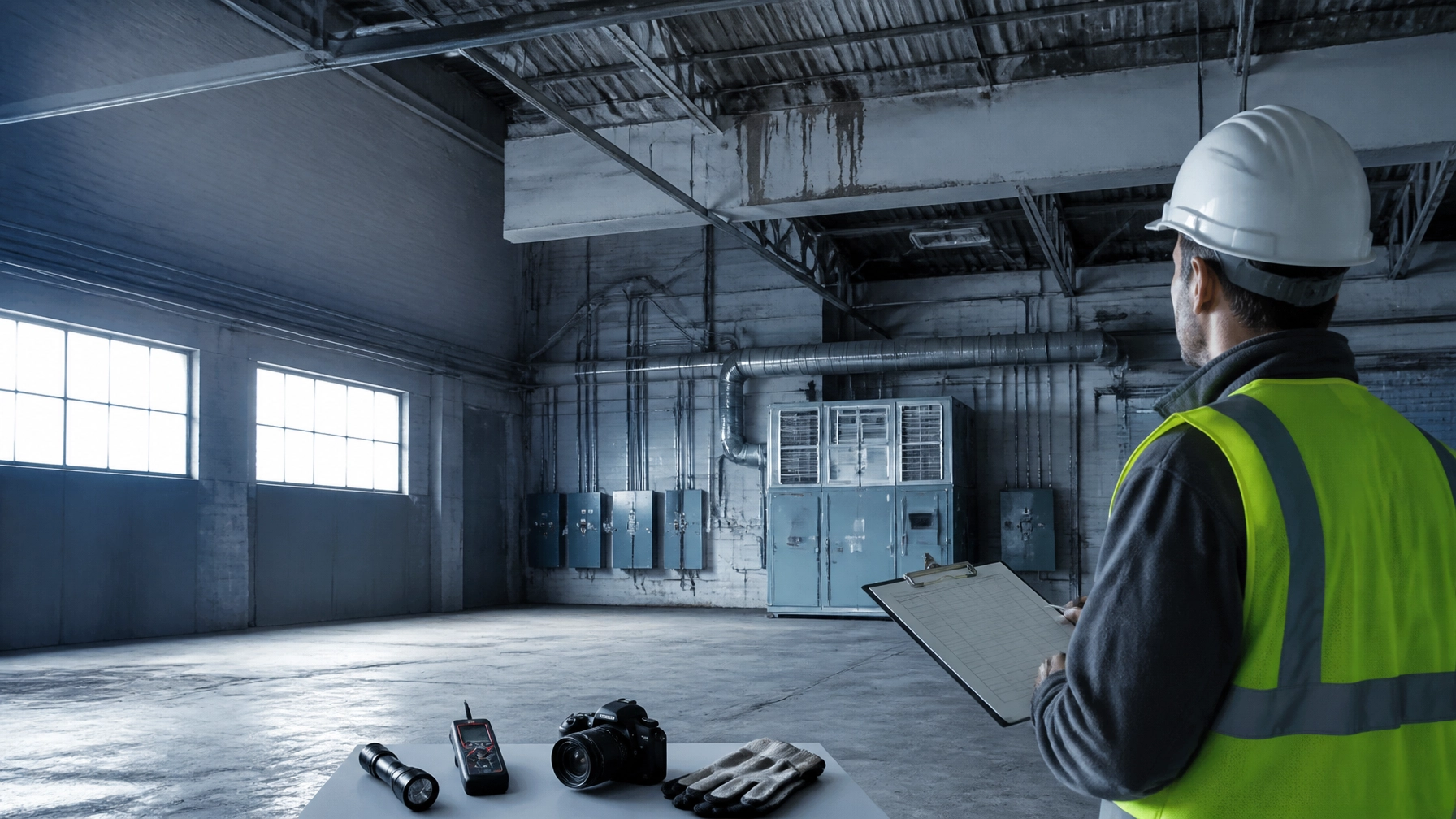
In New York and New Jersey commercial real estate, a property can look stable from the street and still carry significant deferred maintenance, life-safety exposure, or near-term capital needs.
That’s why lenders, investors, and acquisition teams request a property condition report ASTM E2018. The report gives decision-makers a consistent, documented view of the physical condition of the property before closing, refinancing, or committing additional capital.
The current standard is ASTM E2018-24, Standard Guide for Property Condition Assessments: Baseline Property Condition Assessment Process. It provides the framework. The quality of the final PCR depends on how well the consultant applies that framework to the asset, the transaction, and the lender’s requirements.
PCA vs. PCR: What’s the Difference?
A Property Condition Assessment (PCA) is the process. It typically includes:
- A current walk-through survey
- Review of available property documents and records
- Interviews with owners, property managers, or knowledgeable personnel
- Identification of material physical deficiencies
- Opinions of probable costs for suggested repairs
The Property Condition Report (PCR) is the final deliverable. It organizes those findings into a lender- and investor-ready document.
ASTM International describes E2018-24 as a reasonable baseline process used voluntarily for commercial real estate due diligence. It is not a building code, statute, or guarantee that a property has no defects. The official standard also makes clear that a PCR is site-specific and valid for the point in time when the observations and research occurred.
You can review the current standard directly through ASTM International.
What ASTM E2018-24 Covers
ASTM E2018-24 focuses on the primary improvements at a commercial property. Depending on the asset, that may include a multifamily building, office property, warehouse, retail center, industrial facility, or mixed-use development.
The baseline PCA generally evaluates observable conditions involving:
- Site improvements, pavement, drainage, and landscaping
- Foundations and visible structural components
- Exterior walls, façade elements, windows, and doors
- Roofing systems and roof drainage
- Interior common areas and representative tenant spaces
- Heating, ventilation, and air-conditioning systems
- Electrical service and distribution
- Plumbing and domestic water systems
- Fire and life-safety systems
- Elevators and other vertical transportation systems
- Site utilities and related infrastructure
The assessment is typically visual and non-destructive. The field observer does not remove finishes, dismantle equipment, perform destructive testing, or conduct design-level engineering analysis unless those services are separately authorized.
That distinction matters. A baseline PCA is designed to reduce uncertainty efficiently. It is not intended to eliminate every unknown condition before a transaction closes.

The ASTM E2018-24 Walk-Through Survey
The walk-through survey is the foundation of an ASTM E2018 PCR in New York or New Jersey.
The field observer reviews accessible areas and representative components to identify conditions that may affect safety, function, value, or future capital requirements. Under the 2024 edition, the concept of “observe” extends beyond sight. Field observations may also include auditory and olfactory indicators, such as unusual mechanical noise, combustion odors, or odors associated with moisture conditions.
A serious walk-through should not be a quick tour followed by a generic checklist. It should connect field conditions to the property’s operating history and future capital needs.
For example:
- A roof stain may indicate an isolated repair: or an aging membrane with recurring water intrusion.
- Corrosion at a steel connection may require monitoring, repair, or a separate structural evaluation.
- A deteriorated electrical panel may represent routine replacement planning: or an immediate safety concern.
- Ponding at a parking lot may be cosmetic: or evidence of drainage failure that will accelerate pavement deterioration.
- An inoperable fire door may affect both life safety and lender underwriting.
The report should explain what was observed, where it was observed, why it matters, and what additional evaluation may be appropriate.
Immediate Repairs and Life-Safety Conditions
One of the most important sections of a PCR is the Immediate Costs or Immediate Repairs table.
ASTM E2018-24 refines the treatment of immediate costs so the report can clearly identify deficiencies requiring prompt attention. These may include:
- Existing or potential life-safety concerns
- Failing structural systems or components
- Conditions likely to cause near-term system failure
- Material building code or fire-safety concerns
- Active water intrusion causing ongoing damage
- Unsafe electrical, mechanical, or site conditions
An immediate item is not simply the oldest item on the property. It is an item that requires a more urgent response than routine maintenance or normal capital planning.
The PCR should provide a concise description, location, photograph, recommended next step, and opinion of probable cost. If the condition requires a structural engineer, roofing contractor, fire-protection specialist, or other qualified professional, that recommendation should be stated directly.
A PCR does not replace a formal code inspection or structural evaluation. It helps the lender and investor understand when those services should be considered.
Opinions of Probable Cost: Turning Findings Into Capital Decisions
A report that identifies deficiencies without addressing probable cost leaves the hardest part of the decision to the client.
ASTM E2018-24 calls for opinions of cost for suggested remedies to observed physical deficiencies. These are professional, screening-level estimates: not contractor bids, fixed prices, or guarantees.
A lender-ready PCR typically separates costs into categories such as:
Immediate Costs
Repairs that require prompt action because of safety, code, failure risk, or rapidly escalating damage.
Short-Term Capital Costs
Repairs or replacements expected within a near-term planning horizon. The exact period may be defined by the lender or user, commonly within the first several years of ownership.
Long-Term Capital Needs
Major replacements and reserve items that may occur later in the study period, such as roofing, paving, HVAC equipment, façades, elevators, or site utilities.
Cost opinions should identify the assumptions behind the estimate, including:
- Quantity and unit-cost assumptions
- Accessibility and site constraints
- Whether design, permitting, testing, or contractor mobilization is included
- Whether costs reflect current local market conditions
- Whether a specialist’s evaluation is recommended before final budgeting
For a commercial property condition assessment in NJ, local pricing, building age, winter weather exposure, flood risk, salt exposure, and the availability of specialized contractors can materially influence capital planning. A national template with no local context is rarely enough for a high-value transaction.
What Lenders Expect in a Lender-Ready PCR
Lender requirements vary by institution and loan program. ASTM E2018-24 establishes a baseline, but a lender may request additional items, a specific reserve period, or a particular report format.
A lender-ready PCR should clearly include:
- Property address, ownership or user information, and inspection dates
- Description of the buildings and primary improvements
- Scope of assessment and stated objectives
- Current walk-through survey
- Document review and interview summary
- Building and fire department records research, where available
- System-by-system observations
- Photographs tied to specific findings
- Immediate repair and short-term cost tables
- Long-term capital or reserve planning, when requested
- Assumptions, limitations, and inaccessible areas
- Discussion of out-of-scope conditions
- Consultant and reviewer qualifications
- Executive summary with actionable conclusions
A strong PCR also makes limitations easy to find. If a roof area was inaccessible, records were unavailable, tenant spaces could not be entered, or equipment was not operating during the visit, the report should say so plainly.
Transparency protects the user. It also gives the lender a better basis for determining whether supplemental investigation is necessary.
New York and New Jersey Considerations
ASTM E2018-24 is a national standard. It does not change based on whether the property is in Manhattan, Brooklyn, Westchester, Jersey City, Newark, or Hudson County.
The due-diligence context does change.
In New York, a PCA may need to coordinate with available Department of Buildings, fire department, façade, elevator, and property-maintenance records, depending on the property and lender scope. Older urban buildings may also require closer attention to masonry façades, roof conditions, vertical transportation, aging electrical systems, and constrained access.
In New Jersey, commercial assets often present a different mix of concerns, including freeze-thaw damage, stormwater and flood exposure, aging industrial infrastructure, warehouse roofs, site paving, utility service, and deferred maintenance across multiple buildings.
These local factors do not automatically expand a baseline PCA. They help determine whether the baseline scope is sufficient for your risk tolerance and transaction.
A property condition report should also be coordinated with other due-diligence work when appropriate. ASTM E2018-24 does not replace a Phase I ESA, asbestos inspection, lead-based paint survey, mold assessment, radon testing, or design-level structural evaluation. Envicon’s environmental assessment services can be integrated when physical and environmental risks overlap.

Why the Consultant Matters
The standard creates a framework. It does not guarantee that every consultant will deliver the same level of insight.
You should ask:
- Who will conduct the field survey?
- Will a senior engineer review the PCR?
- Does the team understand local NY/NJ building conditions?
- Will the report identify decisions, not just defects?
- Can the consultant coordinate environmental, civil, structural, or permitting follow-up?
- Will the deliverable match the lender’s requirements before the site visit?
At Envicon Group, we combine field-first experience with disciplined documentation and technology-enabled project delivery. Our clients work directly with senior professionals instead of being handed off after the proposal is signed.
We don’t produce bloated reports designed to bury uncertainty. We identify what matters, explain what it means, quantify probable costs, and give you a clear path to the next decision.
Final Takeaway
An ASTM E2018-24 PCR is more than a building checklist. It is a risk-management tool for acquisition, lending, refinancing, asset management, and capital planning.
The most useful report does four things well:
- Documents current physical conditions.
- Separates immediate life-safety concerns from routine and long-term capital needs.
- Provides defensible opinions of probable cost.
- States limitations clearly enough for lenders and investors to act.
If you need an ASTM E2018 PCR in New York, a commercial property condition assessment in New Jersey, or a coordinated PCA and environmental due-diligence scope, start with the decision you need to make: not a generic template.
Ready for a Lender-Ready Property Condition Report?
Envicon Group helps investors, lenders, developers, and attorneys evaluate commercial properties across New York and New Jersey with precision, speed, and trust.
[ ]
]
Leave a Reply