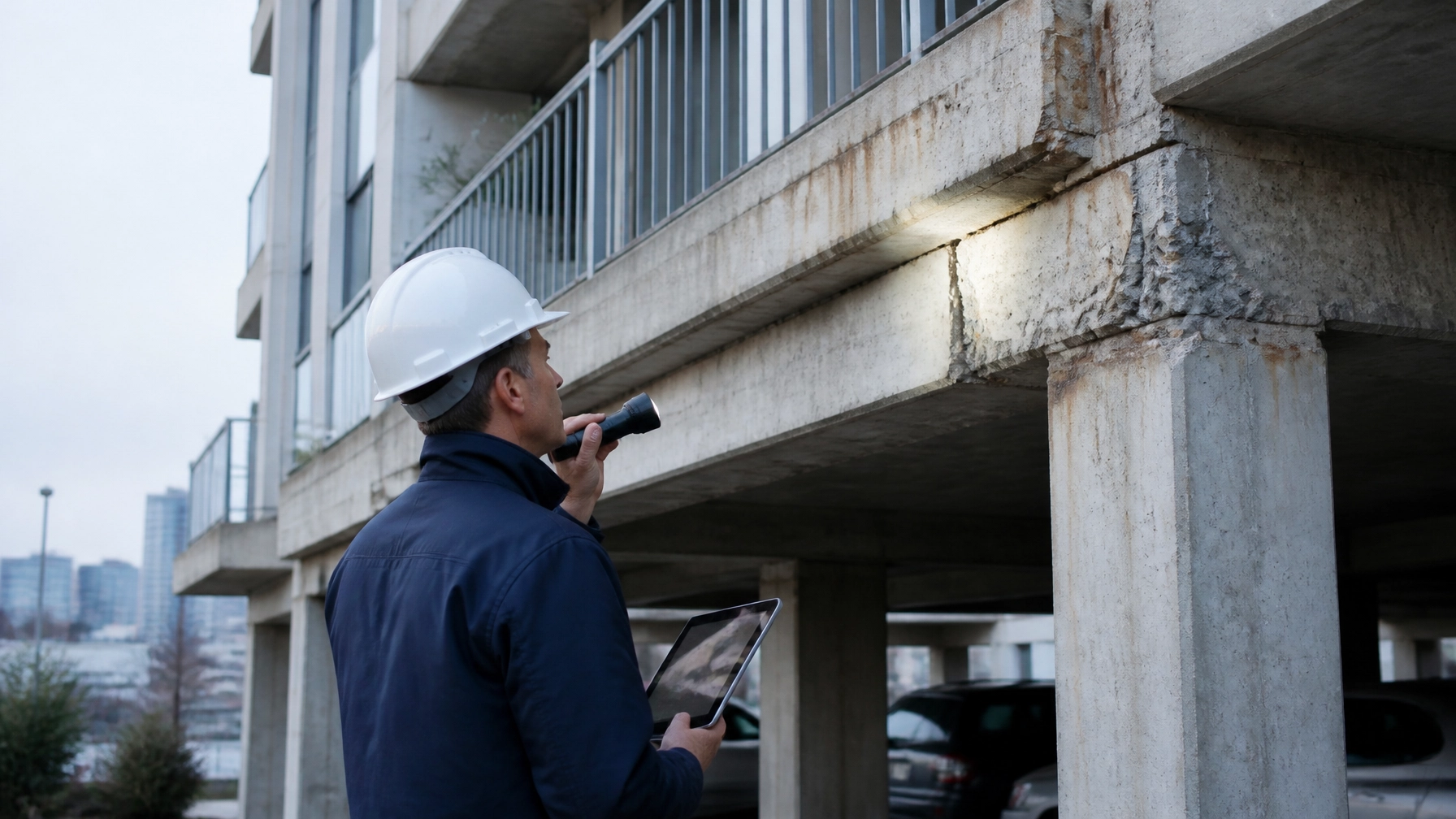
A New Jersey condominium board’s structural inspection deadline may be tied to a date already sitting in its records: the building’s certificate of occupancy.
Under New Jersey’s Residential Structural Integrity Law, P.L.2023, c.214, covered condominium and cooperative buildings must undergo an initial structural integrity inspection by the earlier of:
- 15 years after the certificate of occupancy date, or
- 60 days after observable damage to the primary load-bearing system.
For older buildings, the transition deadline has already arrived in 2026. Boards that haven’t confirmed their compliance status should act now.
This article explains the NJ structural integrity inspection deadline 2026, the NJ Senate Bill 2760 inspection date, and what boards need to know about a condo load-bearing inspection in New Jersey.
“Within the earlier of” 15 years after the certificate of occupancy or 60 days after observable damage : P.L.2023, c.214, §3.
Which New Jersey condominium buildings are covered?
The law applies to a “covered building,” generally meaning a residential condominium or cooperative building with a primary load-bearing system made of:
- Concrete
- Masonry
- Steel
- Heavy timber
- A hybrid structural system
- A podium deck supporting residential construction
The law defines the primary load-bearing system as the connected structural components that transfer building forces to the foundation. The evaluation includes:
- Columns
- Beams
- Bracing
- Foundations
- Connected or attached balconies
- Podium slabs and other load-transfer elements
Conventional wood-frame condominium buildings may fall within an excluded structure category, but boards shouldn’t assume an exemption based only on the building’s appearance. The construction type, ownership structure, podium design, and association maintenance responsibilities all matter.
The official statutory definitions appear in P.L.2023, c.214. The New Jersey Department of Community Affairs also provides a summary in its Construction Code Communicator.
The 15-year certificate of occupancy timeline
For a covered condominium or cooperative building receiving a certificate of occupancy after the law’s effective date, the initial structural inspection must occur within 15 years of the CO date.
In practice, boards should treat the 15th anniversary of the certificate of occupancy as the controlling planning date.
For example:
- CO issued on March 10, 2011: inspection should be completed by the March 10, 2026 anniversary.
- CO issued on July 22, 2015: inspection should be completed by July 22, 2030.
- CO issued on November 5, 2024: inspection should be planned before November 5, 2039.
Do not use the building’s marketing opening, first unit closing, or date of association turnover as a substitute for the CO date. The board should confirm the applicable certificate of occupancy through its municipal records, construction files, turnover documents, or counsel.
A 2026 example for a newer covered building
A condominium with a CO date of March 10, 2011 was less than 15 years old when P.L.2023, c.214 became effective on January 8, 2024. Its inspection deadline is based on the 15-year anniversary: March 10, 2026.
If the inspection hasn’t occurred, the board should not wait for a notice or enforcement inquiry. It should:
- Confirm the building’s covered status.
- Retain a qualified New Jersey structural inspector.
- Assemble prior reports, plans, repair records, and CO documents.
- Coordinate access to common areas and structural components.
- Complete the inspection and required reporting process.
- Address corrective maintenance identified in the report.
Older buildings had a separate transition deadline
The law created a special schedule for buildings that received their certificate of occupancy before January 8, 2024.
If the CO was issued 15 or more years before the law’s effective date, the initial structural inspection had to occur within two years after the effective date. Because the law became effective on January 8, 2024, that transition deadline fell on or about January 8, 2026.
This generally applies to covered buildings with a CO date on or before January 8, 2009.
A second category applies to buildings whose CO was issued one day to 14 years and 364 days before January 8, 2024. For those buildings, the inspection must occur within one year after the date that is 15 years after the CO was issued.
Example:
- CO issued June 1, 2010
- Fifteenth anniversary: June 1, 2025
- Transition period: one additional year
- Outside inspection date: June 1, 2026
The exact calculation depends on the official CO date. Boards should create a property-specific compliance calendar rather than rely on a general “2026” label.

The 60-day observable damage rule
The 15-year schedule does not protect a board from an earlier inspection obligation.
If the association observes damage to the primary load-bearing system, it must arrange the inspection within 60 days. This applies even when the building is younger than 15 years or has recently completed a scheduled inspection.
Potential indicators include:
- Cracking in structural beams, columns, or slabs
- Concrete spalling that exposes reinforcing steel
- Corrosion-related deterioration
- Noticeable deflection or sagging
- Displacement or movement at structural connections
- Significant deterioration at balcony attachments
- Foundation movement affecting the load path
- Damage to podium decks or transfer slabs
Not every crack in a wall is structural damage. Drywall shrinkage, paint failure, and isolated nonstructural finishes may not involve the primary load-bearing system. The problem is that boards and property managers often cannot determine that distinction from appearance alone.
When damage could involve a structural component, document it immediately with photographs, dates, locations, and observations. Then have a licensed New Jersey engineer evaluate the condition. Do not wait for the next reserve study or the next routine property inspection.
What the structural inspection must evaluate
A New Jersey condo load-bearing inspection is not a visual tour of hallways and common rooms. The structural inspector evaluates the building’s primary load-bearing system using a protocol established by the American Society of Civil Engineers or a similar protocol from another nationally recognized structural engineering organization.
The inspection should be coordinated around the building’s actual structural system and site conditions. Depending on the property, that may include:
- Exterior façades and balconies
- Parking garages and podium decks
- Basement and foundation areas
- Columns, beams, and structural walls
- Visible framing and bracing
- Water intrusion and corrosion conditions
- Areas with known repairs or recurring deterioration
- Structural drawings and prior engineering reports
The resulting written report must describe the system’s condition, identify required maintenance or repairs, establish the timing of the next inspection, and provide the required information to the municipal appointing authority, construction official, and enforcing agency.
The New Jersey DCA explains that local enforcing agencies do not enforce this particular law, but reports should be maintained in the building’s records. Boards should also understand how this inspection interacts with separate Bureau of Housing Inspection requirements. The New Jersey Bureau of Housing Inspection administers cyclical inspections under the Hotel and Multiple Dwelling Law.
What happens after the first inspection?
The first report sets the direction for future inspections and corrective work.
Under P.L.2023, c.214:
- The second inspection cannot be later than the earlier of 10 years after the initial inspection or 60 days after observable damage.
- Later inspections must occur within the period established by the preceding report, but generally no later than five years after the prior inspection.
- New or progressive deterioration must be identified.
- Required corrective maintenance must be described with reasonable detail.
- Plans or specifications may be required for structural repairs or maintenance.
- Reports must be provided to the association and made available to residents upon request.
A board should not treat the inspection report as a document to file and forget. It is a capital-planning document. If it identifies deterioration, the board needs a defined scope, budget, schedule, access plan, and regulatory path for repairs.

Pair the inspection with a reserve study
A structural inspection answers: What condition is the primary load-bearing system in today?
A reserve study answers: How should the association fund expected repairs and replacements over time?
They are different services, but they should inform each other. A reserve study should account for:
- Structural inspection costs
- Corrective maintenance
- Balcony and façade work
- Waterproofing and drainage repairs
- Concrete restoration
- Future inspections
- Engineering design and permitting
- Long-term replacement costs
Envicon’s New Jersey reserve study services combine licensed engineering review, common-element condition assessment, cost forecasting, and a 30-year funding plan. For boards, that means fewer surprises when an inspection identifies work that cannot be deferred.
The practical advantage is coordination. Instead of commissioning an inspection, receiving a technical report, and then starting over with a separate consultant, the board can build a clear path from condition assessment to funding and implementation.
A board-ready 2026 action checklist
If your association may be subject to the law, complete these steps:
- Locate the building’s official certificate of occupancy.
- Calculate the 15-year anniversary.
- Determine whether the building was already 15 or more years old on January 8, 2024.
- Review balconies, podium decks, parking areas, foundations, beams, columns, and structural walls for observable damage.
- Document any suspected damage within the 60-day response window.
- Retain a qualified New Jersey licensed engineer.
- Provide prior inspection reports, plans, repair records, and maintenance documents.
- Confirm where the final report must be submitted and maintained.
- Build identified repairs into the association’s capital plan.
- Update the reserve study and funding schedule.
- Calendar the next inspection before the current report expires.
A large consulting firm may assign the inspection to a rotating team and leave the board to interpret the result. Envicon takes a more direct approach: licensed professionals, field-level review, clear documentation, and coordination with the board, property manager, counsel, contractors, and local officials.
That matters when the report identifies work that affects safety, budgets, residents, insurance, or lender confidence.
The takeaway
For a covered New Jersey condominium or cooperative, the key dates are straightforward:
- 15 years after the certificate of occupancy
- January 8, 2026, for many buildings already 15 or more years old when the law took effect
- Within 60 days after observable damage to the primary load-bearing system
The safest strategy is to verify the CO date now, determine the building’s coverage, and schedule the inspection before the deadline becomes an emergency.
Structural compliance is not just a filing exercise. It is how a board protects residents, preserves the building, and makes responsible capital decisions.
Schedule your New Jersey structural integrity inspection
Envicon helps condominium boards move from deadline uncertainty to a documented, actionable plan.

Leave a Reply