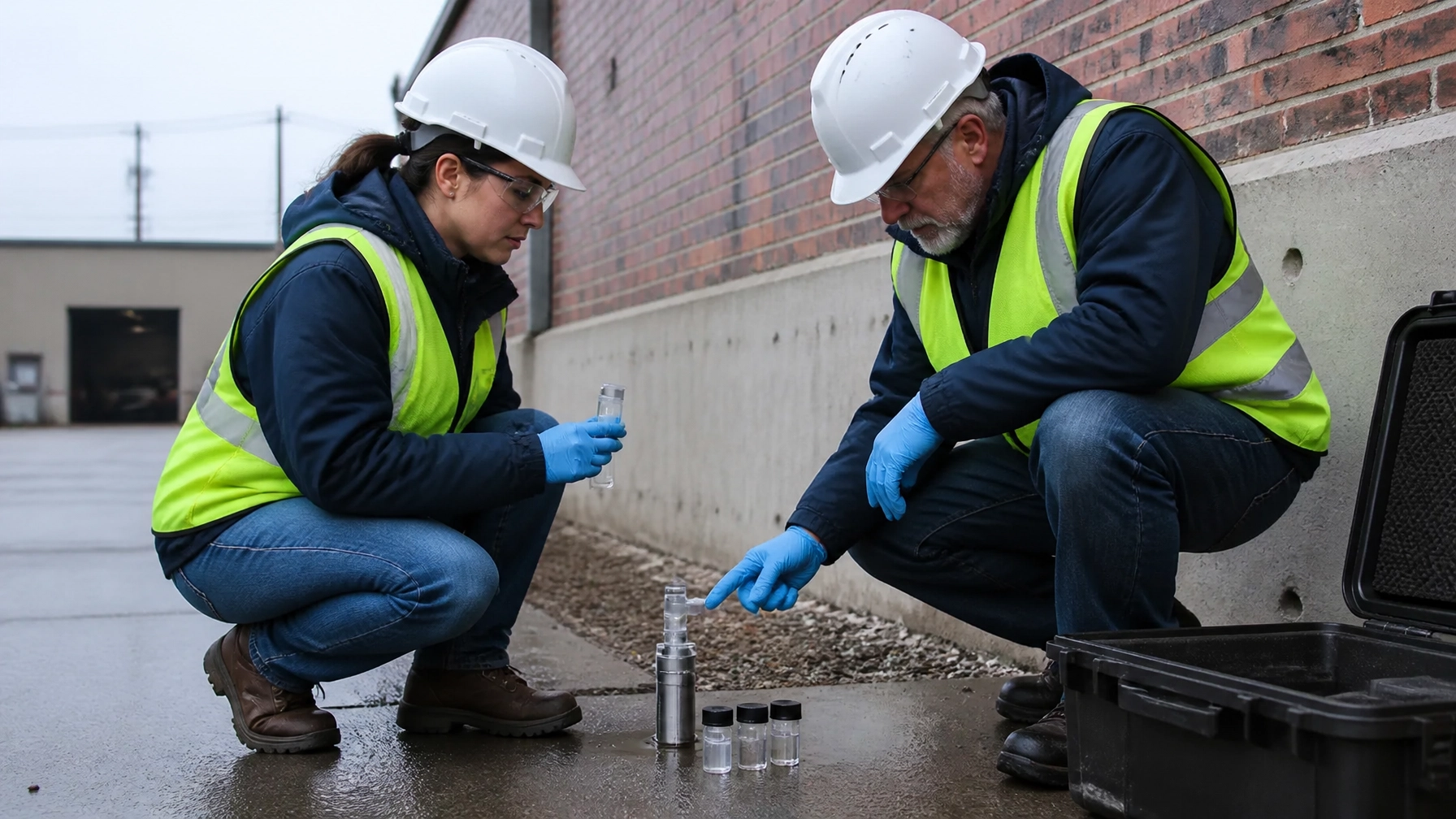
A commercial real estate closing in Brooklyn, Jersey City, Newark, or anywhere across the New York–New Jersey region can move quickly, until a Phase I ESA identifies a potential vapor concern.
Volatile organic compounds, or VOCs, can migrate from contaminated soil or groundwater into buildings through cracks, utility penetrations, sump pits, elevator shafts, and other pathways. A vapor condition may not be visible during a site walk. It may not appear in a conventional soil investigation. But lenders, attorneys, and regulators increasingly expect buyers to address the risk before closing.
A properly scoped vapor intrusion assessment helps answer the questions that matter:
- Is there a potential vapor source beneath or near the property?
- Could vapors enter the building?
- Does the available data support closing?
- Will the property require mitigation, monitoring, or additional investigation?
- Can the issue be resolved within the transaction schedule?
The earlier you answer those questions, the more options you have.
What Is a Vapor Intrusion Assessment?
Vapor intrusion occurs when chemicals in contaminated soil or groundwater volatilize and migrate upward into an overlying building.
Common VOC sources include:
- Former dry cleaners using PCE or other chlorinated solvents
- Auto repair facilities and service stations
- Former manufacturing and metal-working operations
- Petroleum releases from underground storage tanks
- Industrial degreasing or chemical storage
- Manufactured gas plant, or MGP, sites
- Contaminated properties listed in state or local regulatory databases
A vapor intrusion assessment evaluates the complete pathway from source to building. That means reviewing the contaminant, subsurface conditions, building construction, air pressure, utility corridors, and current or planned occupancy.
The objective isn’t simply to collect samples. It’s to determine whether a complete exposure pathway exists and what action will protect the property, occupants, lender, and transaction.
When Do Lenders and Buyers Require Vapor Screening?
There is no single rule that requires a vapor intrusion assessment for every commercial property. The need usually depends on the findings in the Phase I ESA, the property’s history, the lender’s environmental policy, and the requirements of the applicable regulatory program.
A lender or buyer may request vapor screening when:
- The Phase I identifies a current or historical dry cleaner, gas station, industrial facility, or chemical operation on or near the property.
- A former use involved solvents, petroleum, degreasers, or other VOCs.
- Soil or groundwater data shows VOC impacts.
- The property sits above or near a known contaminant plume.
- The building has a basement, crawlspace, slab-on-grade construction, or other direct subsurface connection.
- The site has an NYC hazardous materials E-Designation.
- The property is part of an NYSDEC Brownfield Cleanup Program or other remedial program.
- A New Jersey site is subject to NJDEP oversight or an LSRP-managed investigation.
- Existing mitigation equipment is present but its design, operation, or maintenance records are incomplete.
- The buyer plans to change the use to residential, daycare, healthcare, or another sensitive occupancy.
For a vapor intrusion assessment in Brooklyn, the review may also need to address NYC Office of Environmental Remediation records, E-Designation requirements, historic fill, former industrial uses, and nearby parcels with regulatory listings.
The practical standard is simple: if the Phase I identifies a credible VOC source or migration pathway, don’t wait until the closing attorney asks for additional documentation. Scope the next step immediately.
How VOC Impacts Change the Phase I and Phase II ESA
Phase I ESA: Identifying the Concern
A Phase I ESA performed under ASTM E1527-21 evaluates historical records, regulatory databases, site conditions, interviews, and potential sources of contamination. Vapor migration is part of that risk analysis.
A targeted vapor encroachment screen may review:
- Nearby contaminated sites
- Dry cleaners and former dry-cleaning operations
- Gas stations and petroleum releases
- Historic industrial uses
- Soil and groundwater plume information
- Known environmental controls or deed restrictions
- Building features that could create preferential pathways
The Phase I may classify the vapor concern as a Recognized Environmental Condition, Controlled Recognized Environmental Condition, Historical Recognized Environmental Condition, or a potential concern requiring additional investigation.
That classification matters to the lender. A report that merely mentions “possible vapor migration” without a clear recommendation often creates more questions than it answers.
Phase II ESA: Testing the Pathway
If the Phase I identifies a potential vapor concern, the next step may include a Phase II ESA with targeted vapor sampling.
Depending on the property, the investigation may include:
- Soil borings and soil VOC analysis
- Groundwater sampling
- Sub-slab soil gas sampling
- Indoor air sampling
- Outdoor ambient air sampling
- Building inventory and chemical product review
- Utility and foundation pathway review
- Pressure measurements beneath the slab
- Temporary or permanent sub-slab sampling points
Samples are commonly analyzed for VOCs using EPA Method TO-15, particularly for soil gas and indoor air. At NYC E-Designation sites, the applicable city rule can require VOC analysis by TO-15 at an ELAP-certified laboratory. The sampling plan should be reviewed against the specific property and regulatory requirements before fieldwork begins.

New York Requirements: NYC, Brooklyn, and NYSDEC
NYC does not operate from a separate set of numerical vapor intrusion standards. For many projects, the city relies on New York State guidance and adds its own procedural requirements.
The NYC Office of Environmental Remediation E-Designation program can require an approved environmental review and sampling protocol before investigation begins. The exact E-Designation language for the property controls the required steps.
The NYC CEQR Technical Manual directs practitioners to use the NYSDOH Guidance for Evaluating Soil Vapor Intrusion in New York, including subsequent updates, when designing and interpreting vapor investigations.
For properties under NYSDEC oversight, the NYSDEC vapor intrusion guidance page provides the current framework and related decision materials. The 2024 updates to the NYSDOH soil vapor and indoor air decision matrices are particularly important when interpreting current data.
For a Brooklyn closing, confirm:
- Whether the lot carries an E-Designation
- Whether OER has approved previous sampling or remedial plans
- Whether a vapor barrier or sub-slab depressurization system exists
- Whether the system has current operation and maintenance records
- Whether OER or NYSDEC has issued a sign-off, notice, or continuing obligation
- Whether the proposed future use changes the exposure scenario
A property with an existing mitigation system is not automatically a failed transaction. It does require documentation, performance verification, and a clear understanding of who will operate the system after closing.
New Jersey Requirements: NJDEP and LSRP Oversight
In New Jersey, vapor intrusion investigations typically follow the NJDEP Vapor Intrusion Technical Guidance, Version 5.0, together with current NJDEP screening-level tables and applicable site-remediation requirements.
The assessment should be coordinated with the project’s Licensed Site Remediation Professional, or LSRP, when the property is part of a regulated remediation.
New Jersey due diligence should address:
- NJDEP Known Contaminated Sites information
- Current and former industrial uses
- Groundwater contamination and plume direction
- Soil gas and indoor air screening results
- Immediate Environmental Concern conditions
- Deed notices and institutional controls
- Existing engineering controls
- Remedial Action Outcome documentation
- Ongoing monitoring and maintenance obligations
The NJDEP framework uses site-specific information to determine whether additional investigation, monitoring, or mitigation is appropriate. Current screening tables matter. Do not rely on an outdated spreadsheet or an old consultant’s generic threshold list.
In Hudson County, Jersey City, Newark, and other former industrial areas, the property’s surroundings can be as important as the parcel itself. A contaminant source may sit across a lot line, beneath a neighboring building, or within a groundwater plume that crosses several properties.

A Closing-Friendly Path from Finding to Resolution
A vapor concern does not have to derail the transaction. It does need a defined decision path.
1. Review the Phase I immediately
Ask whether the report evaluated vapor migration, not just soil and groundwater contamination. Confirm whether the consultant reviewed nearby VOC sources and regulatory listings.
2. Build a site-specific conceptual model
Map the likely source, direction of migration, depth to groundwater, soil conditions, building slab, utility penetrations, and occupied spaces.
3. Match the scope to the deal
A Tier 1 screen may be enough for a low-risk property. A known VOC source beneath an occupied building may require sub-slab and indoor air sampling. Avoid both under-scoping and unnecessary testing.
4. Coordinate with the lender and attorney
Confirm what documentation will satisfy the lender before sampling begins. A technically valid report can still cause delays if it doesn’t answer the lender’s specific questions.
5. Identify mitigation options early
Potential controls include:
- Sub-slab depressurization systems
- Vapor barriers
- Sealing of cracks and penetrations
- Passive venting systems
- HVAC or building-pressure modifications
- Source removal or groundwater remediation
- Long-term monitoring and operation-and-maintenance plans
Our vapor intrusion mitigation guide explains how these systems work and when each approach may fit.
6. Document the closing strategy
If the issue cannot be fully resolved before closing, counsel may consider escrows, indemnities, access agreements, post-closing work obligations, or other transaction-specific protections. Those are legal decisions, but the technical scope must give counsel reliable facts.
Why Envicon Is Built for This Work
Envicon combines Phase I and Phase II environmental due diligence, vapor intrusion assessment, remediation design, construction oversight, and regulatory coordination under one project team.
That matters when your closing date is fixed.
You work directly with senior professionals instead of passing questions through a national-firm queue. We provide clear findings, practical recommendations, and deliverables designed for lenders, attorneys, developers, and regulators.
Our environmental assessment team offers standard and expedited schedules, with one-week Phase I turnaround options for time-sensitive transactions. Our vapor intrusion assessment service covers screening, sub-slab and indoor air sampling, TO-15 laboratory analysis, mitigation design, and regulatory coordination.
We don’t hand you a report and leave you to interpret the risk. We help turn the finding into a decision.
Frequently Asked Questions
Is a vapor intrusion assessment required for every commercial closing?
No. The need depends on site history, VOC impacts, regulatory status, building conditions, lender requirements, and intended use. A Phase I ESA should identify whether further evaluation is warranted.
What is the difference between vapor encroachment screening and vapor intrusion sampling?
Vapor encroachment screening evaluates whether a potential vapor source or plume could migrate toward the property. Vapor intrusion sampling tests the pathway directly using soil gas, sub-slab, indoor air, or related data.
How long does a vapor intrusion assessment take in NYC or New Jersey?
A screening assessment may take one to two weeks, while sub-slab and indoor air sampling generally requires additional coordination, laboratory time, interpretation, and reporting. Seasonal conditions, building access, agency review, and lender deadlines can affect the schedule.
Can a property close if vapor intrusion is confirmed?
Often, yes: but the transaction may require a mitigation plan, engineering control, monitoring program, escrow, or other risk allocation. The right path depends on the data and the applicable agency requirements.
The Takeaway
Vapor intrusion is a transaction issue, not just an environmental issue.
If VOCs are present beneath or near a commercial property in Brooklyn, Manhattan, Jersey City, Newark, or elsewhere in NY/NJ, buyers and lenders need a defensible answer before closing. Start with a focused Phase I review. Move to Phase II sampling when the pathway warrants it. Coordinate with OER, NYSDEC, NJDEP, or the LSRP as required. Then choose the clearest path to mitigation, monitoring, or closure.
Precision keeps the report defensible. Speed protects the deal. Trust keeps the project moving.
Start Your Vapor Intrusion Assessment
- Call Envicon now at (917) 764-2171
- Use our proprietary cost estimator
- View Envicon’s complete list of services
Leave a Reply