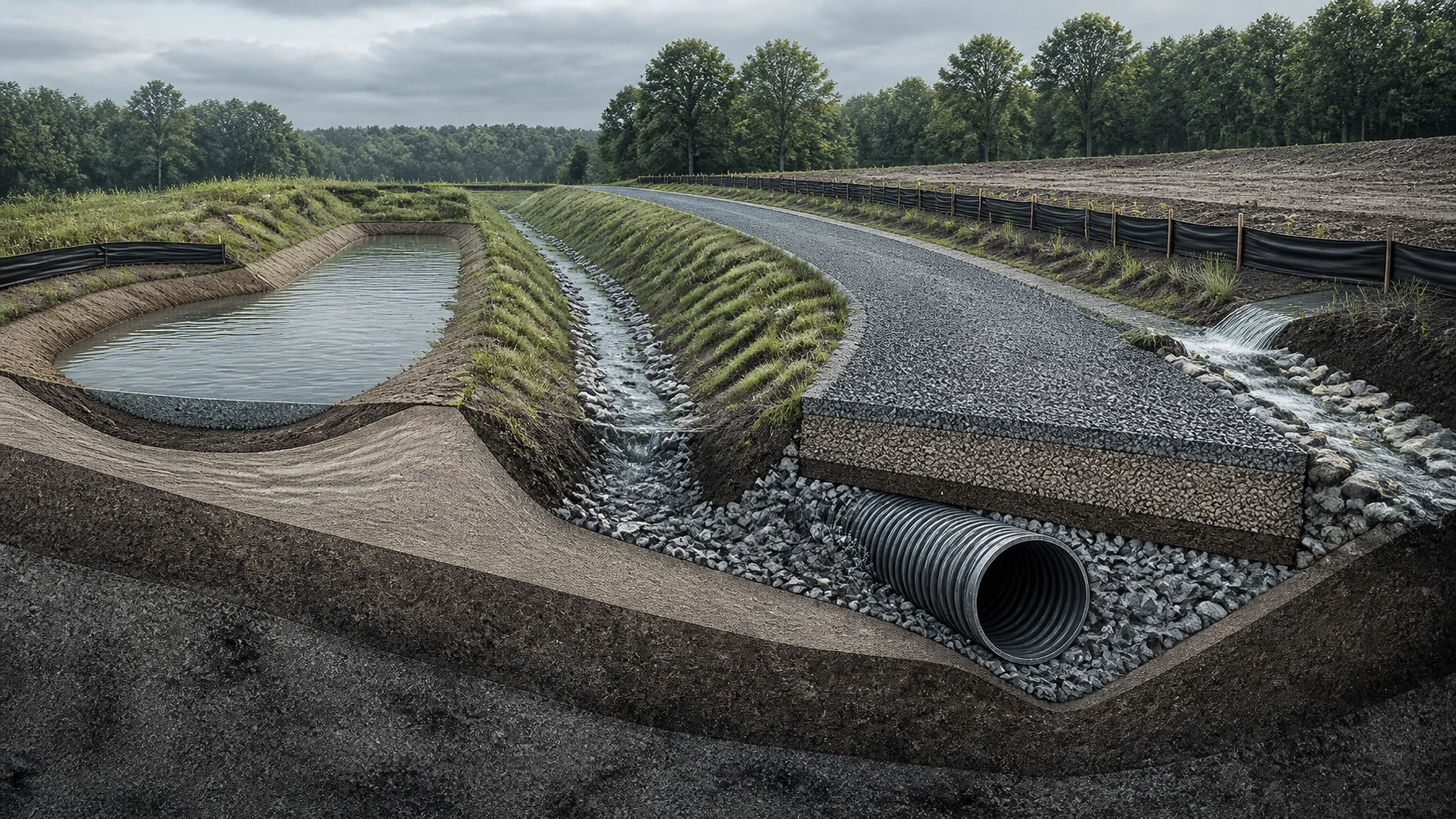
A stormwater plan is not a permit-form attachment. It is the operating plan for keeping sediment, fuel, concrete washout, debris, and other pollutants from leaving your construction site.
In New Jersey, the plan is commonly referred to as a Stormwater Pollution Prevention Plan (SPPP) in NJDEP materials. In New York, it is generally called a Stormwater Pollution Prevention Plan (SWPPP). Contractors, developers, and construction managers use both terms interchangeably.
The obligation is clear: construction activity disturbing one acre or more, or less than one acre as part of a larger common plan of development, generally requires stormwater permit coverage and a properly prepared plan.
- In New Jersey, that means the NJPDES Construction Stormwater General Permit 5G3.
- In New York, that means the NYSDEC SPDES General Permit for Stormwater Discharges from Construction Activity, GP-0-20-001.
A copied template may satisfy a checklist at a glance. It will not necessarily satisfy the site, the regulator, or the next rain event.
Why a Template SWPPP Creates Real Project Risk
A generic SWPPP usually describes a site that does not exist.
The drainage arrows don’t match the grading plan. The proposed inlet protection appears in the wrong location. The sediment basin has no relationship to the actual drainage area. The plan does not account for soil stockpiles, phased excavation, utility work, access roads, or changing site conditions.
That creates two problems.
First, the plan may be rejected during agency, municipal, or MS4 review. Second, even if it gets accepted, the controls may fail during construction because the field team cannot implement what the drawings actually show.
A single major rain event can lead to:
- Sediment entering a storm drain or waterway
- Failed inlet protection and clogged conveyance systems
- Mud tracked onto public roads
- Re-mobilization and emergency stabilization costs
- Inspection findings and corrective-action requirements
- Delays to excavation, utilities, foundations, or vertical construction
- Potential enforcement exposure and damage to lender or owner confidence
The plan has to work in the field. That is the standard that matters.
When Do You Need SWPPP Services in NJ and NY?
The one-acre threshold is the starting point, not the entire analysis.
A project generally needs stormwater permit coverage when construction will disturb one acre or more of land. This includes clearing, grading, excavation, utility installation, staging, access improvements, and related earthwork.
A project under one acre may also be regulated if it forms part of a larger common plan of development or sale that will disturb at least one acre in total.
New York may also regulate certain smaller disturbances in specific watersheds or where NYSDEC determines that stormwater discharges could affect water quality. Local requirements and MS4 review can add another layer.
In New Jersey, construction stormwater authorization also works alongside soil erosion and sediment control requirements and, where applicable, the state’s major development stormwater management rules.
Before mobilization, confirm:
- The total planned disturbance area
- Whether the work is part of a larger common plan
- The receiving waters and drainage infrastructure
- Whether the site is within an MS4 jurisdiction
- Whether post-construction stormwater management applies
- Which agency, municipality, or Soil Conservation District approvals are required
- Who will prepare, certify, implement, inspect, and update the plan
The wrong answer can put the construction schedule at risk before the first excavator arrives.
What a Stormwater Plan Actually Has to Cover
1. Site Conditions and Limits of Disturbance
A compliant plan starts with the actual site.
It should identify existing topography, drainage patterns, slopes, surface waters, storm drains, outfalls, wetlands or other sensitive features, access points, and areas that will remain undisturbed.
The drawings should clearly show:
- The limits of disturbance
- Existing and proposed contours
- Drainage areas and flow paths
- Excavation and fill areas
- Soil stockpiles
- Staging and material storage areas
- Construction entrances and exits
- Temporary and permanent stabilization areas
- Surface-water and storm-drain protection measures
If the SWPPP does not match the civil drawings, it is not site-specific. It is paperwork disconnected from construction.
2. Erosion and Sediment Controls
Erosion controls keep soil in place. Sediment controls capture soil that does move.
The plan should explain the design, location, installation, and maintenance of measures such as:
- Silt fences
- Sediment basins and traps
- Inlet protection
- Check dams
- Stabilized construction entrances
- Diversion swales
- Slope interrupters
- Concrete washout areas
- Dust and tracking controls
- Riprap outlet protection
- Temporary slope stabilization
In New York, erosion and sediment controls must generally follow the New York State Standards and Specifications for Erosion and Sediment Control, commonly known as the Blue Book.
In New Jersey, the SPPP works with the applicable certified soil erosion and sediment control plan and NJPDES permit requirements.
Controls should follow the water, not simply appear around the perimeter. That requires coordination with grading and drainage design.

3. Construction Phasing and Stabilization
The highest-risk period is often the period when the site is open, graded, and not yet stabilized.
A strong SWPPP sets out the sequence for:
- Installing perimeter controls
- Stabilizing construction entrances
- Clearing and grubbing
- Performing earthwork in manageable phases
- Protecting stockpiles and exposed slopes
- Installing drainage and sediment controls
- Stabilizing completed areas
- Removing temporary controls only when the site is ready
Stabilization may include seeding, mulching, erosion-control blankets, paving, stone, landscaping, or other approved measures.
The plan should also explain what happens when construction conditions change. A new utility alignment, revised building footprint, relocated stockpile, or expanded excavation can change the drainage pattern. The plan must be updated accordingly.
4. Pollution Prevention Beyond Dirt and Sediment
Stormwater compliance is not only about soil.
The pollution-prevention section should address materials and activities that can contaminate runoff, including:
- Fuel and petroleum storage
- Hydraulic fluids and lubricants
- Concrete washout
- Paints, curing compounds, and solvents
- Fertilizers and landscaping materials
- Construction debris and litter
- Portable sanitation
- Waste containers
- Equipment maintenance and fueling
- Spill response and cleanup
A site can have excellent silt fences and still fail an inspection because a leaking drum, uncovered dumpster, or poorly managed concrete washout is exposed to rainfall.
The plan should identify responsible personnel, storage locations, inspection procedures, and corrective actions. It should be clear enough for the superintendent and field crew to use without interpreting a twenty-page narrative on the fly.
5. Post-Construction Stormwater Management
Some projects require more than temporary erosion and sediment controls.
Where applicable, the plan must also address permanent stormwater management practices. Depending on the project and jurisdiction, that may include:
- Detention or retention basins
- Infiltration systems
- Bioretention areas
- Permeable pavement
- Green infrastructure
- Permanent conveyance systems
- Water-quality treatment practices
- Drainage outfalls and energy dissipation
These systems need to connect to the civil design. Hydrology, hydraulics, grading, soil conditions, groundwater, utilities, and long-term maintenance all matter.
In New York, applicable projects must follow the relevant requirements in GP-0-20-001 and the NYS Stormwater Management Design Manual. In New Jersey, post-construction design may also fall under the state’s stormwater management rules at N.J.A.C. 7:8.
A plan that shows a permanent basin but does not resolve constructability, access, outlet details, or maintenance is incomplete in practical terms.

6. Inspections, Maintenance, and Qualified Personnel
A SWPPP only works when someone owns implementation.
The plan should identify qualified personnel and define:
- Inspection frequency
- Inspection locations
- What must be checked
- How deficiencies are documented
- Who has authority to direct repairs
- How quickly controls must be maintained or replaced
- How significant changes are incorporated into the plan
- Where inspection records are maintained
Inspectors should evaluate actual conditions, not simply confirm that a control is shown on a drawing. They need to look for undercut silt fencing, clogged inlets, sediment accumulation, exposed stockpiles, damaged stabilization, standing water, and evidence of discharge.
The contractor, owner, engineer, and environmental consultant need a clear communication process. When a control fails, the response cannot wait for the next scheduled meeting.
NJ and NY Requirements Are Similar: but Not Identical
The core objective is the same: control stormwater pollution before it leaves the site. The process differs by state and project context.
| Requirement | New Jersey | New York |
|---|---|---|
| Primary construction permit | NJPDES General Permit 5G3 | NYSDEC SPDES General Permit GP-0-20-001 |
| Common threshold | One acre or more, including larger common plans | One acre or more, including larger common plans |
| Erosion and sediment controls | Coordinated with certified soil erosion and sediment control requirements | Generally designed to the NYS Blue Book |
| Post-construction controls | Applicable NJ stormwater management rules may apply | Required where GP-0-20-001 and project conditions require them |
| Local review | Soil Conservation District and municipal requirements may apply | MS4 acceptance or no-jurisdiction documentation may apply |
| Plan implementation | Required before regulated construction activity | Required before soil disturbance under permit coverage |
Always verify the current permit, forms, technical standards, and local requirements before submitting. NJDEP and NYSDEC update guidance, permit documents, and administrative procedures.
For official references, review the NJDEP stormwater program, the NJPDES 5G3 permit information sheet, and NYSDEC’s construction stormwater permit resources.
How SWPPP Fits Into Environmental Due Diligence for Developers in NJ and NY
An SWPPP is not a Phase I or Phase II Environmental Site Assessment. It does not replace investigation, remediation, or regulatory closure.
But for developers, it is part of managing the project’s environmental risk.
Your due diligence should account for how soil conditions, groundwater, contamination, grading, dewatering, and stormwater controls interact. A brownfield redevelopment project may require additional controls for impacted soil, stockpile management, dust suppression, dewatering discharge, and off-site disposal.
New Jersey’s one-permit RAP system also brings stormwater-related requirements into the broader remediation framework for applicable remediation sites. The plan cannot sit in a separate folder from the remedial action work plan, civil drawings, and construction schedule.
That is where integrated coordination matters.
Envicon prepares SWPPP services in NJ and NY as a standalone service or as part of broader civil and site engineering, compliance and permitting, and environmental assessment support.
What Makes an SWPPP Usable in the Field?
Our approach is straightforward:
- Review the actual site, plans, phasing, and drainage conditions
- Tie erosion and sediment controls to grading and stormwater design
- Identify pollution sources before they become inspection findings
- Coordinate with owners, contractors, CMs, architects, and regulators
- Assign clear inspection and maintenance responsibilities
- Update the plan when site conditions or construction sequencing change
- Produce documentation that supports action, not just file retention
You should not have to choose between a plan that satisfies the regulator and a plan that helps your superintendent run the site. The right SWPPP does both.
Collaboration is not a buzzword: it is how the work gets done. When environmental, civil, and construction decisions stay aligned, your project moves with fewer surprises.
The Takeaway
A stormwater plan must cover more than silt fence locations.
It needs to address the complete construction reality: site drainage, erosion and sediment controls, stabilization, pollution prevention, permanent stormwater practices where required, inspections, maintenance, qualified personnel, and plan updates.
A photocopied template may look efficient. It becomes expensive when the site does not match it.
Envicon develops site-specific SWPPPs for contractors, developers, and construction managers across New Jersey and New York. We connect the plan to actual grading, drainage, remediation, and construction sequencing so you have a cleared path from permit approval to project closeout.
Ready for an SWPPP that matches your site?

Leave a Reply