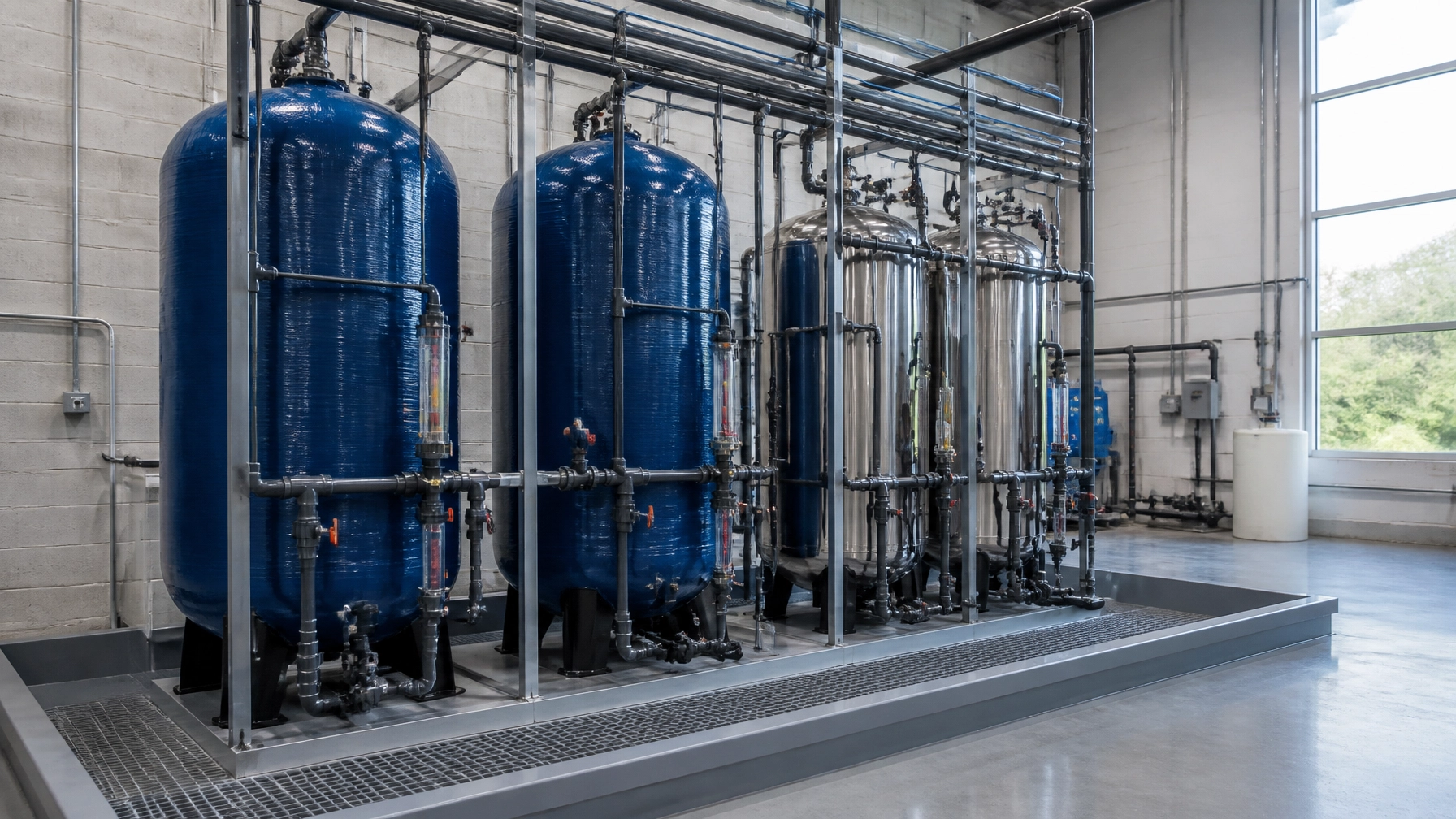
PFAS remediation cost is never a single number. Anyone giving you a fixed price before reviewing the water chemistry, flow rate, PFAS profile, and treatment endpoint is guessing.
For developers, investors, and municipal or utility managers in New York and New Jersey, that guess can become an expensive surprise. A treatment system that looks reasonable during early budgeting may require frequent media changes, additional pretreatment, more sampling, or a separate residuals-management process once the system operates in the field.
The right question isn’t simply, “What does GAC cost?” It’s:
What treatment train can reliably meet the regulatory endpoint at this site, for this water, over the full project schedule?
Below are practical cost benchmarks for granular activated carbon (GAC), ion exchange (IX), and foam fractionation, along with the variables that determine whether your project lands near the low or high end.
Current PFAS remediation cost benchmarks
The following ranges provide a starting point for planning. They are not a substitute for a site-specific design basis.
| Treatment or cost category | Planning benchmark | Important qualification |
|---|---|---|
| GAC and IX operating costs | $0.03–$3.20 per cubic meter | Broad range reflecting different water chemistries, system sizes, targets, and operating conditions |
| GAC and IX case-study operating costs | Approximately $0.14–$0.45 per 1,000 gallons | Equal to roughly $0.04–$0.12 per cubic meter |
| GAC and IX capital costs | Approximately $0.01–$0.45 per cubic meter | A normalized planning range, not a universal installed-system price |
| Leachate systems using GAC and foam fractionation | Approximately $0.058–$0.095 per gallon in reported scenarios | Roughly $15–$25 per cubic meter; these figures reflect high-strength leachate and total-cost scenarios |
The operating and capital benchmarks for GAC and IX are discussed in the Water Research Foundation treatment comparison and the EPA PFAS Treatment Technology Cost document.
The apparent spread is significant. A large municipal system treating relatively consistent water may operate close to the lower range. A smaller remediation system handling concentrated groundwater, landfill leachate, or industrial wastewater can cost substantially more per cubic meter.
That’s why cost per gallon alone can mislead decision-makers.
GAC: Proven technology, but media replacement drives the budget

GAC removes PFAS through adsorption. Water passes through carbon media, and PFAS compounds attach to the carbon surface.
It’s a proven approach with a large operating history. GAC can be a practical fit for groundwater treatment, municipal systems, and certain industrial applications. But the cost depends heavily on how quickly the media becomes exhausted.
The main GAC cost drivers include:
- Influent PFAS concentrations and the mix of compounds present
- Total organic carbon (TOC)
- Competing organic compounds
- Suspended solids and pretreatment requirements
- Required empty bed contact time (EBCT)
- Total flow and hours of operation
- Frequency of carbon change-out
- Transportation and disposal or regeneration of spent carbon
- Sampling, laboratory analysis, and compliance monitoring
TOC matters because other organic material competes with PFAS for available adsorption sites. A system treating water with elevated TOC may consume carbon faster than a system treating cleaner groundwater at the same PFAS concentration.
The result is straightforward: two sites with the same flow rate may have very different operating costs.
GAC also requires a plan for spent media. Changing the carbon is not the end of the process. You need documentation, transportation, and a compliant destination for the spent material. Those residuals costs belong in the initial estimate.
IX: More selective media, different design tradeoffs
Ion exchange systems use specialized resin to capture PFAS from water. Depending on the resin and water chemistry, IX can offer strong PFAS removal and may reduce the treatment footprint or extend media life compared with GAC.
That does not mean IX is automatically cheaper.
IX cost depends on:
- Resin selection and capacity
- PFAS chain length and compound mixture
- TOC and other competing constituents
- Pretreatment needs
- Resin replacement or regeneration requirements
- Disposal or management of spent resin
- Required treatment levels and breakthrough limits
- System flow, redundancy, and monitoring requirements
IX can be attractive when PFAS selectivity is important or when space is limited. However, the resin must match the actual influent. A generic resin selection made from a lab report alone may not perform as expected once the system sees variable site water.
This is where a site-specific remedial design has real financial value. The cheapest equipment on paper is not necessarily the lowest-cost solution if it produces frequent breakthrough, unplanned shutdowns, or repeated media replacement.
Foam fractionation: Lower water volume, concentrated residuals

Foam fractionation removes PFAS by transferring surface-active compounds into a concentrated foam stream. The process can reduce the volume of water requiring downstream management, but it does not eliminate the need to manage the captured PFAS.
The cost question shifts from “How much media will we replace?” to:
How will we handle, transport, treat, destroy, or dispose of the concentrated residual?
Foam fractionation may be considered for high-volume water or waste streams, including certain landfill leachates. Its performance depends on the PFAS mixture, surfactant behavior, organic content, solids, and process configuration.
Reported landfill-leachate case studies have shown total-cost scenarios for systems combining GAC with foam fractionation in the range of approximately $0.058–$0.095 per gallon, or roughly $15–$25 per cubic meter. Those numbers should not be applied to every PFAS project. They reflect difficult, concentrated leachate streams and broader annualized cost assumptions.
They also are not a standalone equipment price for foam fractionation. The total may include pretreatment, pumping, energy, monitoring, residuals handling, and downstream treatment.
Foam fractionation can reduce the volume of concentrated waste. It cannot make the liability disappear.
The five variables that make PFAS remediation costs move
Before comparing vendor quotes, establish the design basis. At minimum, your consultant should evaluate:
1. Influent water chemistry
TOC, suspended solids, iron, manganese, co-contaminants, and other constituents can affect media capacity and system performance.
2. PFAS compound profile
PFOA, PFOS, PFNA, GenX, and other PFAS compounds do not behave identically. Chain length and functional group influence how readily a treatment technology removes them.
3. Flow and treatment duration
A temporary system treating 20 gallons per minute for six months has a different cost profile from a permanent system treating 500 gallons per minute for ten years.
4. Regulatory endpoint
The required endpoint may be based on groundwater, discharge, drinking water, soil-leachate protection, or another site-specific standard. Treatment to a low-parts-per-trillion target requires tighter controls than simple mass reduction.
5. Residuals and field logistics
Budget for mobilization, electrical service, tanks, secondary containment, sampling ports, laboratory analysis, waste hauling, media or resin replacement, maintenance, and contingency response.
A credible estimate should show these assumptions clearly. If the quote only provides a lump sum for “PFAS treatment,” you don’t yet have enough information to make a sound investment decision.
What changed in New Jersey on June 15, 2026?
NJDEP formally adopted final site remediation standards for PFNA, PFOA, PFOS, and GenX, effective June 15, 2026. The final standards replace interim standards that had been in place since 2022 and 2023.
NJDEP also added PFNA, PFOA, PFOS, GenX, and 2,3,7,8-TCDD to required analyses when contamination at a site is unknown or not well documented. The department’s June 15, 2026 announcement provides the regulatory details and links to the applicable guidance.
This matters for NJ property transactions and redevelopment planning. A project that previously relied on a narrow historical contaminant list may now require a broader analytical program. That can affect:
- Phase II sampling scope
- Groundwater investigation
- Soil-leachate evaluation
- Remedial alternatives
- Construction dewatering
- Discharge permitting
- Schedule and lender communication
The New Jersey rules do not create one universal treatment cost. They make early characterization more important.
As NJDEP Acting Commissioner Ed Potosnak stated, the rule adoption is intended to “protect public health, improve our drinking water, and protect our natural resources.” For owners and developers, the practical response is to identify PFAS risk before it reaches the closing table or construction schedule.
How Envicon builds a defensible estimate
Envicon does not select a treatment technology from a template. We start with the site conditions, the regulatory pathway, and the project’s actual schedule.
Our process typically evaluates:
- Existing sampling data and data gaps
- Flow rate, pumping duration, and seasonal variability
- PFAS compounds and concentration trends
- TOC and competing constituents
- GAC, IX, foam fractionation, or combined treatment options
- Pretreatment and residuals management
- Agency requirements and discharge constraints
- Capital cost, operating cost, and contingency exposure
We then turn those findings into an actionable remedial design and implementation plan. That may include pilot testing, treatment-train evaluation, construction oversight, environmental monitoring, and direct regulatory coordination.
You get more than a report. You get a clear path from findings to action, with direct access to the engineers managing the work. Our remediation and brownfield support is built around the conditions in New York and New Jersey: not a national playbook applied from a distance.
The takeaway: price the water before you price the equipment
GAC, IX, and foam fractionation can all be appropriate PFAS treatment technologies. None is automatically the cheapest.
Your PFAS remediation cost depends on the water chemistry, TOC, PFAS mixture, flow, regulatory endpoint, treatment duration, and residuals plan. EPA’s PFAS cost model and Work Breakdown Structure can help organize the estimate, but the model is only useful when the inputs reflect actual site conditions.
The best cost-control measure is early characterization followed by a remedial design tailored to the site.
PFAS surprises blow budgets. Field data, transparent assumptions, and accountable engineering keep projects moving.
Get a site-specific PFAS cost range
If you’re evaluating a contaminated property, planning a dewatering system, or preparing for NJDEP or NYSDEC review, Envicon can help you establish the design basis before you commit to equipment or construction.
Leave a Reply