DRAFT
Primary keyword: NJDEP historic fill
Updated: September 9, 2026
Service focus: Historic fill investigation, soil management, remediation, and NJDEP LSRP oversight
Primary market: Newark and Jersey City, New Jersey
Historic fill is common beneath redevelopment sites in Newark, Jersey City, Hoboken, Bayonne, Bergen County, Hudson County, and Essex County. It can support a practical redevelopment strategy, but it can also create unexpected sampling, disposal, cap, and schedule requirements.
The decision is not simply whether soil looks clean. The decision depends on the material’s origin, physical composition, analytical results, groundwater conditions, planned reuse, receiving area, and current New Jersey Department of Environmental Protection guidance.
For a project involving brownfield remediation and site cleanup, the objective is clear: characterize the material early, document every movement, and choose a reuse or disposal path before excavation begins.
What is historic fill in New Jersey?
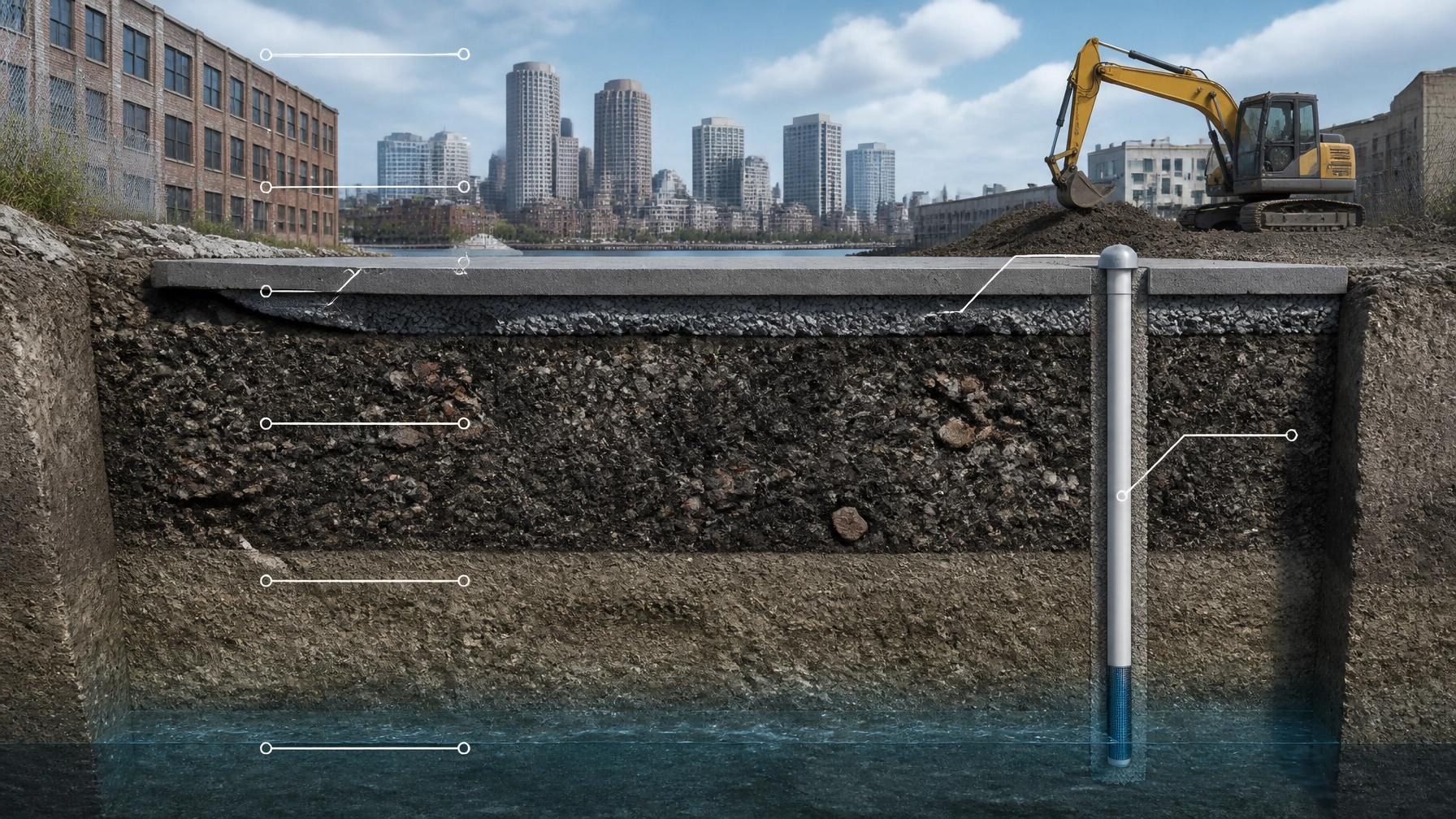
Under N.J.A.C. 7:26E-1.8, historic fill is non-indigenous material placed to raise a site’s elevation. It was contaminated before placement and was not connected to operations at the location where it was placed.
Historic fill may include:
- Construction and demolition debris
- Dredge spoils
- Incinerator residue
- Fly ash
- Brick, ash, and soil mixtures
- Non-hazardous solid waste
NJDEP’s definition does not include material that is substantially chromate chemical production waste, chemical production waste, ore-processing waste, slag, tailings, or a municipal solid waste landfill.
That distinction matters in Hudson County. A fill layer associated with general waterfront placement may be historic fill. A layer connected to a former chemical manufacturing operation may represent a separate area of concern that requires independent investigation.
NJDEP’s Historic Fill Material Technical Guidance states:
“Historic fill material is material generally deposited to raise the topographic elevation of the site.”
In practice, the definition must be supported by historical research, site observations, boring logs, test pits, maps, aerial photographs, and the conceptual site model.
Why historic fill is common in Newark and Jersey City
Large portions of the Newark Bay, Passaic River, Hackensack River, Hudson River, and Meadowlands industrial corridors were altered through grading, dredging, filling, and redevelopment.
Historic fill is especially relevant to:
- Former industrial parcels in Newark and the Ironbound
- Waterfront and rail-adjacent properties in Jersey City
- Journal Square and Bergen-Lafayette redevelopment areas
- Former manufacturing properties in Hoboken and Bayonne
- Industrial and commercial properties in Bergen and Essex Counties
- Parcels with undocumented elevation changes or buried structures
A historic fill investigation should not rely on a map alone. NJDEP’s current rules require the person responsible for remediation to determine whether historic fill is present and to investigate other areas of concern independently.
Build the conceptual site model before sampling
A conceptual site model, or CSM, connects the site history to the field conditions and potential exposure pathways.
For historic fill, the CSM should address:
- When and why the site was raised
- The likely source and composition of the fill
- The thickness and lateral extent of each fill layer
- Native soil, meadow mat, bedrock, and groundwater conditions
- Former tanks, drains, process areas, and waste handling areas
- Potential migration to groundwater
- Exposure pathways under the proposed future use
- Excavation areas for foundations, utilities, garages, and stormwater systems
- Whether the fill extends beyond the property boundary
The CSM also determines whether historic fill is the only issue. Elevated photoionization detector readings, petroleum odors, free product, stained soil, buried tanks, or operational evidence may indicate separate VOC, petroleum, or source-related areas of concern.
What contaminants should be tested?
Historic fill is commonly associated with metals and polycyclic aromatic hydrocarbons, or PAHs. That does not mean every site has the same contaminant profile.
Depending on site history and current NJDEP requirements, the analytical program may include:
- TAL metals, including lead, arsenic, mercury, chromium, and nickel
- PAHs
- VOCs
- SVOCs
- Extractable petroleum hydrocarbons, or EPH
- PCBs
- Pesticides
- Cyanide or phenolics for specific industrial histories
- PFAS compounds when the site history, regulatory requirements, or data gaps warrant evaluation
NJDEP’s current Technical Requirements at N.J.A.C. 7:26E-2.1 identify PFAS compounds including PFOA, PFOS, PFNA, GenX chemicals, and other analytes for consideration when contaminants are unknown or not well documented.
PFAS should not be added to every historic fill program automatically. The scope should reflect the site history, regulatory pathway, intended use, prior reports, and current NJDEP guidance.
NJDEP historic fill sampling options
Under N.J.A.C. 7:26E-3.12, the investigator generally has two paths:
- Assume the historic fill is contaminated above applicable standards and proceed with the required remedial investigation.
- Sample the historic fill and groundwater to determine whether contamination is present above applicable standards.
If sampling is selected, the investigation must be designed to represent the fill’s physical and chemical variability. Different strata should not be treated as one uniform material without technical support.

NJDEP historic fill guidance has historically recommended:
- Test pits, trenches, or borings through the fill and into underlying native material
- Field screening and detailed stratigraphic logging
- Documentation of fill depth, thickness, color, odor, ash, brick, and debris
- Sampling that accounts for distinct fill layers
- Groundwater evaluation where required by site conditions
The current rule and guidance should control the final sampling design. Older sample frequencies should not be copied into a new work plan without checking the applicable requirements and discussing the approach with the project LSRP.
Caps, deed notices, and engineering controls
Complete removal is not automatically required for historic fill. Under N.J.A.C. 7:26E-5.4, New Jersey has a rebuttable presumption that historic fill contamination can be addressed through engineering and institutional controls.
Common controls include:
- Asphalt or concrete caps
- Clean soil covers
- Building slabs
- Geotextile or visible contamination boundary markers
- Deed notices
- Soil remedial action permits
- Groundwater classification exception areas
- Site Management Plans
- Long-term inspection and maintenance
A cap must match the proposed use. A parking lot, landscaped area, utility corridor, crawl space, and residential play area do not present the same exposure conditions.
The remedial design should show:
- Cap materials and thickness
- Subgrade preparation
- Drainage and erosion controls
- Utility trench details
- Construction quality assurance
- Inspection and maintenance requirements
- As-built documentation
- Deed notice limits and institutional controls
A cap is not a paperwork substitute. If excavation or utility work later penetrates the control, the project team must know what lies below and how to manage it.
Excavation and stockpiling requirements
The lowest-risk approach is to make soil management decisions before excavation. Once historic fill is mixed into a stockpile, the material becomes harder to characterize and more expensive to route.
Before excavation, establish:
- Excavation limits
- Expected soil volumes
- Stockpile locations
- Impervious staging surfaces
- Covers and stormwater controls
- Dust and odor controls
- Sampling and segregation procedures
- Trucking and disposal requirements
- Clean fill import requirements
- Daily field documentation
Keep soil from separate areas of concern segregated. Do not mix material simply to reduce the number of stockpiles. Mixing can increase disposal volumes, obscure contaminant patterns, and create a more difficult waste classification problem.
Stockpiled material should be covered and managed to prevent runoff, fugitive dust, odors, leaching, and tracking. Disposal facilities may also impose their own sampling and acceptance requirements.
Historic fill soil reuse versus disposal
Reuse depends on current NJDEP guidance, analytical results, and site approvals. There is no universal approval based only on the label “historic fill.”
Clean fill
Clean fill meets all applicable soil remediation standards, site-specific alternative standards, or interim standards. It must not contain extraneous debris, solid waste, or free liquids.
Clean fill still requires documentation of:
- Source
- Quantity
- Analytical results
- Origin and destination
- Bills of lading
- Placement location
- Field verification
Alternative fill
Alternative fill contains contaminants above applicable standards but may be used as part of a remedial action if the requirements of N.J.A.C. 7:26E-5.2 are met.
The current rule addresses whether the material:
- Contains contaminants already present at the receiving area of concern
- Exceeds the receiving area’s 75th percentile for an individual contaminant
- Exceeds the volume needed to restore pre-remediation grade and elevation
- Requires prior NJDEP written approval
The receiving area’s LSRP must evaluate the data and document the decision in the fill use plan and remedial action documentation.
The NJDEP Fill Material Guidance for SRP Sites should be reviewed with the current rule before moving material.
Non-soil historic fill and debris
Historic fill containing substantial debris, such as trash, lumber, plastics, roofing materials, insulation, or mixed demolition waste, may be regulated as solid waste.
Non-soil historic fill may require a Certificate of Authority to Operate or Beneficial Use Determination, commonly called a CAO/BUD. It may also need to go to a permitted solid waste facility.
Do not assume that an LSRP approval alone authorizes unrestricted reuse of debris-rich material.

Soil decision tree for Newark and Jersey City projects
Use this as a screening framework. The project LSRP must confirm the final path.
Historic fill suspected
        |
        v
Confirm definition and extent through records, borings, test pits, and logs
        |
        v
Is the material connected to a separate operational area of concern?
        | yes                         | no
        v                            v
Investigate separately       Characterize or assume contamination
        |                            |
        v                            v
Determine contaminants,       Are results below applicable standards?
waste status, and remedy      | yes                  | no
                                     v                     v
                              Potential reuse        Evaluate remedy
                              with documentation     and fill use plan
                                                           |
                                                           v
                                     Can it meet alternative fill criteria?
                                     | yes                  | no
                                     v                      v
                              LSRP-documented reuse   Obtain approval, BUD,
                              under approved remedy  or dispose at permitted facility
How LSRP oversight protects the schedule
An LSRP should be involved before acquisition or construction mobilization, not after a stockpile has been created.
For Newark, Jersey City, Hoboken, Bayonne, and nearby Hudson, Bergen, and Essex County projects, early LSRP involvement can align:
- Due diligence findings
- Remedial investigation
- Geotechnical borings
- Foundation and utility plans
- Cap and deed notice requirements
- Soil export and import routes
- NJDEP submissions
- Construction sequencing
- Confirmation sampling
- Remedial Action Reports and RAOs
Envicon’s NJ LSRP services combine regulatory coordination, field investigation, remedial design, soil management, and construction oversight. The benefit is not another report sitting in a project folder. It is one accountable team connecting the data to the construction plan.
Practical acquisition checklist
Before closing on a brownfield with suspected historic fill, request:
- Historical maps and aerial photographs
- Existing Phase I and Phase II ESA reports
- Boring logs and laboratory data
- Deed notices and remedial action permits
- Site Management Plans
- Groundwater CEA information
- Prior soil disposal or reuse records
- NJDEP correspondence
- Planned grading and excavation quantities
- Future-use plans, including residential or child care components
Then compare the environmental findings against the actual construction design. A site may appear manageable until a proposed basement, underground garage, deep utility trench, or stormwater basin changes the exposure and soil-handling requirements.
Frequently asked questions
Can historic fill be reused in Jersey City?
Potentially. Reuse depends on the material’s analytical results, physical composition, groundwater protection, receiving area conditions, proposed use, and current NJDEP requirements. Approval by an LSRP may be sufficient in some remedial contexts, while other materials or uses require prior NJDEP approval or a CAO/BUD.
Does historic fill always require excavation?
No. Containment and exposure controls are often the practical remedy. Excavation may still be necessary for foundations, utilities, basements, underground structures, groundwater work, or areas with separate source contamination.
Does historic fill automatically mean the site has a discharge?
Not necessarily. Historic fill must be evaluated under the applicable remediation rules. If contaminated historic fill is identified, the site still requires appropriate investigation and remediation. The LSRP should determine the reporting and regulatory pathway.
Should PFAS be included in every historic fill investigation?
No. PFAS scope should reflect current NJDEP requirements, site history, prior uses, data quality, and the applicable remedial program. The absence of PFAS from an older report does not prove the site has no PFAS concern.
What is the difference between historic fill and clean fill?
Historic fill is defined by origin and placement history. Clean fill is defined by its analytical and physical characteristics. Historic fill may contain contaminants and debris. Clean fill must meet applicable standards and contain no extraneous debris or solid waste.
Takeaway
NJDEP historic fill is a site-management issue, not just a soil-description issue.
For a Newark or Jersey City brownfield, the right sequence is:
- Confirm the definition and extent.
- Build a defensible conceptual site model.
- Investigate separate areas of concern independently.
- Characterize metals, PAHs, VOCs, PFAS, petroleum, and other contaminants as appropriate.
- Decide early whether material will remain under a cap, be reused as alternative fill, be imported as clean fill, or be disposed.
- Document every soil movement under LSRP oversight.
- Align the remedy with acquisition, design, permitting, and construction milestones.
The fastest project is not the one that moves soil first. It is the one that makes the soil decision before the excavator arrives.
Official NJDEP sources
- N.J.A.C. 7:26E Technical Requirements for Site Remediation
- NJDEP Historic Fill Material Technical Guidance
- NJDEP Fill Material Guidance for SRP Sites
- NJDEP Understanding Regulatory Requirements for Soil and Fill Recyclable Materials
- NJDEP Remediation Standards, N.J.A.C. 7:26D
Talk with Envicon about your site
Historic fill decisions affect acquisition risk, construction cost, regulatory closure, and the date your project can mobilize.
- Call Envicon now
- Get a free project quote
- View brownfield remediation services
- Review NJ LSRP services
- Explore environmental consulting in Jersey City

Leave a Reply