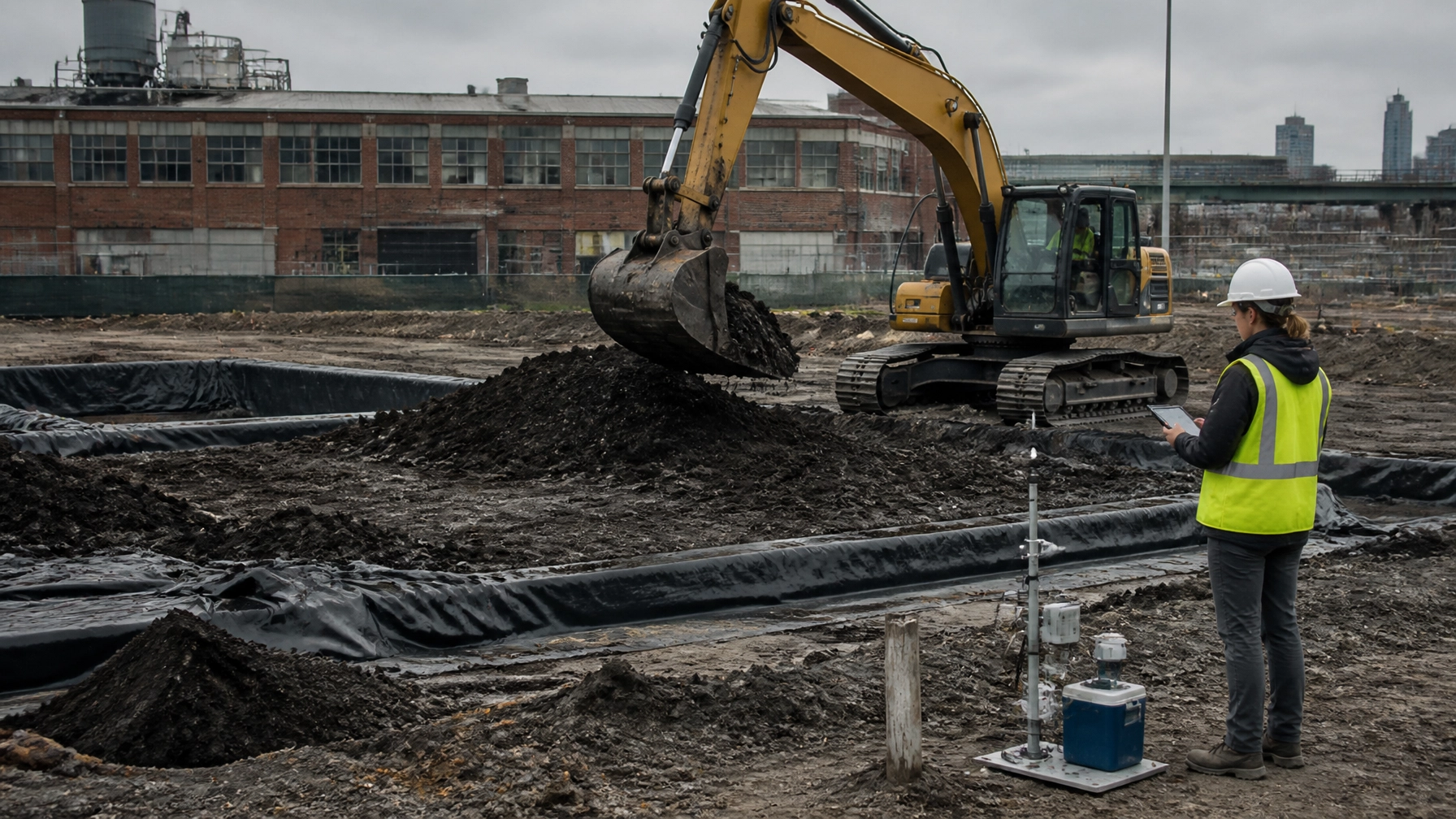
A brownfield acquisition in Newark, Jersey City, Hoboken, Bayonne, Hudson County, Bergen County, or Essex County rarely fails because the buyer overlooked the purchase price.
It fails because the buyer underestimated the environmental work required after closing.
That work may include historic fill management, PFAS and dioxin testing, UST closure, soil disposal, groundwater treatment, vapor controls, LSRP oversight, ISRA compliance, civil design, and construction monitoring. Each item can affect the acquisition model, lender approval, construction schedule, and long-term operating obligations.
There is no responsible single price for New Jersey brownfield redevelopment. The right approach is to identify the cost drivers early, place them into planning categories, and update the budget as the site data improves.
What drives NJ brownfield redevelopment cost in Newark?
The first budget should not pretend to know the final remedy. It should show what is known, what is probable, and what still needs investigation.
For a Newark industrial property, the main cost categories usually include:
- Due diligence: Phase I ESA, regulatory file review, historical research, lender requirements, and transaction support.
- Site characterization: Phase II ESA work, soil borings, groundwater monitoring wells, soil vapor sampling, and laboratory analysis.
- Contaminant-specific investigation: PFAS, dioxins, petroleum compounds, metals, volatile organic compounds, and other analytes selected based on historical use and NJDEP requirements.
- UST work: Tank locating, closure assessment, removal, soil sampling, disposal, and follow-up remediation if a release is identified.
- Remedial design: Excavation plans, caps, vapor barriers, groundwater systems, dewatering controls, soil management plans, and engineering documents.
- Regulatory oversight: LSRP services, remedial action work plans, remedial action permits, deed notices, ISRA coordination, and agency communication.
- Construction implementation: Excavation, hauling, disposal or reuse, import material, field documentation, air monitoring, water management, and contractor oversight.
- Civil integration: Grading, drainage, utilities, stormwater controls, foundations, and site design that must work with the environmental remedy.
- Contingency: Unknown tanks, buried structures, unexpected soil classifications, groundwater impacts, weather delays, and changes to the construction sequence.
The earlier these categories are separated, the easier it becomes to compare acquisition scenarios.
Historic fill can change the soil disposal budget
Historic fill is common across older urban and industrial areas of New Jersey. It may contain ash, brick, concrete, cinders, dredge material, demolition debris, or other non-native material placed before the current redevelopment.
The key question is not simply whether historic fill exists. The key questions are:
- How deep is it?
- How much of it will construction disturb?
- What contaminants are present?
- Can it remain beneath an engineered cap?
- Can portions be reused on site under an approved soil management approach?
- What volume must leave the property?
- What waste classification will the receiving facility assign?
A site that can manage historic fill in place may have a very different budget from a site that requires broad excavation and off-site disposal. That difference affects trucking, tipping fees, replacement fill, traffic control, dewatering, and schedule.
This is why historic fill disposal cost in New Jersey should never be estimated from acreage alone. Soil volume, depth, moisture, classification, haul distance, receiving facility requirements, and reuse options all matter.
New Jersey’s brownfield framework recognizes historic fill as a distinct condition. The New Jersey Brownfields and Contaminated Site Remediation Act and NJDEP’s Brownfields and Contaminated Site Remediation Program provide the regulatory context for evaluating these sites.

PFAS and dioxin testing can expand the scope quickly
PFAS and dioxin are not automatic findings at every brownfield. They are potential cost drivers that should be evaluated based on site history, surrounding properties, fill composition, industrial processes, and regulatory direction.
PFAS may affect:
- Soil and groundwater sampling plans.
- Laboratory methods and reporting limits.
- Disposal or treatment options.
- Groundwater treatment design.
- Long-term monitoring.
- Lender and purchaser risk requirements.
Dioxin concerns may arise at properties with historical combustion, ash, waste handling, or certain industrial uses. The cost impact depends on the number of samples, the depth and distribution of impacts, laboratory requirements, and whether the results change the selected remedy.
For a buyer searching for PFAS cleanup cost in Newark industrial property, the important point is that sampling cost is only one part of the budget. The larger question is whether PFAS affects excavation, groundwater management, disposal, treatment, or long-term controls.
A Phase II ESA should answer the questions that matter to the transaction. It should not become a generic sampling exercise disconnected from the planned redevelopment.
UST closure is both an environmental and construction issue
Underground storage tanks can create direct costs and schedule risk.
A tank may be abandoned, partially removed, undocumented, or located beneath an active structure or paved area. Closure can require:
- Utility and geophysical locating.
- Tank removal or closure in place where allowed.
- Soil sampling beneath and around the tank.
- Product removal and tank cleaning.
- Disposal of tank contents and impacted soil.
- Additional delineation.
- Confirmatory sampling.
- LSRP reporting and regulatory coordination.
A UST discovery during excavation is more expensive than a UST identified during acquisition due diligence. The work may require remobilization, temporary shoring, traffic changes, additional disposal, and a revised construction sequence.
For this reason, UST review should be connected to the planned foundation, utility, parking, and stormwater design. A tank located beneath a proposed building footprint carries a different risk from a tank in an undisturbed corner of the property.
See Envicon’s UST closure services and Phase II ESA services.
Decision table: how to budget a New Jersey brownfield
| Planning condition | Typical budget pressure | Questions to resolve before acquisition |
|---|---|---|
| Limited soil impacts with no groundwater concern | Lower | Are lender and regulatory requirements satisfied? |
| Historic fill beneath a planned cap | Moderate | What cap, deed notice, or engineering control will be required? |
| Historic fill requiring excavation | Moderate to high | What volume leaves the site, and where can it go? |
| UST with confirmed petroleum release | Moderate to high | Is additional delineation or active remediation required? |
| PFAS in soil or groundwater | High and uncertain | Will treatment, special disposal, or long-term monitoring be needed? |
| Dioxin or other persistent contaminants | High and uncertain | Does the result change the remedy or reuse plan? |
| Groundwater within the excavation zone | High | Will dewatering require treatment, discharge approval, or off-site disposal? |
| Vapor intrusion concern | Moderate to high | Is a vapor barrier, sub-slab system, monitoring, or building redesign needed? |
| ISRA-triggered transaction | Variable | Does the industrial establishment require a separate compliance path? |
| Dense urban construction in Newark or Hudson County | Higher implementation cost | How will trucks, utilities, neighbors, and active operations affect the work? |
These are planning categories, not bids. A credible budget should include assumptions, exclusions, unit-cost placeholders, and a contingency that reflects the quality of the available site data.
LSRP, ISRA, RAP, and engineering controls belong in the first model
New Jersey brownfield redevelopment often requires an LSRP to manage the remediation process and certify work completed under the state’s Site Remediation Reform Act framework.
An LSRP may support:
- Site investigation and delineation.
- Remedial investigation reports.
- Remedial action work plans.
- Soil and groundwater management plans.
- Deed notices.
- Remedial Action Permits.
- Engineering and institutional controls.
- Regulatory submissions and response coordination.
- Long-term monitoring and certification.
The NJDEP Site Remediation Program should be reviewed alongside the project’s intended reuse. A residential redevelopment, warehouse, manufacturing facility, and mixed-use project may require different controls and documentation.
If the property is an industrial establishment, ISRA may create additional obligations when the facility is sold, closed, or transferred. ISRA should not be treated as a last-minute legal item. It can affect transaction timing, responsibility allocation, financial security, and the work plan.
Envicon provides New Jersey LSRP services that connect regulatory requirements to field conditions and construction decisions.

Do not forget groundwater, vapor, dewatering, and civil design
Soil is only one part of the redevelopment budget.
If groundwater enters an excavation, the project may need temporary wells, pumps, treatment tanks, discharge controls, laboratory testing, water hauling, or permit coordination. If volatile contaminants are present, soil vapor may affect the building design through vapor barriers, sub-slab depressurization, utility sealing, or indoor air monitoring.
Civil design also affects remediation cost. A deeper basement, new utility corridor, underground parking area, or altered grading plan can disturb more impacted soil than the original concept assumed.
This is where environmental and civil teams need to work together. Collaboration is not a buzzword. It is how the project avoids designing a remedy that conflicts with the foundation, stormwater system, or construction sequence.
How to build a defensible acquisition budget
For NJ brownfield acquisition due diligence cost, start with a decision-focused scope.
Ask your consultant to provide:
- A clear Phase I ESA scope and report timeline.
- A Phase II investigation tied to historical operations and planned use.
- A contaminant and analyte rationale.
- A preliminary soil volume estimate.
- Potential disposal and reuse pathways.
- UST and vapor risk assumptions.
- Groundwater and dewatering considerations.
- LSRP and ISRA requirements.
- Likely engineering controls.
- Construction oversight needs.
- Lender-specific deliverables.
- A written list of exclusions and contingency triggers.
Do not bury these assumptions in a long report. Put them in a cost-driver matrix that your acquisition, finance, legal, design, and construction teams can use.
That is the difference between receiving environmental information and making an informed investment decision.
Envicon’s approach to brownfield cost planning
Envicon works with developers, investors, attorneys, contractors, lenders, and public agencies across Newark, Jersey City, Hoboken, Bayonne, Hudson County, Bergen County, and Essex County.
We connect Phase I and Phase II findings to remediation strategy, LSRP requirements, civil design, disposal planning, and construction oversight. Our role is not to hand you a report and leave you to interpret the risk.
We help you understand what the site needs, what the remedy may cost, what the regulator will expect, and what must happen next.
For projects in Hudson County, see our Jersey City environmental consulting location page. For broader brownfield planning, review our remediation and brownfield redevelopment services.
The takeaway
Brownfield redevelopment cost in Newark and northern New Jersey is driven by conditions below the surface and decisions above it.
Historic fill, PFAS, dioxin, USTs, groundwater, vapor, disposal classification, ISRA, RAPs, engineering controls, civil design, and construction sequencing all belong in the acquisition conversation.
The strongest budgets do not claim false precision. They identify the cost drivers, test the highest-risk assumptions, and show how additional information will change the model.
Ready to review your brownfield cost drivers?
Request a brownfield cost-driver review before you finalize your acquisition or construction budget.
Solve environmental and engineering challenges with precision, speed, and trust.

Leave a Reply