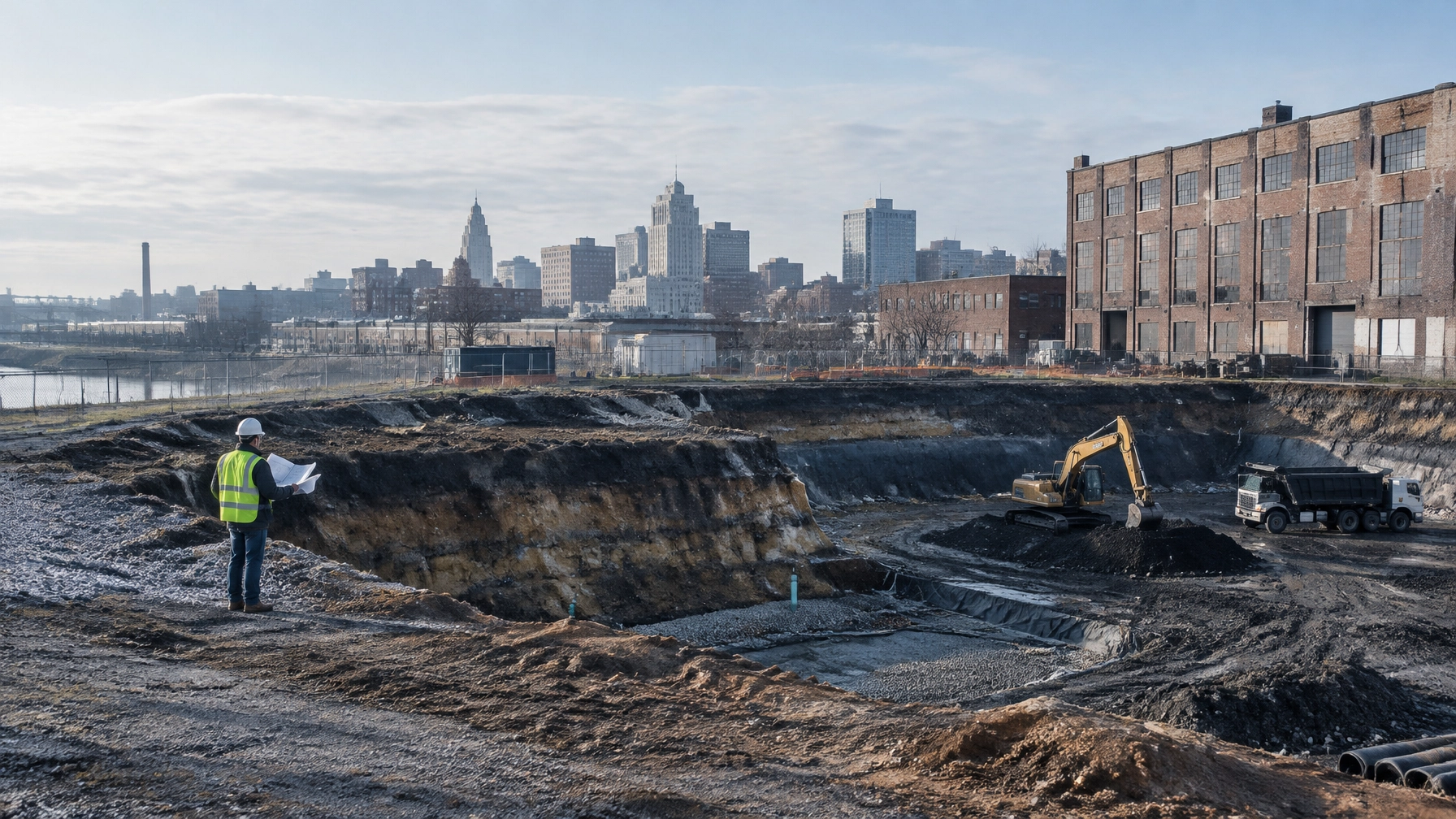
Title tag: NJDEP FY2027 Fees: What Newark Developers Need to Budget
Meta description: NJDEP FY2027 SRP fees took effect July 1, 2026. See the updated annual rates, RAP fees, ISRA application fees, and budgeting steps for Newark-area deals.
For Newark and Essex County transactions, NJDEP fees belong in the deal model before closing, not as a surprise after the remediation schedule is set. Fiscal Year 2027 (FY2027) fees apply to qualifying invoices and application events on or after July 1, 2026. Some charges increased. Others, including the listed Remedial Action Permit (RAP) activity fees, did not.
The distinction matters. Your project’s fee exposure depends on the case, permit type, application milestone, and ongoing obligations. Here’s how to budget those costs and keep a fee-triggering milestone from getting missed.
What changed for NJDEP FY2027?
NJDEP’s FY2027 fee schedule sets the current annual remediation fees and RAP activity fees. For annual remediation fees, NJDEP says the invoice date determines which fiscal-year rates apply. For RAP activity fees, the agency’s schedule ties the rate to when an application or other permit activity is administratively complete and submitted. Check the current online filing instructions when you prepare a filing.
The annual remediation fees increased from FY2026:
| Fee category | FY2026 | FY2027 | Increase |
|---|---|---|---|
| Category 1 | $950 | $985 | $35 |
| Category 2 | $1,900 | $1,970 | $70 |
| Category 3 | $10,450 | $10,835 | $385 |
| Category 4 | $20,900 | $21,670 | $770 |
| Contaminated media | $1,590 | $1,655 | $65 |
The applicable category and media charges depend on the case. Don’t assume a project will receive just one annual fee. Review the NJDEP invoice and case details to identify the billed components.
The listed RAP activity fees did not increase between FY2026 and FY2027. For example, a soil RAP application remains $1,100, and a soil RAP modification remains $1,210. Groundwater RAP applications are $770, while vapor intrusion or indoor air RAP applications are $805. The schedule lists a $550 annual fee for each listed RAP type.

Which fees can reach a Newark-area development deal?
Fees come into play at different points. A useful budget separates recurring charges from filing events and project costs.
ISRA case processing and alternative compliance
For Industrial Site Recovery Act (ISRA) transactions, don’t treat every compliance path as having the same NJDEP application cost. The FY2027 fee guidance lists a $600 application fee for a Certificate of Limited Conveyance and a $300 application fee for a De Minimis Quantity Exemption. These apply to those specific alternatives, not as a flat charge for every ISRA case. Confirm current forms and instructions through NJDEP’s SRP forms update log.
ISRA can affect both closing conditions and the sequence of investigation, remediation, and documentation. Add applicable filing fees to the same schedule as the required submissions, LSRP milestones, and lender or purchaser review.
RAP applications and modifications
A RAP fee is only one part of the permit’s economics. Budget the application or modification fee, the annual permit fee where applicable, and the professional work needed to prepare a complete, supportable package. A modification is not automatically required every time project details change. Determine whether the change requires a permit modification under the applicable NJDEP process before assuming either a fee or no fee.
Timeframe extension requests
NJDEP’s fee schedule lists RAP applications, modifications, transfers, and terminations. It does not list a separate RAP activity fee for a remediation timeframe extension request. Don’t automatically budget an extension as a RAP modification fee. At the same time, an extension can affect schedule, carrying costs, and ongoing obligations. Check the current SRP forms and guidance for the applicable request process and confirm which fee obligations continue during the extension period.
October delineation guidance can change the cost forecast
In October 2026, NJDEP issued reminders about delineation requirements for certain alternative remediation standards (ARS) and compliance averaging approaches. Under the October 7 notice, some ARS methods require full delineation to the appropriate default soil remediation standard before developing the ARS. The notice identifies exceptions, including certain alternative exposure scenarios and methods using a pre-approved Dilution-Attenuation Factor, the Synthetic Precipitation Leaching Procedure, or fraction of organic content. The method matters, so don’t assume every ARS follows the same sequence.
NJDEP also clarified on October 21 that full horizontal and vertical delineation is required when compliance averaging is selected as part of a remedial action. Required reporting must document the data and sampling locations. See the agency’s October 7 delineation notice and October 21 compliance averaging notice.
For your deal, the practical effect is straightforward: incomplete delineation can mean additional fieldwork, laboratory analysis, revised documents, and later submissions. Those steps add consulting and project costs. They can also create new fee exposure if a later filing triggers a fee under the NJDEP schedule. Not every additional submission automatically carries a separate state fee, so confirm the specific trigger rather than budgeting a fee for every document.
Budget the fees against acquisition and ISRA milestones
A sound environmental due diligence model for developers in NJ should show both the expected state charges and the work needed to reach the next regulatory milestone. For a Newark-area acquisition, we recommend mapping:
- Case and transaction status: Confirm whether an SRP case exists, whether ISRA applies, and who will be responsible for the remediation and invoices.
- Applicable fee events: Identify annual remediation fees, relevant ISRA alternate-compliance fees, RAP applications or modifications, and any applicable annual permit charges.
- Technical dependencies: Check whether delineation is complete for the selected remedial approach, including ARS or compliance averaging requirements.
- Submission dates and completeness: Track the target filing date, required supporting material, and evidence that the submission meets the applicable administrative completeness requirements.
- Ongoing obligations: Carry annual fees and permit-related responsibilities beyond closing if they remain with the owner or responsible party.
Keep state fees separate from LSRP services, sampling, laboratory work, remediation, financial assurance, and carrying costs. They affect the same transaction economics, but they are not interchangeable budget lines.
Fee tracking should follow the case, not a spreadsheet snapshot
One common failure in large-firm delivery is treating agency fees as pass-through costs without flagging the event that creates them. Then the project team discovers a required filing, extension, or permit step late, when the closing schedule has less room to absorb it.
At Envicon, we map fee triggers to case milestones in our project management platform. The client can see schedule, deliverable status, field activity, and the upcoming decisions that may affect the budget. Our team checks whether the intended filing matches the case status and current forms, then coordinates with the LSRP, counsel, developer, and other project professionals.
For Newark projects, local regulatory fluency matters. So does clear ownership. A responsive engineer should be able to explain what the charge covers, what event triggers it, and what remains before the next milestone. Our regulatory compliance and permitting team works across those details, while our broader services team supports the due diligence and remediation work behind the filing.
Whether a project sits in Newark, Monmouth County, or another New Jersey market, the goal is the same: put the right cost and schedule assumptions in front of the deal team early. No surprise fees. No avoidable duplicate work. A clear path from findings to action.
FAQ: NJDEP FY2027 fees
When did NJDEP FY2027 SRP fees take effect?
FY2027 rates apply from July 1, 2026. NJDEP uses the invoice date to determine the annual remediation fee schedule. For RAP activity fees, refer to NJDEP’s current schedule and submission instructions for the applicable completeness and filing milestone.
Did NJDEP increase all RAP application fees for FY2027?
No. The fee comparison on NJDEP’s FY2027 page shows no change to the listed RAP activity fees, including applications and modifications. Annual remediation fees increased, and the applicable annual RAP fee remains $550 for the listed permit types.
What are the FY2027 ISRA Certificate of Limited Conveyance and De Minimis fees?
NJDEP’s FY2027 fee guidance lists $600 for a Certificate of Limited Conveyance application and $300 for a De Minimis Quantity Exemption application. These apply to the specified alternative-compliance options. Check the current form and instructions before filing.
Does a remediation timeframe extension request have a separate RAP activity fee?
NJDEP’s FY2027 RAP activity schedule does not list a separate extension fee. A timeframe request is distinct from a RAP modification. Confirm the current extension process and continuing annual obligations against the case facts and current NJDEP guidance.
Takeaway: budget fees as milestones, not miscellaneous costs
FY2027 increased NJDEP’s annual remediation fees, while the listed RAP activity fees remained unchanged. For Newark and Essex County developers, the larger exposure may come from planning the filing path too late. Confirm case status, delineation requirements, fee triggers, and continuing obligations before you lock the acquisition model or ISRA schedule.
We solve environmental and engineering challenges with precision, speed, and trust. The point is not to hand you another fee table. It’s to keep the deal moving with a clear view of what comes next.
Talk with Envicon Group

Leave a Reply