SEO title: NYC Community Air Monitoring 2026: CAMP PM-10 and VOC Thresholds
Meta description: Understand CAMP PM-10 and VOC action levels, NYC construction dust rules, and the field controls and documentation that help prevent excavation stoppages.
Status: DRAFT for approval. Not published.
A dust-related stop-work event can hold up excavation, truck movements, and the trades scheduled behind them. The cause is often preventable: monitors placed without regard to wind direction, dust controls that arrive after readings rise, or field logs that don’t explain what the crew did in response.
For remediation work in Queens, the Community Air Monitoring Plan (CAMP) is a field procedure, not just a report appendix. It sets monitoring locations, measurement intervals, response levels, and what the team must document. Your project’s approved CAMP and work plan control. Confirm their requirements before mobilization.
The CAMP thresholds to know
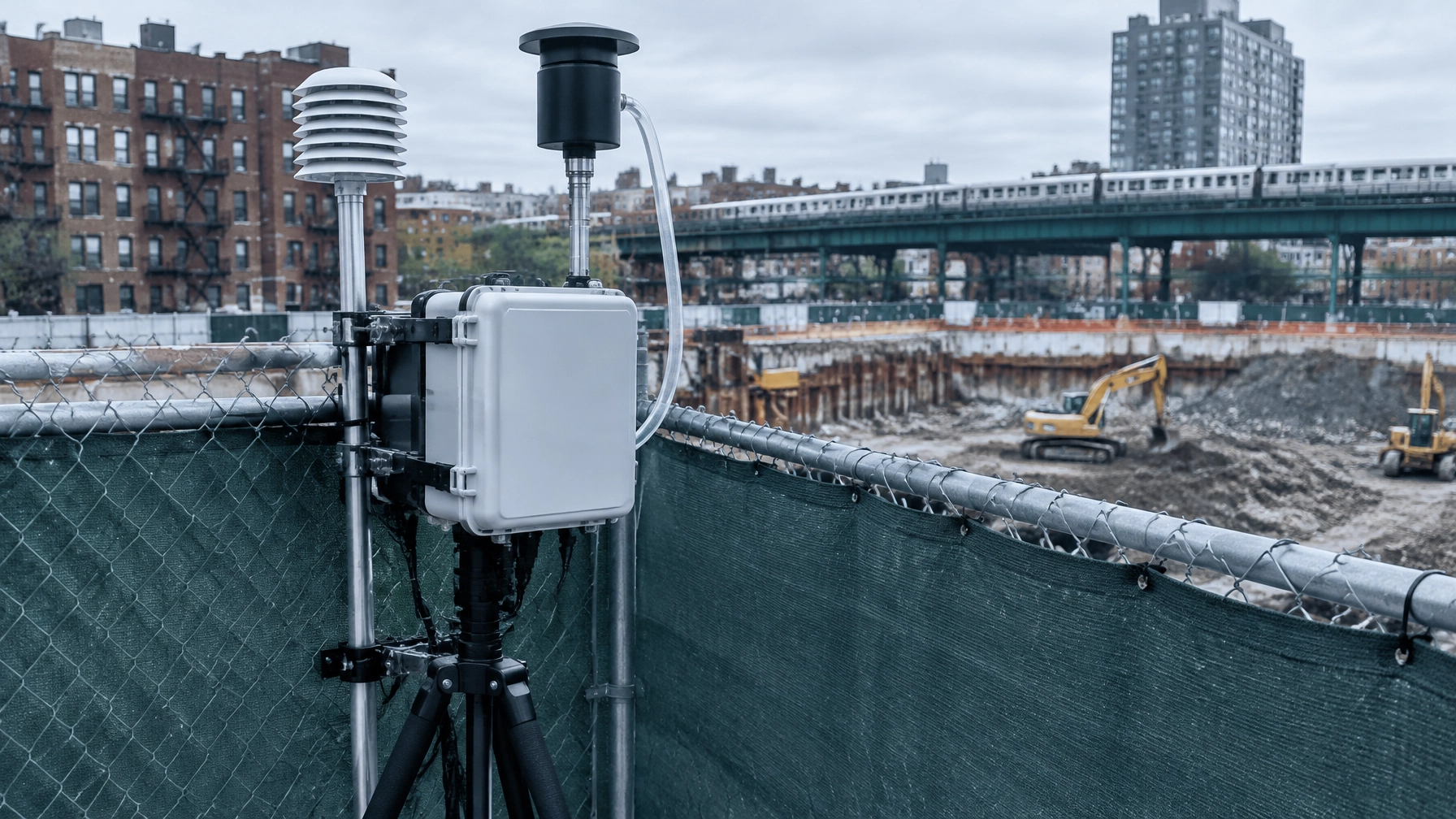
A typical New York remediation CAMP calls for continuous monitoring of volatile organic compounds (VOCs) and PM-10 particulates at the work-area perimeter. PM-10 instruments integrate readings over 15-minute periods. Upwind measurements establish background, which the downwind results are compared against.
Common CAMP response levels are:
| Reading | Typical response |
|---|---|
| Downwind PM-10 reaches 100 µg/m³ above background | Alert level. Apply or increase dust suppression and monitor the result. |
| Downwind PM-10 reaches 150 µg/m³ above background | Stop work and reevaluate the activity and controls. Resume only when the project’s CAMP conditions are met. |
| VOCs reach 5 ppm above background | Halt the activity under the applicable CAMP response procedure and assess the readings. |
| VOCs exceed 25 ppm at the work-zone perimeter | Stop work under the typical CAMP shutdown procedure. |
These are common CAMP levels, not a substitute for checking the site-specific plan. Approved project documents may establish additional or more restrictive procedures. For an example of a current project plan using CAMP action levels, see this NYSDEC Community Air Monitoring Plan.
The distinction between an alert and a stop-work level matters. At 100 µg/m³ above background, the crew should act to control dust and watch the trend. At 150 µg/m³ above background, the issue is no longer just a warning. The work must stop for reassessment under the applicable plan. Visible dust migrating beyond the work area can also demand an immediate response. Don’t wait for a monitor to validate what the field team can already see.
Set up the perimeter before excavation starts
A monitor can only guide decisions if it measures the right air. Before the first bucket breaks ground, confirm the monitoring locations against the site layout, work zone, receptors, and prevailing wind conditions.
At a minimum, the field team should confirm:
- Upwind and downwind locations are identified and accessible.
- Instruments are operating and positioned according to the approved CAMP.
- The crew understands who receives readings and who can pause the work.
- Dust suppression equipment and a reliable water supply are ready.
- The contractor and monitor agree on how to communicate alerts and record responses.
Wind direction can shift. A fixed “downwind” location may not stay downwind all day. Monitor placement and field decisions should account for changing conditions and the plan’s requirements.

Dust suppression is a work method, not a last-minute fix
NYC’s construction dust rules are separate from CAMP. Under 15 RCNY Chapter 13, construction sites must take measures to prevent particulate matter from becoming airborne. NYC DEP summarizes the city’s building and construction emissions requirements.
In practice, the rule requires wetting construction material as needed to prevent off-site dust, unless wetting would damage utilities or create a safety hazard. The rule also addresses the supply of water, fine mist for excavation work, dust from drilling and grinding, covered trucks, and keeping piles from becoming airborne. Apply controls in a way that doesn’t create a slipping hazard or unmanaged drainage.
A workable dust-control setup may include:
- Fine mist at active excavation and material handling.
- Pre-wetting of soil before loading or disturbing dry material.
- Covered trucks carrying particulate matter.
- Covered or moistened stockpiles where needed.
- Water supply, hoses, and spray equipment ready for the day’s scope.
- A plan to manage runoff and avoid unsafe wet surfaces.
Build these controls into the work sequence. If a dry soil face starts generating dust, the crew should have a clear response before the monitor reaches an action level.

Document the reading and the response
Monitoring data protects the contractor when it records what happened and how the team responded. It can establish that the crew followed the CAMP, identify whether a reading tracks with background conditions, and support a clear account of a work pause or control adjustment.
Record all 15-minute readings required by the project plan, including upwind and downwind values. When a reading reaches an alert or action level, document:
- Time and location of the reading.
- Upwind background and downwind result.
- Wind direction and relevant site conditions.
- The work activity underway.
- Dust suppression or other corrective measures applied.
- Whether work continued, paused, or stopped.
- Follow-up readings and the basis for resuming work.
Avoid reconstructing the day from memory after the shift. A complete, timely log gives the contractor, project manager, and regulator a defensible record. It also helps identify a recurring issue, such as a particular loading point or soil condition, before it causes another interruption.
For projects requiring construction oversight and field engineering, real-time communication between the monitor and contractor is part of effective QA/QC. A reading without a documented response is an incomplete record.
Keep asbestos notification on a separate track
CAMP is not an asbestos filing, and an asbestos notification does not replace dust monitoring. NYC DEP states that work disturbing more than 25 linear feet or more than 10 square feet of asbestos-containing material is an asbestos project. The building owner or authorized agent must file an ACP-7 through ARTS at least one week before work begins. The ACP-7 is valid for one year. Report covered changes or deviations using an ACP-8. See DEP’s asbestos abatement forms and filing instructions.
Keep the filing, CAMP, and construction schedule coordinated. A missing notification or an unready perimeter-monitoring setup can delay a start for different reasons.
Field support that keeps the excavation moving
A national firm may send a monitor who logs numbers and leaves the contractor to work out what they mean. Envicon’s field staff sit with the contractor at 7 a.m., adjust the perimeter before it trips, and give the project manager real-time answers that keep excavation moving. We support field-level QA/QC with direct coordination, active monitoring, and records that explain the decisions made on site.
That approach matters on an NYC E-Designation project, where environmental work and the construction schedule must stay aligned. Our Queens location supports projects across the borough. For broader NYC environmental work, visit our Environmental Consultant NYC hub.
Questions about Phase I ESA cost NYC or asbestos inspection cost NJ involve separate services and scopes. Neither changes the CAMP action levels or the need for a site-specific monitoring plan.
CAMP and dust-control checklist
Before the next excavation shift, confirm that:
- The approved CAMP is available and the crew understands its action levels.
- Upwind and downwind stations are placed and operating as specified.
- PM-10 readings are recorded at the required 15-minute intervals.
- Dust suppression equipment and water are ready before disturbance begins.
- The contractor knows who will act on an alert or stop-work reading.
- Each response, reading, and restart decision is documented.
- Any required ACP-7 is filed on time, with changes handled through ACP-8.
The practical takeaway is straightforward: monitor the perimeter, control dust early, and keep a complete record. A prepared field team can respond to rising readings before they become a schedule problem.
Discuss your monitoring plan
If excavation is approaching, review the site-specific CAMP, perimeter layout, dust controls, and documentation process before mobilization.

Leave a Reply