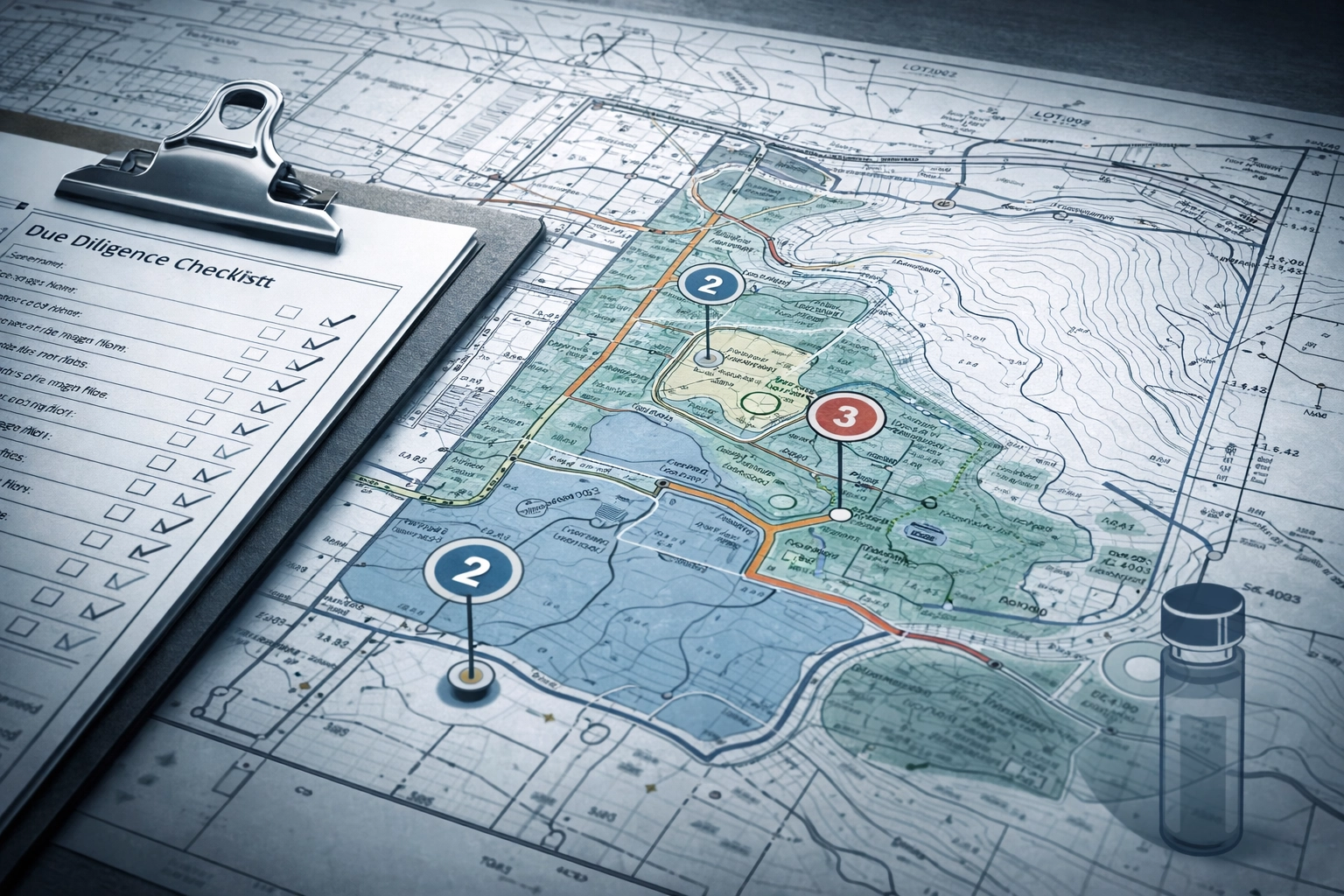
In the New Jersey real estate market, speed is often the enemy of certainty. You find a site in Jersey City or an industrial pocket in Woodbridge, and the clock starts ticking. You have a 30-day due diligence window to decide if you’re looking at a goldmine or a liability nightmare.
Most developers approach this window with a "check-the-box" mentality. They hire a big-box consultancy, wait three weeks for a generic report, and then scramble in the final 72 hours to understand what the findings actually mean for their pro forma. That’s how projects die: or worse, how they survive only to bleed cash during construction.
At Envicon, we look at due diligence differently. It’s not just a technical requirement; it’s a competitive advantage. If you can move faster, uncover risk earlier, and give lenders and partners clear answers, you put yourself in a better position to close. For NJ developers, that means a disciplined process for environmental due diligence in New Jersey, not a last-minute scramble. Here is how we break down a high-stakes NJ acquisition in exactly 30 days.
“In this market, good due diligence doesn’t slow a deal down. It keeps a bad deal from speeding up.” — Jason Pancoast, CEO of Envicon Group
Days 1–5: The Foundational Layer
The first 120 hours are about momentum. If you aren't ordering your core documents by Day 2, you've already lost the window. In New Jersey, the regulatory landscape is governed by the Site Remediation Reform Act (SRRA), which means you need to know if the property is already "in the system."
The Immediate Checklist:
- Phase I Environmental Site Assessment (ESA): This is the bedrock. In NJ, we aren't just looking for old gas stations; we’re looking for Historic Fill, Isopropyl Ether (IPE) plumes, and Industrial Site Recovery Act (ISRA) triggers.
- Title Commitment & 30-Year Chain of Title: NJ title issues are notorious. We look for breaks in the chain or "suspicious" transfers that could signal hidden environmental indemnifications.
- ALTA Survey: Forget a simple boundary survey. For development, you need an ALTA survey that plots every utility easement and right-of-way.
The goal here is to identify "Fatal Flaws" immediately. If the preliminary search shows a massive unregulated heating oil tank or a direct discharge into a sensitive waterway, you need to know by Day 5, not Day 25.

Days 6–12: Data Ingestion and Zoning Realities
While the environmental records are being pulled, we shift focus to the "as-is" operational reality. For developers, this is where environmental due diligence for NJ developers overlaps with civil engineering.
We scrutinize the rent rolls, but more importantly, we look at the permits. New Jersey's municipal "Home Rule" means every town has its own quirks. Does the existing use match the CO? Are there outstanding building code violations that will trigger a full-site upgrade the second you pull a renovation permit?
This is also the stage where NJ real estate environmental due diligence needs to connect with site planning. We review public mapping, flood context, utility constraints, and prior site activity so you’re not evaluating environmental risk in a silo.
During this week, we also perform a Geotechnical Desktop Review. We look at USDA soil maps and NJ Geological Survey data. If you’re building on the "Meadowlands muck," your foundation costs could easily double. Knowing this on Day 10 allows you to re-trade the price or walk away before you’ve spent $50k on legal fees.
Days 13–20: The "Deep Dive" and Specialized Inspections
By Day 14, your Phase I ESA should be in draft form. This is the pivot point. If the Phase I identifies "Recognized Environmental Conditions" (RECs), you don't have time to wait for a 45-day Phase II schedule. You need a team that can mobilize a Geoprobe immediately.
For New Jersey buyers, we often see too much focus on report price and not enough focus on scope. The real question in Phase I ESA for NJ development sites is whether the work actually identifies the issues that can delay closing, financing, permitting, or redevelopment. While cost matters, the real expense is the omission.
“A cheap Phase I can get expensive fast if it misses the one issue that changes your whole acquisition model.” — Envicon
Specialized areas we target during this window:
- PFAS and Emerging Contaminants: NJ has some of the strictest PFAS standards in the country. If you’re near an old manufacturing site or a fire station, you need a quick screen.
- Vapor Intrusion (VI): If you're planning residential over an old industrial site, VI is a project-killer. We look for sub-slab soil gas risks early.
- Utility Conflict Mapping: We use high-resolution GIS mapping to see where the "invisible" infrastructure is. Nothing kills a 30-day window like finding a high-pressure gas main right where your foundation is supposed to go.

Days 21–27: Strategy and Mitigation Costing
The final week of the 30-day sprint isn't about data collection; it’s about valuation. A technical report that says "there is lead in the soil" is useless to a developer. You need to know: How much will it cost to get an LSRP to issue a Response Action Outcome (RAO)?
We bridge the gap between technical findings and the pro forma. This is where environmental due diligence for commercial property in NJ has to become practical. We sit down with our clients and provide a "Probable Cost of Remediation."
- Is it a $50k "dig and haul" job?
- Is it a $500k capping strategy with a Deed Notice?
- Can we use the Brownfield Reimbursement Program to offset costs?
"Due diligence isn't a post-mortem of the property's past; it's a blueprint for its future. If you can't quantify the risk, you haven't done the work." : Jason Pancoast, CEO of Envicon Group.
Days 28–30: The Go/No-Go Decision
By Day 28, you should have a clear vision. You have the environmental liability quantified, the geotechnical foundation risks identified, and the zoning hurdles mapped out.
At this stage, you aren't just looking at a "Pass" or "Fail." You’re looking at a strategy. If the site has issues, you go to the seller with hard data and a specific price reduction request. Because you’ve done the work in 30 days, you have the leverage.

Why the "Standard" Approach Fails
Most developers use a fragmented team: an environmental guy who doesn't talk to the civil engineer, and a lawyer who doesn't understand the LSRP process. This silos the risk.
The big-box firms operate on "billable hours," not project timelines. They are risk-averse to the point of uselessness, often hiding behind 20 pages of disclaimers rather than giving you a straight answer on whether the dirt is clean.
The Envicon Approach is different:
- Speed as a Priority: We understand that a 30-day window means 30 days. Our LSRPs and Engineers work in parallel, not in sequence.
- Tech-Forward Mapping: We use GIS and 3D subsurface modeling to visualize risks that others just write about in paragraphs.
- Accountability: We don't just identify problems; we own the solutions. If we find a REC, we’re already drafting the remediation plan while the other guys are still formatting their Phase I report.
- Better Fit for NJ Developers: We tailor our work to acquisitions, lender expectations, and redevelopment timelines in New Jersey. That means fewer generic reports, faster answers, and clearer next steps than the typical big consultant model.
Summary: Your 30-Day Roadmap
- Days 1-5: Order everything. Phase I, Title, ALTA Survey. Identify the "Fatal Flaws."
- Days 6-12: Review zoning and geotechnical data. Check the pro forma against the soil.
- Days 13-20: Mobilize for Phase II if needed. Scan for PFAS and Vapor Intrusion.
- Days 21-27: Quantify the remediation and infrastructure costs. Build the "Real" budget.
- Days 28-30: Execute the contract or renegotiate based on the data.
Final Takeaway
New Jersey development is a high-stakes game of information. The winner isn't the one who buys the most property; it's the one who buys the right property with the right plan. Strong environmental due diligence for NJ developers helps you spot risk early, price deals more accurately, and keep approvals moving.
If you’re looking at an acquisition and need a team that moves at the speed of your business, let’s talk. We don't just do due diligence; we help you make smarter go/no-go decisions with confidence.
Ready to start your 30-day sprint?
Explore our Full Suite of Services or check out our Project Portfolio to see how we’ve cleared the path for NJ’s top developers.

Envicon Group
Northern NJ + NYC | Site-Civil • Geotechnical • Environmental
Contact: https://wp.envicongroup.com/contact
Website: https://wp.envicongroup.com
Leave a Reply