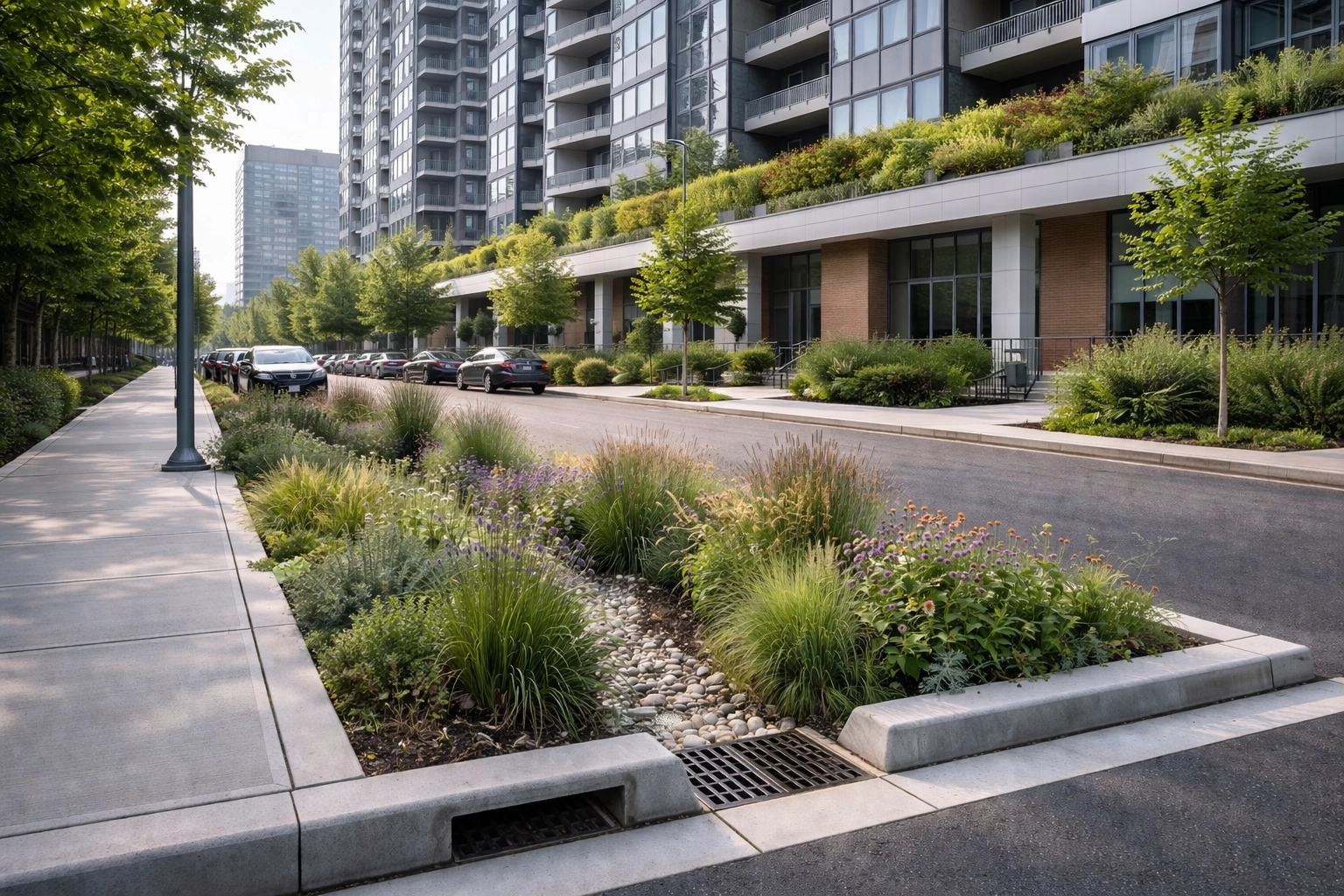
Here's a perspective shift that's changing the game for NYC developers: that stormwater management requirement on your site plan isn't just a regulatory checkbox. It's a design opportunity hiding in plain sight.
We've watched countless projects treat green infrastructure as an afterthought: something to squeeze into the leftover corners of a site just to satisfy DEP. But the smartest developers in the city have figured out something different. They're turning these mandated systems into genuine amenities that attract tenants, boost property values, and create places where people actually want to be.
Let's talk about how you can do the same.
The NYC Stormwater Reality
New York City's combined sewer system handles both stormwater and wastewater in the same pipes. During heavy rain events, that system gets overwhelmed: and the results aren't pretty. The city has responded with increasingly stringent stormwater management requirements, pushing developers to handle runoff on-site rather than sending it into the already-strained infrastructure.
If you're developing in NYC right now, you're likely facing requirements to manage the first inch (or more) of rainfall through retention, detention, or infiltration. The regulations aren't going away: they're getting tighter.
But here's what we tell our clients: don't fight it. Lean into it.
Governor Hochul's Green Resiliency Grant program specifically emphasizes "nature-based infrastructure that absorbs stormwater, reduces flooding, and cools neighborhoods during extreme heat." The city isn't just asking for compliance: it's incentivizing transformation. And Local Law 2025-70 now requires DEP to map all green roofs citywide, tracking their water absorption capacity and building type. Green infrastructure is becoming a visible, valued part of the urban fabric.

From Compliance Burden to Competitive Advantage
The traditional approach goes something like this: engineer calculates required stormwater volume, designer finds the cheapest way to store it underground, and everyone moves on. It works. It's compliant. And it adds exactly zero value to the finished project.
The alternative approach treats that same stormwater volume as a design driver. Instead of hiding water management underground, you integrate it into the landscape in ways that serve multiple purposes:
Rain Gardens and Bioswales
These planted depressions collect and filter runoff while creating lush, natural focal points. A well-designed rain garden in a courtyard or building entrance becomes a signature landscape feature: not a detention basin with plants on top.
Green Roofs
NYC's Green Infrastructure Grant Program offers funding for green roof retrofits meeting minimum standards of 1.5-inch soil depth and 3,500 square feet of coverage, with a $50,000 minimum project investment. But beyond the grant money, a green roof creates usable amenity space, reduces cooling costs, extends roof membrane life, and provides views that tenants will pay premium rents for.
Permeable Pavement Systems
Parking areas, patios, and walkways can infiltrate water while maintaining full functionality. The visual texture of permeable pavers often looks better than standard asphalt: and you're managing stormwater without sacrificing a single square foot of usable space.
Stormwater Planters
These integrated systems combine architectural elements with living infrastructure. A row of stormwater planters along a building façade manages roof runoff while creating a green buffer between the street and your ground-floor retail.
The Business Case Nobody's Talking About
Let's get specific about value. When green infrastructure is designed as amenity rather than afterthought, you're looking at:
-
Higher achievable rents. Tenants pay more for buildings with green roofs, landscaped courtyards, and visible sustainability features. This isn't speculation: it's documented across the NYC market.
-
Faster lease-up. In a competitive market, distinctive outdoor spaces and sustainability credentials differentiate your property. Marketing "LEED-certified with rooftop garden" beats "code-compliant building" every time.
-
Reduced operating costs. Green roofs lower cooling loads. Properly designed landscapes reduce irrigation needs. Permeable surfaces minimize drainage infrastructure maintenance.
-
Climate resilience. As extreme weather events become more frequent, buildings with integrated stormwater management perform better. That's a risk mitigation story that matters to lenders and insurers.
-
Community goodwill. Projects that visibly contribute to neighborhood greening face less opposition and smoother approvals. That's not soft value: it's real time and money saved during entitlements.
"Nature-based infrastructure absorbs stormwater, reduces flooding, and cools neighborhoods during extreme heat." : Governor Hochul's Green Resiliency Grant Program
The developers who understand this are building differently. They're not asking "how do we meet the stormwater requirement?" They're asking "how do we maximize value from the stormwater investment we're already making?"

Integration Is Everything
Here's where a lot of projects go sideways: the civil engineer designs the stormwater system, the landscape architect designs the amenity spaces, and nobody talks to each other until the plans don't fit together.
At Envicon, we've built our practice around integrated civil and environmental solutions because we've seen what happens when these disciplines work in silos. Stormwater management that's bolted on at the end of design never performs as well: or looks as good: as systems conceived from the start as integral site features.
The best green infrastructure projects we've worked on share a common trait: early collaboration between engineering, landscape, and architecture. When everyone's at the table from schematic design forward, you get solutions that are:
- More efficient. Shared infrastructure serves multiple purposes.
- More beautiful. Engineering constraints become design opportunities.
- More cost-effective. Redundant systems get eliminated.
- More approvable. Coordinated submissions move faster through DEP review.
Making It Happen: A Practical Roadmap
If you're approaching a NYC project and want to maximize value from your stormwater requirements, here's where to start:
1. Know Your Numbers Early
Before design begins, understand exactly what stormwater volume you'll need to manage. This drives everything else. Don't wait for DEP comments to figure this out.
2. Map Your Opportunities
Identify every surface on your site: roofs, plazas, parking areas, setbacks: and evaluate each for green infrastructure potential. Some will be better candidates than others based on soil conditions, sun exposure, and programmatic needs.
3. Integrate with Amenity Programming
What outdoor spaces does your project need anyway? Courtyards, roof decks, entrance plazas? Design stormwater management into these spaces from day one rather than treating them as separate systems.
4. Explore Incentives
NYC's grant programs can offset significant costs for qualifying green infrastructure. The math often works better than developers expect: but you need to design to program requirements from the start.
5. Engage Compliance and Permitting Expertise Early
DEP review of green infrastructure plans requires specific documentation and performance calculations. Projects that engage experienced consultants early avoid costly redesigns later.
The Bottom Line
NYC's stormwater regulations aren't going anywhere. Every project you build in this city will need to manage runoff on-site, and the requirements will likely get more stringent over time as climate pressures increase.
You can treat that reality as a burden: another cost center, another compliance headache, another constraint on your design.
Or you can treat it as what it actually is: a mandate to build greener, more resilient, more valuable projects. The infrastructure investment is required either way. The question is whether you capture the upside.
The developers winning in this market have made their choice. They're building rain gardens that double as signature courtyards. Green roofs that command premium rents. Permeable plazas that handle stormwater while hosting farmers markets.
They're not just meeting NYC stormwater rules. They're meeting them with style: and banking the returns.
Ready to explore what integrated green infrastructure could mean for your next project? Let's talk.
Leave a Reply