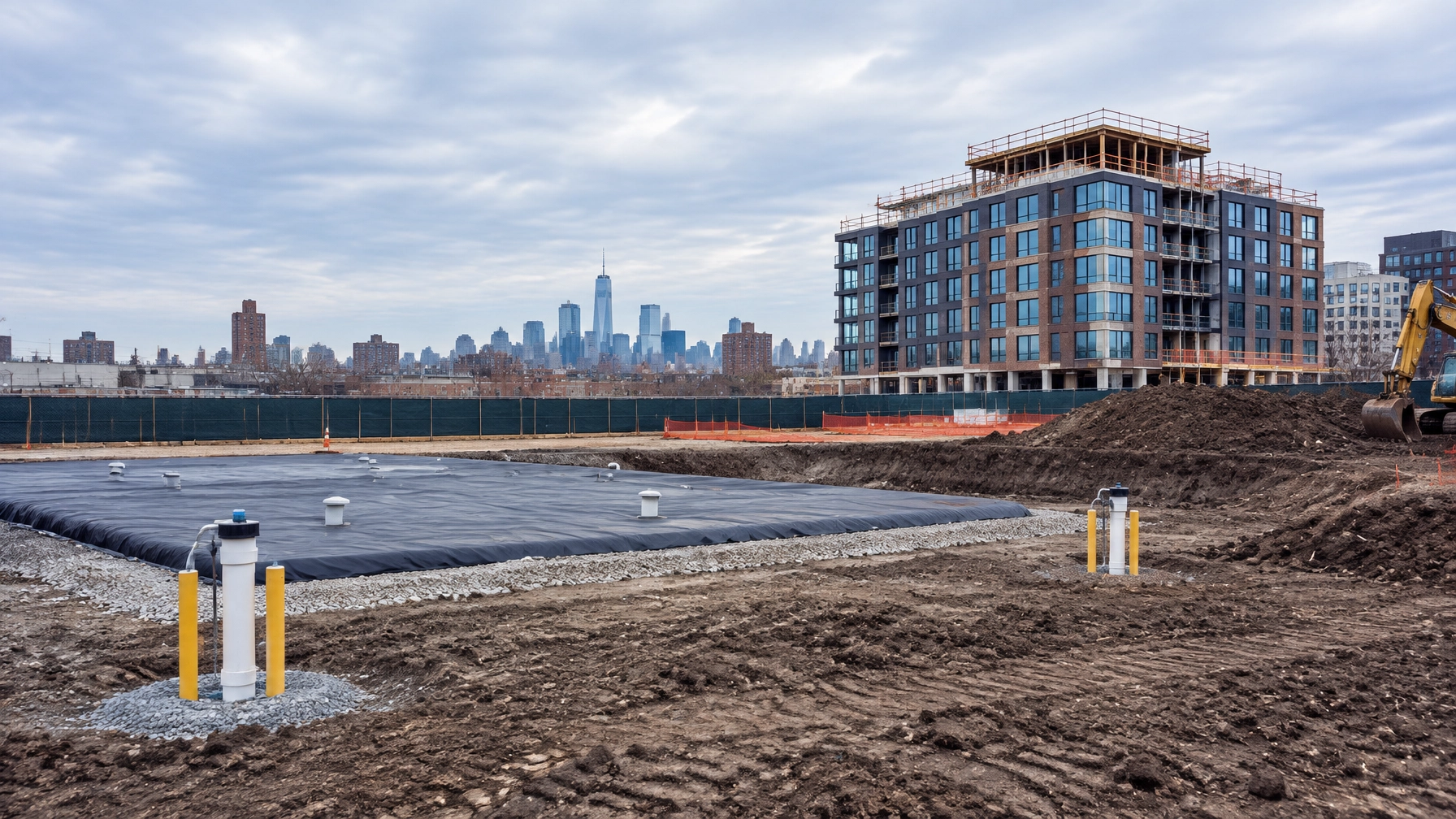
For NYC property investors and environmental attorneys, the Office of Environmental Remediation’s Voluntary Cleanup Program can turn a contaminated or underused property into a financeable, buildable asset.
The program offers a defined path for investigation, remedial design, agency coordination, construction oversight, and closure. It can also provide liability protection, grant funding, Clean Soil Bank access, and hazardous waste fee relief.
Those benefits are not automatic. They depend on site facts, enrollment status, the approved remedy, proper implementation, and continuing compliance with the project’s VCP Agreement and site management requirements.
This guide explains how the NYC OER VCP works in 2026 and where investors should focus before acquisition, construction, or refinancing.
What the NYC OER Voluntary Cleanup Program does
NYC OER manages the VCP as a local brownfield cleanup program. The program is designed for properties affected by contamination, historic industrial use, petroleum operations, fill, spills, or other recognized environmental conditions.
According to NYC OER, a developer may often receive an approved remedy and enroll a property within approximately 45 days of the first meeting with OER, depending on the site and the quality of the information available.
A typical VCP process includes:
- Initial consultation with OER.
- Eligibility and site history review.
- Remedial Investigation Report.
- Remedial Action Work Plan.
- VCP Agreement.
- OER-approved remedial construction.
- Confirmation sampling and closure documentation.
- Notice of Completion and, where applicable, Green Property Certification.
- Long-term maintenance and certification of institutional or engineering controls.
The practical objective is not simply to produce another environmental report. It is to create a defensible path from site conditions to regulatory closure.
Liability protection begins with enrollment, but it depends on performance
The most important commercial benefit is potential liability protection.
Once a property enrolls in the VCP, NYSDEC states that it generally has no plan to require the developer to perform more than the OER-approved remedy at the site under CERCLA or New York’s Environmental Conservation Law.
The protection continues while the enrolled party complies with the City cleanup agreement. It can also continue after successful completion of the VCP and receipt of a Notice of Completion.
NYC OER also explains that:
“The state and city liability protection is assignable to an enrolled party’s successors and assigns who acquire title to, develop, or otherwise occupy a VCP site, provided such parties adhere to requirements of the VCP.”
For investors and counsel, that language matters. The protection is not a blanket release from every environmental risk. It is tied to the contamination addressed by the approved program, the terms of the agreement, and the conduct of current and future parties.
Standard reopener provisions may apply. New information, a failed remedy, a change in site conditions, or a threat to human health or the environment can create additional regulatory concerns.
Before relying on VCP protection in a purchase agreement, review:
- The VCP Agreement and all amendments.
- The approved Remedial Action Work Plan.
- The Site Management Plan.
- Any Notice of Completion or Notice of Satisfaction.
- Recorded restrictions, environmental easements, or use limitations.
- Open agency comments, violations, or unresolved reporting duties.
- Whether the proposed redevelopment changes the exposure assumptions or engineering controls.
Legal conclusions depend on the property history, transaction structure, agency documents, and actual compliance. Environmental counsel should evaluate the legal allocation of risk. A qualified environmental professional should confirm the technical status of the site.
BIG grants can reduce investigation and cleanup costs
The NYC Brownfield Incentive Grant program supports eligible projects from early due diligence through remediation.
The official BIG Grants page identifies three primary grant categories for Qualifying Brownfield Projects:
- Pre-Development Grant: $5,000 for eligible due diligence and design tasks.
- Environmental Investigation Grant: $10,000 for environmental investigation.
- Cleanup Grant: $25,000 for approved remedial work under the VCP.
The maximum for a standard Qualifying Brownfield Project is $25,000. Preferred Community Development Projects may qualify for larger amounts, including $35,000 or $50,000 cleanup grants in certain affordable housing and nonprofit scenarios.
Bonus grants may also apply:
- Track 1 Cleanup Grant: $10,000 when soil across the entire site meets New York State unrestricted use soil standards.
- Resilience Grant: $10,000 for qualifying cleanups in a designated coastal flood zone.
- Community-Directed Strategic Site Grant: $10,000 for a site identified as strategic to community revitalization.
Commercial teams should address BIG eligibility early. The program has insurance requirements, qualified vendor requirements, eligible activity rules, and application deadlines. The current OER materials state that BIG enrollment grant applications must be submitted no later than six months after OER issues the project’s Notice of Completion.
Do not wait until closeout to ask whether costs qualify. Build the grant strategy into the investigation scope, remedial budget, procurement plan, and construction documentation.

Clean Soil Bank access can change the excavation budget
Urban redevelopment often creates two soil problems at the same time:
- The project has surplus clean soil that must leave the site.
- The project needs imported clean fill for grading, utility trenches, or site restoration.
VCP projects may use the NYC Clean Soil Bank to dispose of surplus clean soil at no cost other than trucking. Qualifying projects may also receive clean soil at no cost.
That can materially affect the earthwork budget, especially on constrained NYC sites where trucking, disposal, and imported fill costs can become a major line item.
The opportunity still requires coordination. Soil must meet applicable OER requirements, quantities must be documented, and the project team must plan timing, testing, staging, and transportation before excavation begins.
Envicon’s remediation and brownfield redevelopment team can connect soil characterization, remedial design, waste profiling, construction sequencing, and documentation instead of treating each scope as a separate handoff.
Hazardous waste fee relief requires advance planning
A VCP site that excavates and ships hazardous waste off site may qualify for relief from New York State charges.
According to NYC OER’s hazardous waste fee exemption guidance, the potential savings include:
- $130 per ton for the State Hazardous Waste Program Fee.
- Up to $27 per ton for the Special Assessment on Hazardous Waste.
- Up to $157 per ton in combined taxes and fees, depending on the applicable charges.
Three conditions must be met:
- The property must be enrolled in the NYC VCP.
- The approved Remedial Action Work Plan must authorize hazardous waste removal.
- OER must oversee the removal.
The sequence matters. Before hazardous waste leaves the site, OER must submit a Notice of Potential Generation of Hazardous Waste to NYSDEC. The project team must provide the EPA generator ID, soil test date, anticipated tonnage, and anticipated remediation dates.
After removal, the generator and qualified environmental professional complete the required certification. OER then prepares its remedial action certification for DEC review.
The official guidance also identifies ongoing filing duties:
- A Hazardous Waste Annual Report is due each March 1 for sites that generated 15 tons or more during the prior calendar year.
- A TP-550 quarterly return is due to the New York State Department of Taxation and Finance within 20 days after the end of the quarter in which hazardous waste was generated.
A project that begins excavation before enrollment or before the approved work plan authorizes the activity may lose the opportunity for the exemption.
Institutional and engineering controls create long-term duties
Many NYC cleanups do not remove every contaminant. Instead, the remedy may rely on controls that manage exposure over time.
Institutional controls can include:
- Environmental easements.
- Recorded use restrictions.
- Soil handling requirements.
- Restrictions on groundwater use.
- Requirements for future construction or excavation.
Engineering controls can include:
- Concrete or asphalt caps.
- Clean soil covers.
- Vapor barriers.
- Sub-slab depressurization systems.
- Impermeable barriers.
- Groundwater treatment or monitoring systems.

The Site Management Plan and VCP Agreement control the actual obligations. In many VCP files, the owner must complete an annual certification or other periodic certification confirming that controls remain in place, functional, and protective.
The certification generally requires review by a qualified environmental professional or another party approved by OER. The exact schedule, form, signatory, and supporting documentation depend on the site documents.
A practical annual control review should include:
- Inspection of caps, barriers, vents, and monitoring points.
- Verification that required access remains available.
- Review of building or site alterations.
- Confirmation that no excavation or utility work bypassed controls.
- Review of vapor mitigation system operation and maintenance.
- Updated photographs, inspection logs, and repair records.
- Submission of the required certification to OER.
Failure to maintain controls or submit required certifications can create enforcement exposure and undermine the practical value of the site’s closure status. A Notice of Completion is not a reason to close the environmental file permanently. It is the point where long-term stewardship begins.
Green Team coordination helps keep remedial work moving
The OER Green Team assists VCP parties with permits from other government agencies needed for remedial activities. Access typically runs through the project’s OER project manager.
This coordination can matter when remedial work requires interaction with agencies responsible for:
- Street openings.
- Utility conflicts.
- Construction activity.
- Public property.
- Transportation controls.
- Parks or waterfront areas.
- Other local or state approvals.
The Green Team does not replace the project engineer, construction manager, attorney, or permit applicant. It helps connect the VCP remedial plan to the approvals required for implementation.
Do not confuse Green Team coordination with NYC Green Property Certification. Green Property Certification is a separate OER recognition issued after successful cleanup and ongoing maintenance requirements are satisfied.
NYC OER VCP investor and counsel checklist
Before committing capital or closing an acquisition, confirm:
- The property’s VCP eligibility has been reviewed with OER.
- Phase I and Phase II data support a current conceptual site model.
- Contaminant impacts are horizontally and vertically delineated.
- The proposed remedy matches the planned land use.
- The VCP Agreement assigns obligations clearly among owner, developer, and successors.
- The RAWP authorizes the anticipated excavation and waste streams.
- BIG grant eligibility and deadlines are documented.
- Insurance and qualified vendor requirements are addressed.
- Clean Soil Bank opportunities are evaluated before earthwork.
- Hazardous waste fee exemption steps are scheduled before shipment.
- IC and EC maintenance responsibilities are included in the operating budget.
- Annual or periodic certifications are calendared.
- Green Team and other agency coordination needs are identified.
- Closure documents, restrictions, and site management records are ready for lender and counsel review.
Why Envicon is a practical VCP partner
A VCP project needs more than a report. It needs one technical team that understands the investigation, the remedy, the construction sequence, the regulator’s comments, and the closeout record.
Envicon supports NYC owners, investors, developers, and environmental attorneys from investigation through construction closeout. Our work can include Phase I and Phase II assessment, remedial investigation, RAWP preparation, soil and waste management, engineering control design, field oversight, agency coordination, and closure documentation.
We work directly with project counsel, architects, contractors, and public agencies. You get senior-level access, clear documentation, and responsive decisions when field conditions change.
That is the difference between a consultant who delivers a file and a technical partner who helps move the asset forward.
Final takeaway
The NYC OER VCP can provide a credible path to cleanup, liability protection, grant funding, soil management savings, and long-term regulatory control.
The value depends on execution.
Enroll before critical work begins. Coordinate the remedy with the development plan. Document hazardous waste and soil movements. Budget for annual site management. Maintain every institutional and engineering control. Keep OER informed when site conditions or planned use changes.
Envicon helps property teams solve environmental and engineering challenges with precision, speed, and trust.
Ready to evaluate an NYC VCP property?
- Call now: (917) 764-2171
- Get a free quote today
- Use our proprietary project risk screener
- View our complete list of services

Leave a Reply