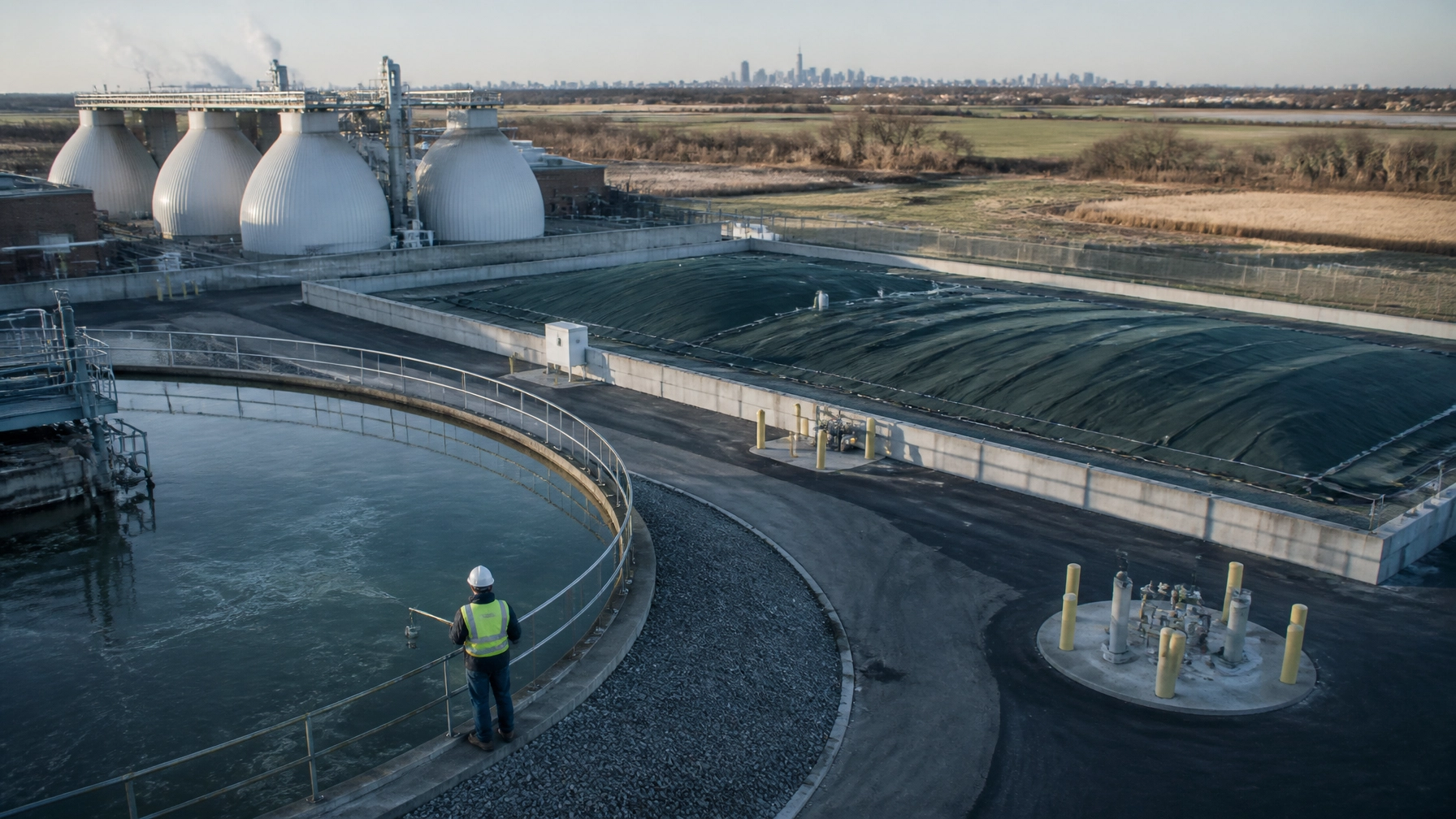
As of August 2026, PFAS in biosolids is no longer a future compliance issue for New York and New Jersey wastewater operators, agricultural users, municipalities, and environmental counsel. It is an active sampling, reporting, and land-management issue.
The regulatory picture is not identical in both states:
- New York has interim PFAS thresholds that can restrict or stop biosolids recycling.
- New Jersey has imposed targeted quarterly PFAS monitoring while developing a broader residuals strategy.
- EPA has not yet established federal PFAS limits for biosolids land application.
For any facility that produces, transports, applies, composts, or distributes biosolids, the practical message is simple: test early, document the source, understand the receiving site, and build a response plan before a result creates a scheduling or disposal problem.
Why PFAS in biosolids matters
PFAS: per- and polyfluoroalkyl substances: are persistent chemicals that can enter wastewater systems through industrial discharges, commercial operations, consumer products, landfills, and other sources.
Wastewater treatment plants are not designed to destroy PFAS. Some PFAS can pass through the liquid treatment process and accumulate in residuals, including sewage sludge and biosolids. If those biosolids are land-applied, PFAS may become part of the soil and groundwater management equation.
That is why regulators are focusing on more than the biosolids pile itself. The compliance question now includes:
- The PFAS concentration in the biosolids
- The likely industrial sources entering the treatment plant
- The soil and groundwater conditions at the receiving property
- The proposed application rate and land use
- Potential pathways to surface water, groundwater, crops, livestock, and nearby receptors
EPA’s current biosolids framework, 40 CFR Part 503, does not contain federal PFAS pollutant limits. EPA’s current PFAS biosolids work includes a draft risk assessment and draft voluntary guidance, not a final nationwide land-application standard. The agency’s PFAS and sewage sludge page states that the draft guidance released July 1, 2026, is intended to provide voluntary recommendations.
That federal uncertainty has pushed states to act first.

New York: interim thresholds are already driving decisions
New York regulates biosolids land application and biosolids products under the 6 NYCRR Part 360 series, including:
- Subpart 361-2: Land Application and Associated Storage Facilities
- Subpart 361-3: Biosolids Products
New York’s primary interim PFAS policy is DMM-7, Biosolids Recycling in New York State: Interim Strategy for the Control of PFAS Compounds. The policy applies to biosolids recycling activities and requires sampling for PFAS compounds using procedures acceptable to the New York State Department of Environmental Conservation (NYSDEC).
DMM-7 focuses on PFOA and PFOS as indicators of industrial impacts. The interim action levels are:
- 20 µg/kg or less, dry weight: No PFAS-specific action required under the interim policy.
- More than 20 but less than 50 µg/kg: Additional sampling is required. If concentrations remain above 20 µg/kg for more than one year, NYSDEC may restrict recycling.
- 50 µg/kg or greater: NYSDEC may prohibit recycling, including land application, until the concentration is reduced below 20 µg/kg.
These values are commonly reported as parts per billion, or ppb, on a dry-weight basis.
DMM-7 also requires facilities to sample each biosolids source and submit results to NYSDEC. Testing must generally use Draft EPA Method 1633, unless NYSDEC approves an alternative. The analysis covers the PFAS compounds included in the method: not only PFOA and PFOS.
The policy is available in full through NYSDEC’s DMM-7 document.
New York’s 2026 product requirements
On June 10, 2026, NYSDEC adopted Program Policy 7a, expanding PFAS monitoring to biosolids-derived soil products, including compost and heat-dried products.
Facilities permitted under Subpart 361-3, along with certain facilities distributing out-of-state biosolids products, must sample products for PFAS and use a laboratory acceptable to NYSDEC. A key 2026 deadline is September 8, 2026, when required sampling results are due for currently permitted facilities covered by the policy.
This matters to more than wastewater treatment plants. Composting facilities, product distributors, municipalities, agricultural users, and property owners receiving biosolids-derived products all need a reliable chain of documentation.
NYSDEC is also developing formal rule amendments for Parts 361-2 and 361-3. Stakeholder materials have discussed possible standards for PFOA and PFOS in biosolids and receiving soils, but those draft concepts should not be treated as final rules until formally adopted.
New Jersey: monitoring first, numeric limits later
New Jersey regulates biosolids and residuals through the NJPDES program, residuals permits, the Sludge Quality Assurance Regulations at N.J.A.C. 7:14C, and land-application requirements including N.J.A.C. 7:14A-20.7.
Beneficial use of residuals as fertilizer or soil conditioner is managed through a Letter of Land Application Management Approval, commonly called a LLAMA or Class B site approval.
NJDEP’s July 2025 PFAS strategy identifies biosolids and land application as part of the state’s broader PFAS source-management program. It also recognizes that PFAS can accumulate in wastewater residuals and may move through soil to groundwater or surface water.
The most direct current requirement came through NJDEP’s January 13, 2025 Request for Information to Delegated Local Agencies. The requirement applies to 17 designated direct-land-application POTWs and requires quarterly sampling of:
- Influent
- Effluent
- Residuals, including biosolids
The samples must be analyzed for 40 PFAS compounds.
NJDEP’s PFAS DLA FAQ specifies that:
- Influent, effluent, and residuals samples must be grab samples.
- Residuals samples must be collected at the same location used for compliance with the Sludge Quality Assurance Regulations.
- Residuals results must be reported in µg/kg.
- One field blank is required per sampling event.
- Laboratories must be New Jersey-certified for EPA Method 1633 or another approved user-defined method capable of detecting the required PFAS.
The FAQ also directs facilities to contact dwqpfas@dep.nj.gov regarding extensions, reporting, and questions about the RFI.
Unlike New York, NJDEP’s current public materials do not identify a statewide numeric PFAS concentration limit that automatically prohibits biosolids land application. New Jersey is collecting data, evaluating Class B sites, studying soil and groundwater conditions, and developing a broader residuals strategy.
That does not mean New Jersey operators can wait. Permit conditions, LLAMA requirements, source-control obligations, and future rulemaking can affect whether a specific land-application program remains workable.

What operators and landowners should do now
A defensible PFAS-in-biosolids program starts before the next sample is collected.
1. Confirm your regulatory category
Determine whether your facility is:
- A New York Part 361-2 land-application facility
- A New York Part 361-3 biosolids-products facility
- A New Jersey POTW subject to the DLA RFI
- A New Jersey Class B site or LLAMA holder
- A distributor or receiver of out-of-state biosolids products
The answer controls sampling, reporting, approvals, and agency contacts.
2. Build a source-control record
PFAS results are not just a laboratory issue. Track industrial users, pretreatment activities, landfill leachate contributions, commercial discharges, and process changes that may affect the wastewater stream.
A rising PFOA or PFOS result requires more than another sample. It may require source investigation, industrial outreach, pretreatment changes, or a revised residuals-management plan.
3. Protect sample integrity
PFAS sampling is unusually sensitive to contamination from field clothing, tubing, waterproof materials, personal-care products, and equipment.
Use trained personnel, laboratory-approved containers, appropriate field blanks, clean-handling procedures, and documented decontamination protocols. A technically correct result is only useful if the chain of custody and quality-control record can withstand agency review.
4. Characterize the receiving property
For land application, biosolids testing is only one side of the analysis. The receiving property may require baseline soil sampling, groundwater review, surface-water evaluation, agronomic-rate calculations, and receptor screening.
That is especially important near drinking-water sources, wetlands, streams, private wells, sensitive ecological areas, and sites with a history of industrial activity.
5. Plan for a result above the action level
Do not wait until a result exceeds a threshold to decide what happens next. Your response plan should identify:
- Who reviews and validates the laboratory data
- How affected material is isolated
- Which agency must be notified
- Whether additional sampling is required
- How application schedules will change
- What alternative management or disposal options are available
- How the result will be communicated to owners, farmers, contractors, and counsel
Where Envicon fits
PFAS compliance is not a single laboratory transaction. It is a field, regulatory, engineering, and documentation problem.
Envicon helps clients connect those pieces through site investigation, soil and groundwater management, regulatory compliance, sampling coordination, construction oversight, and environmental monitoring. Our team works directly with owners, attorneys, operators, contractors, engineers, and regulators so decisions do not disappear into a consultant’s queue.
That matters in New York and New Jersey, where the difference between a usable result and a rejected or delayed program often comes down to details:
- Was the sample representative?
- Was the method acceptable to the agency?
- Were the reporting units correct?
- Was the receiving site evaluated before application?
- Can the source be traced?
- Does the documentation support the decision?
We do not just deliver a report. We help create a clear path from PFAS data to an operational decision.
“Collaboration is not a buzzword: it’s how we work.”
The takeaway
New York is using interim PFAS thresholds and expanding product sampling through DMM-7 and Program Policy 7a. New Jersey is requiring targeted quarterly monitoring while developing its residuals strategy. EPA is still working toward a federal approach.
For biosolids generators, landowners, municipalities, and agricultural users, the prudent approach is to treat PFAS as a current project-control issue: not a distant regulatory possibility.
Test the material. Verify the site. Track the source. Document every decision.
When the rules are moving, the cleared path belongs to the team that is already working ahead of them.
Talk with Envicon
- Visit the Envicon Group main website
- Call Envicon Group at (917) 764-2171
- Get a free consultation and quote
Leave a Reply