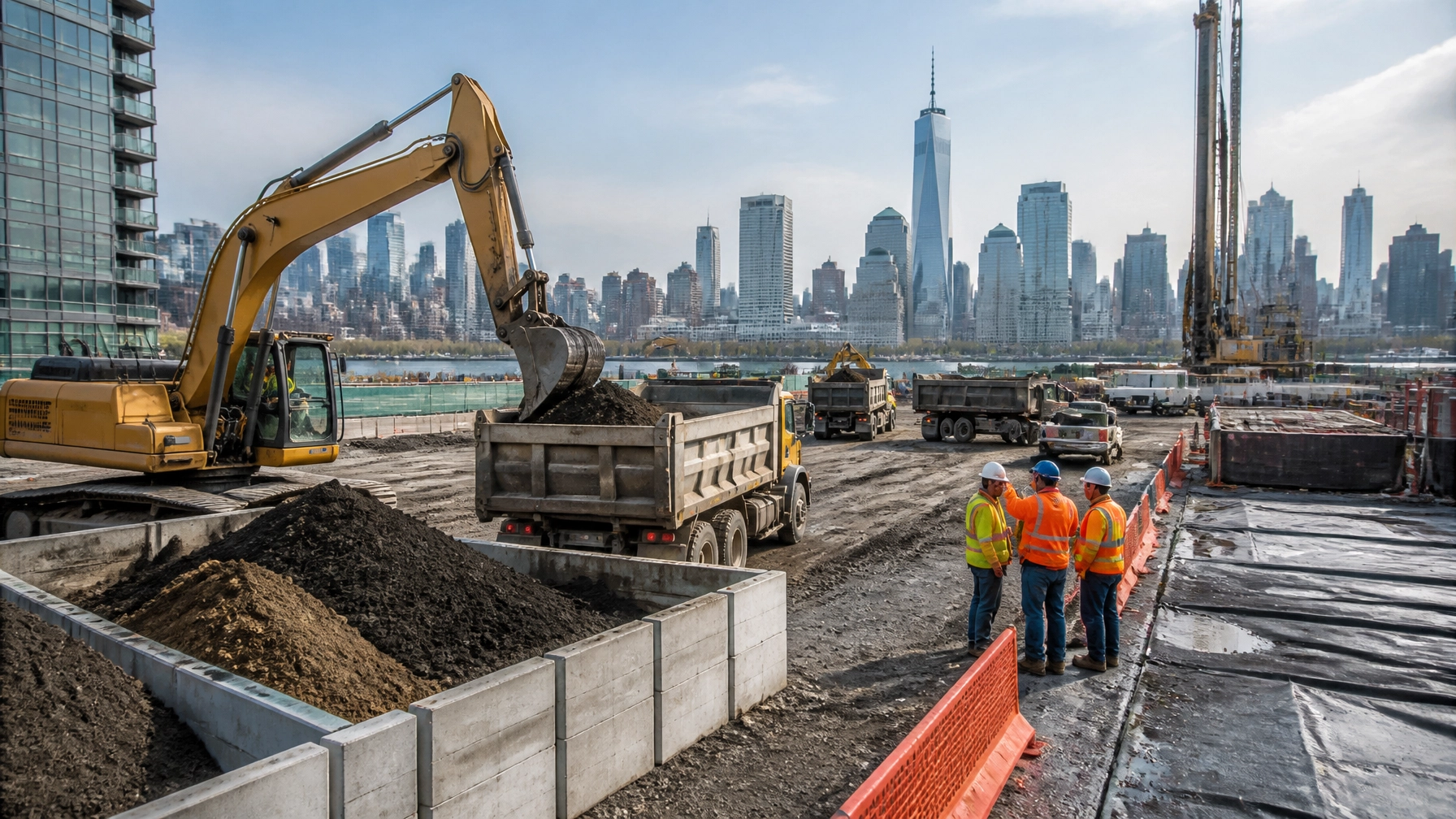
If you’ve spent five minutes on a construction site in New York City or Northern New Jersey, you know that dirt is never just "dirt." It’s either a liability or an asset, and the difference usually comes down to how your consultant handles the Soil Management Plan (SMP).
We see it all the time: a developer gets a Phase II report back, sees some elevated lead or semi-volatile organic compounds (SVOCs) in the historic fill, and the big-box firm they hired checks the box for "disposal at a permitted facility." Fast forward six months, and that developer is staring at a $500,000 change order because 10,000 yards of soil they thought was "clean" is being rejected by facilities or handled as regulated waste.
At Envicon Group, we don’t write reports to protect our own liability; we write them to move your project forward. If you’re looking to avoid the massive financial hit of mismanaged excavation, you need to understand the technical nuances of Soil Management Plans NYC construction and why the "big firm" playbook is costing you a fortune.
The Problem: The "Big Firm" Defensive Report
When you hire a national firm with 10,000 employees, you’re paying for their overhead and their insurance premiums. Their engineers are trained to be defensive. If there’s even a whiff of a regulatory threshold being crossed, they default to the most expensive disposal route because it’s the "safest" for them.
They deliver a bloated, 200-page report that your contractor can’t actually use to bid the job. You’re left with a "disposal surprise" when the actual excavation starts and the facility requirements don't match your consultant's generic assumptions.
Technical Depth: Characterization vs. Generic Sampling
A real SMP isn't just a set of instructions; it’s a strategic map. To avoid contaminated soil disposal fees NYC 2026 levels of pain, you have to move beyond generic grid sampling.
We lean into high-resolution site characterization. By using 3D plume modeling and understanding the specific geology of the Hudson River waterfront or the glacial till of Brooklyn, we can delineate exactly where the "clean" native soil begins and the "historic fill" ends.
In NYC, this distinction is the difference between paying $15/ton to move soil and paying $110/ton plus trucking. If you have 5,000 cubic yards of clean native soil trapped under four feet of fill, and your consultant didn't delineate it properly, you just set half a million dollars on fire.

The NYC Gold Mine: The Clean Soil Bank (CSB)
One of the most underutilized tools in the city is the Clean Soil Bank NYC. Managed by the NYC Office of Environmental Remediation (OER), this program allows for the transfer of clean native soil from "generating sites" to "receiving sites" (like NYC Parks or other construction projects) with zero tipping fees.
To play in this game, your soil characterization for OER must be bulletproof. The soil has to meet the lower of the NYS residential or protection of groundwater standards.
When we step onto a site, our first question is: "How much of this can we get into the Clean Soil Bank?" We don’t just look for what’s wrong with the soil; we look for what’s right with it. We’ve saved clients hundreds of thousands by proactively matching their clean native exports with city projects that need fill, bypassing the landfill entirely.
The NJDEP Cross-Border Trap
If you’re moving soil from NYC into New Jersey, or vice versa, you’re entering a regulatory minefield. NJDEP soil disposal regulations Part 360 and the newer Soil and Fill Recycling and Licensing Law (A-901) have changed the game.
In 2026, you can’t just "send it to Jersey." Every load needs to be tracked, and the receiving facility needs to have the right certifications. Large firms often lose the thread here, failing to coordinate between NY-based architects and NJ-based Licensed Site Remediation Professionals (LSRPs).
At Envicon, we sit at both tables. We know the reviewers at the NJDEP and the NYC OER by name. We ensure that your NJDEP soil and fill recycling law compliance is baked into the SMP from day one, so you don’t have trucks sitting idle at the George Washington Bridge because a manifest was filled out incorrectly.

Technology: Why We Don't Do "Monthly PDFs"
Most consultants give you a report and vanish until the next billing cycle. We think that’s garbage.
We’ve built a proprietary technology infrastructure that gives our clients real-time visibility. When we’re managing a soil export, you don’t have to wonder how many trucks left the site today or if we’re hitting our budget targets. You can log into your dashboard and see:
- Real-time truck counts and GPS-tagged manifests.
- Dynamic budget tracking against our initial estimates.
- Digital Soil Tracking that satisfies both NYSDEC and NJDEP record-keeping requirements instantly.
This isn't "synergy" or "leveraging": it's basic accountability. If a facility rejects a load at 10:00 AM, we know about it at 10:01 AM, and we’re already pivoting to the backup plan.

Logistics: The Contractor-Adjacent Approach
A Soil Management Plan is only as good as the guy running the excavator's ability to follow it. We don't write academic papers. We write field manuals.
We spend time with the site super and the excavation sub to make sure they understand the on-site soil reuse NYC protocols. We mark out the "bays" in the field with high-visibility paint so there’s no confusion about what goes in the "CSB" pile versus the "Non-Regulated Fill" pile.

Summary: The Envicon Takeaway
Managing soil in the NY/NJ metro area isn't just about environmental compliance; it's about protecting your capital. A generic SMP from a national firm is a liability waiting to happen.
To avoid the $500k surprise:
- Delineate precisely: Don't let clean soil be handled as waste because of lazy sampling.
- Maximize the Clean Soil Bank: If you have native soil, use the city's programs to eliminate tipping fees.
- Demand transparency: Stop waiting for monthly reports and get a real-time dashboard.
- Verify cross-border rules: Ensure your NJ and NY regulations are talking to each other.
We’re a family-owned firm that’s been doing this for 20 years. We’ve seen the "big-box" disasters, and we’ve built our business on being the team that picks up the phone at 7:00 AM to solve the problem before the first truck leaves.
Ready to clear the path for your next project? At Envicon Group, we don’t just deliver reports: we deliver outcomes. Contact us today to discuss your site’s specific challenges.
Leave a Reply