You’ve got a Phase I Environmental Site Assessment (ESA) report sitting on your desk. It’s got a few “Recognized Environmental Conditions” (RECs) highlighted in the conclusions. Now, your lender is asking for a Phase II, and your project schedule is already looking tight.
The first thing every developer or property owner asks is: “What is this going to cost me?”
The second thing they ask, usually after they’ve been burned by a big-box firm, is: “Is this quote actually the final price, or am I going to get hit with five change orders the moment the drill rig hits a rock?”
In New Jersey, where the regulatory landscape is governed by the NJDEP and the Site Remediation Reform Act (SRRA), the cost of a Phase II ESA isn't just about the number of holes in the ground. It’s about the strategy behind those holes. At Envicon Group, we’ve spent 20 years navigating these requirements. We’ve seen how the "big guys" quote low to get the job, only to "discover" site complexities that were obvious from the start, leading to budget-breaking change orders.
Here is the truth about Phase II ESA costs in NJ, why they vary, and how we eliminate the "surprise" factor from your pro forma.
The Standard Cost Reality in New Jersey
If you’re looking for a ballpark, a standard Phase II ESA in New Jersey typically ranges from $6,000 to $25,000.
Why such a wide gap? Because a Phase II isn't a "one-size-fits-all" product. It is a targeted investigation designed to confirm or disappear the concerns raised in the Phase I. According to industry data, sampling and laboratory fees can account for nearly 50% of the total project cost.
The complexity of the investigation is driven by three main factors:
- The Number of RECs: Are we just checking one former Underground Storage Tank (UST) grave, or are we investigating a century’s worth of industrial floor drains and historic fill?
- Media Being Sampled: Soil sampling is relatively straightforward. Groundwater sampling requires more specialized equipment, well installation, and often longer lab turnaround times. Vapor intrusion (VI) testing adds another layer of technical rigor.
- Site Access and Geology: Drilling through New Jersey’s diverse geology: from the sands of the Pinelands to the trap rock of the Palisades: requires different rigs and timeframes.

Why Big-Box Firms Live for Change Orders
We’ve all seen the scenario. A national firm submits a bid that looks incredibly attractive. It’s thin, it’s templated, and the price is low. You sign the contract, and two days into the field work, the junior staffer (who was sent because the Principal who sold you the job is busy on a "larger account") calls you.
"We hit refusal at five feet," they say. "We need a different rig. That’s a change order."
"The lab results came back 'non-detect' but the detection limits were too high for the NJDEP. We need to re-sample. That’s a change order."
At Envicon, we view change orders as a failure of the initial scoping process. When you hire a large firm, you’re often paying for their massive overhead: the fancy office in another state, the marketing department, the layers of middle management. To keep their margins high, they commoditize the field work.
We don't do that. We are PE-led and field-first. When we quote a Phase II, we do the homework upfront. We look at the Sanborn maps, the historic topography, and the NJDEP DataMiner records before we send you a proposal. We price for the reality of the site, not a best-case scenario that we know won't happen.
Breaking Down the Line Items
To understand where your money goes, you have to look at the three pillars of a Phase II ESA:
1. The Field Investigation (Drilling & Sampling)
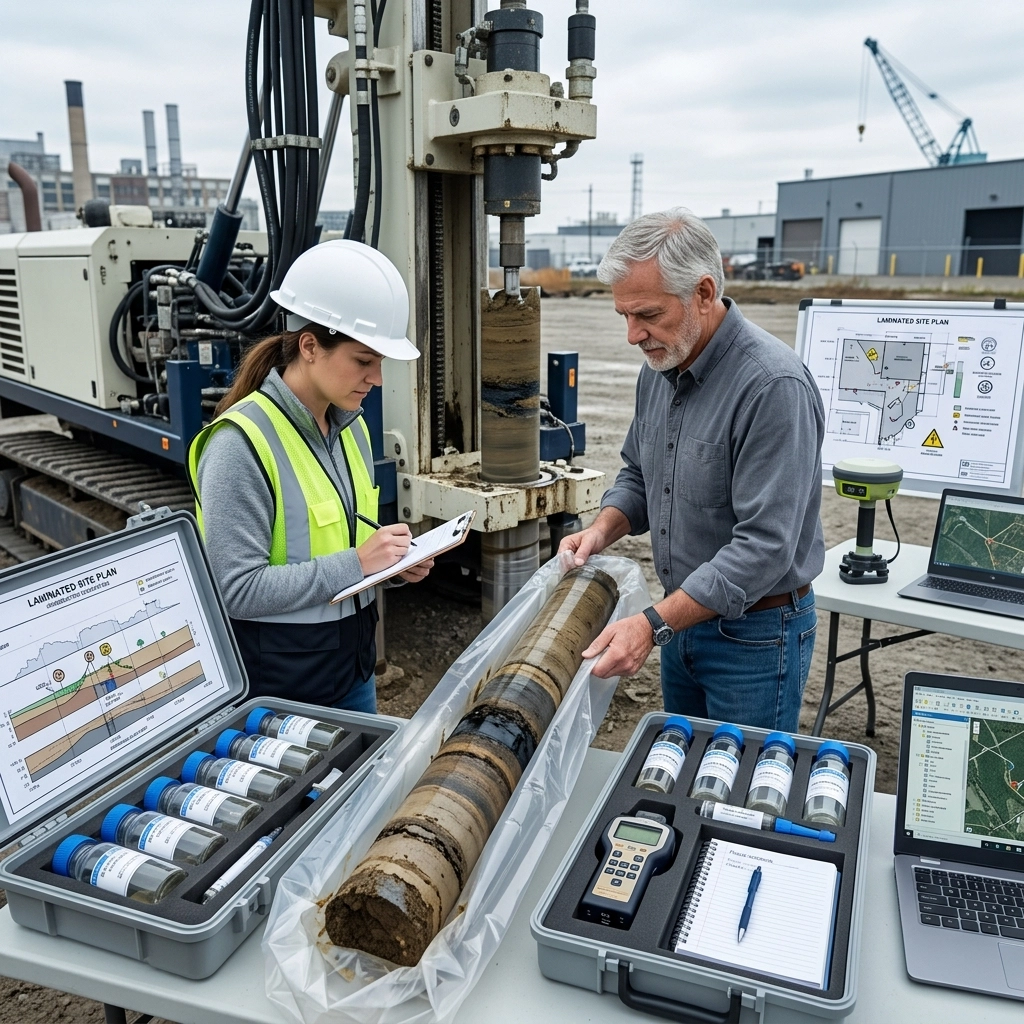
This involves mobilizing a drill rig to the site: usually a Geoprobe: to collect soil cores or install temporary monitoring wells. In NJ, we often deal with "Historic Fill," which requires a specific density of sampling to meet NJDEP Technical Requirements for Site Remediation (N.J.A.C. 7:26E). If your consultant doesn't know these specs by heart, you’re going to fail an audit later.

Caption: Envicon team conducting precise groundwater sampling and soil borings to ensure accurate data for NJDEP compliance.
2. Laboratory Analysis
This is where many consultants hide costs. They might quote for a "Standard Turnaround Time" of 10 business days. But in the NYC/NJ development world, nobody has 10 days. If you need 48-hour results to meet a closing date, that lab fee can double. We maintain direct relationships with certified labs to ensure we get the best rates and the fastest times for our clients without the "rush" markups some firms tack on.
3. Professional Evaluation and Reporting
This is the most critical part. You aren't paying for a pile of lab data; you’re paying for the interpretation of that data. Does the arsenic in the soil mean you need a multi-million dollar cleanup, or is it just naturally occurring in New Jersey's Piedmont soils? A "defensive" report from a big firm will tell you to sample more. An Envicon report will give you a path to closure.
The Envicon Approach: No Surprises
We believe that collaboration isn't a buzzword; it’s a financial strategy. Our goal is to move the obstacles between you and a buildable site. Here is how we ensure "No Surprises" on Phase II costs:
- Own the Outcome: We don't just hand you a report and walk away. We take responsibility for how that report is received by your lender or the NJDEP.
- Technical Precision: By using advanced data analytics and field technology, we minimize the need for re-mobilization. We get the data right the first time.
- Direct Leadership: You aren't dealing with a junior associate. Our PEs and senior environmental professionals are on-site or a phone call away. We make field decisions in real-time to keep the project moving.
- Transparent Pricing: Our proposals are detailed. We show you the lab costs, the drilling costs, and our professional fees. If we say it’s $12,500, it’s $12,500.
Beyond the Report: Selling Authority, Not Just Knowledge
Most consultants are afraid of the NJDEP. They treat the regulators like a black box. At Envicon, we’ve spent two decades building relationships with reviewers. We know what they are looking for, and we know how to present data so it gets approved, not scrutinized.
When you're dealing with high-stakes redevelopment in Hudson County or along the vibrant waterfronts of Northern NJ, you don't need an "expert" who can quote the law. You need an authority who can navigate it. Every week your project is stalled by a "request for more information" (RI) from a regulator, you're losing money on carry costs and market timing.
"Integrity is not just ethical behavior: it is about delivering the truth and never cutting corners. We do not just deliver services; we help transform underused and contaminated properties into thriving assets."
Summary: What You Should Take Away
When evaluating Phase II Environmental Site Assessment NJ costs, remember these key points:
- Typical Costs: Expect $6k–$15k for standard sites; $20k+ for complex industrial ones.
- Watch the Scope: Ensure the consultant is pricing for the specific contaminants identified in the Phase I, not just a "general scan."
- Ask About the Rig: If the consultant doesn't know the soil type, they can't accurately price the drilling.
- Demand Transparency: If a firm can't explain their pricing without using jargon, they're probably hiding a future change order.
Stop Paying for Reports. Start Buying Results.
If you’re tired of the "Big Box" consulting model where you’re just another project number in a queue, it’s time to switch. Envicon Group provides the precision of a top-tier engineering firm with the urgency and personal accountability of a family-owned business.
We don't just find problems; we engineer the exit strategy. Whether it's soil management, groundwater characterization, or navigating the LSRP program, we are your partners from the first boring to the final No Further Action (NFA) letter.
Ready for a quote that actually stays the price?
Contact Envicon Group today and let’s clear the path for your next project. We'll give you the truth, the whole truth, and a buildable site.
Leave a Reply