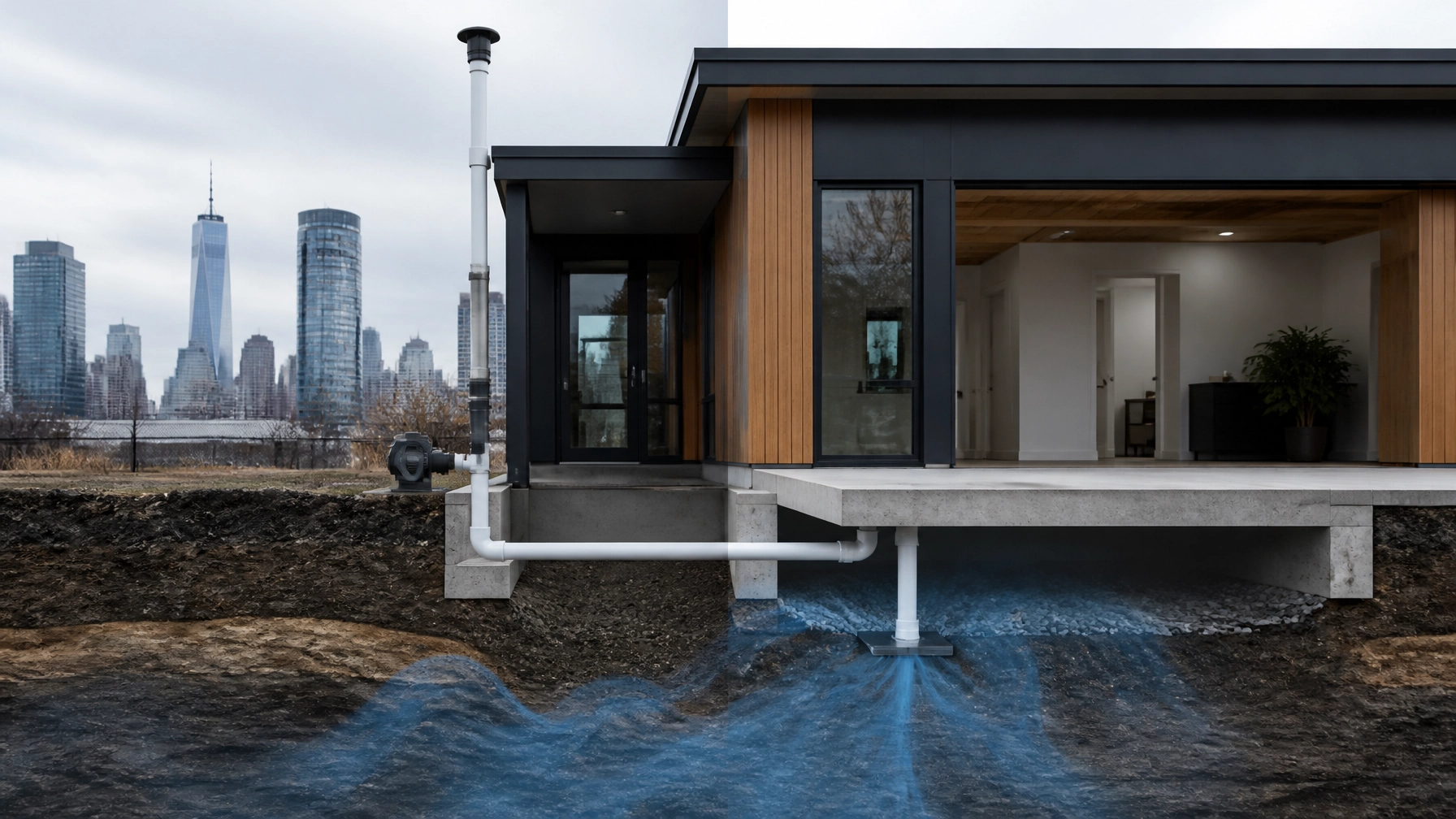
Vapor intrusion mitigation systems protect building occupants when volatile organic compounds, or VOCs, migrate from contaminated soil or groundwater into indoor air.
For developers, lenders, attorneys, and property owners in New York and New Jersey, the question is not simply whether a system can be installed. The real questions are:
- What pathway is active?
- Which regulatory framework applies?
- What system fits the building?
- How will performance be verified?
- What documentation is needed for a closing, permit, or certificate of occupancy?
A defensible answer requires site-specific investigation, practical design, and direct regulatory coordination. Envicon Group handles that work from assessment through installation oversight, verification, and long-term operation.
Start with the pathway, not the equipment
Vapor intrusion begins below grade. VOCs in soil, groundwater, or trapped soil gas can migrate toward a building and enter through:
- Cracks and joints in concrete slabs
- Utility penetrations
- Sumps and floor drains
- Elevator pits and crawlspaces
- Foundation walls
- Construction joints
- Preferential pathways created by utility trenches and buried conduits
The investigation should evaluate the entire pathway. A single indoor air sample rarely explains the source by itself.

A typical vapor intrusion assessment may include:
- Historical records and regulatory database review
- Groundwater and soil data review
- Soil vapor sampling
- Sub-slab vapor sampling
- Indoor and outdoor air sampling
- Crawlspace evaluation
- Utility and foundation review
- Tracer gas or pressure-field testing
- Comparison with applicable regulatory criteria
For a transaction, this work often builds on the Phase II ESA. For an occupied building, it may require careful sampling around tenants, HVAC systems, operating equipment, and changing building pressures.
See Envicon’s vapor intrusion assessment service for the full screening, sampling, and reporting scope.
Soil vapor, sub-slab vapor, indoor air, and crawlspace data answer different questions
These sample types are related, but they are not interchangeable.
- Soil vapor helps identify subsurface sources and migration patterns.
- Sub-slab vapor shows what is present immediately below the building floor.
- Indoor air measures the potential exposure condition inside the occupied space.
- Outdoor air provides background context.
- Crawlspace air may represent a direct exposure pathway where the building lacks a sealed slab.
Interpretation also depends on building conditions. HVAC operation, weather, barometric pressure, foundation design, and recent construction can change results.
Tracer gas testing can help identify whether air is moving from below the slab into occupied areas. Pressure measurements can show whether a building is under negative pressure, which can draw subsurface vapors indoors. These tests are especially useful when the chemistry suggests risk but the pathway remains uncertain.
NYC and NJ use different regulatory tools
New Jersey vapor intrusion screening
NJDEP’s Vapor Intrusion Technical Guidance uses a staged process for evaluating potential vapor intrusion.
The current framework generally considers:
- Potential receptors and exposure pathways
- Groundwater, soil gas, and indoor air data
- Rapid action conditions
- Vapor Intrusion Screening Levels
- Indoor Air Rapid Action Levels
- Mitigation, monitoring, or additional investigation
NJDEP maintains current screening tables for groundwater, soil gas, and indoor air. Use the Department’s current screening level memorandum rather than relying on an older consultant table.
For a Jersey City property, this work may also involve historic fill, former industrial operations, underground storage tanks, and dense utility corridors. These conditions can create multiple preferential pathways that a generic checklist will miss. Envicon’s Jersey City environmental consulting team works across these overlapping site conditions.
New York and NYC vapor intrusion evaluation
New York projects commonly rely on NYSDOH and NYSDEC guidance. NYSDOH’s soil vapor and indoor air decision matrices compare sub-slab vapor and indoor air concentrations to recommended actions, including:
- No further action
- Monitoring
- Source identification and resampling
- Mitigation
NYSDOH has expanded its matrix structure beyond the original chlorinated VOC group to address petroleum-related compounds. Review the NYSDOH soil vapor intrusion updates and the NYSDEC vapor intrusion guidance page for current documents.
For NYC properties, an E-designation can add another layer. According to the NYC Office of Environmental Remediation, a hazardous-materials E-designation requires investigation and, when contamination is confirmed, an OER-approved Remedial Action Plan before development proceeds. The work must be completed to OER’s satisfaction before occupancy.
That means vapor intrusion can affect more than environmental reporting. It can affect building permits, construction sequencing, financing, and the certificate of occupancy.
Comparing vapor intrusion mitigation systems
The right system depends on the building, contaminant, foundation, soil conditions, occupancy, and regulatory endpoint.
| System | Best application | Strengths | Limitations |
|---|---|---|---|
| Active sub-slab depressurization | Existing slab-on-grade or basement buildings | Reliable control, measurable pressure field, adaptable to existing buildings | Requires power, fan maintenance, discharge design, and long-term documentation |
| Sub-membrane depressurization | Crawlspaces or earthen floors | Controls vapor below a sealed membrane | Requires careful membrane detailing and protection from damage |
| Passive vapor barrier and venting | New construction or lower-risk conditions | Can be integrated into foundation design and converted to active operation | Performance depends on design, seals, and site conditions |
| Building pressurization or HVAC controls | Supplemental or interim control | Can reduce inward vapor movement in controlled buildings | Not a substitute for source control in every case |
| Source remediation | Soil or groundwater source areas | Can reduce long-term vapor generation | May require excavation, treatment, groundwater control, or extended monitoring |
| Combined barrier and active system | Higher-risk or sensitive-use buildings | Adds redundancy and long-term protection | Higher installation cost and more complex O&M |
How active systems are designed
An active sub-slab depressurization system, or SSDS, creates negative pressure beneath the slab. The system captures vapors before they enter the building and routes them through piping to a controlled discharge point.
A complete design should address:
- Suction point locations
- Sub-slab communication and pressure-field extension
- Piping diameter and routing
- Manifold configuration
- Fan type and operating range
- Electrical supply and controls
- Pressure monitoring ports
- Slab cracks, joints, sumps, and penetrations
- Condensation management
- Roof discharge location
- Separation from windows, doors, and HVAC intakes
- Access for inspection and replacement

New construction may allow a vapor barrier, sub-slab aggregate layer, and venting network to be installed before the slab is placed. Existing buildings require more coordination. The team may need to core through finished floors, work around tenants, protect utilities, and maintain building operations.
A vapor barrier alone is not automatically a complete mitigation strategy. Seams, penetrations, utility entries, and future slab penetrations must remain controlled. The design must also explain what happens if the passive system does not meet performance objectives.
Installation and verification matter as much as design
A system can fail because of poor sealing, incorrect fan sizing, blocked piping, damaged membranes, or an exhaust location that allows re-entrainment.
Envicon’s field oversight typically focuses on:
- Confirming suction point locations
- Checking pipe and fitting installation
- Inspecting slab and membrane seals
- Verifying fan installation
- Documenting pressure readings
- Checking alarms and monitoring ports
- Coordinating electrical and roofing work
- Maintaining photo and as-built records
After installation, the system should be commissioned. Depending on the project, verification may include:
- Pressure differential measurements
- Pressure-field extension testing
- Smoke testing at cracks and joints
- Fan and alarm checks
- Indoor and outdoor air sampling
- Sub-slab sampling
- Tracer gas testing
- Review of discharge configuration

Commissioning creates the evidence needed to show that the system works. It also identifies problems before a regulator, lender, tenant, or building department does.
Operation, maintenance, and closing strategy
Vapor intrusion mitigation systems are not “install and forget” equipment.
An O&M plan should identify:
- Who checks the fan
- How often inspections occur
- What pressure readings are acceptable
- How alarms are handled
- When indoor air or sub-slab sampling occurs
- How repairs are documented
- What happens during a power outage or building renovation
- Who reports results to the regulator
A system may remain in operation for years. Closing or decommissioning requires more than a clean indoor air result while the fan is running. The project team generally needs to evaluate source conditions, confirm stable results, and obtain regulatory concurrence before changing the control strategy.
For an NYC E-designation, the system and related documentation may need to remain tied to the OER remedial program until the requirements are satisfied. In New Jersey, long-term controls may involve an institutional control, deed notice, or site management obligation.
Timing vapor intrusion work around a real estate closing
If vapor intrusion is identified late in diligence, the transaction can lose weeks while the team investigates, designs, installs, and verifies a system.
Address the issue early when:
- A Phase I identifies a recognized environmental condition
- Historic dry cleaning, manufacturing, fuel use, or chemical storage occurred nearby
- Groundwater contamination exists beneath or upgradient of the building
- The property has an NYC E-designation
- A lender requests vapor intrusion documentation
- A tenant occupies a basement or slab-on-grade space
- A prior consultant recommended mitigation without a clear closure path
The practical sequence is:
- Screen the pathway.
- Define the data gap.
- Collect targeted samples.
- Compare results with the applicable NYSDOH, NYSDEC, or NJDEP framework.
- Select a site-specific mitigation approach.
- Design and install the system.
- Verify performance.
- Document O&M and regulatory obligations.
A fast report is useful only when it leads to a clear decision. Envicon combines field investigation, engineering design, construction oversight, and agency coordination so the environmental issue does not sit in a separate queue from the project itself.
FAQ
What are vapor intrusion mitigation systems?
They are engineered controls that prevent or reduce the movement of contaminated soil gas into occupied buildings. Common systems include active sub-slab depressurization, sub-membrane depressurization, vapor barriers, passive venting, and supplemental HVAC controls.
Is sub-slab depressurization the best system for every building?
No. SSDS is common and effective, but the correct approach depends on the building foundation, soil conditions, contaminant profile, occupancy, and regulatory requirements.
What are NJDEP screening levels?
NJDEP screening levels are comparison values used to evaluate groundwater, soil gas, and indoor air conditions during vapor intrusion investigations. Always use the current NJDEP tables and project-specific regulatory direction.
How do NYSDOH decision matrices affect a NYC project?
The matrices help relate sub-slab vapor and indoor air results to recommended actions. On an NYC E-designation project, the findings may also need to be incorporated into an OER-approved Remedial Action Plan and construction documentation.
Can a vapor intrusion system be turned off after installation?
Sometimes, but not automatically. The source, indoor air, sub-slab conditions, building use, and long-term monitoring history must support the change. Regulatory approval or concurrence may be required.
How long does vapor intrusion mitigation take?
Assessment may take one to three weeks depending on access, sampling conditions, and laboratory turnaround. Design, permitting, installation, and verification can take several additional weeks. Early coordination reduces transaction and construction risk.
The takeaway
Vapor intrusion mitigation systems are part of a larger risk-management process. The goal is not to install the most equipment. The goal is to control the pathway, protect occupants, satisfy the applicable regulator, and give the owner a documented path to construction, occupancy, financing, or closing.
If your property is in NYC, Brooklyn, Jersey City, or elsewhere in the NY/NJ metro area, involve the vapor intrusion team before the issue reaches the closing table.
Start with Envicon

Leave a Reply