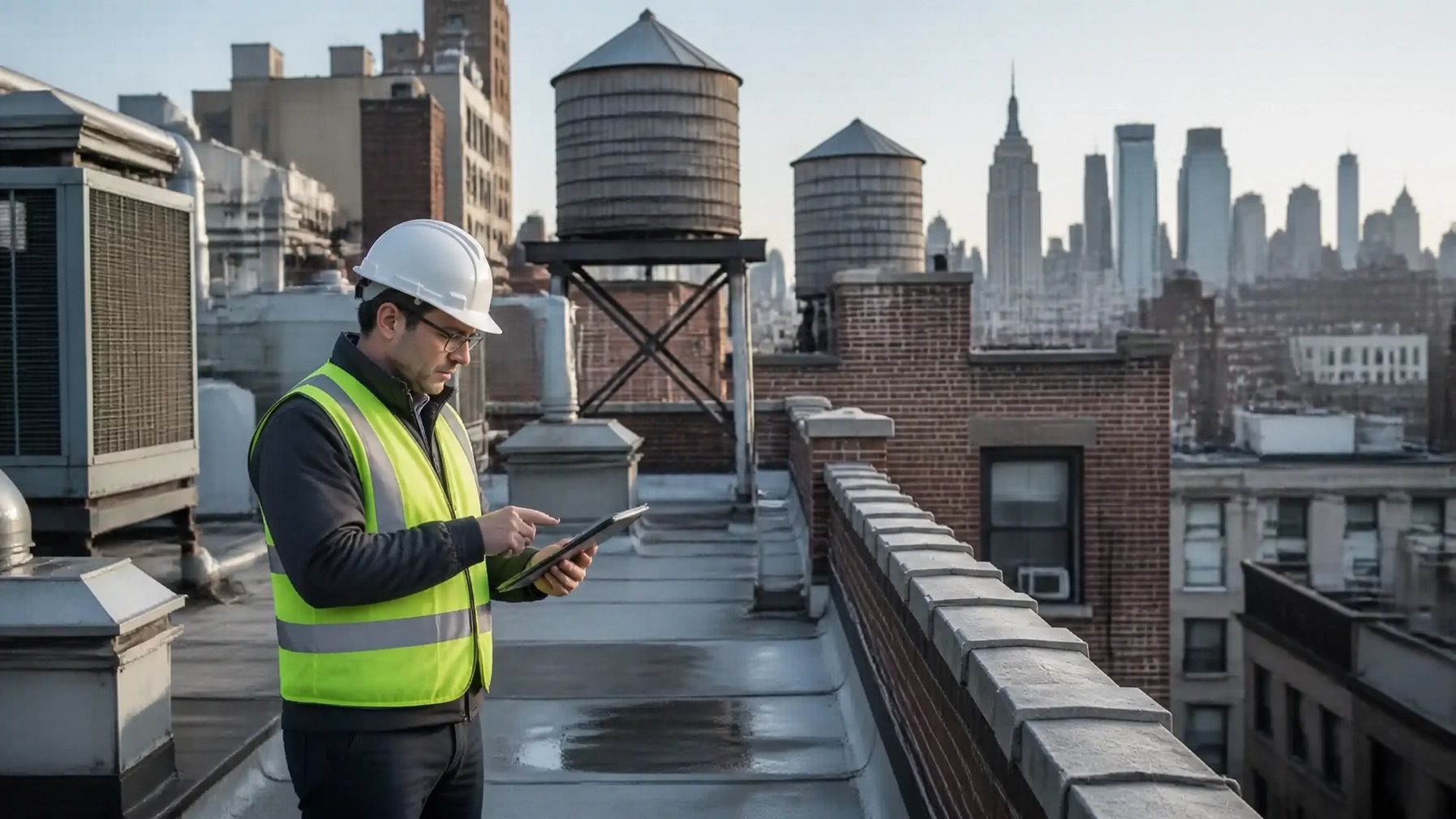
For New York co-ops, condominiums, and multifamily properties, deferred maintenance rarely stays a maintenance issue. A roof replacement becomes an emergency assessment. A façade repair becomes a financing problem. An aging boiler or elevator becomes a disruption for residents, lenders, and property managers.
A professional reserve study for NYC residential buildings gives the board a clearer path. It identifies major capital components, estimates remaining useful life, forecasts replacement costs, and builds a funding plan before the work becomes urgent.
Envicon Group prepares board-ready reserve studies and 30-year capital plans for residential properties across New York City, Westchester, Long Island, and the surrounding New York–New Jersey region.
Does New York require a reserve study?
As of 2026, New York does not have a general statewide law requiring every condominium, co-op, or HOA to complete a reserve study on a fixed schedule. That distinction matters.
However, boards still face practical obligations driven by:
- Governing documents, bylaws, proprietary leases, and offering plans
- Board fiduciary responsibilities
- Mortgage and lender requirements
- Insurance underwriting and renewal requirements
- NYC façade and building safety requirements
- Known deferred maintenance and capital needs
- Owner expectations and resale marketability
New York Assembly Bill A8945 would create a formal capital reserve study requirement for many condominium and cooperative associations, including a 30-year funding plan and annual review. The bill remains in committee and is not currently enacted law. Its proposed framework nevertheless shows where reserve planning requirements may be heading.
A reserve study is not simply a compliance document. It is a financial and physical roadmap for protecting the building and the people who rely on it.
NYC’s Reserve Fund Law is not the same as an ongoing reserve study
New York City’s Reserve Fund Law applies primarily to residential building conversions. Under Local Law 70 of 1982, sponsors generally must establish a reserve fund for future capital repairs and replacements as part of the conversion process.
The New York Attorney General’s guidance explains that the reserve fund is separate from working capital and is intended for qualifying capital work. The guidance also addresses sponsor contributions, permitted uses, disclosures, and reporting obligations.
That requirement creates an initial reserve fund. It does not require an existing co-op or condominium board to complete periodic reserve studies or maintain a specific reserve balance indefinitely.
The practical lesson is straightforward: an initial fund does not tell you whether the building can afford its next façade cycle, elevator modernization, roof replacement, or mechanical system upgrade. A current condo capital reserve study in New York does.
Read the New York Attorney General’s guidance on the NYC Reserve Fund Law.
FISP and Local Law 11 must be part of the capital forecast
For residential buildings higher than six stories, NYC’s Façade Inspection & Safety Program, commonly known as Local Law 11, requires exterior walls and appurtenances to be inspected every five years by a Qualified Exterior Wall Inspector.
The NYC Department of Buildings states:
“Owners of properties higher than six stories must have exterior walls and appurtenances inspected every five (5) years.”
The required technical report must be filed electronically through DOB NOW: Safety. A façade may be classified as:
- Safe: No repair or maintenance is required to sustain exterior structural integrity during the next five years.
- Safe with a Repair and Maintenance Program, or SWARMP: The façade is safe today but requires repairs or maintenance during the inspection period.
- Unsafe: The façade presents a hazard and requires repair within the applicable timeframe.
These classifications directly affect reserve planning. A SWARMP finding may represent a scheduled capital project. An unsafe condition may require immediate public protection, design work, permits, contractor mobilization, and funding.
A reliable reserve study NYC board members can use should model:
- Façade inspection and filing cycles
- Masonry repairs and repointing
- Lintel, shelf angle, and parapet work
- Window and sealant replacement
- Scaffolding, sidewalk sheds, and access costs
- Design, permit, and construction oversight fees
- Contingency for concealed conditions
Treating Local Law 11 as an isolated inspection expense is a mistake. It is a recurring capital obligation that belongs inside the building’s long-range funding plan.
Review NYC Department of Buildings façade requirements.

What a New York residential reserve study should include
A useful reserve study combines a physical assessment with financial modeling. One without the other leaves the board with an incomplete picture.
1. Common-element inventory
The study should identify the major components the association is responsible for maintaining. Depending on the property, that may include:
- Roof membranes, flashing, drains, and roof equipment
- Exterior masonry, façades, balconies, parapets, and windows
- Elevators and associated controls
- Boilers, chillers, pumps, and domestic hot-water systems
- Electrical service, distribution equipment, and emergency power
- Plumbing risers and major piping systems
- Fire protection and life-safety systems
- Parking areas, retaining walls, sidewalks, and site drainage
- Building envelope and waterproofing systems
- Energy and emissions-related improvements
The component list should reflect the actual building, not a generic template. A 1920s Manhattan co-op has different risks from a newer Queens condominium or a suburban Westchester HOA.
2. Condition and useful-life assessment
Each component needs a practical assessment of:
- Current condition
- Age and installation history
- Expected useful life
- Remaining useful life
- Maintenance history
- Known defects or recurring failures
- Replacement or rehabilitation options
- Consequences of delaying the work
A reserve study is not a substitute for a specialized structural, façade, elevator, environmental, or mechanical inspection when one is required. Instead, it identifies where those investigations should be scheduled and funded.
3. Local replacement costs
Construction costs in Manhattan, Brooklyn, Queens, the Bronx, Staten Island, and nearby counties vary significantly. A credible multi-family property reserve analysis should account for local labor, access limitations, permits, logistics, prevailing conditions, and escalation.
A roof replacement on a low-rise property is not priced the same way as façade work requiring sidewalk protection in a dense NYC corridor. Similarly, replacing a boiler in an occupied co-op requires coordination that a simple equipment-price estimate will not capture.
4. Long-term funding scenarios
The financial model should show how the reserve balance changes over time under different contribution strategies. Typical scenarios may include:
- Current contribution levels
- Gradual increases in monthly common charges or maintenance
- One-time special assessments
- Project-specific financing
- A blended funding approach
- Conservative and aggressive investment assumptions
The goal is not to create a perfect prediction. No 30-year forecast can eliminate uncertainty. The goal is to make risk visible early enough for the board to make deliberate decisions.

How reserve studies reduce special-assessment risk
Special assessments are not always avoidable. A major concealed defect, emergency failure, or regulatory repair can exceed even a well-funded reserve account.
The problem is surprise.
When a board does not have a current reserve analysis, it may discover several major projects at the same time:
- A façade cycle approaching its filing deadline
- An aging elevator nearing modernization
- A roof beyond its expected service life
- Boiler equipment with obsolete controls
- Water intrusion damaging interior finishes
- New energy or emissions requirements
- Insurance-mandated repairs
A capital plan sequences these obligations. It helps the board determine which work should happen now, what can be monitored, and what funding must begin years in advance.
For owners, that creates more predictable costs. For lenders, it provides better documentation. For property managers, it creates a usable schedule rather than a report that sits in a file cabinet.
A practical reserve-planning schedule for New York boards
A strong process is continuous.
Every year
- Update the reserve balance and contribution history.
- Record completed repairs and revised project costs.
- Review open violations, inspection findings, and maintenance records.
- Confirm whether major components are deteriorating faster than expected.
- Compare actual spending against the 30-year plan.
Every three to five years
- Complete a full reserve study or an update with a site visit.
- Reassess façade, roof, mechanical, electrical, plumbing, and life-safety components.
- Refresh local construction pricing and escalation assumptions.
- Revisit funding scenarios with the board, manager, accountant, and counsel.
Before a major transaction or refinancing
- Obtain a current reserve analysis.
- Assemble inspection reports, capital-project records, budgets, and insurance information.
- Identify unfunded obligations and pending assessments.
- Coordinate the capital plan with lender and purchaser due diligence.
For a portfolio owner, the same process should be applied across properties using a consistent reporting structure. Envicon’s digital project-management approach can help owners track schedules, budgets, deliverables, and inspection findings without waiting for a monthly PDF that is already outdated.
Why boards choose an engineer-led approach
A reserve study should not be built from spreadsheets alone. The numbers must connect to actual conditions in the building.
Envicon’s reserve studies are:
- Led and signed by licensed Professional Engineers
- Built around on-site component verification
- Structured around National Reserve Study Standards
- Designed for 20- to 30-year capital forecasting
- Coordinated with property managers, boards, CPAs, and attorneys
- Prepared with clear contribution scenarios and board-ready summaries
- Integrated with structural, property-condition, and compliance assessments when needed
We also connect reserve planning with Property Condition Reports, Structural Engineering, and Environmental Compliance Audits.
That matters because a board does not need another disconnected report. It needs a clear path from building conditions to funding decisions.

What boards should do next
If your building has not completed a reserve study recently, start with the records you already have:
- Current budget and reserve account balance
- Prior reserve studies and engineering reports
- Local Law 11/FISP filings
- Roof, elevator, boiler, and façade repair records
- Open violations and inspection reports
- Insurance recommendations
- Governing documents and offering-plan disclosures
- Planned capital projects and recent contractor proposals
Then ask a qualified professional to reconcile those records with a site assessment and a long-range funding model.
A reserve study does not eliminate every capital expense. It gives the board the information to manage those expenses with more discipline, transparency, and control.
The takeaway
New York’s current legal framework does not impose one universal reserve-study requirement on every co-op or condominium. That does not make reserve planning optional in practice.
NYC façade obligations, lender expectations, governing documents, aging building systems, insurance requirements, and fiduciary responsibilities all point in the same direction: boards need a defensible capital plan.
The best time to identify a future special assessment is before it becomes one.
Envicon Group helps New York residential boards turn building conditions into a clear, fundable plan: with precision, speed, and trust.
Plan your building’s capital future

Leave a Reply