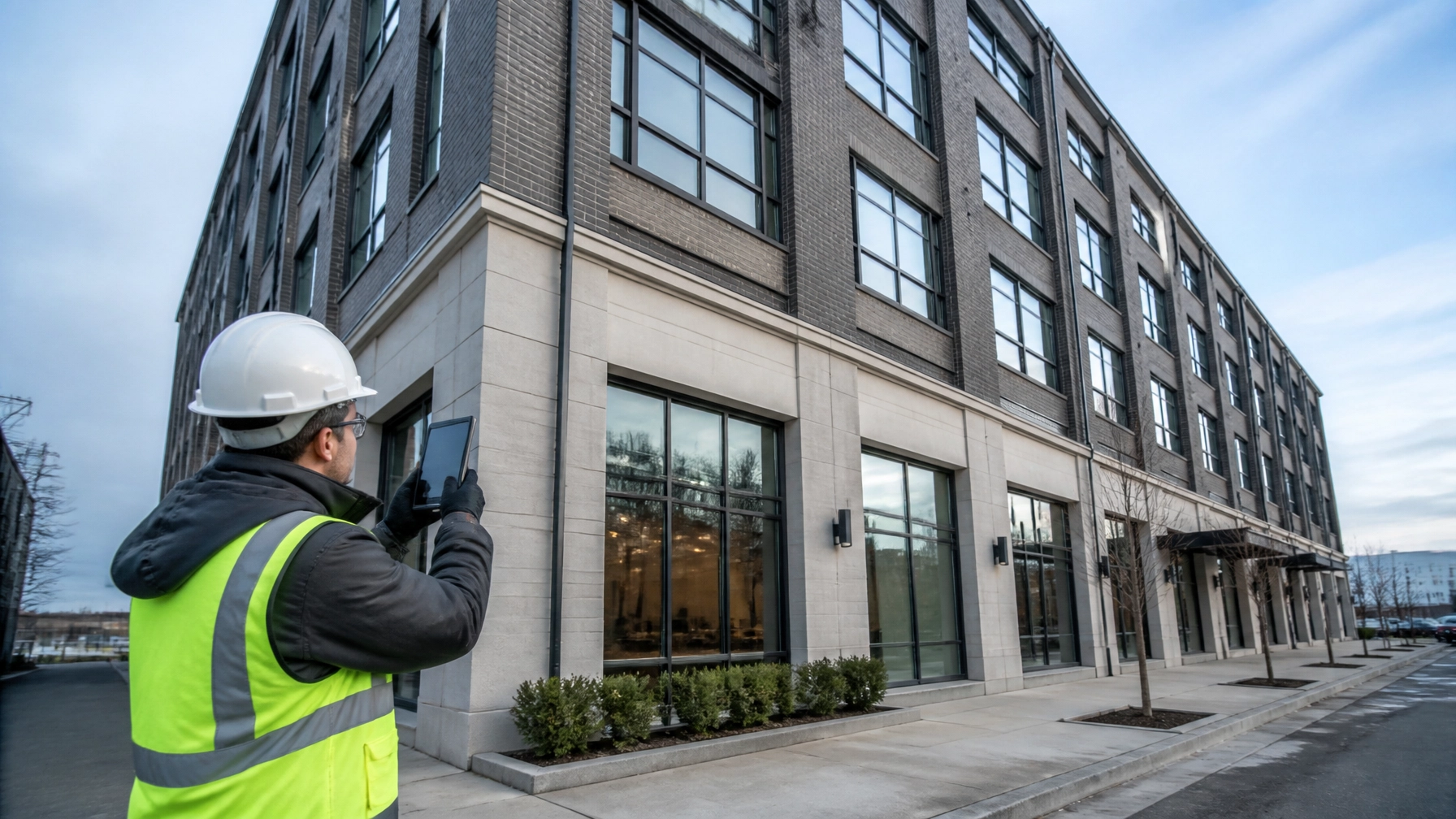
A commercial acquisition can look strong on paper and still carry major physical risk. An aging roof, failing façade, obsolete HVAC equipment, drainage problems, or an unbudgeted structural repair can affect loan proceeds, closing conditions, operating income, and the property’s long-term value.
That’s why lenders and investors often require an ASTM E2018-24 property condition assessment before approving a commercial real estate loan or completing a transaction.
The resulting Property Condition Report, or PCR, gives decision-makers a consistent view of the building’s physical condition, known deficiencies, anticipated capital needs, and probable repair costs. In New York and New Jersey, where commercial properties often include older building systems, dense urban sites, and complicated maintenance histories, the quality of that assessment matters.
What ASTM E2018-24 Covers
ASTM E2018-24 is the Standard Guide for Property Condition Assessments: Baseline Property Condition Assessment Process. It establishes a national framework for evaluating the physical condition of a commercial property’s primary improvements.
“Standard Guide for Property Condition Assessments: Baseline Property Condition Assessment Process.” , ASTM E2018-24 listing through ANSI
The standard is not a full building code audit, structural design, environmental assessment, or contractor bid. It provides a baseline process that can be expanded when the property, lender, investor, or transaction requires additional investigation.
A baseline PCA generally includes:
- Review of available property documents and maintenance records
- Interviews with owners, property managers, and maintenance personnel
- A visual walk-through of accessible areas
- Evaluation of major building systems and site improvements
- Identification of material physical deficiencies
- Opinions of probable costs to address deficiencies
- A final report with photographs, narratives, assumptions, and limitations
The objective is straightforward: identify conditions that could affect the property’s safety, performance, value, or financial obligations.
What Lenders Review First
Underwriters rarely begin with every page of a PCR. They usually go directly to the executive summary, immediate repair findings, cost tables, and any limitations that could create uncertainty.
For a lender property condition report in NJ, or for a commercial property condition report in New York, lenders commonly focus on five questions:
- Are there immediate health, safety, or operational risks?
- What repairs must occur before or shortly after closing?
- Which major systems will require replacement during the loan term?
- Are the estimated costs realistic for the local market?
- Did the consultant identify any areas that could not be inspected?
A report that simply says “roof appears serviceable” does not give an underwriter enough information. The lender needs to understand the roof’s apparent age, observed condition, remaining useful life, maintenance history, visible deficiencies, and probable replacement cost.
The same applies to façades, parking areas, elevators, boilers, chillers, electrical distribution, plumbing, fire protection, and stormwater systems.
A clean report reduces uncertainty. A vague report creates more questions, more review cycles, and sometimes additional lender conditions.
The Walk-Through: Where Report Quality Is Determined
The field walk-through is the core of the assessment. It is not a quick tour of representative spaces.
A qualified assessor should evaluate the accessible portions of the:
- Site and grounds
- Paving, curbs, sidewalks, and parking areas
- Drainage and stormwater features
- Foundations and visible structural elements
- Exterior walls, windows, doors, and sealants
- Roof coverings, flashing, drains, and penetrations
- Interior finishes and common areas
- Heating, ventilation, and air-conditioning systems
- Electrical service and distribution
- Domestic water, sanitary, and storm piping
- Fire alarm and sprinkler systems
- Elevators and other vertical transportation equipment
- Site lighting and exterior utilities
The assessor should document the condition of each system, not just note whether it is present. That includes visible signs of water intrusion, corrosion, settlement, cracking, leakage, poor maintenance, capacity concerns, and end-of-life equipment.

For New York and New Jersey properties, site access can be difficult. Roofs may require controlled access. Mechanical rooms may be occupied or restricted. Older buildings may have incomplete drawings or undocumented alterations. A strong PCA identifies these limitations instead of treating them as invisible.
Deferred Maintenance Becomes a Financial Finding
Deferred maintenance is not just a property-management issue. In a transaction, it becomes a capital and underwriting issue.
ASTM E2018-24 treats significant deferred maintenance as part of the physical deficiency analysis when the condition is conspicuous, material, or connected to the failure of normal maintenance or the end of a system’s useful life.
Common examples include:
- A roof with recurring leaks and multiple repair patches
- Deteriorated masonry joints or failed exterior sealants
- Corroded steel railings or exposed structural components
- Failing asphalt, concrete, or parking deck surfaces
- Inadequate site drainage causing repeated ponding
- Obsolete boilers, chillers, or air-handling units
- Electrical equipment approaching the end of its useful life
- Damaged sidewalks or nonfunctional site lighting
- Fire and life-safety systems with unresolved deficiencies
- Water intrusion around windows, foundations, or below-grade areas
Not every maintenance item becomes an immediate repair. The assessor must distinguish routine maintenance from material physical deficiencies and explain the difference in the report.
That distinction matters. If every cosmetic issue is presented as a major capital concern, the report loses credibility. If significant deterioration is minimized, the lender and investor inherit unnecessary risk.
Opinions of Probable Cost: Planning Numbers, Not Contractor Bids
A PCR typically includes opinions of probable cost for correcting identified deficiencies. These are planning-level estimates, not guaranteed bids or fixed construction prices.
The cost opinion should connect each amount to:
- The observed condition
- The recommended corrective action
- The affected system
- The expected timing
- The basis of the estimate
- Any assumptions or exclusions
Most lenders expect costs to be organized into categories such as:
Immediate Repairs
These are conditions that require prompt attention, often because they involve life safety, active water intrusion, severe deterioration, or a material risk of system failure.
Depending on the lender’s requirements, immediate repairs may be expected within approximately 90 days or shortly after closing.
Short-Term Repairs
These are repairs that may not require immediate correction but should be addressed within the first one to two years. Examples may include localized façade repairs, pavement replacement, drainage improvements, or equipment repairs.
Replacement Reserves and Capital Forecast
This category covers major replacements expected during the analysis period. A lender may request a 10-year or 12-year forecast, while an owner may use the information for longer-term capital planning.

The report should show how the assessor calculated the property’s anticipated capital needs. A lender may use that information to establish a repair escrow, adjust underwriting assumptions, require replacement reserves, or negotiate closing conditions.
Investors also use the forecast to test whether projected operating income can support future capital obligations. A property with low current maintenance costs may still require significant investment if multiple major systems are nearing the end of their useful lives.
Lender Acceptance Depends on More Than the ASTM Reference
Putting “ASTM E2018-24” on the cover does not guarantee lender acceptance.
Lenders may have their own requirements for:
- Assessor qualifications
- Professional engineer or architect involvement
- Report age
- Cost-estimating methodology
- Reserve analysis period
- Structural or façade review
- Environmental observations
- Seismic, flood, or climate-risk considerations
- Required forms and appendices
- Independence and conflict-of-interest disclosures
- Property access and inspection limitations
The engagement should begin with the lender’s scope requirements whenever possible. Otherwise, the borrower may receive a technically sound report that still requires revisions or supplemental work.
This is where local experience becomes practical: not theoretical. A commercial property condition report in New York may need to account for façade maintenance, rooftop equipment, below-grade conditions, aging masonry, and complex building access. A lender property condition report in New Jersey may involve industrial components, parking fields, stormwater infrastructure, site utilities, or multiple structures on one parcel.
ASTM provides the baseline. The property and lender determine how that baseline must be applied.
PCA Versus Phase I Environmental Site Assessment
A PCA evaluates the physical condition of the improvements. A Phase I ESA evaluates potential environmental liability.
They answer different questions.
A PCA may observe staining, suspect asbestos-containing materials, mold-like growth, underground storage tank indicators, or other environmental concerns. However, those observations do not replace a Phase I ESA or Phase II investigation.
For environmental due diligence, Envicon provides Phase I and Phase II ESA services in New York and New Jersey, including site reconnaissance, historical research, soil and groundwater investigation, vapor assessment, and transaction support.
The two studies often work best together. Combining them early can reduce duplicated site visits, improve communication with the lender, and create a clearer risk picture before closing.
How Envicon Helps Keep the Deal Moving
A PCA should not end with a report that leaves you to interpret the consequences. You need a clear explanation of what matters, what can wait, what requires pricing, and what could affect closing.
Envicon approaches property condition work with the same field-first discipline we bring to environmental and engineering projects:
- Direct access to senior professionals
- Clear system-by-system findings
- Practical cost opinions tied to observed conditions
- Coordination with lenders, attorneys, architects, property managers, and contractors
- New York and New Jersey market familiarity
- Transparent scope, assumptions, and limitations
- Integrated support when environmental or engineering issues emerge
Our Property Condition Report service can also be coordinated with reserve studies, structural evaluations, environmental assessments, and capital planning. Our reserve study service is designed for longer-term funding and replacement planning, while an ASTM-based PCA supports transaction and lending decisions.
The difference is accountability. We do not just identify a problem. We help you understand the decision in front of you and the next step required to keep the project moving.
What to Request Before Ordering a PCA
Before commissioning an ASTM E2018-24 assessment, gather:
- The lender’s PCA requirements and preferred report format
- Current rent roll and property manager contact information
- Available drawings, surveys, and prior inspection reports
- Roof, elevator, HVAC, fire alarm, and other service records
- Recent repair invoices and capital improvement history
- Utility information and equipment schedules
- Access instructions for roofs, mechanical rooms, tenant spaces, and site areas
- Any known violations, insurance claims, leaks, or pending repairs
Also confirm whether the assignment includes only a baseline PCA or requires additional structural, façade, environmental, accessibility, energy, or specialty inspections.
The Takeaway
An ASTM E2018-24 property condition assessment gives lenders and investors a structured way to evaluate physical risk in a commercial real estate transaction. The most important parts are not the page count or the cover designation. They are the quality of the walk-through, the accuracy of the deficiency analysis, the transparency of the cost opinions, and the assessor’s ability to identify what could affect closing and ownership.
In New York and New Jersey, local building conditions and lender expectations make experienced execution especially important.
A good PCR does more than document deterioration. It turns uncertainty into a decision.
Ready to Evaluate Your Commercial Property?

Leave a Reply