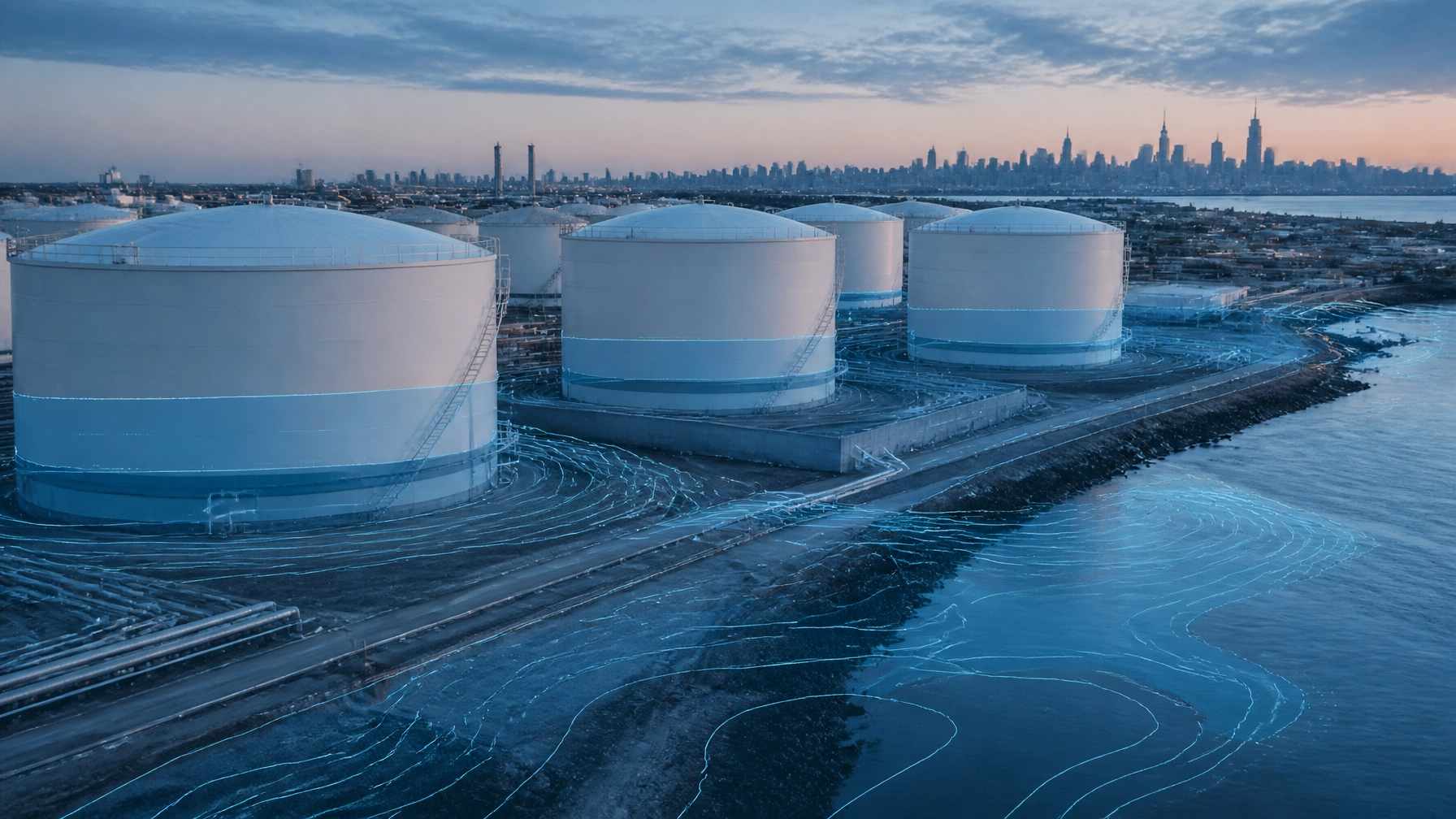
For decades, petroleum bulk storage (PBS) compliance in New York was a matter of checklists and hardware: secondary containment, overfill protection, and leak detection. If your tanks were tight and your paperwork was in order, you were "compliant."
That era is ending.
The New York State Department of Environmental Conservation (NYSDEC) is currently moving to integrate aggressive climate-risk assessments into the 6 NYCRR Part 613 regulations. Driven by the Climate Leadership and Community Protection Act (CLCPA), these amendments shift the regulatory burden from historical compliance to predictive resilience.
If you own or operate a PBS facility in New York, the question is no longer just "Is your tank leaking today?" It is "Will your tank survive a 50-year storm surge in 2040?"
The Statutory Trigger: ECL §17-1015 and the CLCPA
The legal foundation for this shift is already in the books. The CLCPA amended Environmental Conservation Law (ECL) §17-1015, explicitly requiring the NYSDEC to consider "future physical climate risk due to sea-level rise, and/or storm surges and/or flooding" when drafting PBS standards.
While the 2023 revisions to Part 613 focused largely on harmonizing state rules with federal EPA underground storage tank standards, the next wave of rulemaking is much more local: and much more technical. The NYSDEC’s current regulatory agenda identifies a dedicated initiative to embed these climate objectives into the design, siting, and operation of both new and existing facilities.

What the Part 613 Amendments Mean for Operators
The proposed amendments are moving toward a framework where climate risk is not an "add-on" but a core engineering requirement. We expect the forthcoming rules to focus on three primary areas:
- Siting and Hazard Mapping: Facilities will likely be required to utilize state-provided hazard risk analysis data to assess vulnerability. This goes beyond the traditional FEMA 100-year floodplain maps, incorporating forward-looking sea-level rise projections.
- Hardened Infrastructure Standards: For facilities in high-risk zones, we anticipate stricter standards for tank anchoring (to prevent buoyancy during flooding), waterproof electrical systems, and reinforced secondary containment walls capable of withstanding hydrodynamic loads from storm surges.
- Operational Emergency Planning: Compliance will likely require "extreme weather" contingency plans that go beyond a standard SPCC. This includes proactive tank drawdown or ballast procedures ahead of predicted surge events.
The Business Impact: Beyond the Checklist
Every week your project sits in a regulatory queue at a big-box firm, your carrying costs mount. When the NYSDEC rejects a submittal because it lacks a proper "Future Physical Climate Risk" assessment, the delay isn't just a nuisance: it’s a financial drain.
Most consultants are still handing out reports that look backward. They use yesterday's data to justify today's permits. At Envicon, we recognize that a "cleared path" to compliance requires anticipating the regulator's next move. We don’t just deliver reports; we provide civil and site engineering solutions that are built to withstand both the environment and the audit.

Why the "Big-Box" Firm Approach Falls Short
When you hire a national firm with 10,000 employees, you often get a cookie-cutter playbook designed for any market. But the NYSDEC, NYC OER, and NJ DEP don’t work from a global playbook: they work from regional mandates.
- The "Black Box" Communication: At a national firm, you never know who is actually speaking to your NYSDEC reviewer. At Envicon, our leadership is at the table. We know the reviewers by name because we work these jurisdictions daily.
- Defensive Reporting: Large firms write reports to protect themselves from liability, often resulting in bloated documents that don’t actually move your project forward. We produce clean, technical documentation designed to get you to the next step: construction and operation.
- Junior-Staff Execution: You pay for a partner’s name but get a junior staffer’s field notes. Our construction oversight and engineering teams are led by professionals who understand the field conditions and the regulatory endpoints.
How Facilities Should Prepare Now
Waiting for the final rulemaking to be published is a risk-heavy strategy. Proactive operators should begin a "Climate Audit" of their PBS assets now:
- Vulnerability Assessment: Overlay your facility’s footprint with the latest NYSDEC sea-level rise projections. Identify critical infrastructure (pumps, vents, electrical) that falls below projected flood elevations.
- Evaluate Anchoring and Containment: Ensure your aboveground storage tanks (ASTs) are properly anchored to their foundations. Flooding can turn a half-empty tank into a floating hazard, leading to structural failure and catastrophic spills.
- Update Your Permit Matrix: Review your compliance and permit matrix to ensure your registration and inspections are current. Lapsed compliance is the first thing a regulator looks for when new rules are implemented.

The Envicon Resolution: Engineering for the Future
At Envicon Group, we specialize in turning environmentally challenged sites into buildable assets. Our mission is to resolve complex engineering challenges with precision and urgency. Whether it’s remedial design for a contaminated waterfront or civil engineering for a new infrastructure program, we take ownership of the outcome.
Collaboration isn't a buzzword for us; it’s our operating model. We work directly with architects, attorneys, and regulators to ensure alignment. We don't just tell you there's a problem; we give you a cleared path to the solution.
Summary and Key Takeaways
The NYSDEC Part 613 amendments represent a permanent shift in how petroleum storage is regulated in New York.
- Mandate: ECL §17-1015 requires future climate risk (flooding, surge, sea-level rise) to be part of PBS standards.
- Focus: New and existing facilities will face stricter design and operational requirements.
- Action: Facilities should conduct vulnerability audits now to avoid costly retrofits or permit rejections later.
- Advantage: Partnering with a firm that has deep NY/NJ regional fluency and direct agency relationships is the only way to navigate these changes without project-stalling delays.
If your current consultant is giving you reports instead of paths to closure, it's time for a different approach.
Take the Next Step
Ensure your facility is ready for the next wave of NYSDEC regulations. Choose the team that moves your project forward.
- Risk screener tool: Assess your project's environmental risk
- Book a free consultation: Speak with an Envicon engineer
- Call now: (917) 764-2171
Leave a Reply