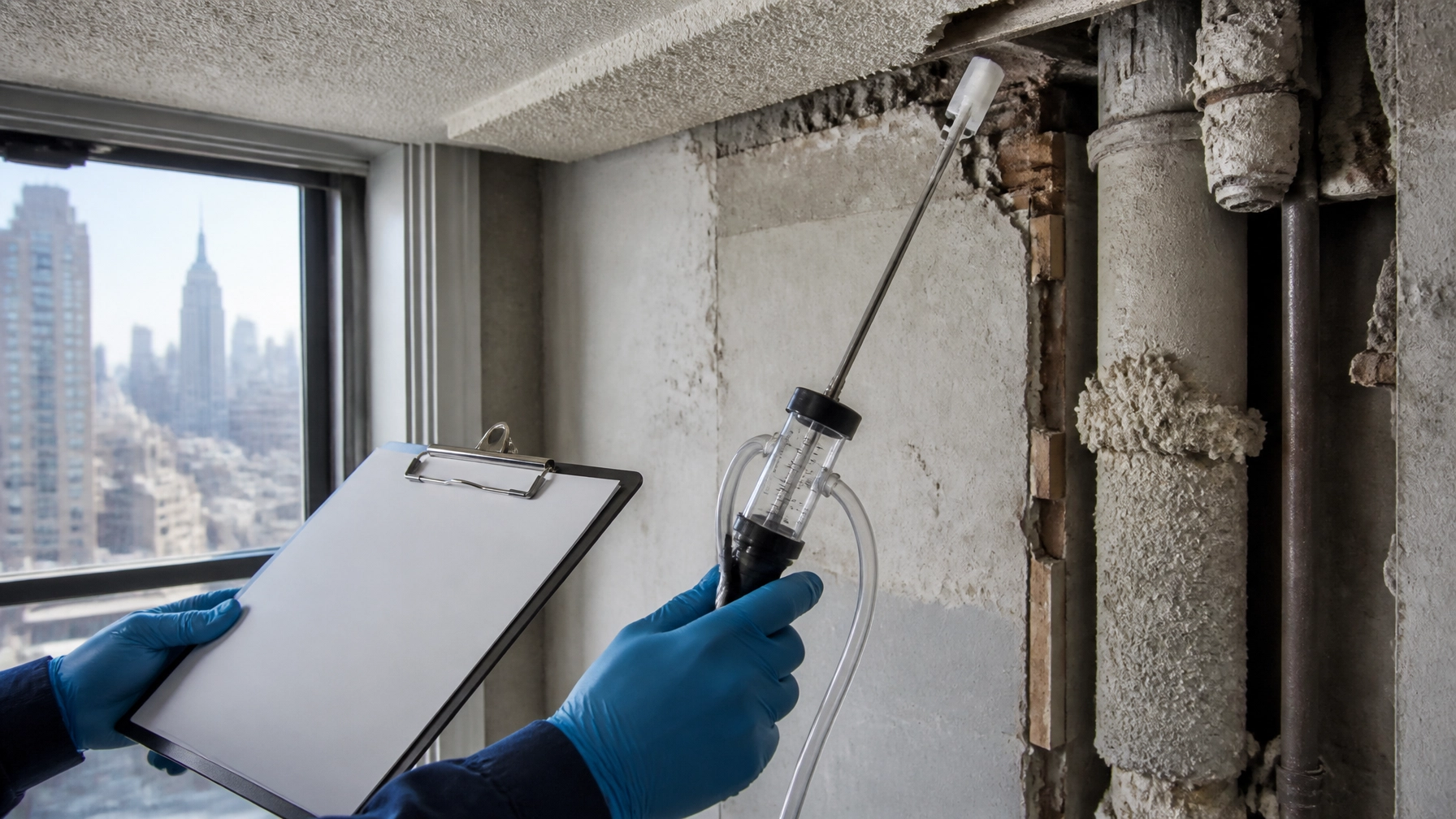
A building permit does not clear asbestos risk. In New York, the asbestos question must be addressed before renovation, remodeling, repair, or demolition work begins: and often before construction documents move through the approval process.
For owners, developers, architects, and contractors, the practical issue is simple: if the survey is late, incomplete, or signed by the wrong professional, your permit and construction schedule can stop.
This guide explains the core requirements under NYSDOL Industrial Code Rule 56, how the rules interact with NYC Department of Buildings asbestos requirements, and what to expect from a certified asbestos inspector in Manhattan, Brooklyn, Queens, and throughout New York State.
What Industrial Code Rule 56 requires
New York State Industrial Code Rule 56, found in 12 NYCRR Part 56, establishes requirements for asbestos surveys, project classification, abatement, worker qualifications, air monitoring, and clearance.
Under Section 56-5.1, the owner or owner’s agent must arrange for an asbestos survey before work involving:
- Demolition of a building or structure
- Renovation or remodeling
- Repair work
- Alteration of building systems or components
- Work that may disturb suspect asbestos-containing materials
The survey must cover the building or affected portion of the building where work will occur. It should identify presumed asbestos-containing material, suspect miscellaneous asbestos-containing material, and other materials that could be disturbed by the proposed scope.
The survey belongs in the planning and design phase: not after the contractor mobilizes.
“Before work begins, a survey must be conducted.” : NYSDOL asbestos survey guidance
A post-permit discovery can force redesign, change orders, additional sampling, abatement, air monitoring, and schedule extensions. That is avoidable project risk.
Who can perform an Industrial Code Rule 56 asbestos survey?
The credentials of the person performing the inspection matter.
NYSDOL guidance states that the required survey must be performed by a certified asbestos inspector working for a currently licensed asbestos contractor firm. The inspector should hold a valid NYSDOL asbestos inspector certificate and have the certificate available while performing inspection duties.
The inspector’s role typically includes:
- Reviewing available building plans, specifications, prior surveys, and maintenance records.
- Inspecting accessible areas affected by the proposed work.
- Identifying suspect materials, including flooring, mastic, plaster, insulation, roofing, caulking, ceiling systems, and pipe or equipment insulation.
- Collecting representative bulk samples when appropriate.
- Documenting material locations, condition, quantity, and homogeneous areas.
- Coordinating laboratory analysis through an appropriate accredited laboratory.
- Preparing a clear report that supports the permit and project decision.
A professional engineer, architect, environmental consultant, or contractor may help coordinate the project, but that does not automatically make the person qualified to perform an ICR 56 asbestos survey. Confirm the inspector’s current certification and the firm’s licensing before fieldwork begins.
NYC asbestos inspection requirements: DEP and DOB work together
New York City adds another layer. NYC projects must comply with NYSDOL requirements and the NYC Department of Environmental Protection’s Asbestos Control Program under Title 15, Chapter 1 of the Rules of the City of New York.
For most NYC renovation and demolition projects, the building owner must have a survey performed by a NYC DEP-certified asbestos investigator. In practice, the investigator should also meet the applicable NYSDOL certification and licensing requirements for the work.
This applies across all five boroughs, including:
- Manhattan: prewar residential buildings, commercial towers, institutional properties, and interior build-outs frequently contain multiple generations of suspect materials.
- Brooklyn: warehouse conversions, multifamily renovations, industrial properties, and brownfield redevelopment often require careful survey phasing.
- Queens: airport-adjacent properties, industrial corridors, public facilities, and large residential developments can involve complex scopes and multiple permit applications.
The inspection must match the actual construction scope. A survey limited to one floor will not necessarily support work on another floor, a façade, a roof, a cellar, or building systems that the original scope did not include.

ACP-5, ACP-7, ACP-20, and ACP-21: What each form does
One of the most common causes of delay is confusing the NYC asbestos forms.
| Form | General purpose |
|---|---|
| ACP-5 | Asbestos Assessment Report for work that is not an asbestos project, including no ACM, no disturbance, or a qualifying minor project |
| ACP-7 | Asbestos Project Notification when the work will disturb more than 25 linear feet or 10 square feet of ACM |
| ACP-20 | Conditional completion documentation issued after qualifying asbestos project work |
| ACP-21 | Asbestos project completion documentation issued after abatement and required closeout steps |
According to NYC DEP’s official filing instructions, an asbestos project generally involves disturbing more than 25 linear feet or 10 square feet of asbestos-containing material.
For a non-asbestos project, the DEP-certified investigator prepares and seals the ACP-5. The form is submitted to DEP and verified by DOB as part of the construction approval and permit process.
If the work is an asbestos project, the owner or authorized agent must submit an ACP-7 through the Asbestos Reporting & Tracking System, generally at least one week before work begins. After abatement and clearance, DEP issues the applicable completion documentation, including ACP-20 and/or ACP-21.
Full demolition has a stricter rule
For a full building demolition, NYC DOB requires an ACP-5 with only item 8(d) checked, confirming that the entire building is free of asbestos-containing material.
An ACP-20 or ACP-21 does not replace that ACP-5 requirement for a full demolition permit. NYC identifies limited exceptions, including certain concurrent demolition and abatement projects reviewed through the Asbestos Technical Review Unit, as well as emergency demolition circumstances.
If your project involves full demolition, confirm this requirement early. It can affect sequencing, abatement strategy, financing milestones, and the demolition permit application itself.
What people mean by an NYC DOB asbestos abatement permit
The phrase “NYC DOB asbestos abatement permit” is commonly used, but the actual approval path may involve multiple agencies and documents.
Depending on the scope, the project may require:
- An asbestos survey and laboratory results
- An ACP-5 or ACP-7
- A DOB construction or demolition application
- An asbestos abatement permit through DEP
- An Asbestos Technical Review Unit review
- A Work Place Safety Plan prepared by a registered design professional
- A V5 variance for a complex or phased project
- Independent air monitoring
- Clearance testing and project closeout documentation
A-TRU review can become relevant when work affects corridors, stairs, elevators, fire alarm components, fire doors, risers, exits, or other building life-safety systems. For these projects, the safety plan must address occupant protection, egress, fire protection, work-area boundaries, and project phasing.
Do not treat the ACP form as a paperwork exercise. It is a project classification decision tied to the building’s physical conditions and the proposed work.
Sampling, documentation, and field verification
A defensible asbestos inspection requires more than a quick walk-through.
The inspector should coordinate sample locations with architectural plans and note areas that were inaccessible, concealed, damaged, or not included in the scope. Sample records should identify the material, location, quantity, condition, and corresponding laboratory result.
For a Queens gut renovation, for example, the inspection may need to address:
- Vinyl floor tile and mastic
- Plaster and joint compound
- Pipe and fitting insulation
- Boiler-room materials
- Roofing and flashing
- Window glazing and caulking
- Transite or cement board
- Fireproofing and elevator-related materials

The survey should also be compared against the contractor’s proposed means and methods. A material that remains undisturbed during one construction approach may be impacted by another. Mechanical demolition, coring, saw cutting, utility replacement, and façade work can all change the asbestos determination.
A practical compliance workflow for New York projects
Before submitting a building permit application, owners and project teams should:
- Define the complete construction scope, including selective demolition and utility work.
- Identify the building age, prior uses, additions, and renovation history.
- Engage a properly certified asbestos inspector early.
- Survey every affected area, not just the most visible rooms.
- Obtain laboratory results and map findings to the plans.
- Determine whether the work is exempt, non-asbestos, minor, or an asbestos project.
- Prepare and file the correct NYC DEP form.
- Coordinate ACP documentation with DOB filing milestones.
- Select a licensed asbestos abatement contractor when required.
- Use independent air monitoring and project oversight where applicable.
- Retain surveys, laboratory data, forms, permits, clearance results, and closeout records.

This is where project coordination makes a measurable difference. The survey, design documents, contractor scope, and permit filings need to tell the same story. If they do not, reviewers may object, field conditions may conflict with the report, and the owner may pay to solve the same problem twice.
How Envicon helps keep the project moving
Envicon Group works with owners, developers, architects, contractors, attorneys, and public agencies across New York and New Jersey to resolve environmental and engineering obstacles before they become construction delays.
Our approach is field-first and regulator-facing. We help connect the inspection findings to the larger project: due diligence, building permits, demolition sequencing, remediation, contractor coordination, and closeout.
Unlike a large national consultant where the senior partner may disappear after the proposal, Envicon keeps project leadership close to the work. You get direct communication, clean documentation, practical recommendations, and visibility into what needs to happen next.
We do not just deliver a report. We help create a cleared path from suspect material to permit approval and safe construction.
The takeaway
For any New York renovation or demolition project, treat asbestos inspection as an early design and permitting requirement: not a last-minute compliance task.
An accurate Industrial Code Rule 56 asbestos survey, performed by the right certified professional, can help you:
- Avoid permit delays
- Classify the project correctly
- Select the right ACP form
- Plan abatement and air monitoring
- Reduce change orders
- Protect your construction schedule
- Give lenders, tenants, contractors, and regulators confidence in the project
The right inspection does more than identify asbestos. It gives your team the information needed to make the next decision with precision, speed, and trust.
Ready to confirm your project’s asbestos requirements?
Leave a Reply