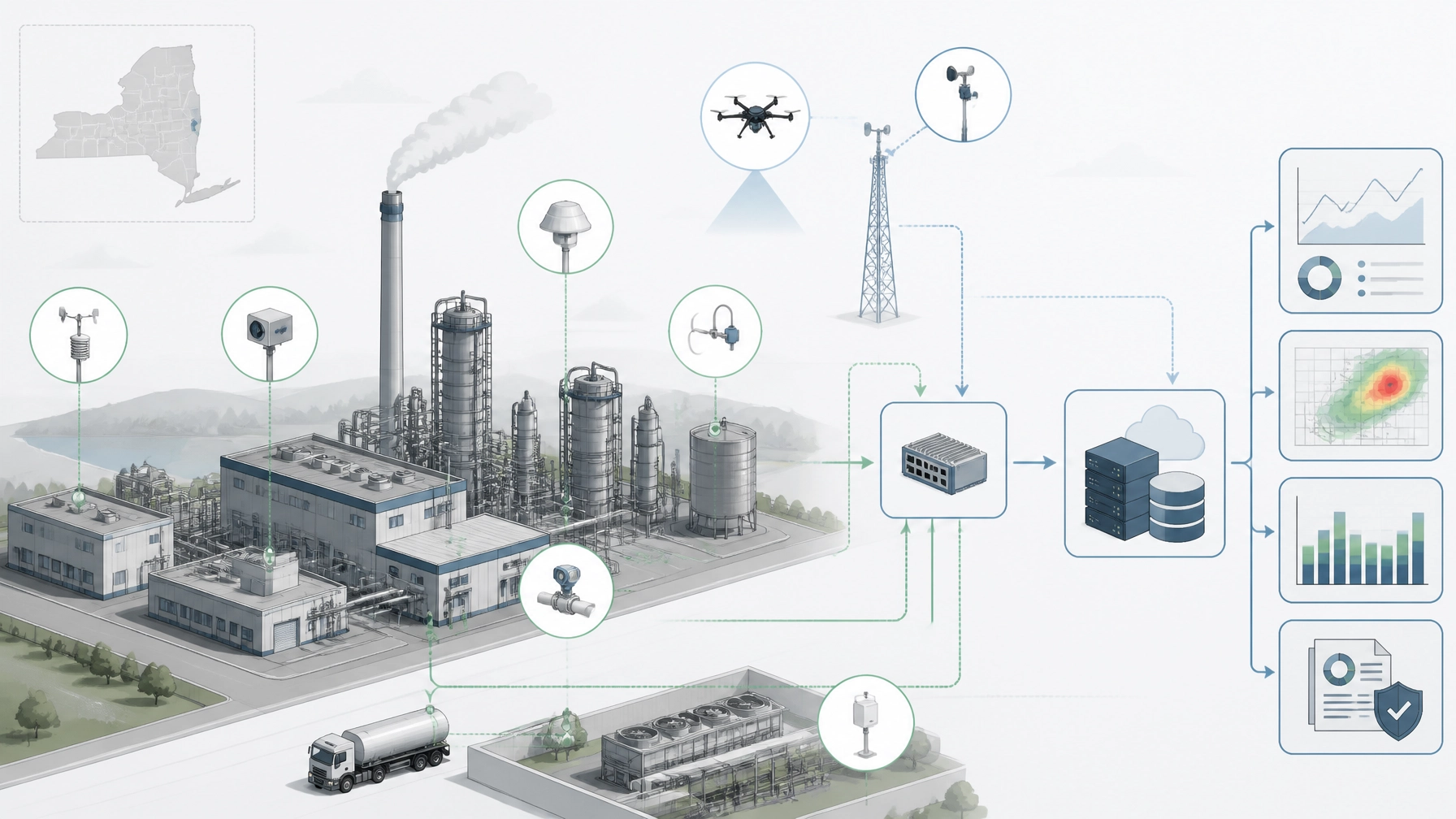
For industrial operators, manufacturers, energy providers, and waste management facilities across New York State, regulatory calendars are shifting quickly. The New York State Department of Environmental Conservation (NYSDEC) Climate Leadership and Community Protection Act (CLCPA) implementation has reached a critical juncture with 6 NYCRR Part 253: the state’s Mandatory Greenhouse Gas Reporting Program.
If your facility qualifies as an applicable reporter or Large Emission Source under Sections 2.2 and 2.13 of the rule, your immediate priority sits squarely on the calendar: September 1, 2026, when your facility’s Emissions Monitoring and Measurement Plan (EMMP) is due to NYSDEC for formal review and approval [1][2][3][5][6].
This is not a routine administrative checkbox that can be delegated to junior staff or rushed through a generic template. Part 253 establishes rigorous, enforceable requirements for direct emission measurements, continuous monitoring, and strict third-party verification. Missing this deadline, or submitting a defensive, poorly structured plan that fails to satisfy agency expectations, immediately triggers regulatory scrutiny, potential enforcement action, and costly project friction.
At Envicon Group, we don’t just deliver reports: we clear the path between your facility and absolute regulatory compliance. With two decades of hands-on engineering, field-first oversight, and direct agency relationships across New York and New Jersey, our PE-led team helps industrial leaders navigate complex environmental mandates without the bureaucratic bloat of national consulting firms.
Deconstructing 6 NYCRR Part 253: Who Qualifies and What Is Required?
Part 253 applies broadly to fossil fuel suppliers, electricity generators, large industrial manufacturing plants, and specific waste-handling sectors. However, the rule draws sharp distinctions between general greenhouse gas (GHG) reporting obligations and specialized methane-monitoring requirements.
Understanding your facility’s precise threshold status is the first line of defense against compliance delays.
The Part 253 Compliance Timeline At a Glance
Navigating Part 253 requires mastering multiple overlapping deadlines. Missing any single milestone cascades into broader operational and legal liabilities:
- September 1, 2026: Submission deadline for the specialized Emissions Monitoring and Measurement Plan (EMMP) under Section 2.20 for applicable reporters (including anaerobic digesters, liquid waste handlers, solid waste facilities, and high-emission sources) [1][2][3][5][6].
- December 31, 2026: General GHG Monitoring Plans due to NYSDEC for designated Large Emission Sources [2][3][4][5][8].
- June 1, 2027: First annual Emissions Data Report due, covering facility emissions generated throughout calendar year 2026 [1][3][4][6][7][8].
- December 1, 2027: First annual third-party verification statements due for Large Emission Sources verifying the 2026 data [3][4][5][6].

The September 1 Deadline: Why the Specialized EMMP Demands Immediate Attention
While general GHG monitoring plans cover broad data collection and quality assurance protocols, Section 2.20 of Part 253 requires covered facilities to develop and submit a standalone Emissions Monitoring and Measurement Plan (EMMP) focused specifically on methane emissions [1][2][5].
This requirement targets specific high-methane sectors, including:
- Anaerobic digesters processing organic waste or agricultural byproducts.
- Handlers of liquid wastes operating under specific emission thresholds.
- Solid waste management facilities and landfills with fugitive gas generation potential.
- Industrial sources exceeding 300,000 metric tons of $\text{CO}_2\text{e}$ calculated under Section 2.13 [2].
Unlike standard recordkeeping obligations where documents remain on-site for review, the EMMP is an approval-based plan. NYSDEC must affirmatively review and approve your methodology [2]. If your submission lacks technical rigor, relies on out-of-date emission factors, or fails to meet EPA 40 CFR Part 98 cross-references, your facility enters a regulatory limbo that can stall operations, complicate financing, and invite enforcement penalties.
Big-Box Consulting vs. The Envicon Advantage
When facing complex regulatory mandates like Part 253, industrial operators often default to large national consulting firms. The pitch sounds reassuring: a global footprint, massive staff numbers, and a recognizable brand name.
In reality, hiring a big-box firm introduces hidden friction:
- The Bait-and-Switch: You meet senior partners during the pitch, but your actual monitoring plan is written by junior staff who have never stepped foot on an industrial floor in New York.
- Defensive, Bloated Reports: Large firms write reports designed to protect their own liability rather than move your project forward, burying your engineering team in dense, unactionable text.
- The Regulatory Black Box: You never know who is talking to your NYSDEC reviewer, when discussions are happening, or whether your submittal is languishing at the bottom of a queue.
At Envicon Group, we operate differently. We are PE-led, field-first, and regulator-facing. We sit at the table with NYSDEC officials: not behind an automated queue. When you partner with us, you get direct access to seasoned engineers and environmental scientists who know your regional jurisdiction, understand your industrial processes, and take full accountability for your compliance outcomes.
Key Elements of a Defensible EMMP Submittal
Building an approved EMMP under Section 2.20 requires meticulous technical documentation. A comprehensive plan must incorporate:
- Detailed Source Characterization: Precise identification of all emission units, fugitive methane sources, process vents, and combustion devices operating on-site.
- Measurement Methodologies: Clear documentation of direct measurement techniques, continuous emission monitoring systems (CEMS), or mass-balance calculations that align strictly with state and federal standards.
- Quality Assurance and Quality Control (QA/QC): Documented calibration schedules, sensor maintenance protocols, and data validation procedures to ensure data integrity.
- Execution Timeline and Contact Protocols: A clear schedule for implementing monitoring activities, alongside designated authorized representatives and signed certifications [2].

The Business Impact of Non-Compliance
Treating Part 253 as a minor paperwork exercise is a high-stakes gamble. The business impact of delayed or rejected submittals extends far beyond statutory fines:
- Carrying Costs and Market Timing: Regulatory delays stall capital improvements, encumber facility financing, and disrupt operational planning.
- Re-Mobilization and Re-Sampling Expenses: If NYSDEC rejects your monitoring plan or data submittal due to methodological errors, correcting the record requires costly re-evaluations and extended agency negotiations.
- Lender Scrutiny: Institutional investors and commercial lenders routinely flag unresolved environmental liabilities during due diligence and refinancing rounds. Clean, defensible compliance documentation is your best insurance policy.
As our core philosophy dictates: Collaboration is not a buzzword: it’s how we work. We bridge the gap between engineering precision and regulatory reality, ensuring your facility stays fully compliant and operational.
Action Items for Facility Operators Ahead of September 1
To ensure your facility meets the upcoming September 1 EMMP deadline without operational disruption, take these proactive steps today:
- Audit Your Source Categories: Review your facility’s 2025 and projected 2026 emission totals against Sections 2.2 and 2.13 thresholds to determine if your operations trigger mandatory EMMP submittal [1][2].
- Review Existing Monitoring Infrastructure: Evaluate whether your current data collection systems, flow meters, and sampling protocols satisfy EPA and NYSDEC measurement standards.
- Partner with Regional Experts: Engage an experienced environmental engineering firm that maintains active, daily working relationships with NYSDEC Division of Air Resources personnel.

Take Control of Your Regulatory Compliance Today
Navigating NYSDEC Part 253 doesn't have to be a guessing game. Whether you need a comprehensive Emissions Monitoring and Measurement Plan drafted before September 1, a rigorous GHG monitoring plan for your Large Emission Source, or a strategic partner to manage your upcoming third-party verifications, Envicon Group delivers certainty when it matters most.
We remove the obstacles between your facility and absolute compliance. We don't sell reports. We sell cleared paths.
Ready to Secure Your NYSDEC Part 253 Compliance?
Talk directly with our senior environmental engineers and schedule your regulatory readiness review today.
Call now: (917) 764-2171
Book a free consultation
Cost estimator tool
Leave a Reply