Author: jpancoas23

  • Climate-Adjusted Flood Elevations (CAFE): Understanding NJ’s 4-Foot Above BFE Mandate in the REAL Rules

    Climate-Adjusted Flood Elevations (CAFE): Understanding NJ’s 4-Foot Above BFE Mandate in the REAL Rules

    If you are a developer in New Jersey, the goalposts just moved: and they moved uphill.

    As of January 2026, the New Jersey Department of Environmental Protection (NJDEP) officially adopted the Resilient Environments and Landscapes (REAL) rules. While the name sounds like a sustainability initiative, for the real estate industry, it is a massive shift in how we design, grade, and permit projects.

    The centerpiece of these rules is the Climate-Adjusted Flood Elevation (CAFE). In coastal and tidal areas, the NJDEP now mandates that the regulated flood elevation is no longer just the FEMA Base Flood Elevation (BFE). It is now FEMA BFE plus four feet.

    This isn't a suggestion; it's a mandate for new construction and substantial improvements. If your project is sitting in a tidal flood hazard area, your foundations, mechanicals, and access roads are about to get a lot higher.

    Why the Math Changed

    For decades, FEMA’s maps have been the "Bible" for flood risk. But as any developer in Hudson County or along the Shore knows, those maps are often looking in the rearview mirror. They rely on historical data.

    The NJDEP’s REAL rules are forward-looking. By establishing the CAFE at BFE + 4 feet, the state is effectively modeling for approximately five feet of sea-level rise by the year 2100. The goal is to ensure that the infrastructure we build today won't be underwater, literally or financially: in thirty years.

    But here is the rub: this new elevation standard applies even to properties that FEMA currently considers "low risk."

    The "Hidden" Flood Zones

    One of the most disruptive aspects of the CAFE mandate is its reach. The NJDEP has created new mapping layers that extend beyond the traditional FEMA Special Flood Hazard Areas. We are seeing properties previously classified as Zone X (outside the 100-year floodplain) now falling within the state-regulated Inundation Risk Zones (IRZ).

    If you are evaluating a site based solely on a FEMA map, you are flying blind. You might think you’re in the clear, only to find out during permitting that the NJDEP requires you to elevate your first habitable floor five feet higher than expected (4 feet for CAFE plus typically 1 foot of municipal freeboard).

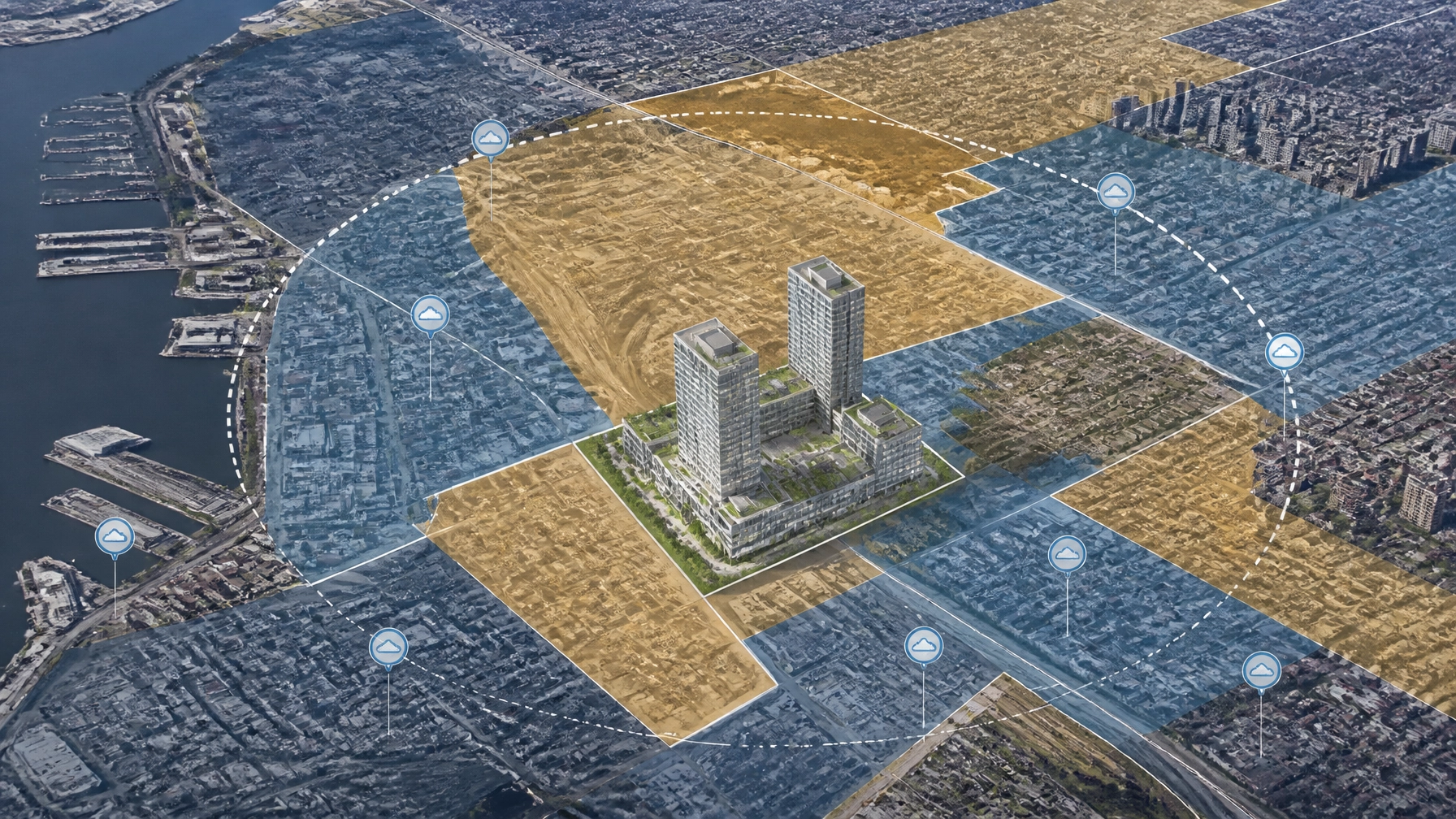
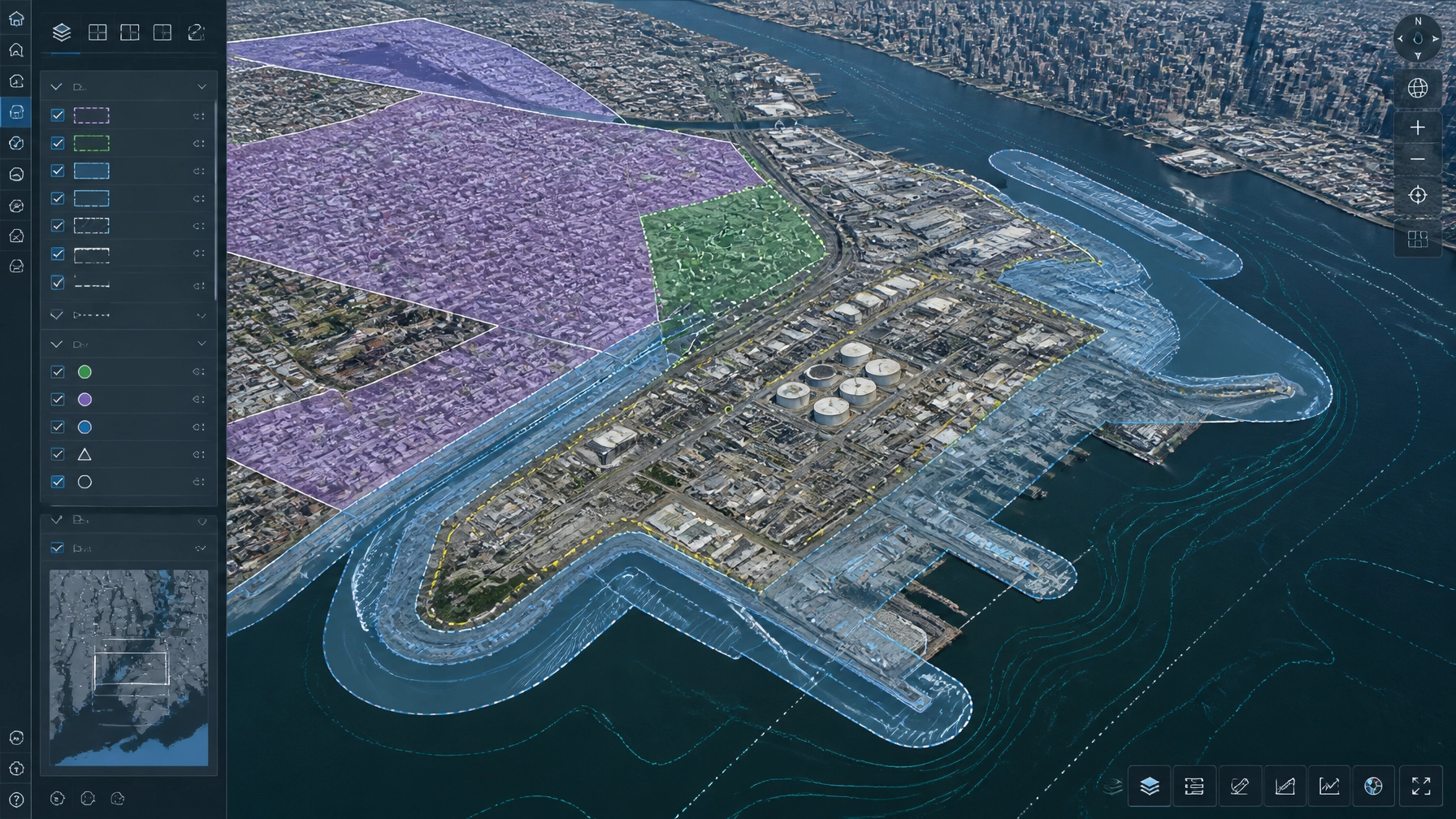
    Widescreen monitor showing 3D GIS analysis of topographic data used to identify new climate-adjusted flood zones

    The Engineering Headache: Grading, Fill, and Walls

    Designing a building to be four feet higher sounds simple on paper. In the field, it’s a domino effect of civil engineering challenges. At Envicon Group, we are seeing these challenges manifest in four specific ways:

    • Massive Fill Requirements: Elevating a site by four feet across several acres isn't just expensive; it’s logistically complex. You need to source clean fill, manage the soil and groundwater, and account for the added weight on the underlying soil strata.
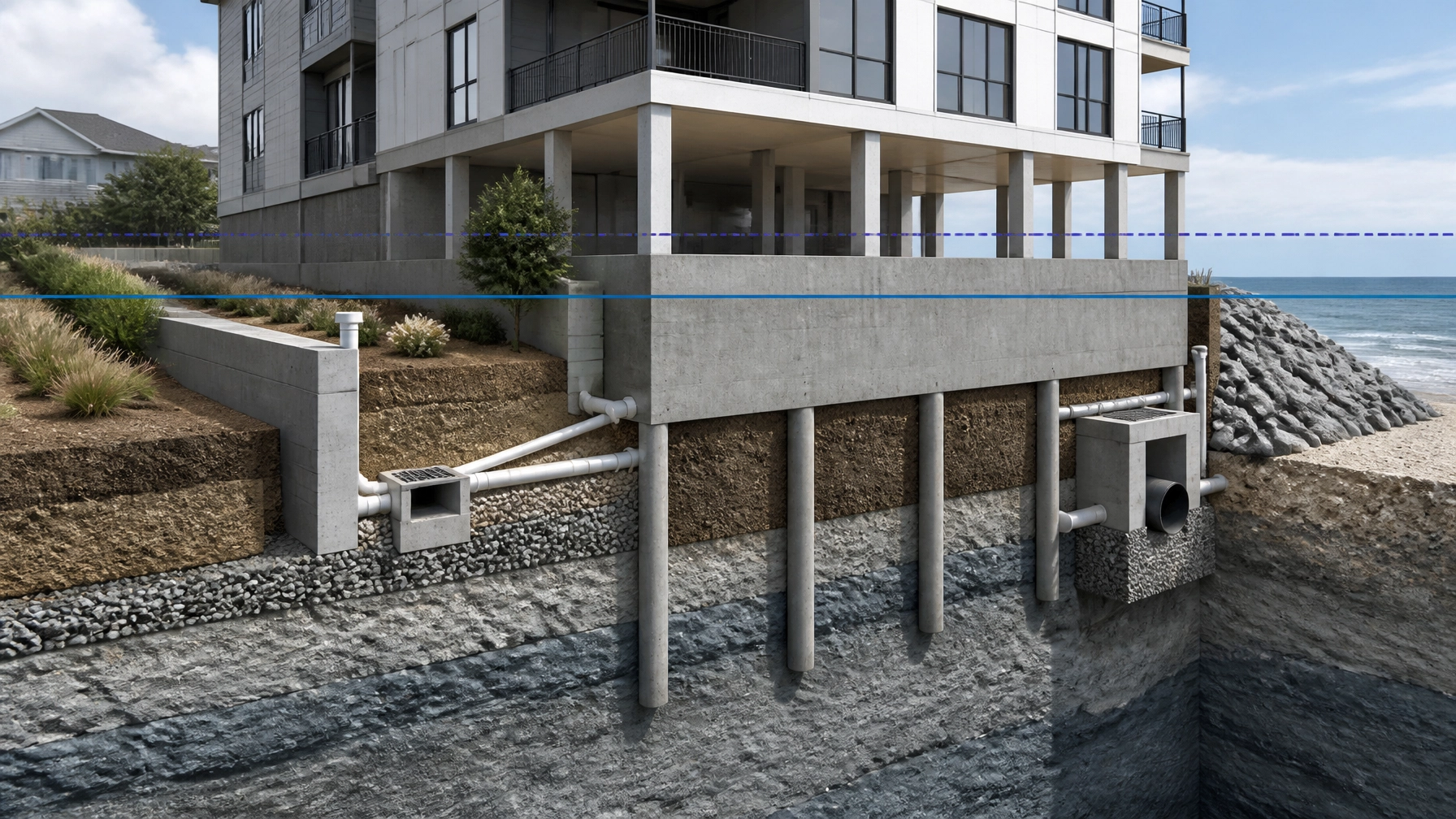
    • Retaining Wall Complexity: When you raise a building site significantly above the adjacent street level, you can’t just slope the soil. You need robust retaining wall systems to manage the grade change. This adds significant structural costs and impacts your setback requirements.
    • ADA and Access Issues: A higher first floor means longer ramps and more complex elevator configurations. Designing a site that is both flood-resilient and accessible requires a level of precision that "cookie-cutter" engineering firms often miss.
    • Stormwater Management: Raising the site changes how water flows off your property and onto your neighbors'. In New Jersey, you can’t solve your flood problem by creating one for the guy next door. This requires advanced stormwater and drainage design to ensure compliance.

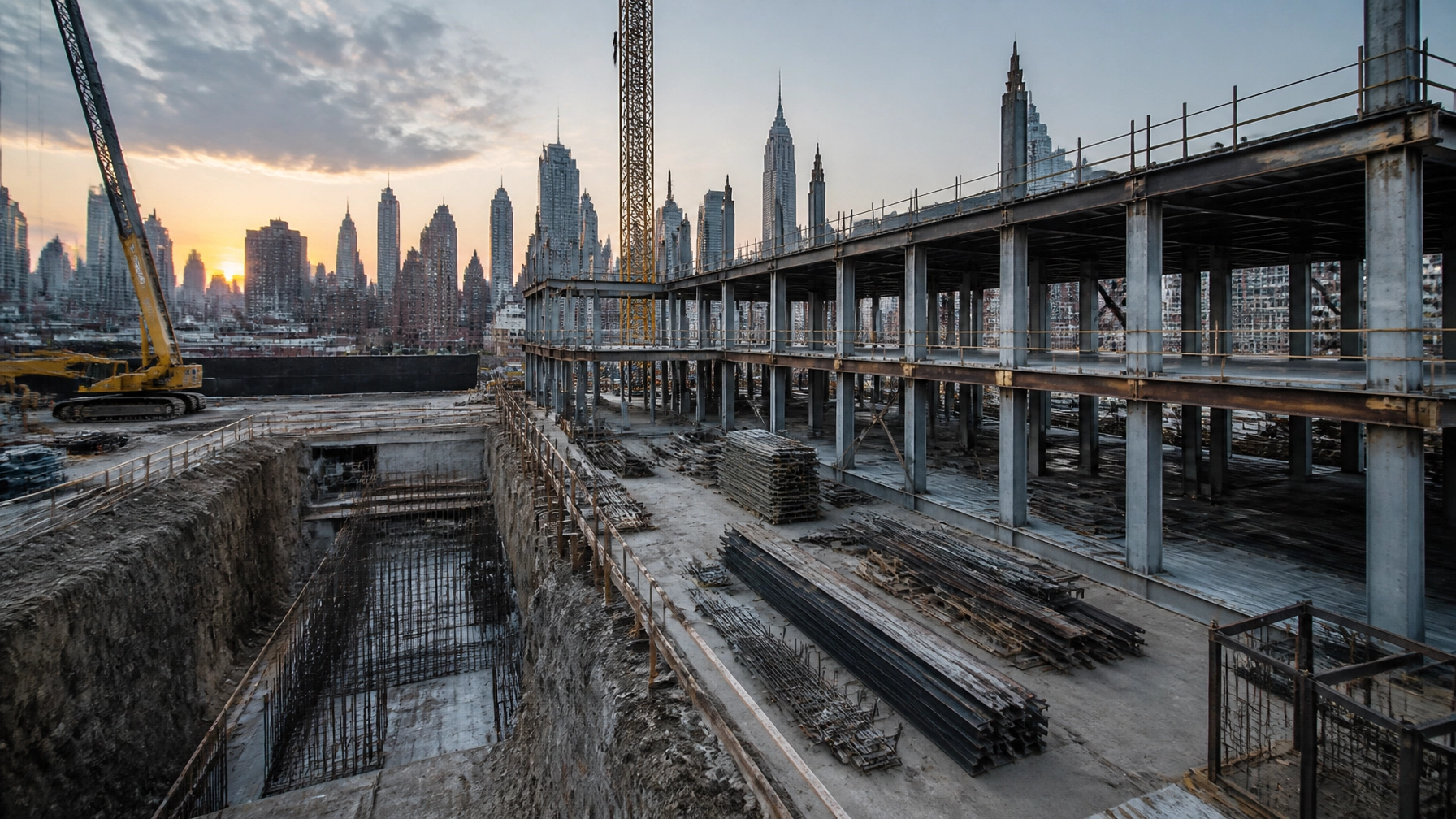
    Close-up of a complex concrete retaining wall system being installed at a flood-resilient construction site

    The "Legacy" Window is Closing

    There is a small silver lining, but the clock is ticking. When the REAL rules were adopted on January 20, 2026, the NJDEP included a 180-day legacy period.

    As we sit here on July 6, 2026, that window is nearly shut. Projects with "administratively and technically complete" applications submitted before the July 20 deadline can still be reviewed under the old standards (FEMA BFE + 1 or 2 feet).

    While there is a proposal to extend this legacy period to July 2027, you cannot bet your project’s viability on a "proposed" extension. If you haven't secured your flood hazard permits yet, you need a team that knows how to navigate the NJDEP regulatory landscape with urgency.

    "The CAFE mandate is the biggest shift in NJ land use in a generation. It’s no longer about where the water was; it’s about where the water is going to be."

    Why the "Big Box" Consultants Are Failing You

    If you’ve hired a national firm for your NJ/NY development, you might be getting "defensive" reports. These are the 400-page PDFs that tell you everything that might be a problem but offer no clear path to solving it.

    Large firms often apply a national playbook to a very local NJ problem. They’ll tell you that the CAFE rules are a "constraint." At Envicon, we see them as a design parameter.

    When you hire a massive firm, the person who pitched you the project is rarely the one talking to the NJDEP reviewer. At Envicon, we sit at the table with the regulators. We know the reviewers by name. We don't just hand you a report and leave you to figure out why your grading plan was rejected. We take ownership of the outcome.

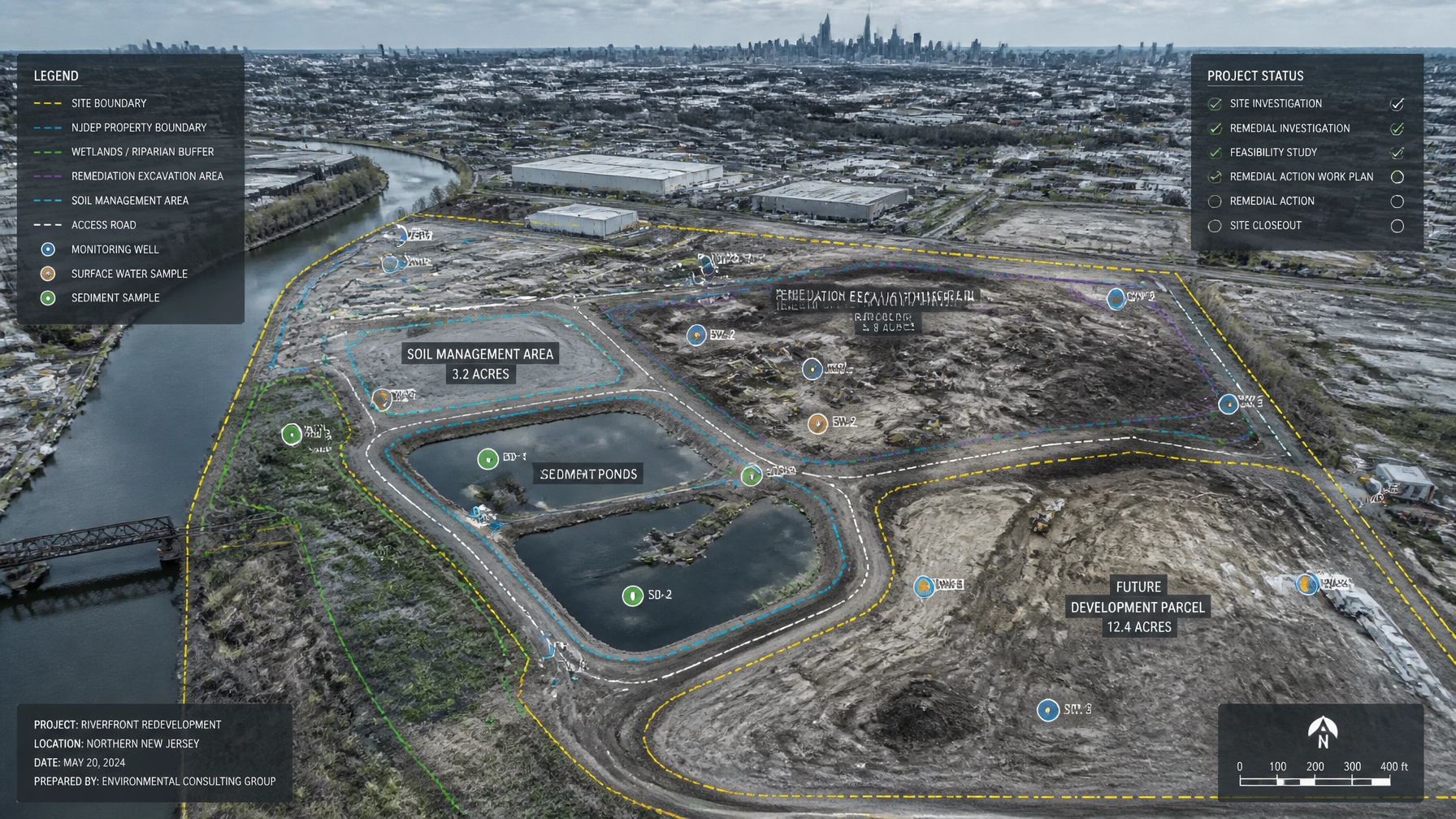
    Active brownfield redevelopment site showing soil excavation and site preparation for a complex urban project

    How We Clear the Path

    At Envicon Group, we’ve built a project management infrastructure that most firms our size don’t have. We use real-time dashboards to track permit status, so you never have to wonder if your application is sitting in a "black box" at the NJDEP.

    For projects affected by the CAFE mandate, we provide:

    1. Precision Mapping: We identify exactly where the new CAFE and IRZ lines hit your property line: not just where the FEMA map says they are.
    2. Integrated Site-Civil Design: Our environmental and civil teams work in the same room. We don't design a remediation plan that conflicts with your flood-elevation grading. We design one cohesive strategy.
    3. Regulator-Facing Expertise: We know how to present "hardship" cases and alternative designs that meet the spirit of the REAL rules without killing your project’s ROI.

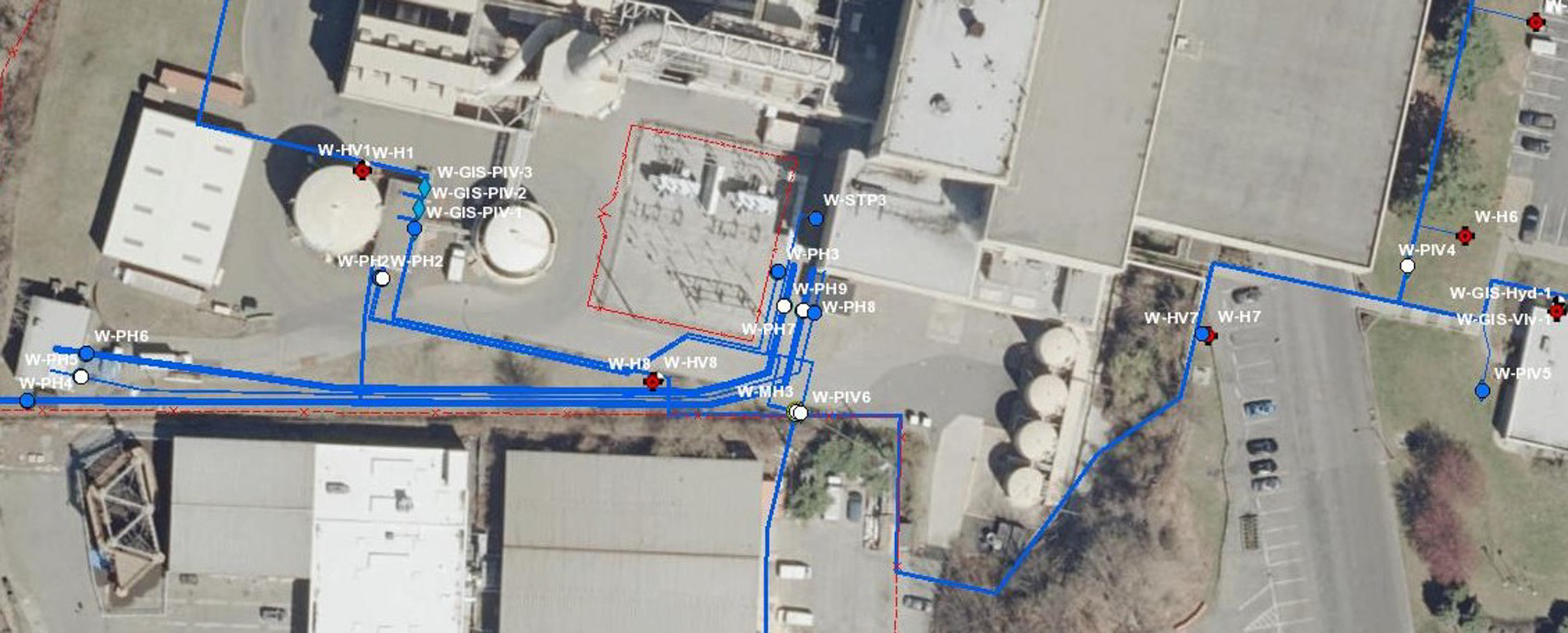
    Municipal waterfront facility illustrating the integration of industrial infrastructure and flood-compliant design

    The Takeaway: Don’t Wait for the Water

    The REAL rules and the CAFE mandate are not "emerging" issues: they are here. Every week you delay in understanding your site’s new elevation requirements is a week of carrying costs and potential regulatory rejection.

    If your project is in a coastal or tidal area in New Jersey, you need more than a consultant. You need a partner who can translate complex sea-level rise models into actionable site plans.

    Key Summary:

    • The Mandate: Coastal construction must now be elevated to FEMA BFE + 4 feet.
    • The Reach: The rules apply to properties previously considered "low risk" by FEMA.
    • The Deadline: The original 180-day legacy window closes on July 20, 2026.
    • The Solution: Integrated civil and environmental engineering that addresses grading, fill, and drainage as a single challenge.

    Ready to Navigate the REAL Rules?

    If you're worried your current plans don't meet the new 4-foot mandate, let’s get ahead of it. We provide the technical precision and regulatory relationships needed to keep your project moving.

    1. Check your site's risk now: Risk screener tool
    2. Talk to a Principal Engineer: Book a free consultation
    3. Stay updated on NJ regulations: Read more on our blog
    Envicon Group Logo

  • Climate-Adjusted Flood Elevations (CAFE): Understanding NJ’s 4-Foot Above BFE Mandate in the REAL Rules

    Climate-Adjusted Flood Elevations (CAFE): Understanding NJ’s 4-Foot Above BFE Mandate in the REAL Rules

    If you are a developer in New Jersey, the goalposts just moved: and they moved uphill.

    As of January 2026, the New Jersey Department of Environmental Protection (NJDEP) officially adopted the Resilient Environments and Landscapes (REAL) rules. While the name sounds like a sustainability initiative, for the real estate industry, it is a massive shift in how we design, grade, and permit projects.

    The centerpiece of these rules is the Climate-Adjusted Flood Elevation (CAFE). In coastal and tidal areas, the NJDEP now mandates that the regulated flood elevation is no longer just the FEMA Base Flood Elevation (BFE). It is now FEMA BFE plus four feet.

    This isn't a suggestion; it's a mandate for new construction and substantial improvements. If your project is sitting in a tidal flood hazard area, your foundations, mechanicals, and access roads are about to get a lot higher.

    Why the Math Changed

    For decades, FEMA’s maps have been the "Bible" for flood risk. But as any developer in Hudson County or along the Shore knows, those maps are often looking in the rearview mirror. They rely on historical data.

    The NJDEP’s REAL rules are forward-looking. By establishing the CAFE at BFE + 4 feet, the state is effectively modeling for approximately five feet of sea-level rise by the year 2100. The goal is to ensure that the infrastructure we build today won't be underwater, literally or financially: in thirty years.

    But here is the rub: this new elevation standard applies even to properties that FEMA currently considers "low risk."

    The "Hidden" Flood Zones

    One of the most disruptive aspects of the CAFE mandate is its reach. The NJDEP has created new mapping layers that extend beyond the traditional FEMA Special Flood Hazard Areas. We are seeing properties previously classified as Zone X (outside the 100-year floodplain) now falling within the state-regulated Inundation Risk Zones (IRZ).

    If you are evaluating a site based solely on a FEMA map, you are flying blind. You might think you’re in the clear, only to find out during permitting that the NJDEP requires you to elevate your first habitable floor five feet higher than expected (4 feet for CAFE plus typically 1 foot of municipal freeboard).

    Widescreen monitor showing 3D GIS analysis of topographic data used to identify new climate-adjusted flood zones

    The Engineering Headache: Grading, Fill, and Walls

    Designing a building to be four feet higher sounds simple on paper. In the field, it’s a domino effect of civil engineering challenges. At Envicon Group, we are seeing these challenges manifest in four specific ways:

    • Massive Fill Requirements: Elevating a site by four feet across several acres isn't just expensive; it’s logistically complex. You need to source clean fill, manage the soil and groundwater, and account for the added weight on the underlying soil strata.
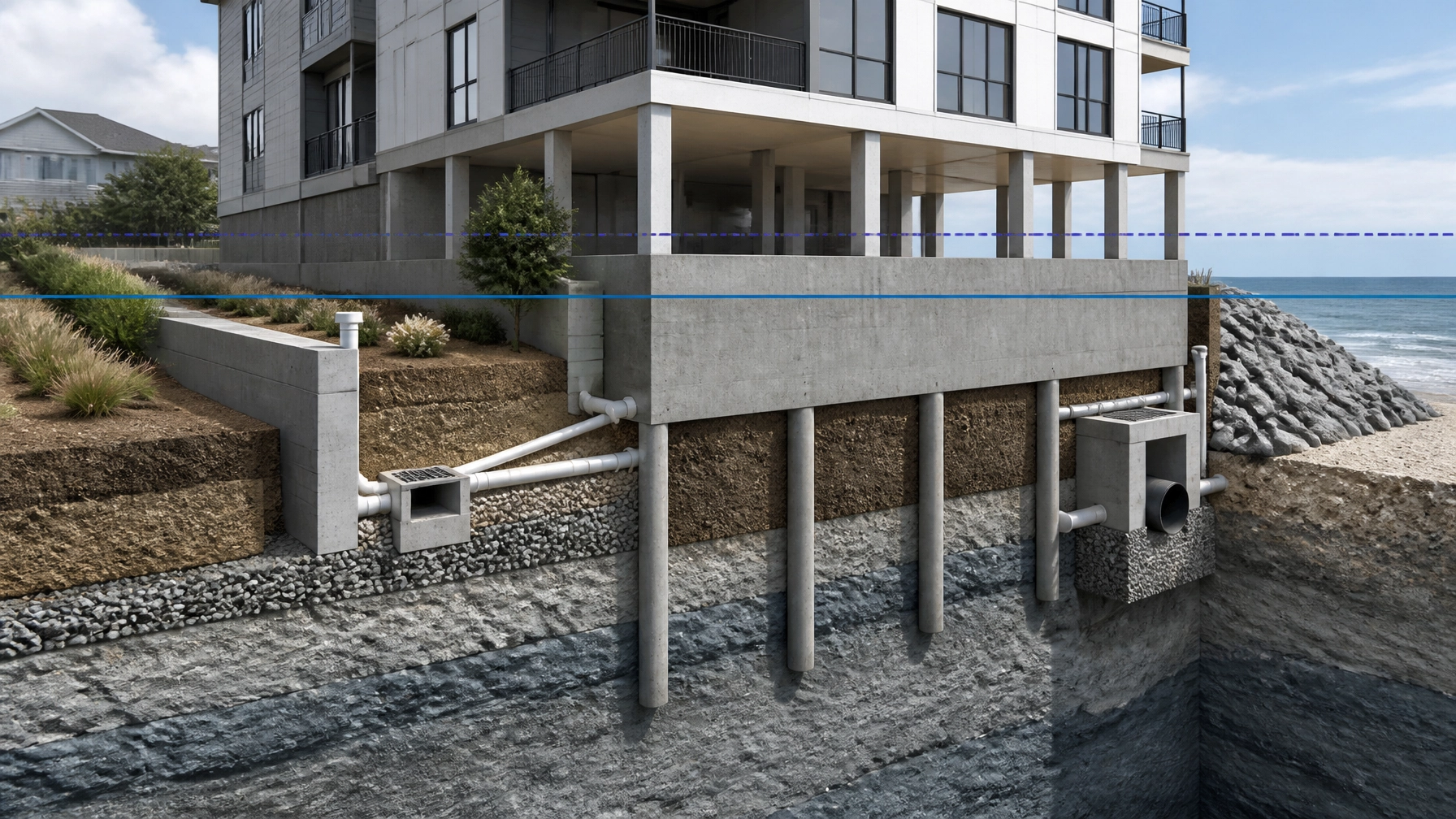
    • Retaining Wall Complexity: When you raise a building site significantly above the adjacent street level, you can’t just slope the soil. You need robust retaining wall systems to manage the grade change. This adds significant structural costs and impacts your setback requirements.
    • ADA and Access Issues: A higher first floor means longer ramps and more complex elevator configurations. Designing a site that is both flood-resilient and accessible requires a level of precision that "cookie-cutter" engineering firms often miss.
    • Stormwater Management: Raising the site changes how water flows off your property and onto your neighbors'. In New Jersey, you can’t solve your flood problem by creating one for the guy next door. This requires advanced stormwater and drainage design to ensure compliance.

    Close-up of a complex concrete retaining wall system being installed at a flood-resilient construction site

    The "Legacy" Window is Closing

    There is a small silver lining, but the clock is ticking. When the REAL rules were adopted on January 20, 2026, the NJDEP included a 180-day legacy period.

    As we sit here on July 6, 2026, that window is nearly shut. Projects with "administratively and technically complete" applications submitted before the July 20 deadline can still be reviewed under the old standards (FEMA BFE + 1 or 2 feet).

    While there is a proposal to extend this legacy period to July 2027, you cannot bet your project’s viability on a "proposed" extension. If you haven't secured your flood hazard permits yet, you need a team that knows how to navigate the NJDEP regulatory landscape with urgency.

    "The CAFE mandate is the biggest shift in NJ land use in a generation. It’s no longer about where the water was; it’s about where the water is going to be."

    Why the "Big Box" Consultants Are Failing You

    If you’ve hired a national firm for your NJ/NY development, you might be getting "defensive" reports. These are the 400-page PDFs that tell you everything that might be a problem but offer no clear path to solving it.

    Large firms often apply a national playbook to a very local NJ problem. They’ll tell you that the CAFE rules are a "constraint." At Envicon, we see them as a design parameter.

    When you hire a massive firm, the person who pitched you the project is rarely the one talking to the NJDEP reviewer. At Envicon, we sit at the table with the regulators. We know the reviewers by name. We don't just hand you a report and leave you to figure out why your grading plan was rejected. We take ownership of the outcome.

    Active brownfield redevelopment site showing soil excavation and site preparation for a complex urban project

    How We Clear the Path

    At Envicon Group, we’ve built a project management infrastructure that most firms our size don’t have. We use real-time dashboards to track permit status, so you never have to wonder if your application is sitting in a "black box" at the NJDEP.

    For projects affected by the CAFE mandate, we provide:

    1. Precision Mapping: We identify exactly where the new CAFE and IRZ lines hit your property line: not just where the FEMA map says they are.
    2. Integrated Site-Civil Design: Our environmental and civil teams work in the same room. We don't design a remediation plan that conflicts with your flood-elevation grading. We design one cohesive strategy.
    3. Regulator-Facing Expertise: We know how to present "hardship" cases and alternative designs that meet the spirit of the REAL rules without killing your project’s ROI.

    Municipal waterfront facility illustrating the integration of industrial infrastructure and flood-compliant design

    The Takeaway: Don’t Wait for the Water

    The REAL rules and the CAFE mandate are not "emerging" issues: they are here. Every week you delay in understanding your site’s new elevation requirements is a week of carrying costs and potential regulatory rejection.

    If your project is in a coastal or tidal area in New Jersey, you need more than a consultant. You need a partner who can translate complex sea-level rise models into actionable site plans.

    Key Summary:

    • The Mandate: Coastal construction must now be elevated to FEMA BFE + 4 feet.
    • The Reach: The rules apply to properties previously considered "low risk" by FEMA.
    • The Deadline: The original 180-day legacy window closes on July 20, 2026.
    • The Solution: Integrated civil and environmental engineering that addresses grading, fill, and drainage as a single challenge.

    Ready to Navigate the REAL Rules?

    If you're worried your current plans don't meet the new 4-foot mandate, let’s get ahead of it. We provide the technical precision and regulatory relationships needed to keep your project moving.

    1. Check your site's risk now: Risk screener tool
    2. Talk to a Principal Engineer: Book a free consultation
    3. Stay updated on NJ regulations: Read more on our blog
    Envicon Group Logo

  • New York Housing Exemption from Environmental Review: Why Phase I ESAs Are Still Non-Negotiable

    New York Housing Exemption from Environmental Review: Why Phase I ESAs Are Still Non-Negotiable

    The landscape of New York real estate development just underwent its most significant regulatory shift in a generation. Under the Fiscal Year 2026-2027 budget amendments, the State Environmental Quality Review Act (SEQRA) has been overhauled to fast-track housing. For developers, this sounds like the holy grail: a categorical exemption from the grueling environmental impact statement (EIS) process that has stalled projects for years.

    But there is a critical caveat that many are overlooking. While the "Let Them Build" initiative removes the full SEQRA review for qualifying projects, it does not remove the environment from the equation. In fact, it tethers the exemption directly to your due diligence. For most applicant-initiated permits, a Phase I Environmental Site Assessment (ESA) is no longer just a lender requirement: it is a statutory mandate for the exemption itself.

    At Envicon Group, we have seen how "fast" can quickly become "fatal" if the paperwork isn't airtight. Here is what you need to know about the 2026 housing exemption and why your Phase I ESA remains your most important document.

    The Exemption Framework: What Qualifies?

    The new SEQRA amendments create a "Type II" (exempt) category for housing projects that meet specific unit counts and siting criteria. The goal is simple: increase density on previously disturbed land without the three-year detour of a full environmental review.

    The thresholds are strictly defined:

    • In New York City: Up to 250 units in lower-density districts, or up to 500 units in high-density districts (where height limits exceed 45 feet).
    • Outside NYC: Up to 300 units in urbanized areas, 100 units in non-urban areas with zoning, or 20 units in municipalities without zoning.
    • The Site Condition: The project must be on "previously disturbed" land: meaning it was substantially altered by improvements at least two years prior to your application.
    • Infrastructure: Projects must connect to existing public water and sewer systems.

    If your project fits these boxes, you bypass the Environmental Assessment Form (EAF) and the potential for a Positive Declaration. However, to claim this victory, you must prove your site is safe.

    The Phase I ESA: The New Statutory Gateway

    For any application that involves a permit or authorization: beyond just a simple variance or zoning text amendment: the statute requires the developer to complete a Phase I ESA. This isn't just any report; it must comply with federal standards for All Appropriate Inquiries (40 CFR § 312).

    Lender-ready Environmental Site Assessment (ESA) reports and documentation on a desk, representing the rigorous due diligence required for the new SEQRA exemptions.

    Most consultants deliver a report that highlights "Recognized Environmental Conditions" (RECs) and then leaves you to figure out the risk. The 2026 law changes that. To use the exemption, you must:

    1. Conduct the Phase I ESA following EPA AAI standards.
    2. Commit to following all recommendations within that Phase I.
    3. Certify compliance with all hazardous waste laws and local remediation requirements.

    This is where the "big-box" consulting model fails. A national firm might deliver a 400-page boilerplate report written by a junior staffer in a different time zone. If that report recommends a Phase II investigation or a sub-slab depressurization system (SSDS), you are now statutorily obligated to follow that path to maintain your SEQRA exemption.

    The "Certification Trap": Risk Beyond the Report

    The most dangerous part of the new guidance is the certification requirement. Developers must now certify that they will report any contamination found and comply with all remediation laws.

    When you sign that certification, you are taking ownership of the site's environmental history. If your Phase I was performed "defensively": meaning the consultant flagged every minor detail to protect themselves: you might find yourself legally committed to unnecessary and expensive remediation just to keep your project in the "exempt" category.

    Environmental sampling kit with soil probes and sample vials, used for the high-precision characterization required under the 2026 SEQRA standards.

    "We don’t sell reports. We sell cleared paths," is the throughline at Envicon. In this new regulatory environment, you need a consultant who understands that every recommendation in a Phase I has a direct impact on your project's legal status. We look at the Risk Screener and the data before the first draft is ever written to ensure your path to closure is clear.

    Land Use vs. Permits: Understanding the Carve-Out

    There is a subtle distinction in the 2026 law that environmental attorneys and savvy developers are watching closely. The Phase I ESA requirement does not strictly apply to applications limited to land-use approvals, zoning text/map amendments, or variances.

    However, do not let this nuance lead to complacency. While the Phase I might not be mandated for the zoning change itself, it will be required as soon as you file for your building permits or site-specific authorizations. Furthermore, the hazardous materials certifications: stating you will comply with all remediation laws: apply regardless.

    Using 3D GIS Analysis and Geospatial Data allows us to identify these hurdles before they become work-stoppage orders. We help you navigate which approvals trigger which requirements so your project doesn't get caught in a "black box" of regulatory coordination.

    Widescreen monitor showing 3D GIS terrain modeling and geospatial data analysis, essential for navigating complex NYC/NJ zoning and environmental hurdles.

    The Envicon Difference: Speed is a Professional Competency

    Every week your project sits in a queue at a large national firm, your carry costs are mounting. These firms apply a cookie-cutter playbook to the New York market. They don't know your regulator’s reviewer by name, and they certainly don't understand the urgency of a closing date.

    Envicon is family-owned and PE-led. We have spent 20 years sitting at the table with NYC OER, NYSDEC, and the NJ DEP. When the 2026 housing exemption was announced, we didn't just read the guidance: we integrated it into our proprietary project management infrastructure.

    • 48-Hour Turnarounds: We move at the speed of your transaction, not at the speed of a corporate bureaucracy.
    • Direct Leadership: You talk to the engineer on the site, not a project manager reading notes.
    • Regulator Fluency: We know how to structure your Phase I ESA and certifications so they hold up under scrutiny and actually get you to the next step.

    Active remediation site with heavy equipment conducting soil removal, demonstrating the field-first approach Envicon takes to move projects from contamination to compliance.

    Summary: A Build-Ready Future

    The 2026 New York housing exemption is a massive opportunity for developers, but it is not a free pass. It is a trade-off: you get speed in exchange for accountability.

    • Phase I ESAs are mandatory for most permit-related exemptions.
    • Recommendations are binding: if your report says you need it, the law says you must do it.
    • Certifications matter: you are legally responsible for compliance and reporting.

    Don't let a generic report from a big-box firm stall your project. Navigate the new SEQRA landscape with precision and urgency.


    Take Control of Your Project Timeline

    The new 2026 regulations require more than just technical knowledge: they require a partner who can execute.

    Envicon Group Logo

  • Wastewater Cybersecurity: New SPDES Compliance Rules for NY POTWs

    Wastewater Cybersecurity: New SPDES Compliance Rules for NY POTWs

    For decades, the primary concerns at a Publicly Owned Treatment Works (POTW) were flow, nitrogen levels, and sludge management. But the landscape has shifted. As of June 2026, the New York State Department of Environmental Conservation (NYSDEC) has made it clear: cybersecurity is no longer an "IT problem": it is a core requirement for State Pollutant Discharge Elimination System (SPDES) compliance.

    The amendments to 6 NYCRR Parts 616, 650, and 750 represent a significant regulatory pivot. If you are operating a facility in New York, the "wait and see" approach is officially over. These rules are designed to protect critical infrastructure from digital threats that could lead to environmental disasters, and they come with strict reporting timelines that will catch unprepared operators off guard.

    At Envicon, we’ve spent 20 years navigating the intersection of engineering and regulatory enforcement. We know that when the DEC moves the goalposts, the last thing you need is a bloated, defensive report from a national firm that doesn’t move your project forward. You need a path to closure.

    The New Regulatory Framework: Parts 616, 650, and 750

    The new rules don't just suggest better passwords; they codify cybersecurity into the permit-holding process. Here is the breakdown of what has changed:

    • 6 NYCRR Part 750: This is the hammer. It introduces mandatory cybersecurity incident reporting for all SPDES permittees and specific technical controls for POTWs.
    • 6 NYCRR Part 650: This shifts the burden to the people on the ground, requiring certified wastewater operators to complete specific cybersecurity training for recertification.
    • 6 NYCRR Part 616: This provides a layer of protection, allowing sensitive cybersecurity information to be shielded from public FOIL (Freedom of Information Law) requests to prevent exposing system vulnerabilities.

    Technical diagram showing OT and IT network segregation for wastewater security

    Mandatory Incident Reporting: The 24-Hour Clock

    The most immediate change for every SPDES permit holder: public or private: is the new reporting mandate under Part 750-2.7(h). If you experience a "cybersecurity incident," the clock starts immediately.

    1. Initial Notification: You must notify your Regional Water Engineer as soon as possible, but no later than 24 hours after becoming aware of the incident.
    2. Written Report: A detailed written submission must follow within 30 days.

    An "incident" isn't just a full system lockout. It includes any unauthorized access or activity that disrupts or has the potential to disrupt operations, monitoring, or compliance. If your SCADA system hangs or a technician notices "ghost" logins, you have a reporting obligation.

    Large national firms often struggle here. They want to run everything through three layers of legal review before making a call. In the NY/NJ metro, that delay is a liability. Envicon’s field-first approach means we help you identify, report, and mitigate in real-time, keeping you in the DEC’s good graces while maintaining site security.

    Core Technical Controls for POTWs

    If you run a POTW, the requirements go beyond reporting. You are now required to implement and maintain formal cybersecurity controls. These aren't suggestions; they are part of your operational compliance.

    • Access Control and MFA: You must establish written procedures for access control based on the principle of "least privilege." Default credentials must be purged, and Multi-Factor Authentication (MFA) is now a baseline requirement for system access.
    • Vulnerability Management: Facilities must have a written process for identifying, assessing, and remediating vulnerabilities in their digital infrastructure.
    • OT/IT Segregation: You are required to isolate your Operational Technology (OT): the systems that actually move the water: from your business IT networks. A breach in the office email should not be able to shut down your pumps.
    • Large Facility Monitoring (≥ 10 MGD): For plants with a design flow of 10 million gallons per day or more, there are additional requirements for network monitoring and logging to detect intrusions in real-time.

    Cybersecurity Incident Response Plan on a field-ready clipboard at a treatment plant

    Operator Training and FOIL Protections

    The human element is often the weakest link in cybersecurity. Under the amended Part 650, certified wastewater operators must now complete dedicated cybersecurity training hours to renew their certifications. This ensures that the people at the controls understand the digital risks as well as they understand the chemical ones.

    Crucially, the amendments to Part 616 address a major concern for utility owners: transparency vs. security. By allowing entities to request FOIL exemptions for sensitive security data, the DEC is encouraging honest reporting. You can now provide the necessary details to regulators without worrying that a bad actor will use that same report as a roadmap for a future attack.

    The Envicon Resolution: Moving Beyond the Report

    Most consultants treat cybersecurity like a checkbox exercise. They hand you a 200-page report that sits in a drawer until an inspector asks for it. At Envicon, we believe a report that doesn't move your project forward is a waste of your budget.

    When you work with us, you aren’t getting a junior staffer reading from a template. You’re getting a team that understands the site investigation and characterization process and how digital infrastructure impacts your overall project timeline. We treat cybersecurity as an engineering challenge: one that requires precision, urgency, and direct coordination with regulators.

    We’ve built a proprietary project management infrastructure that gives our clients real-time visibility into their compliance status. While big-box firms are still trying to figure out which regional office should handle your NYC OER or NJ DEP coordination, we are already on-site, solving the problem.

    Aerial view of an active remediation site showing heavy equipment and site work

    Summary: What You Need to Do Now

    The June 2026 deadline for full implementation is closer than it appears. Every week of delay in updating your Emergency Response Plan (ERP) or implementing MFA increases your carrying costs and regulatory risk.

    • Update your ERP: Ensure cybersecurity is explicitly integrated into your emergency planning.
    • Audit your OT/IT: Verify that your SCADA systems are segregated from the public internet and business networks.
    • Train your team: Ensure your operators are tracking their cybersecurity hours for their next renewal.
    • Establish reporting protocols: Make sure your staff knows who to call within that first 24-hour window.

    Wastewater management is no longer just about pipes and pumps; it’s about protecting the data that keeps those systems running. We don't just sell reports; we sell cleared paths. Let's make sure your path stays open.

    Take Action Today

    Don't let a "stalled" compliance status affect your market timing or lender patience. Envicon provides the regional fluency and technical depth needed to navigate these new NYSDEC mandates without the big-firm overhead.

    Envicon Group Logo

  • NY’s New Environmental Justice Law: How SEQRA Amendments Affect Your Next NYC Project

    NY’s New Environmental Justice Law: How SEQRA Amendments Affect Your Next NYC Project

    If you are a developer or a property investor in New York City, the regulatory ground beneath your feet just shifted.

    As of June 12, 2026, the State Environmental Quality Review Act (SEQRA) has undergone one of its most significant transformations in decades. This isn’t just another administrative update or a box to check on a form. The new Environmental Justice Siting Law (S.8830/A.2103) and the accompanying amendments to 6 NYCRR Part 617 have introduced a mandatory hurdle for almost every high-stakes project in the five boroughs: the Disproportionate Pollution Burden Assessment.

    At Envicon Group, we don’t just deliver reports; we sell cleared paths. And right now, the path to project approval in NYC requires a level of environmental justice (EJ) fluency that most "big-box" national firms simply aren't equipped to provide. If your consultant is still treating SEQRA as a template-driven exercise, your project is already at risk of a "Positive Declaration" that could stall your timeline for months, if not years.

    The New Reality: Environmental Justice as a Standalone Trigger

    For years, SEQRA was focused primarily on a project’s direct physical impact: traffic, noise, shadows, and soil contamination. While those remain critical, the June 12 amendments have elevated Environmental Justice to a standalone basis for requiring a full Environmental Impact Statement (EIS).

    Under the new law, if a proposed action "may cause or increase a disproportionate pollution burden on a disadvantaged community," a lead agency can trigger a Positive Declaration even if there are no other significant adverse impacts.

    This means that a project that would have sailed through a Negative Declaration six months ago might now be forced into the multi-year EIS process simply because it is located near a Disadvantaged Community (DAC). The definition of "nearby" is also more expansive than many realize, often involving a half-mile radius that covers a significant portion of New York City’s buildable land.

    What is a "Disproportionate Pollution Burden"?

    The core of the new regulation is the requirement to assess cumulative impacts. It is no longer enough to show that your project’s emissions or traffic are within legal limits. You must now analyze your project’s incremental impact in the context of the community’s existing burdens.

    A "Disproportionate Pollution Burden" assessment requires looking at:

    • Existing Health Burdens: Higher rates of asthma, heart disease, or other pollution-linked conditions in the local census tract.
    • Cumulative Environmental Stressors: The presence of existing waste facilities, heavy truck routes, power plants, or contaminated brownfields.
    • Socioeconomic Vulnerabilities: Income levels, housing quality, and language access.

    If the community is already overburdened, even a minor increase in traffic or localized air emissions from your project could be deemed "disproportionate." Navigating this requires more than just technical data; it requires direct coordination with regulators who understand how these thresholds are being applied in real-time.

    Environmental sampling equipment in the field representing

    Identifying Disadvantaged Communities (DACs)

    The State has provided a screening tool called the Disadvantaged Community Assessment Tool (DACAT). While this tool helps identify DAC census tracts, it is not the analysis itself. It is merely the starting point.

    Applicants must now explicitly disclose in their Environmental Assessment Forms (EAFs) whether a project is within or adjacent to a DAC. The revised Full EAF now includes targeted questions regarding:

    1. New or increased air emissions within a DAC.
    2. Expansion of wastewater treatment or discharges.
    3. Solid or hazardous waste generation.
    4. Increased traffic patterns that could impact local air quality.

    Because so much of NYC: from the South Bronx to North Brooklyn and parts of Queens: falls under the DAC designation, this requirement is nearly universal for urban developers.

    The Danger of the "Big-Box" Approach

    When you hire a large national firm, you often talk to a partner during the pitch and never see them again. The actual SEQRA analysis is then handed off to a junior staffer in a regional satellite office who relies on a cookie-cutter playbook.

    In the new era of Environmental Justice, the "cookie-cutter" approach is a liability.

    National firms often write bloated, defensive reports designed to protect the consultant from liability rather than move your project forward. They hand you a report and leave you to figure out what it means. When it comes to the NYSDEC or NYC OER, these firms are often just another name in the queue.

    At Envicon Group, we work differently. We are family-owned and PE-led, meaning we sit at the table with reviewers from NYC OER and the NYSDEC. We know the reviewers by name. We understand the unspoken expectations behind the compliance and permit matrix. We don’t just flag problems; we design the technical solutions: like advanced air monitoring or localized traffic mitigation: that allow a project to move from a potential Positive Declaration back to a cleared path.

    Real-time project reporting dashboard representing Envicon's digital solutions

    Technical Precision vs. Regulatory Uncertainty

    One of the most effective ways to mitigate the risk of a disproportionate burden finding is through precise, field-first data. If your consultant is using generic "industry standard" numbers for traffic or emissions, they are leaving your project open to challenge.

    Envicon’s digital solutions provide real-time project reporting and data transparency that big firms can't match. By using proprietary technology to track field activity and environmental metrics, we provide the specific, localized data needed to prove that a project will not exacerbate community burdens.

    For instance, if your project involves soil and groundwater management, we don’t just provide a disposal plan. We provide a strategy that minimizes community exposure, utilizes the cleanest transport routes, and incorporates onsite treatment where possible to reduce the "burden" on the local neighborhood.

    Technical soil strata diagram representing deep engineering expertise

    Checklist for NYC Developers Under the New Law

    If you have a project in the pipeline that has not yet received a "no-significance" finding or an accepted Draft EIS as of June 12, 2026, you should take the following steps immediately:

    • Screen for DAC Proximity: Use the DACAT tool to determine if your site or any part of your "impact area" (usually a 0.5-mile radius) touches a Disadvantaged Community.
    • Audit Your EAF: Ensure your Environmental Assessment Form addresses the new EJ questions with specific data, not boilerplate language.
    • Evaluate Cumulative Impacts early: Don’t wait for the agency to ask. Conduct a preliminary analysis of existing pollution sources in the area to understand the "baseline" burden.
    • Enhance Community Engagement: The new law places a high value on community input. Proactive outreach can often prevent a project from being derailed by eleventh-hour objections.
    • Select a Regulator-Facing Partner: Ensure your consultant has a direct line to the NYSDEC and OER. In this new regulatory environment, relationships and regional fluency are as important as technical degrees.

    Summary: From Obstacle to Asset

    The 2026 SEQRA amendments are a challenge, but they are not an insurmountable one. By addressing environmental justice concerns early, with precision and integrity, you can transform a complex, environmentally challenged site into a clean, buildable, and compliant asset.

    At Envicon, we believe that integrity is about delivering the truth and never cutting corners. We help our clients navigate these new regulatory hurdles by providing actionable outcomes, not just bloated documentation. Whether you are dealing with a brownfield redevelopment or a complex civil engineering challenge, we are here to ensure your project stays on schedule and under budget.

    Stop paying for junior-staff execution and slow turnarounds. Get the hands-on leadership your project deserves.

    Contact Envicon Group today to schedule a consultation on how the new Environmental Justice law impacts your specific site. Let’s clear the path together.

    Newly completed mixed-use building in NYC representing a cleared path and successful asset

    Ready to Move Your Project Forward?


    Envicon Strategic Solutions logo – MAIN
    Envicon Strategic Solutions logo - MAIN

  • Avoiding the NJ REAL Rule Transition: Why Submitting by July 2027 is Critical

    Avoiding the NJ REAL Rule Transition: Why Submitting by July 2027 is Critical

    If you are developing property in New Jersey, you already know that the regulatory landscape doesn't just change: it shifts beneath your feet. The latest seismic shift is the NJ DEP’s Resilient Environments and Landscapes (REAL) rule.

    The clock is ticking. On June 1, 2026, the NJ DEP proposed an extension of the "legacy" transition period to July 20, 2027. While that extra year might feel like a breather, it is actually a high-stakes window. If your permit application isn’t submitted and deemed "technically complete" by that date, your project will be forced to comply with the new REAL standards.

    In the world of NJ development, "compliance" with REAL means higher elevations, restricted buildable areas, and significantly increased construction costs. At Envicon Group, we don’t just sell reports; we sell cleared paths. This guide breaks down why that July 2027 date is the most important deadline on your calendar.

    What is the NJ REAL Rule?

    The REAL rule is the NJ DEP’s comprehensive response to climate change, specifically targeting sea-level rise, storm surge, and increased precipitation. It isn’t just a minor update; it’s a fundamental rewriting of how New Jersey handles land use, flood hazard areas, and coastal zones.

    The rule introduces several critical changes:

    • Sea-Level Rise Projections: Adjusting flood hazard areas based on a projected 5-foot rise in sea level by 2100.
    • Inundation Risk Zones (IRZ): Creating new zones where specific development will be restricted or require enhanced permitting.
    • Increased Flood Elevations: Requiring certain coastal constructions to be elevated an additional 4 feet above current standards.
    • Expanded Flood Maps: Bringing more inland properties into regulated flood hazard areas that were previously considered "dry."

    You can view the full scope of these changes on the NJ DEP REAL official page.

    A high-resolution technical engineering site plan with flood hazard zone overlays, illustrating the complexity of NJ REAL rule compliance.

    The July 20, 2027 "Legacy" Window

    The "Legacy" provision is your golden ticket. It allows qualifying projects to be reviewed under the rules that were in effect before January 20, 2026. This is massive. It means you can potentially avoid the 4-foot elevation increase and the restrictive IRZ requirements that could otherwise make your project financially unfeasible.

    However, locking in this legacy status isn't as simple as dropping an envelope in the mail. To qualify, your application must meet three strict criteria before the July 20, 2027 deadline:

    1. Submission: The application must be physically or digitally received by the DEP.
    2. Completeness: The application must be deemed both administratively and technically complete.
    3. Fees: All required fees must be paid in full.

    If your application is missing a single soil boring or a required signature, the DEP can deem it incomplete. If that happens and the clock strikes midnight on July 20, 2027, your legacy status evaporates. You are then back to square one, redesigning your entire site to meet the new, more expensive REAL standards.

    The High Cost of Missing the Deadline

    Why is everyone in a rush? Because the "New Reality" post-July 2027 is expensive. We aren't talking about a few extra hours of paperwork; we are talking about structural changes to your project’s ROI.

    1. Elevation and Construction Costs

    Under the REAL rules, many coastal projects will need to be elevated significantly higher than current FEMA maps require. An extra 4 feet of elevation doesn't just mean more stairs; it means more fill, more concrete, more specialized foundation work, and potentially losing a floor of buildable space due to local height restrictions.

    2. The Inundation Risk Zone (IRZ)

    The IRZ is a new regulatory layer. If your site falls within this zone, you may face stricter limits on the type of development allowed. Some residential or high-occupancy uses may be restricted, forcing you to pivot to less profitable site uses.

    3. Redesign and Carrying Costs

    If you miss the legacy window, your existing site plans: the ones you’ve spent months and thousands of dollars on: become obsolete. You’ll be paying your architects and engineers to do the work twice. Meanwhile, your land carrying costs continue to stack up as your project sits in a redesign loop.

    Field engineers conducting site investigations with a drill rig, essential for ensuring technical completeness in NJ DEP permit applications.

    Why "Submission" is Not the Finish Line

    At Envicon, we see this mistake often: a developer hires a large national firm that submits a "placeholder" application just to beat a deadline. This is a dangerous gamble.

    The NJ DEP is under no obligation to help you fix a sloppy application after the deadline has passed. If your submittal is rejected for technical reasons, you lose your legacy status. This is why having a firm that understands the NJDEP LSRP Guide and the intricacies of the Compliance Permit Matrix is critical.

    Large firms often deliver bloated, defensive reports designed to protect the consultant’s liability rather than move your project forward. They hand you a report and leave you to figure out what it means. At Envicon, we provide the technical heavy lifting: soil borings, groundwater analysis, and vapor mitigation: to ensure your application is "bulletproof" the first time it hits the reviewer's desk.

    The Envicon Difference: Speed and Precision

    When you’re working against a hard regulatory deadline like July 2027, you don't need a "partner" who you only see during the pitch. You need an engineer who picks up the phone at 7:00 AM.

    • We Know the Reviewers: We don't just send applications into a black box. We have 20 years of direct relationships with NJ DEP, NYC OER, and NYSDEC. We know who is reviewing your file and what they are looking for.
    • Field-First Approach: Our leadership is on-site. We don't rely on junior staff to interpret field data. We make real-time decisions that keep your project moving.
    • Proprietary Tech: We use real-time project dashboards so you can see exactly where your permit status stands. No more waiting for a monthly PDF that is already outdated.

    Whether you need a Stormwater Management Guide update or a full Site Development Playbook, we provide actionable outcomes, not just paperwork.

    Technical close-up of a civil engineering schematic for a stormwater management system (SWPPP), showing the precision required for modern NJ site development.

    Action Steps for New Jersey Developers

    If you have a project in the pipeline, do not wait for 2027. The surge of applications hitting the DEP as the deadline approaches will create a bottleneck.

    1. Audit Your Current Permits: Check if your existing approvals will expire before construction starts. If they do, you may need a new application under the REAL rules.
    2. Verify Your Zone: Use the latest DEP maps to see if your site falls into an IRZ or an expanded flood hazard area.
    3. Engage Your Team Now: It takes months to gather the data required for a "technically complete" application.
    4. Lock in Your Legacy: Aim to have your application submitted by late 2026 to allow time for the DEP’s administrative review and any necessary clarifications.

    Summary: The Path to Closure

    The NJ REAL rule is a game-changer, but it doesn't have to be a project-killer. By securing legacy status before July 20, 2027, you can protect your site's value and avoid the massive cost increases associated with the new standards.

    At Envicon Group, we specialize in navigating these exact hurdles. We help you transform environmentally challenged sites into buildable assets with precision and urgency.

    Don't let your project get caught in the 2027 queue.

    Contact Envicon Group today to review your site plan and ensure your legacy application is submitted, complete, and cleared for development.

    A stack of NJ DEP permit application documents with a 'Technical Completeness' form, symbolizing a successfully navigated regulatory process.

    Ready to Move Your Project Forward?

    If you want a clear path through NJ DEP deadlines, we’re ready to help.

    Envicon Strategic Solutions logo - MAIN

  • NJDEP Proposes One-Year Extension of REAL Rules Legacy Period : What It Means for Your Project

    NJDEP Proposes One-Year Extension of REAL Rules Legacy Period : What It Means for Your Project

    For developers and property owners in New Jersey, the clock just got a little more time. On June 1, 2026, the New Jersey Department of Environmental Protection (NJDEP) filed a formal rulemaking proposal to extend the "legacy period" for the Resilient Environments and Landscapes (REAL) rules.

    Instead of the original deadline of July 20, 2026, the NJDEP is proposing to push that window out to July 20, 2027.

    This isn’t just a clerical change. It’s a vital breathing room for the New Jersey development community. If your project qualifies, you could still have your permit applications evaluated under the environmental land use regulations that were in effect prior to January 20, 2026. This allows you to bypass some of the most stringent new elevation and coastal inundation requirements: at least for now.

    At Envicon Group, we don’t just sell reports; we sell cleared paths. Understanding the nuances of this extension is the difference between a buildable site and a project stalled by regulatory red tape.

    What Are the REAL Rules?

    The REAL rules represent a fundamental shift in how New Jersey handles coastal and flood hazard development. Triggered by the increasing frequency of extreme weather and rising sea levels, these rules amended several key areas, including the Coastal Zone Management, Freshwater Wetlands, Stormwater Management, and Flood Hazard Area Control Act rules.

    There are two major technical hurdles that the REAL rules introduced:

    • The 4-Foot Elevation Mandate: The rules generally require new habitable buildings to be elevated at least 4 feet above the FEMA Base Flood Elevation (BFE). This is known as the Climate Adjusted Flood Elevation (CAFE).
    • Inundation Risk Zones (IRZ): These are areas mapped to show where daily tidal flooding is expected in the future due to sea-level rise. Development in these zones is significantly restricted, with an emphasis on making ground floors "floodable" rather than habitable.

    According to the official NJDEP filing, the proposed extension gives the industry more time to align with these rigorous standards.

    "Integrity is not just ethical behavior: it is about delivering the truth and never cutting corners. In the context of REAL, that means being honest about the technical challenges of your site before you commit capital." : Jason Pancoast, CEO, Envicon Group.

    The One-Year Extension: Why It Matters

    The legacy period is the "grandfathering" window. If you submit a qualifying, administratively and technically complete permit application by the deadline, your project is reviewed under the old rules.

    By proposing to extend this from July 20, 2026, to July 20, 2027, the NJDEP is acknowledging the complexity of the transition. For a developer in Jersey City, Hoboken, or the Jersey Shore, this extra year can save millions in construction costs related to foundation design, pile driving, and lost floor-area ratio (FAR) due to increased elevation.

    Active remediation and brownfield site in New Jersey

    Key Dates to Track:

    • June 1, 2026: Rulemaking proposal published.
    • July 7, 2026: Virtual public hearing (at 6:00 p.m.).
    • July 31, 2026: End of the 60-day public comment period.
    • July 20, 2027: The proposed new deadline for legacy applications.

    How to Qualify for the Legacy Window

    It isn't enough to just "apply." To secure your spot under the pre-REAL standards, your application must be:

    1. Eligible: This applies to Individual Permits, General Permits, Verifications, and Letters of Interpretation (LOI).
    2. Complete: The application must be deemed both administratively and technically complete. This means all forms, site plans, and engineering reports are submitted correctly.
    3. Paid: All associated NJDEP fees must be paid in full before the cutoff.

    If your application is rejected for being incomplete after the deadline passes, you will likely be forced to redesign under the REAL standards. This is where most projects fail when using large, "black box" consulting firms. They submit a report to check a box, but they don't have the regional fluency to ensure it passes the reviewer’s desk on the first try.

    The Cost of Inaction: Why You Can’t Wait

    Every week of delay incurs carrying costs. If you miss the July 20, 2027 window, the impact on your project's pro forma is immediate:

    • Increased Construction Costs: Elevating a building an additional 4 feet requires significant structural changes and more expensive materials.
    • Lender Hesitation: Banks are becoming increasingly wary of projects in coastal inundation zones. A "legacy" permit provides certainty that a REAL-compliant design might not.
    • Market Timing: A redesign can push a project start back by 6 to 12 months, missing a key market cycle.

    Aerial utility infrastructure mapping for site development

    Envicon’s Approach: Why We Are Different

    When you hire a large national firm, you often talk to a partner during the pitch and never see them again. Your project gets handed to a junior staffer who is using a cookie-cutter playbook designed for any market, not specifically for the intricacies of the NJDEP reviewers.

    At Envicon Group, we bring 20 years of direct agency relationships. We don't just know the rules; we know the people who review them. We work directly with architects, attorneys, and local officials to ensure alignment. We use proprietary project management technology that gives our clients a real-time dashboard of their project's status. You’ll know exactly where your application stands in the queue.

    “Collaboration is not a buzzword: it's how we work. We don't just deliver services; we help transform underused and contaminated properties into thriving assets.”

    What Should Developers Do Now?

    Even with an extra year, the clock is ticking. The process of taking a site from due diligence to a complete permit application takes time: especially when soil and groundwater management or remedial design is involved.

    1. Audit Your Pipeline: Look at every site you have under contract or in planning. Determine which ones fall within the new CAFE or IRZ maps.
    2. Run a Risk Screen: Use tools like our Risk Screener to identify if your project is at risk of being sidelined by the REAL rules.
    3. Mobilize Early: Don't wait for the 2027 deadline to start your field investigations. Secure your Letter of Interpretation (LOI) or Flood Hazard Area (FHA) verification now.

    Proactive engineering professional at NJ waterfront site

    Summary: A Cleared Path Forward

    The NJDEP’s proposal to extend the REAL rules legacy period to July 20, 2027, is a significant win for the New Jersey real estate and construction industry. It provides a window to lock in existing standards and avoid the costly requirements of the new Climate Adjusted Flood Elevations.

    However, "grandfathering" is not a right: it is a race. To qualify, your application must be bulletproof.

    Takeaways:

    • Extension Date: Proposed for July 20, 2027.
    • The Stakes: Bypassing a 4-foot elevation increase and coastal inundation restrictions.
    • The Requirement: A technically and administratively complete application submitted and paid before the deadline.
    • The Solution: Partnering with a firm that prioritizes precision and direct regulatory coordination over bloated reports.

    We specialize in turning environmentally challenged sites into buildable assets. Whether you are dealing with a complex brownfield redevelopment or need a Stormwater Pollution Prevention Plan (SWPPP), we are here to ensure your project keeps moving.

    Completed modern residential development on a former brownfield


    Ready to Secure Your Project’s Future?

    Don't let your project get caught in the 2027 rush. Secure your legacy status today with a team that knows the NJDEP inside and out.

    Envicon Group Logo

  • Climate Impact Assessments in NY: Navigating the 2026 EAF Updates

    Climate Impact Assessments in NY: Navigating the 2026 EAF Updates

    If you’re a developer or project sponsor in New York, the regulatory landscape just shifted beneath your feet. As of June 12, 2026, the New York State Department of Environmental Conservation (NYSDEC) officially updated the model Environmental Assessment Forms (EAFs) used for SEQRA (State Environmental Quality Review Act) reviews.

    This isn’t just a minor administrative tweak. These updates represent the full integration of the Climate Leadership and Community Protection Act (CLCPA) into the daily due diligence process. If you’re still using the May 2026 versions of the Short or Full EAF, your submittal is already obsolete.

    At Envicon Group, we’ve been tracking these changes since they were first drafted. The new forms demand a level of technical specificity regarding climate resilience and air impact analysis that many "big-box" consulting firms aren’t prepared to handle without a significant: and costly: learning curve.

    The New Baseline: Why the EAF Changed

    The 2026 amendments focus on three pillars: Climate Resilience, Air Emissions, and Environmental Justice (EJ).

    New York’s mandate is clear: every state agency decision, including the issuance of permits or SEQR findings, must now be consistent with statewide Greenhouse Gas (GHG) emission limits. Specifically, Section 7(2) of the CLCPA requires agencies to consider if their actions will interfere with the state’s climate goals.

    The June 12 updates to the EAF provide the mechanism for agencies to gather the data they need to make those determinations. You are no longer just reporting if a project is in a flood zone; you are now required to demonstrate how your project will hold up in 2050’s climate and how its emissions profile affects the local community.

    Decoding the Climate Resilience Questions

    The updated EAFs: particularly the Full EAF used for Type I actions: now include detailed prompts regarding climate-related risks.

    "We don’t just deliver services: we help transform underused and contaminated properties into thriving assets."

    To do that under the new rules, your site investigation must look beyond the current property lines. The new questions ask:

    • Vulnerability to Extreme Weather: How will your project withstand increased frequency and intensity of flooding, storm surges, and extreme heat?
    • Design Resilience: What specific design features (e.g., elevated mechanicals, enhanced stormwater management, or permeable surfaces) are being incorporated to mitigate these risks?
    • GHG Emissions Footprint: For projects above certain thresholds, a quantitative assessment of Greenhouse Gas emissions is now a functional requirement for Part 1 of the EAF.

    If your consultant is just checking "No" on these boxes without a site-specific Civil and Site Engineering strategy, you’re inviting a "Positive Declaration" and a trip into the multi-year purgatory of an Environmental Impact Statement (EIS).

    Close-up of a modern air quality monitoring station on an urban development site, highlighting technical sensors and instrumentation.

    Air Impact Analysis: Beyond the Checkbox

    Air quality has always been part of SEQRA, but the 2026 updates turn up the heat on regulatory compliance and permitting.

    Under the new forms, project sponsors must explicitly identify all air emission sources. This includes not just the obvious ones, like boilers or industrial stacks, but also "co-pollutants" that often accompany GHG emissions.

    For projects requiring air permits, the NYSDEC is moving from informal dialogue to active enforcement of CLCPA conformity. This means your air impact analysis needs to be ready for the "Disadvantaged Communities" test.

    Disadvantaged Communities and Environmental Justice

    Section 7(3) of the CLCPA requires that agency decisions do not disproportionately burden disadvantaged communities. The June 12 EAF updates include new questions designed to flag EJ concerns immediately:

    1. Proximity Mapping: Is the project located within or adjacent to a DEC-identified Disadvantaged Community?
    2. Disproportionate Impact: Will the air emissions or traffic patterns from the project create a new burden or exacerbate an existing one in that community?

    Envicon uses proprietary GIS mapping and data dashboards to answer these questions with precision. We don't guess; we map your project against the latest state data to ensure your Brownfield Redevelopment Support is grounded in defensible facts.

    The Envicon Advantage: Speed, Precision, and Trust

    When you hire a large national firm to handle your EAF, you’re often paying for a "black box" process. You talk to a senior partner during the pitch, but your critical climate and air impact assessments are likely being drafted by a junior associate in a satellite office who has never set foot on your NYC or NJ site.

    At Envicon, we operate differently.

    • Regional Fluency: We’ve spent 20 years building relationships with the NYSDEC, NYC OER, and NJ DEP. We know the reviewers by name, and we know exactly what they are looking for in the new 2026 EAF climate sections.
    • Actionable Outcomes, Not Just Reports: Most consultants hand you a report and leave you to figure out what it means. We provide a cleared path. If the new EAF flags a climate risk, our Civil Engineering team is already designing the fix before the report is even finalized.
    • Transparent Technology: Our clients get real-time visibility into their project status. You’ll see the air monitoring data and the resilience mapping as we generate it, not weeks later in a bloated PDF.

    "Collaboration is not a buzzword: it's how we work."

    Practical Step-by-Step for Your Next Project

    If you are initiating a project in NY after the June 12, 2026 update, here is your roadmap:

    1. Verify the Form Version: Ensure your team is using the revised EAFs (Short or Full) updated specifically for the June 2026 amendments.
    2. Conduct an Early EJ Screen: Before you even file, map your project against the NYSDEC Disadvantaged Communities map. If you’re in a "red zone," your air impact analysis needs to be bulletproof.
    3. Quantify GHG Early: Don't wait for the agency to ask for it. Calculating your project’s greenhouse gas footprint early allows you to build in mitigation measures (like solar-ready roofs or high-efficiency HVAC) that prove CLCPA consistency.
    4. Update Your SWPPP: Climate resilience and stormwater are now linked in the EAF. Ensure your Stormwater Pollution Prevention Plan (SWPPP) accounts for the new 2026 intensity-duration-frequency (IDF) curves.

    Digital site assessment dashboard showing 3D climate resilience modeling and flood zone data for a Manhattan development.

    Summary: Don't Let Regulatory Change Stall Your Site

    The June 12, 2026, EAF updates are a signal that the NYSDEC is no longer treating climate and air impacts as "extra" considerations: they are now the core of the review.

    Every week your project sits in a reviewer's queue because of an incomplete climate assessment is a week of carrying costs and lost market timing. We specialize in turning these complex, environmentally challenged sites into buildable assets by navigating these exact hurdles with precision.

    Your project shouldn't be a test case for a junior consultant's first climate assessment.

    If you want a team that combines 20 years of field experience with the technology needed to master the 2026 EAF updates, contact Envicon Group today. We don't just sell reports; we sell cleared paths.

    Take the Next Step

    If your project is facing new climate review questions, don't wait until a regulator or lender flags the gap. Get clarity early and keep your site moving.

    Envicon Strategic Solutions logo - MAIN

  • Managing Disadvantaged Community Impacts: A Guide to the 2024 EJ Siting Law in NY

    Managing Disadvantaged Community Impacts: A Guide to the 2024 EJ Siting Law in NY

    The regulatory landscape for New York developers just shifted. If you’re operating in the five boroughs or across the state, the "check-the-box" approach to Environmental Justice (EJ) is officially dead.

    With the full implementation of the 2024 EJ Siting Law (S8830/A2103), environmental justice is no longer a peripheral consideration or a paragraph in a report, it is a gatekeeper for your project’s survival. The New York State Department of Environmental Conservation (NYSDEC) has updated its Environmental Assessment Forms (EAFs) to include aggressive proximity probes that can trigger mandatory burden reports and, in some cases, lead to outright permit denial.

    At Envicon, we don’t just deliver reports; we clear paths. This guide breaks down what you need to know about the new "Disadvantaged Community" (DAC) definitions and how to navigate the EAF proximity questions without stalling your schedule.

    The 2024 Regulatory Shift: From Disclosure to Denial

    For years, EJ was largely about public participation, ensuring the community was "informed." The 2024 law, which amends the Environmental Conservation Law (ECL) § 70-0118, changes the game.

    Now, for any project that is not classified as "minor," the NYSDEC is required to evaluate whether a proposed action will cause or increase a disproportionate pollution burden on a Disadvantaged Community.

    "No permit may be approved or renewed if it would cause or contribute, directly or indirectly, more than a de minimis amount of pollution to a disproportionate or inequitable burden on a DAC."

    This isn't just about air emissions or hazardous waste. It covers noise, odor, wastewater, and even traffic-related pollution. If your project is in or near a DAC, the burden of proof has shifted to you, the applicant.

    Defining the "Disadvantaged Community" (DAC)

    The state doesn't leave the definition of a DAC up for debate. Under the Climate Leadership and Community Protection Act (CLCPA), the Climate Justice Working Group has established specific criteria based on 45 environmental, health, and socioeconomic indicators.

    These include:

    • Environmental Burdens: Proximity to contaminated sites, wastewater treatment plants, and high-traffic corridors.
    • Public Health: Rates of asthma, heart disease, and low birth weight.
    • Socioeconomics: Household income levels, unemployment rates, and educational attainment.

    The result is a highly specific DAC Map that covers significant portions of NYC and industrial corridors in New Jersey-adjacent regions. If your site falls within these shaded zones, or even near them, your SEQR process just got more complex.

    Close-up of environmental soil sampling equipment and field logbook on an urban redevelopment site

    The EAF Proximity Probe: The Half-Mile Rule

    The NYSDEC has integrated this law directly into the State Environmental Quality Review (SEQR) process. The updated Environmental Assessment Forms now include a "proximity probe" that every developer needs to answer accurately:

    1. Is this project located within, or within a half-mile of, a disadvantaged community?
    2. If "No," could impacts from the project affect a disadvantaged community?

    A "Yes" to either of these triggers a requirement to identify every potential pollution impact: from soil management during construction to long-term operational emissions. Unlike a national firm that might rely on automated software to flag these, Envicon’s team uses a field-first approach. We know the regulators at the NYSDEC and NYC OER by name, and we understand how they interpret "de minimis" impacts in specific neighborhoods.

    Why Your Current Consultant Might Be a Liability

    Large national firms often apply a cookie-cutter playbook to NYC and NJ projects. They deliver bloated reports designed to protect the consultant, not to move your project forward. In the context of the EJ Siting Law, this defensive writing can be fatal.

    If your consultant is simply "checking the box" on the EAF without a deep understanding of the Existing Burden Report requirements, you risk:

    • Permit Denial: If the DEC determines the pollution increase is more than de minimis, they have the legal authority to deny your permit.
    • Schedule Creep: Re-sampling and re-modeling to address EJ concerns after a submittal has been rejected can add months to your timeline.
    • Lender Friction: Banks are increasingly sensitive to EJ risks. A flagged report can halt financing until a clear path to compliance is demonstrated.

    At Envicon, we provide strategic compliance and permitting that anticipates these hurdles. We don’t wait for the regulator to flag an issue; we identify the burden risks during due diligence and design mitigation strategies into the project from day one.

    Technical diagram of a subsurface remediation system including monitoring wells and soil strata

    Managing the Impact: A Practical Action Plan

    If your project triggers the DAC proximity probe, you need a technical partner who can speak the language of both the developer and the regulator. Here is how we manage EJ impacts:

    1. GIS-Led Site Characterization

    We use advanced GIS mapping to overlay your project footprint with the latest CLCPA DAC boundaries and existing pollution sources. This allows us to see what the regulator sees before the EAF is even filed.

    2. Tailored Mitigation Strategies

    If a project shows potential for disproportionate impact, we design targeted remedial strategies or civil engineering solutions: like advanced stormwater management or electrified construction equipment: to keep pollution increases below the de minimis threshold.

    3. Direct Agency Coordination

    Alignment is how projects get done. We work directly with architects, attorneys, and agency reviewers to ensure the EJ narrative in your EIS or EAF is technically sound and regulator-ready.

    4. Real-Time Transparency

    Through our digital project management infrastructure, you have full visibility into the status of your EJ assessments and regulatory submittals. You’re never in the dark about where your project stands.

    Professional urban redevelopment site in New Jersey showing environmental protection barriers and precision management

    Summary & Key Takeaways

    The 2024 EJ Siting Law is a major shift for development in New York. Success now requires more than technical engineering; it requires an "insider" understanding of how environmental justice criteria are applied in the field.

    • The Half-Mile Rule: Any project within 0.5 miles of a DAC triggers heightened scrutiny.
    • De Minimis is the Standard: Permits can be denied if the project adds any non-negligible pollution to an already burdened community.
    • Field-First Knowledge Wins: You need a firm that knows the NYC/NJ regulatory landscape daily, not a regional satellite office.

    Every week of delay is a week of carrying costs. Don't let your project sit in a queue while a junior staffer at a big-box firm figures out the new EAF questions.

    Envicon Group specializes in turning complex, environmentally challenged sites into clean, buildable assets. We bring 20 years of direct agency relationships and a technology-first approach to ensure your project stays on schedule and under budget.

    Ready to clear the path for your next project? Contact Envicon Group today for a direct consultation with our licensed professionals.

    Digital project management dashboard showing real-time environmental data and permit status

    Call to Action


    Envicon Strategic Solutions logo - MAIN

  • ASTM E1527-21: Why Skipping PFAS in Your Phase I is a Massive Risk

    ASTM E1527-21: Why Skipping PFAS in Your Phase I is a Massive Risk

    If you’re developing in the New York or New Jersey metro area, your due diligence process just got a lot more complicated. For years, the industry treated Per- and Polyfluoroalkyl Substances (PFAS): the so-called "forever chemicals": as an "emerging contaminant" that lived in the margins of a report. You’d see them listed as a "non-scope item," meaning they weren't technically required for a standard Phase I Environmental Site Assessment (ESA) under the old ASTM rules.

    That era is over.

    With the shift to the ASTM E1527-21 standard and recent EPA rulings, treating PFAS as an optional add-on isn't just a technical oversight: it’s a business-killing liability. At Envicon, we’ve seen projects stalled at the finish line because a lender flagged a "clean" Phase I that ignored the PFAS signal. We don't write reports to satisfy a checklist; we write them to clear your path to a buildable site.

    The "Non-Scope" Trap

    Under the federal standard, a Phase I ESA is designed to satisfy "All Appropriate Inquiries" (AAI) to protect you from CERCLA liability. Historically, the scope of that search was limited to substances defined as "hazardous" under CERCLA.

    Until very recently, PFAS didn't make that list.

    In ASTM E1527-21, PFAS were explicitly categorized as "non-scope items." This created a dangerous loophole. Large, national consulting firms: the ones that sell reports by the thousand: often stick strictly to the "scope." If it isn't required by the ASTM template, they don't look for it. They deliver a report that says you’ve met the AAI requirement, while completely ignoring a contaminant that could cost millions to remediate.

    For a developer, this is the "Non-Scope Trap." You get a report that protects your legal defense under CERCLA, but does absolutely nothing to protect your balance sheet from the reality of contaminated soil and groundwater.

    The April 2024 Pivot: PFOA and PFOS are Now In-Scope

    The landscape shifted significantly on April 19, 2024. The EPA officially designated two specific PFAS compounds: PFOA and PFOS: as hazardous substances under CERCLA.

    What does this mean for your Phase I?

    • Mandatory Inclusion: Because ASTM E1527-21 pulls its scope directly from the CERCLA list, PFOA and PFOS are no longer "optional." They must be evaluated as part of your Recognized Environmental Condition (REC) analysis.
    • AAI Compliance: If your consultant delivers a Phase I today that ignores these compounds, that report may not satisfy AAI. You are potentially losing your federal liability protections before you even break ground.
    • The Rest of the "Family": While PFOA and PFOS are now "in-scope," there are thousands of other PFAS compounds (like PFNA or GenX) that remain technically "non-scope." This is where the risk lives.

    If your consultant is only checking the two mandatory boxes and ignoring the rest of the PFAS family, they are handing you a half-finished puzzle.

    Technical drilling rig for soil characterization

    Why "Technically Non-Scope" Still Matters in NJ and NY

    Regional fluency is where Envicon separates itself from the "Big-Box" firms. If you are working in New Jersey or New York, the federal CERCLA definition is only half the story.

    New Jersey: The LSRP Reality

    In New Jersey, the NJDEP LSRP program is significantly more aggressive than federal standards. The NJDEP has already established strict groundwater quality standards for PFOA, PFOS, and PFNA. If you have a site in Jersey City or Newark, "non-scope" is a meaningless term. If it’s in the soil or water, you are responsible for it.

    New York: The OER and DEC Pressure

    In New York City, the OER and NYSDEC have integrated PFAS sampling into nearly every remedial program. Whether you are in the Brownfield Cleanup Program (BCP) or dealing with an "E-Designation," you will be testing for PFAS.

    An ASTM report that excludes PFAS because they aren't "hazardous substances" under federal law yet is a report written for a market that doesn't exist in the Tri-State area.

    The Lender’s Perspective: Why They Care More Than the EPA

    Even if you are willing to take the regulatory risk, your lender likely isn't. Major financial institutions have updated their internal risk assessments faster than the ASTM standards.

    We are increasingly seeing lenders reject Phase I reports that don't include a robust PFAS evaluation. They recognize that PFAS remediation is expensive, complex, and politically sensitive. They don't want to hold a mortgage on a site that has a "forever chemical" plume migrating toward a municipal well.

    "Every week of delay incurs carrying costs and reduces lender patience. A rejected submittal because of an incomplete PFAS assessment isn't just a technical error: it's a financial failure." : Jason Pancoast, CEO, Envicon Group

    The Real-World Risk: What You're Actually Skipping

    When a consultant "skips" PFAS, they aren't just leaving out a few lines of text. They are failing to evaluate:

    1. Historical Industrial Use: Metal plating, textile manufacturing, and even commercial printing often utilized PFAS.
    2. Fire-Fighting Foams (AFFF): If your site is near a former gas station, airport, or industrial facility that had a fire, there is a high probability of PFAS presence.
    3. Adjacency Risks: PFAS are highly mobile in groundwater. A "clean" site can be contaminated by a neighbor a mile away.

    Industrial granular activated carbon water treatment system for PFAS remediation

    Envicon’s Resolution: We Don’t Sell Reports, We Sell Cleared Paths

    At Envicon, we don't treat PFAS as a "non-scope" afterthought. We treat it as a fundamental part of the Site Development Playbook.

    When you hire a large national firm, you get a junior staffer using a template that hasn't been updated since 2021. When you hire Envicon, you get hands-on leadership that understands the NJ/NY regulatory landscape.

    Our approach to PFAS in Phase I is simple:

    • Forensic History: We don't just look at EDR reports. We look at the actual manufacturing processes that happened on your site over the last 50 years.
    • Direct Agency Coordination: We know the reviewers at the NYC OER and NJDEP. We know what they are looking for before they ask for it.
    • Proactive Strategy: If we see a PFAS risk, we don't just flag a REC and walk away. We provide a clear path forward: estimated sampling costs, potential remedial strategies, and a timeline for closure.

    Summary: The Takeaway for Developers

    Ignoring PFAS in your Phase I because it’s "technically non-scope" is like ignoring a foundation crack because it’s not in the architectural rendering. It’s there, it’s a problem, and it will cost more to fix later.

    • PFOA and PFOS are now mandatory in Phase I ESAs.
    • Lenders and State Regulators (NJDEP/NYSDEC) expect a full evaluation of all PFAS compounds, not just the mandatory ones.
    • Big-Box firms often hide behind ASTM templates to avoid the technical work of a real assessment.
    • Envicon provides certainty. We leverage 20 years of local experience and real-time project dashboards to ensure your due diligence holds up under scrutiny.

    Don't let an "emerging contaminant" stall your project. Let's get the work done right the first time.

    Are you sitting on a potential PFAS liability?
    Contact Envicon Group today to review your existing Phase I or to scope your next acquisition with precision.


    Envicon Strategic Solutions logo - MAIN