Category: Industry Insight

  • NJDEP PFAS and Dioxin Default Testing: Phase II Scope for Industrial Property Sales in Newark and Jersey City

    NJDEP PFAS and Dioxin Default Testing: Phase II Scope for Industrial Property Sales in Newark and Jersey City

    A June 15, 2026 NJDEP amendment changes the baseline question for industrial property transactions in New Jersey.

    When contaminants in an Area of Concern are unknown or poorly documented, investigators must now account for five additional analytes across applicable environmental media:

    • GenX chemicals
    • PFNA
    • PFOS
    • PFOA
    • 2,3,7,8-TCDD, commonly called dioxin

    That does not mean every private Phase II Environmental Site Assessment requires the same full default panel. It does mean that buyers, sellers, lenders, attorneys, and LSRPs need to understand when the regulatory trigger applies and when a narrower, defensible scope makes more sense.

    This matters across Newark, Jersey City, Hoboken, Bayonne, Hudson County, Bergen County, and Essex County, where industrial properties often carry incomplete operating records, historic fill, former manufacturing uses, petroleum storage, and overlapping regulatory obligations.

    What changed under NJDEP 7:26E-2.1(c)

    The June 15, 2026 amendment to N.J.A.C. 7:26E-2.1(c) expands the analytes required when contaminants associated with an Area of Concern are unknown or not well documented.

    The expanded default list works alongside traditional requirements such as:

    • Target Compound List and Target Analyte List compounds
    • Tentatively identified compounds, where applicable
    • Hexavalent chromium
    • Extractable petroleum hydrocarbons
    • pH
    • PFNA
    • PFOA
    • PFOS
    • GenX chemicals
    • 2,3,7,8-TCDD

    The key phrase is unknown or poorly documented contaminants.

    That phrase is the regulatory trigger. It is not a blanket instruction that every acquisition Phase II must test every medium for every compound regardless of site history.

    NJDEP’s PFAS program and Technical Requirements for Site Remediation materials should be reviewed with the project-specific facts, the applicable Area of Concern, and the current regulatory pathway.

    The regulatory trigger is not every private Phase II scope

    A private Phase II ESA is usually designed to answer specific questions raised by a Phase I ESA, lender, buyer, seller, or redevelopment plan.

    For example, a former machine shop with a documented solvent use may need a focused volatile organic compound program. A former petroleum terminal may require petroleum-related compounds, EPH, groundwater sampling, and UST investigation. A plating operation may justify metals and hexavalent chromium.

    The scope should follow the recognized environmental conditions and the historical operations.

    The expanded NJDEP default testing requirement becomes more important when:

    • The site operated under multiple industrial tenants.
    • Records do not identify the chemicals used.
    • An Area of Concern has no reliable contaminant profile.
    • Historic fill or undocumented disposal occurred.
    • A previous investigation used a narrow list without explaining why.
    • Site ownership changed repeatedly.
    • A former operator cannot confirm storage, discharge, or waste-handling practices.
    • The property is entering an NJDEP remedial investigation or ISRA pathway.

    A lender-driven Phase II may still have its own requirements. A transaction team may also request additional PFAS testing even when the strict regulatory trigger is not established.

    Those are separate decisions.

    “Default testing is a starting point for uncertainty. It is not a substitute for understanding the property.”

    Industrial property environmental due diligence in Newark

    Newark industrial properties often combine long operating histories with redevelopment pressure. A parcel may have served as a warehouse, metalworking facility, trucking terminal, fuel depot, chemical distributor, or rail-served manufacturing site.

    That history matters more than the property’s current appearance.

    A clean warehouse floor does not eliminate subsurface risk. Contamination may remain beneath slabs, loading docks, former process areas, tank farms, maintenance bays, drainage structures, or filled lowlands.

    A defensible Phase II scope starts with the property’s history and maps each Area of Concern before sampling begins.

    Envicon’s Phase II ESA process uses REC-driven boring and monitoring well layouts. The objective is not to scatter borings across a parcel. The objective is to collect data that answers the transaction question and supports the next decision.

    What should the Phase II scope include?

    1. Historical operations and AOC mapping

    Start with a property timeline.

    Review available:

    • Sanborn fire insurance maps
    • Historic aerial photographs
    • City directories
    • Agency files
    • NJDEP records
    • Prior environmental reports
    • UST and AST records
    • Spill documentation
    • Waste manifests
    • Process descriptions
    • Interviews with current and former operators

    Then map likely Areas of Concern, such as:

    • Former tanks and piping
    • Loading and unloading areas
    • Degreasing or solvent-use areas
    • Plating and metalworking areas
    • Waste storage zones
    • Stormwater inlets and dry wells
    • Former burn areas
    • Rail spurs
    • Historic fill placement
    • Adjacent upgradient industrial parcels

    If the records do not identify the chemicals associated with an AOC, the NJDEP default analytes need to be addressed directly in the Sampling and Analysis Plan.

    2. Media-specific sampling

    The phrase “all media” requires careful application.

    A typical industrial property Phase II may include:

    • Soil: surface soil, subsurface soil, historic fill, and material beneath slabs or proposed excavation areas.
    • Groundwater: temporary wells or permanent monitoring wells placed according to groundwater flow and suspected source areas.
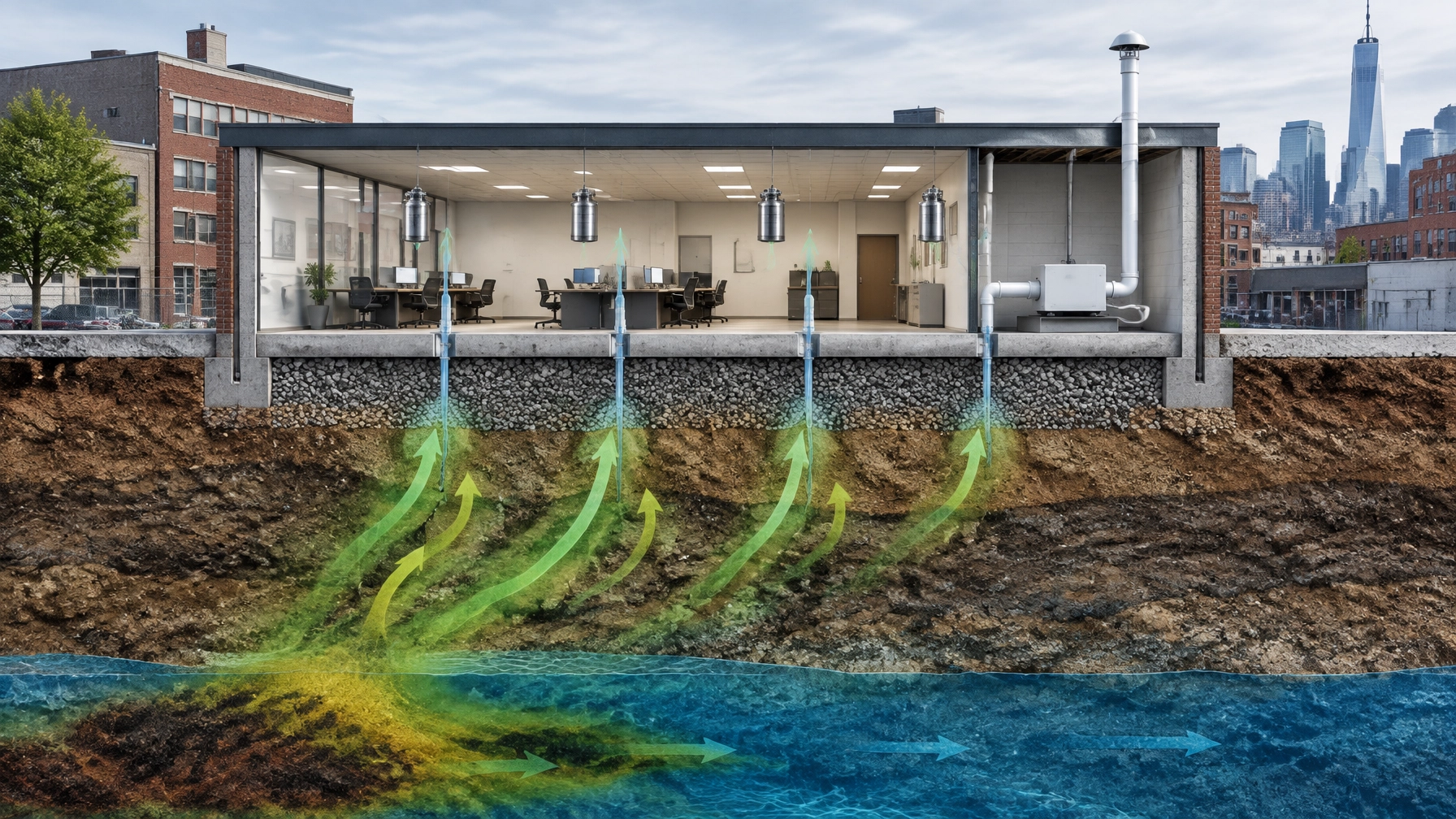
    • Soil vapor: sub-slab or soil vapor sampling where volatile chemicals or vapor intrusion pathways are possible.
    • Surface water or sediment: where drainage features, wetlands, waterways, or discharge pathways connect to the AOC.

    PFAS and dioxin do not behave identically.

    PFAS can migrate through groundwater and may be affected by sampling materials, field handling, and background conditions. Dioxin is strongly associated with soil and fine-grained materials, but its evaluation still depends on source history and the applicable regulatory program.

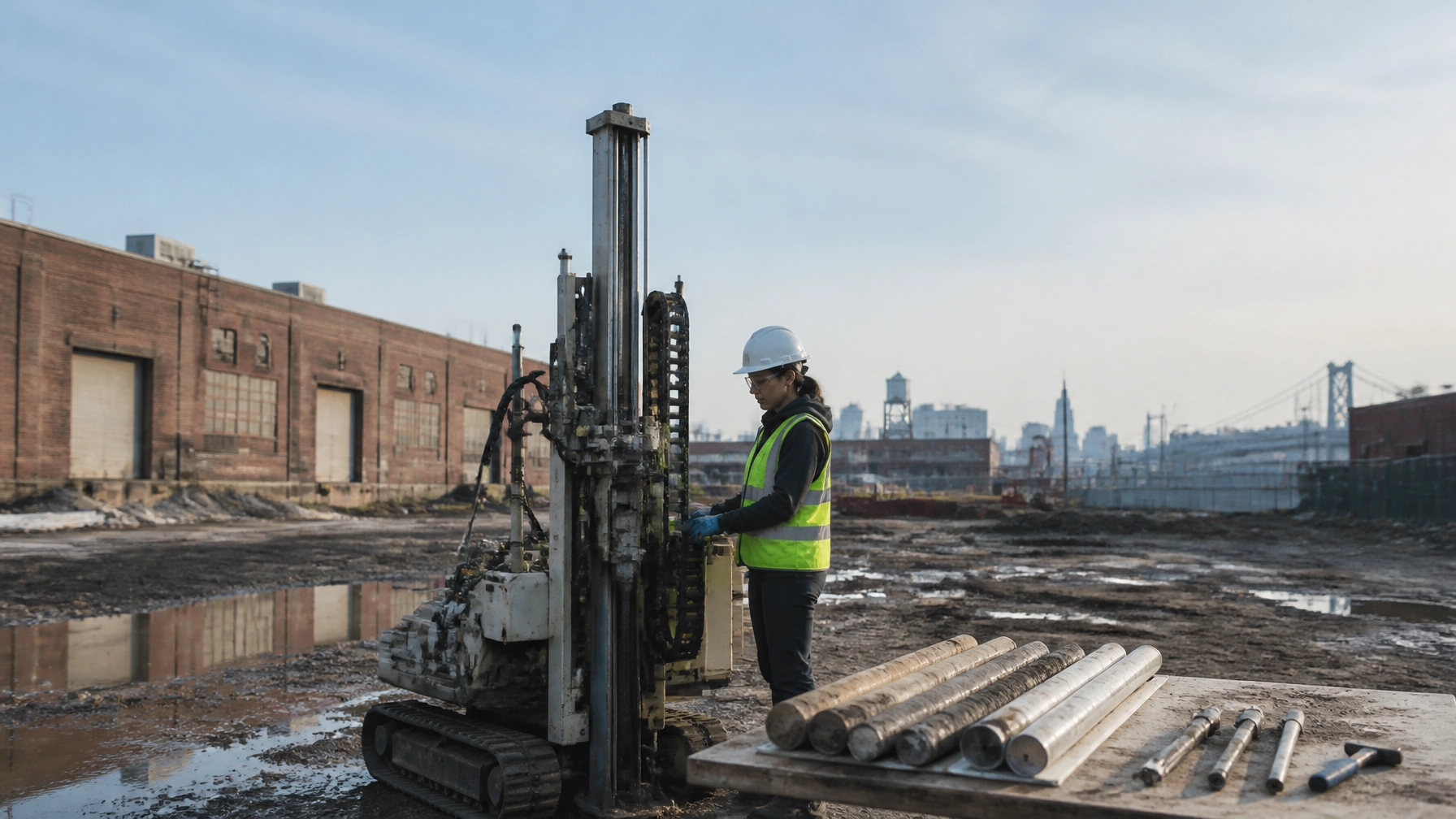
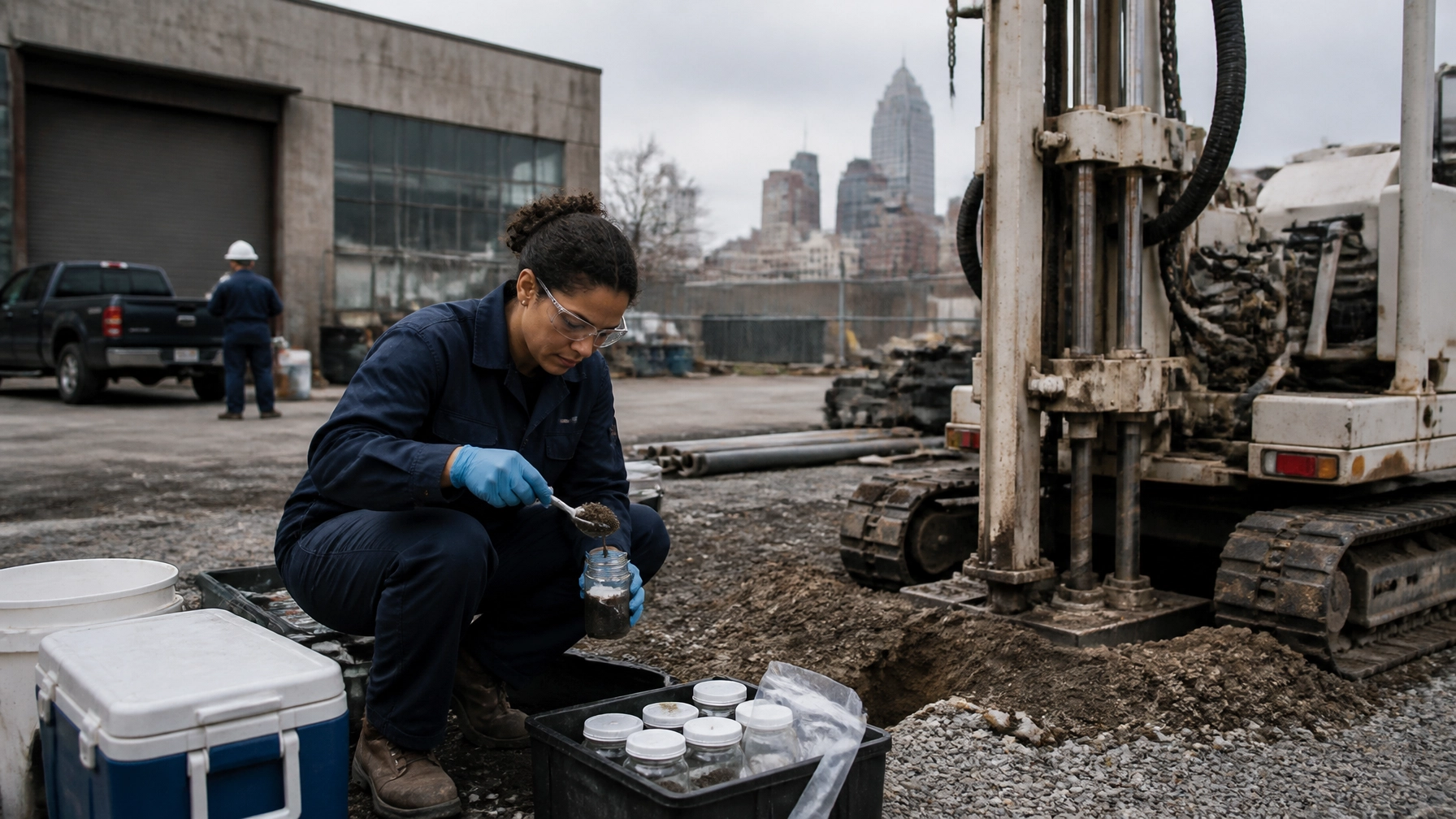
    PFAS groundwater sampling at an industrial site near Jersey City

    3. Laboratory and QA/QC controls

    PFAS sampling requires stricter field controls than a conventional petroleum or VOC program.

    The work plan should address:

    • PFAS-free or PFAS-compatible sampling materials
    • Avoidance of fluoropolymer materials where required
    • Field blanks and equipment blanks
    • Trip blanks when appropriate
    • Dedicated or properly decontaminated equipment
    • Sample preservation and temperature control
    • Chain-of-custody documentation
    • Laboratory method and reporting limits
    • NJDEP or NELAP laboratory credentials
    • Data validation requirements

    Dioxin analysis also requires a qualified laboratory and a clear analytical method. The team should confirm detection limits, sample mass, turnaround time, and reporting format before mobilization.

    A low-quality sample plan creates expensive problems later. It can force resampling, delay lender review, and weaken the transaction’s reliance on the report.

    Decision table for Newark and Jersey City transactions

    Site condition or transaction driver Likely scope decision Regulatory and business consideration
    Documented single-use facility with known chemicals Targeted Phase II based on the documented contaminants Explain why NJDEP default testing does or does not apply
    Multiple historic industrial uses with incomplete records Evaluate expanded default analytes, including PFAS and dioxin Unknown AOC contaminants may trigger N.J.A.C. 7:26E-2.1(c)
    Active NJDEP case or ISRA transaction Coordinate Phase II with the LSRP and NJDEP pathway A lender report alone may not satisfy regulatory obligations
    Former plating, metalworking, or chemical facility Include metals, VOCs, SVOCs, and process-specific compounds Add PFAS and dioxin when the contaminant profile is uncertain
    Planned excavation or redevelopment Sample soil and fill where construction will disturb material Results affect disposal, reuse, worker protection, and schedule
    Groundwater encountered during drilling Install temporary or permanent wells as warranted Consider PFAS, dissolved-phase impacts, and dewatering implications
    Existing report is more than several years old Perform a gap review before relying on it Standards, analyte lists, site conditions, and lender requirements may have changed

    PFAS default analytes for a Phase II in Jersey City

    Jersey City, Hoboken, Bayonne, and the wider Hudson County market include former rail, manufacturing, warehouse, waterfront, and utility uses.

    A Phase II at one property may need a very different scope from a neighboring property.

    The right question is not, “Should we test for PFAS because the property is in Jersey City?”

    The right questions are:

    • What did the property do?
    • What Areas of Concern exist?
    • Are the contaminants documented?
    • Is the investigation regulatory, lender-driven, or both?
    • Could soil or groundwater be disturbed during redevelopment?
    • Does an existing NJDEP case or LSRP file control the scope?
    • Will the lender accept the proposed analyte list?

    Envicon’s Jersey City environmental consulting team works with developers, attorneys, lenders, and contractors on these transaction and redevelopment questions. Local review matters. The same report may receive different scrutiny depending on whether it supports a closing, an ISRA transfer, a remedial investigation, or a construction start.

    LSRP and ISRA coordination

    An industrial property sale may trigger obligations under New Jersey’s Industrial Site Recovery Act, the Spill Compensation and Control Act, or the Site Remediation Reform Act.

    That does not mean every transaction follows the same path.

    The team should screen:

    • Whether the seller operates an ISRA subject facility
    • Whether a General Information Notice or response obligation applies
    • Whether an LSRP is already assigned
    • Whether an active NJDEP case exists
    • Whether a Response Action Outcome, Remedial Action Permit, or deed notice affects the parcel
    • Whether the buyer’s redevelopment plan changes the exposure pathways
    • Whether the Phase II can support both lender diligence and regulatory decision-making

    An LSRP should be involved early when the property has an active case, known discharge, ISRA obligation, or likely remediation pathway. Envicon provides NJ LSRP services, including site investigation, remedial planning, NJDEP coordination, and closure strategy.

    The practical advantage is simple. One team can connect the sampling plan to the regulatory outcome instead of delivering a report that leaves the buyer to start over.

    Cost and schedule planning

    A standard commercial Phase II ESA commonly falls within an approximately $8,000 to $25,000 planning range, depending on site size, access, boring count, wells, analytical program, and reporting requirements. Envicon identifies a typical field and laboratory timeline of approximately three to five weeks, including laboratory work, for a defined Phase II scope.

    An expanded PFAS and dioxin program can increase both cost and schedule because it may require:

    • Additional sample locations
    • Separate sampling protocols
    • Specialized laboratory analysis
    • Longer laboratory turnaround
    • Data validation
    • More complex waste handling
    • Additional groundwater or soil vapor work
    • Regulatory or lender review

    Do not price this work from a generic per-boring rate. The cost depends on the uncertainty that the investigation must resolve.

    A same-day scope review can identify whether the project needs a focused transaction screen, a full Phase II, or a coordinated Phase II and LSRP investigation.

    What to do with legacy environmental reports

    Do not discard older reports. Do not rely on them without a gap analysis.

    Review each legacy report for:

    • Date of field work
    • Laboratory methods
    • Analytes tested
    • Sample locations
    • Detection limits
    • QA/QC documentation
    • Site conditions at the time
    • Changes in building use
    • Changes in NJDEP standards
    • Areas not investigated
    • Whether PFAS or dioxin were considered
    • Whether the report addressed soil, groundwater, and vapor pathways

    A legacy report may still provide useful source information and historical data. It may also leave a material gap under the current NJDEP framework.

    The best next step is often a focused gap memo that compares the old report against the current transaction, lender, and regulatory requirements before anyone remobilizes a drill rig.

    The takeaway for industrial buyers and sellers

    The June 15, 2026 amendment makes uncertainty more expensive to ignore.

    For industrial property sales in Newark and Jersey City, the Phase II scope should connect four things:

    1. Historical operations
    2. Area of Concern documentation
    3. NJDEP and lender requirements
    4. The actual transaction and redevelopment schedule

    PFAS and dioxin testing may be mandatory when an AOC’s contaminants are unknown or poorly documented. It is not automatically mandatory for every private Phase II. The distinction must be documented in the work plan and supported by the site facts.

    If your property has incomplete records, a former industrial use, an active NJDEP matter, or a closing deadline, get the scope right before field work begins.

    Sources

    Review your industrial property risk before closing

    Envicon Group provides an industrial property risk review for buyers, sellers, lenders, attorneys, and developers across Newark, Jersey City, Hoboken, Bayonne, Hudson County, Bergen County, and Essex County.

    We can review your Phase I, legacy reports, historical operations, lender requirements, and transaction timeline. Then we will tell you what the Phase II should include and what it should not.

    Solve environmental and engineering challenges with precision, speed, and trust. The goal is not another report. The goal is a clear path to closing, compliance, and a buildable site.

    Envicon corporate logo

  • NJ ISRA Property Sale Timeline 2026: GIN, LSRP, and Closing Readiness for Newark and Hoboken

    NJ ISRA Property Sale Timeline 2026: GIN, LSRP, and Closing Readiness for Newark and Hoboken

    A New Jersey industrial property sale can trigger environmental obligations before the closing date is on the calendar.

    Under the Industrial Site Recovery Act, the first deadline may arrive only five calendar days after a triggering event. That event can include signing an agreement of sale, transferring ownership or operations, closing an industrial establishment, or completing certain corporate transactions.

    For owners, buyers, attorneys, lenders, and developers in Newark, Hoboken, Jersey City, Bayonne, Bergen County, Hudson County, and Essex County, the practical question is not simply whether contamination exists. The question is whether the property and transaction require an ISRA response, what must be filed, who will manage the remediation, and whether the environmental work can support the closing schedule.

    This guide outlines the NJ ISRA property sale timeline 2026 and the documents that help keep a transaction moving.

    ISRA applicability starts with the industrial establishment screen

    ISRA does not apply to every commercial property. The analysis begins with whether the site qualifies as an “industrial establishment.”

    The current ISRA rules at N.J.A.C. 7:26B use applicable North American Industry Classification System codes, or NAICS codes. The operations must also involve the generation, manufacture, refining, transportation, treatment, storage, handling, or disposal of hazardous substances or wastes on site, subject to applicable exceptions and limitations.

    A screening review should consider:

    • The current and historical operations at the property
    • The applicable NAICS code or codes
    • Whether hazardous substances or wastes were handled on site
    • Whether the property is owner-occupied or leased
    • Whether multiple tenants operate in separate leaseholds
    • Whether contiguous parcels are controlled by the same owner or operator
    • Whether the transaction transfers real property, business assets, ownership interests, or operations
    • Whether an exemption, waiver, or alternate compliance option may apply

    The NAICS code alone does not answer the question. The actual operations and transaction structure matter.

    That is why a standard Phase I ESA may not be enough for an industrial closing. A Phase I can identify recognized environmental conditions and historical uses. An ISRA review adds a New Jersey-specific transfer screen that evaluates the regulatory consequences of the transaction itself.

    Envicon can coordinate a Phase I Environmental Site Assessment with an ISRA applicability review so the buyer and seller are working from one set of facts.

    Technical environmental compliance documents and transaction timeline reviewed by real estate professionals

    What triggers ISRA in a 2026 property sale?

    Under N.J.A.C. 7:26B-3.2, common triggering events include:

    • Signing an agreement of sale for the industrial establishment or its real property
    • Executing an agreement to transfer ownership or operations
    • Closing operations or publicly announcing a decision to close
    • Executing a lease for 99 years or longer
    • Exercising an option to purchase
    • Transferring more than 50 percent of an industrial establishment’s assets within the applicable period
    • Certain mergers, consolidations, stock transfers, partnership changes, or LLC interest transfers
    • Certain dissolution, insolvency, receivership, or bankruptcy events
    • Changing operations in a way that changes the primary NAICS code from one subject to ISRA to one that is not subject to ISRA

    The trigger may occur before the deed records and before the buyer takes possession.

    For that reason, the transaction team should not wait until the anticipated closing date to ask whether ISRA applies.

    ISRA GIN deadline Newark: five calendar days

    The General Information Notice, or GIN, is the formal notice to NJDEP that an ISRA triggering event has occurred.

    The current rule states that the owner or operator must submit the GIN within five calendar days after the triggering event. For a sale, the relevant date may be the date the agreement of sale is signed. It is not automatically the closing date.

    The GIN generally identifies:

    • The industrial establishment and site identification information
    • The current owner and operator
    • The applicable NAICS code or codes
    • The transaction or event that triggered ISRA
    • The date the agreement, transfer, or other event occurred
    • The proposed closing or transfer date
    • The authorized agent
    • The person responsible for conducting the remediation
    • Applicable NJDEP fees and supporting information

    The rule also requires corrections or amendments when information in the original GIN is later found to be incomplete, inaccurate, or incorrect.

    For a Newark transaction, the practical takeaway is simple:

    Do the ISRA applicability screen before signing if possible. If the agreement is already signed, confirm the GIN deadline immediately.

    The NJDEP ISRA information page, current ISRA rules, and NJDEP SRP forms page should be reviewed with the project’s environmental professional and counsel.

    When should the LSRP be retained?

    A Licensed Site Remediation Professional should be involved as early as possible after an ISRA trigger is identified.

    The LSRP helps determine the required scope, manages the investigation and remediation under New Jersey’s Site Remediation Reform Act framework, prepares or certifies required submissions, coordinates with NJDEP, and develops the path toward regulatory closure.

    For an LSRP property sale in Hoboken NJ, early retention matters because the site may involve:

    • Former manufacturing or warehouse operations
    • Petroleum storage and underground storage tanks
    • Historical fill
    • Solvents, metals, petroleum, or other hazardous substances
    • Groundwater impacts
    • Vapor intrusion concerns
    • Existing deed notices or engineering controls
    • Prior NJDEP cases that were never fully closed

    A buyer should not assume that an old No Further Action letter resolves every current obligation. The LSRP must review the actual property boundaries, Areas of Concern, institutional controls, engineering controls, and current site conditions.

    Envicon’s NJ LSRP Services include PA/SI, remedial investigation, RAWP preparation, remedial action oversight, deed notice coordination, NJDEP correspondence, and RAO strategy.

    The PA, SI, RI, and remedial action sequence

    ISRA remediation typically follows the established New Jersey site remediation framework.

    Preliminary Assessment

    The Preliminary Assessment, or PA, reviews current and historical operations, site records, interviews, regulatory files, aerial photographs, and potential Areas of Concern.

    The PA asks where hazardous substances may have been used, stored, released, or disposed of. It also identifies data gaps that require field investigation.

    Site Investigation

    If the PA identifies Areas of Concern, the Site Investigation, or SI, evaluates whether contamination is present.

    Depending on the property, this may include:

    • Soil borings and laboratory analysis
    • Groundwater sampling
    • Soil vapor or sub-slab sampling
    • Underground storage tank investigation
    • Drainage and process-area review
    • Sampling around former tanks, floor drains, transformers, and chemical storage areas

    Remedial Investigation

    If contamination is confirmed, the Remedial Investigation, or RI, defines its nature and extent. The LSRP evaluates horizontal and vertical impacts, exposure pathways, receptors, off-site migration, and the information needed to select a remedy.

    Remedial action and the RAP or RAWP

    The remedial action addresses the contamination through excavation, disposal, treatment, containment, monitoring, engineering controls, institutional controls, or a combination of measures.

    Project teams sometimes use the term RAP for a remedial action plan. In current New Jersey practice, the formal document is commonly a Remedial Action Workplan, or RAWP.

    A RAWP is not the same as a final closure document. It explains how the selected remedy will be implemented. The LSRP may also need to prepare a Site Management Plan, establish a Classification Exception Area, coordinate a deed notice, or document long-term monitoring requirements.

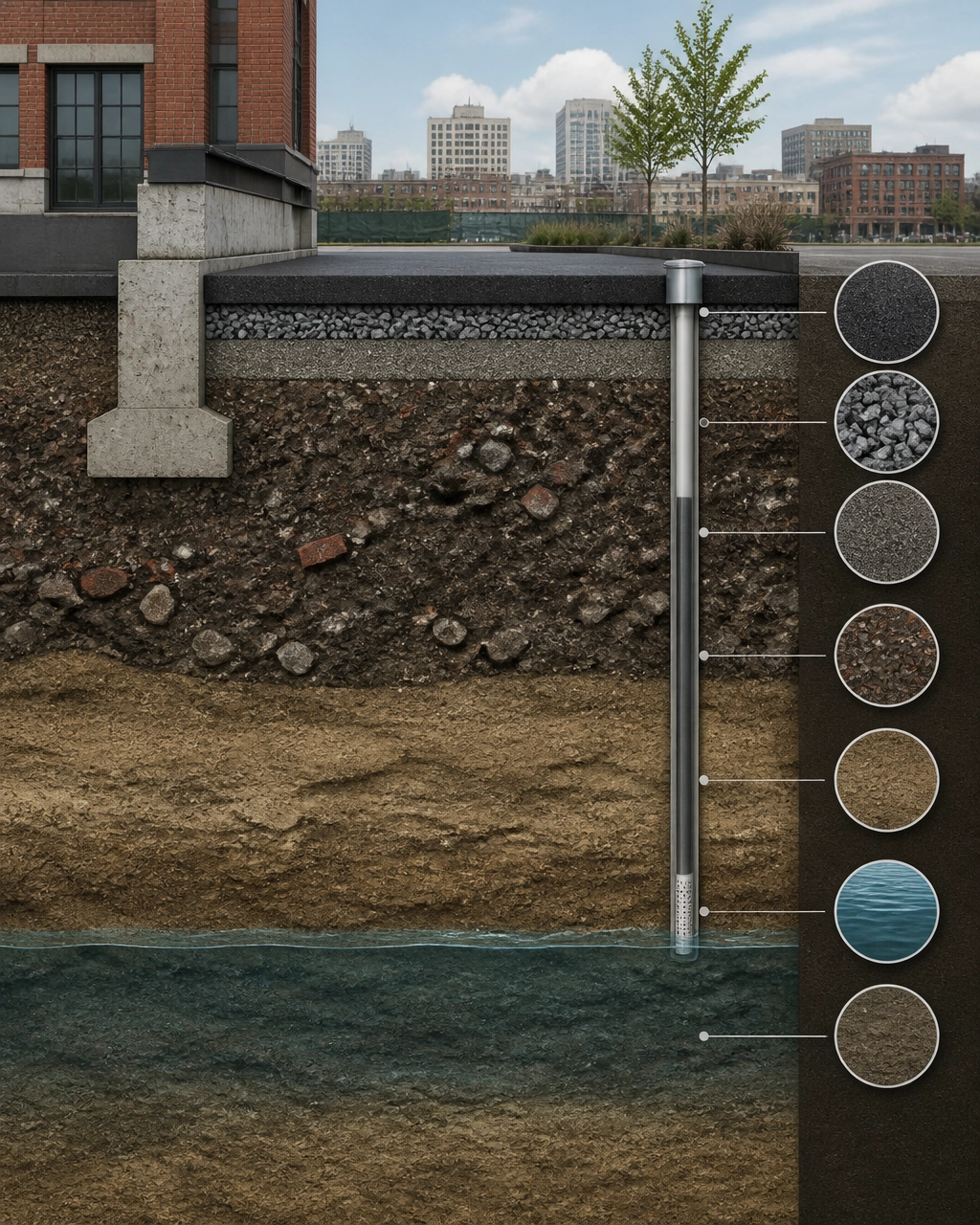
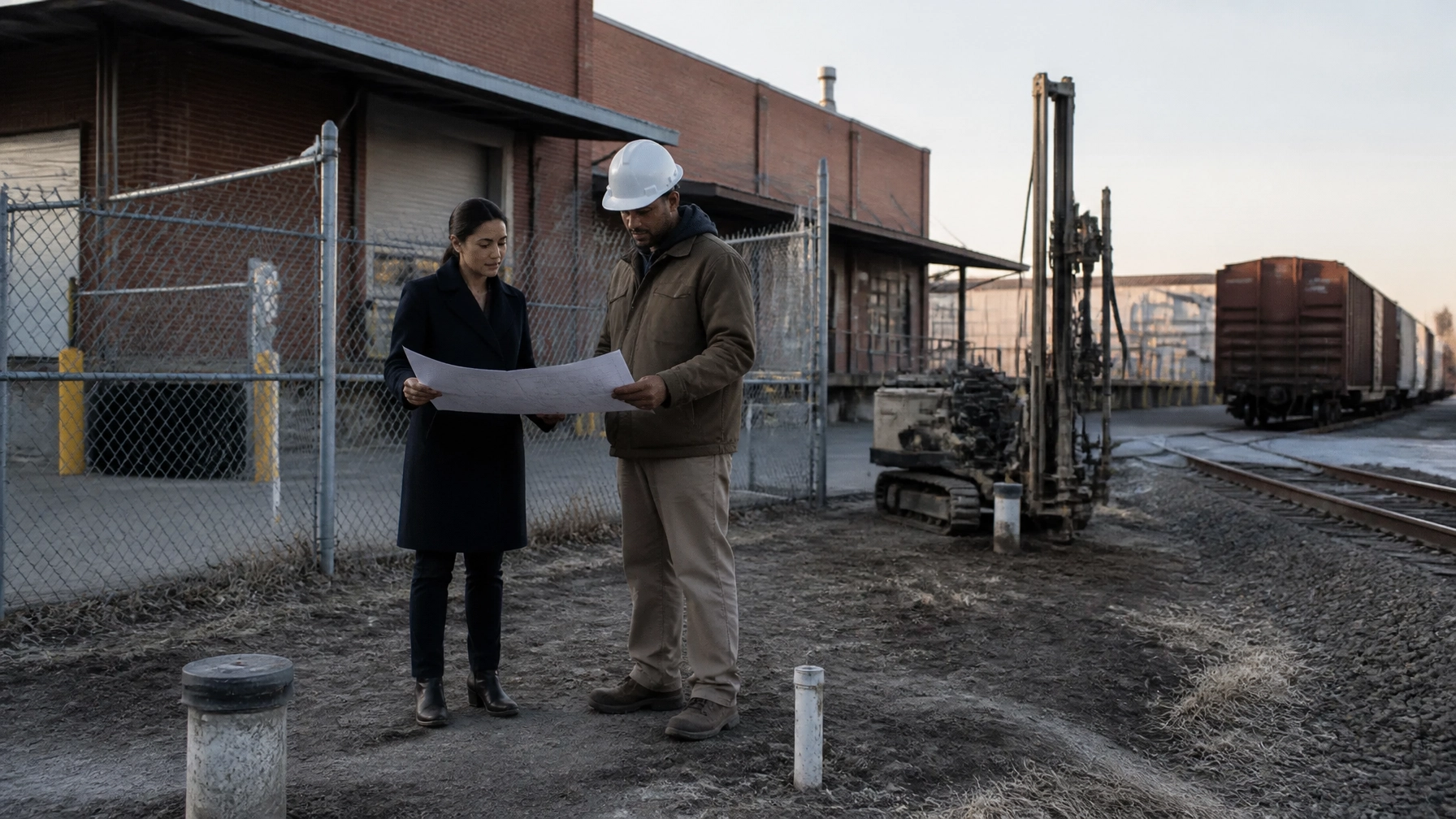
    Licensed site remediation professional inspecting a monitoring well beside a New Jersey industrial warehouse

    RAO, NFA, deed notices, and closing readiness

    An older New Jersey file may contain a No Further Action letter, or NFA. For current LSRP-led remediation, the primary closure document is generally the Response Action Outcome, or RAO.

    An RAO may address:

    • Unrestricted use
    • Limited restricted use
    • Restricted use
    • Engineering controls
    • Institutional controls
    • Groundwater monitoring
    • Vapor mitigation
    • Deed notice requirements
    • Long-term inspection and certification obligations

    A deed notice does not necessarily prevent a sale. It does affect what the buyer owns, what can be built, how the property can be used, and what post-closing obligations must continue.

    If contamination remains under a cap, building slab, pavement, or other engineering control, the transaction documents should clearly allocate responsibility for:

    • Maintaining the control
    • Inspecting the control
    • Repairing damage
    • Preventing disturbance
    • Completing biennial certifications
    • Managing soil during future excavation
    • Maintaining financial assurance when required
    • Continuing groundwater or vapor monitoring

    NJ ISRA property sale timeline 2026

    The actual schedule depends on the site, transaction structure, NJDEP requirements, sampling results, and the selected remedy. The following timeline is a planning framework, not a guarantee.

    Transaction stage Typical environmental action Closing-readiness objective
    Before signing ISRA applicability and NAICS screen; Phase I ESA; review of NJDEP records Identify whether the transaction may trigger ISRA
    Agreement signed Confirm triggering event and calculate five-calendar-day deadline Prepare and submit the GIN on time
    First days after trigger Retain LSRP; gather historical records, leases, site plans, permits, and prior reports Establish one responsible technical lead
    Early investigation Complete PA and, if required, SI Identify Areas of Concern and potential cost exposure
    Confirmed contamination Conduct RI and evaluate remedial alternatives Define scope, budget, schedule, and risk allocation
    Remedy planning Prepare RAP or RAWP, Site Management Plan, and control documents as needed Align remedy with redevelopment and lender requirements
    Before closing Complete RAO or obtain an applicable authorization, remediation certification, waiver, or alternate compliance path Document the legal and technical basis for transfer
    Closing and post-closing Record deed notices and transfer monitoring or control obligations Preserve compliance after ownership changes

    Buyer and seller coordination

    The seller usually controls historical records and has direct knowledge of operations. The buyer needs enough information to underwrite environmental risk and confirm that the planned use is compatible with the site’s conditions.

    The transaction team should coordinate:

    • Purchase and sale agreement
    • Environmental indemnity
    • Access agreement
    • GIN and NJDEP correspondence
    • LSRP engagement letter
    • PA, SI, RI, and RAWP documents
    • RAO, NFA, or other final remediation documents
    • Deed notice and institutional control documents
    • Site Management Plan
    • Remediation cost estimate
    • Remediation Funding Source
    • Remediation Certification
    • Waiver or alternate compliance application
    • Soil management and disposal requirements
    • Construction and redevelopment plans

    A buyer should also confirm whether future excavation, foundation work, utility installation, dewatering, or vapor mitigation will change the remedial obligations.

    This is where a direct, field-first consultant makes a difference. Envicon coordinates with owners, buyers, attorneys, lenders, contractors, architects, and regulators instead of handing over a report and leaving the transaction team to interpret it.

    ISRA due diligence Jersey City and the surrounding market

    Industrial properties in Jersey City, Hoboken, Bayonne, Newark, and nearby Bergen and Essex County communities often carry layered histories. A parcel may have changed tenants several times while retaining old tanks, floor drains, fill, utility corridors, or groundwater impacts.

    The right question is not whether the property looks clean today. The right question is whether the site history, current operations, transaction structure, and regulatory file support the proposed transfer and redevelopment plan.

    If you are planning an NJ industrial property closing, start before the agreement is signed when possible. If the agreement is already signed, treat the five-day GIN deadline as an immediate work item.

    Request an ISRA closing-readiness review

    Envicon Group helps owners, developers, attorneys, lenders, and buyers solve environmental and engineering challenges with precision, speed, and trust.

    We can review the property history, NAICS operations, transaction structure, existing NJDEP records, and proposed closing schedule. Then we give you a practical path forward.

    ISRA compliance is not a box to check at the end of a transaction. It is part of the deal schedule from the beginning. The earlier the environmental path is clear, the more control you have over cost, timing, and closing risk.

    Envicon corporate logo

  • New York Construction Stormwater Permit GP-0-25-001: SWPPP Readiness for NYC and Downstate Projects

    New York Construction Stormwater Permit GP-0-25-001: SWPPP Readiness for NYC and Downstate Projects

    GP-0-25-001 is now the permit controlling New York construction stormwater readiness

    New York’s SPDES Construction General Permit GP-0-25-001 took effect on January 29, 2025, and remains effective through January 28, 2030. It replaced GP-0-20-001 and applies to qualifying construction activity across New York, including New York City, Westchester County, and the Hudson Valley.

    For most projects, coverage is required when construction will disturb one or more acres of soil. It can also apply to a smaller phase that forms part of a larger common plan of development or sale that will ultimately disturb one or more acres.

    The permit authorizes stormwater discharges associated with construction activity only after the project completes the required process. That process includes:

    • A complete Stormwater Pollution Prevention Plan, or SWPPP
    • Proper owner and operator certifications
    • Applicable MS4 or NYCDEP acceptance
    • Electronic Notice of Intent, or eNOI, submission
    • NYSDEC authorization
    • Qualified inspections and ongoing implementation of erosion and sediment controls

    A permit gap can stop mobilization before the first excavator reaches the site. It can also trigger redesign, agency comments, contractor downtime, and expensive rework.

    Review the official NYSDEC construction activity requirements and the GP-0-25-001 fact sheet before finalizing your construction schedule.

    The SWPPP must be ready before the site is ready

    A SWPPP is not a generic erosion control drawing added to a permit package. It is the operating plan for how your project will prevent sediment and pollutants from leaving the site.

    Under GP-0-25-001, the SWPPP should address the full construction sequence, including:

    • Existing site conditions and drainage patterns
    • Limits of disturbance
    • Soil disturbance and grading activities
    • Construction sequencing
    • Stabilization requirements
    • Erosion and sediment control practices
    • Stormwater management practices
    • Pollution prevention procedures
    • Inspection and maintenance requirements
    • Final stabilization and permit termination steps

    The plan must reflect actual site conditions. A SWPPP prepared from an outdated survey or an incomplete grading plan can fail when construction begins. Controls may be shown in locations that conflict with access roads, utility work, excavation support, staging areas, or the final drainage design.

    That is why SWPPP preparation should connect directly to civil engineering and field implementation. Envicon provides civil and geotechnical engineering support so the stormwater plan aligns with grading, drainage, utilities, and the way the contractor will actually build the project.

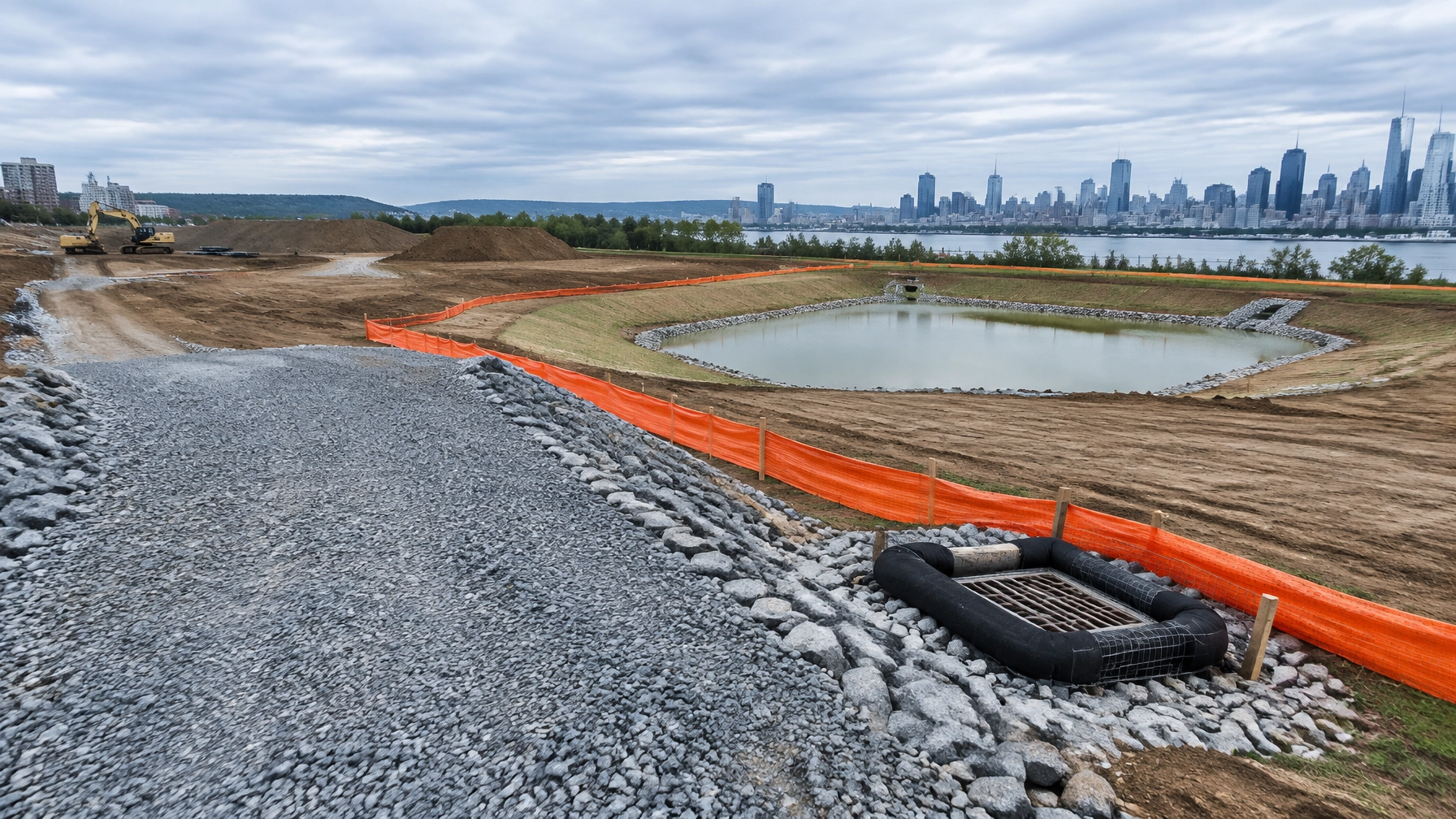
    Construction site BMPs including silt fence, wattles, inlet protection, and riprap outlet protection

    Owner and operator roles must be clear

    GP-0-25-001 places responsibilities on both owners and operators. The project owner generally controls the property or has ownership responsibility for the development. The operator typically controls construction plans, specifications, construction activities, or day-to-day implementation of the SWPPP.

    A project can have more than one operator. For example, the owner, general contractor, and another party with operational control may each have responsibilities under the permit.

    Those responsibilities should be assigned before the eNOI is submitted. The parties responsible for the project need to understand who will:

    • Maintain the SWPPP on site
    • Direct contractors to install and maintain controls
    • Correct deficiencies
    • Coordinate inspections
    • Keep inspection records
    • Update the SWPPP when site conditions change
    • Respond to agency or MS4 comments
    • Complete final stabilization and termination documentation

    Unclear roles create predictable problems. The owner assumes the contractor is managing compliance. The contractor assumes the consultant is handling field conditions. The consultant prepares a plan but has no authority to direct corrective work.

    We avoid that gap by coordinating directly with owners, contractors, civil engineers, architects, attorneys, and reviewing agencies. Collaboration is not a buzzword. It is how the work gets done.

    NYC, Westchester, and Hudson Valley projects need local acceptance review

    NYSDEC permit coverage does not eliminate local stormwater review.

    If a project falls within the boundaries of a Traditional Land Use Control MS4, the owner or operator must contact the applicable MS4 operator. The project generally needs one of two documents:

    • A signed MS4 SWPPP Acceptance Form
    • A signed MS4 No Jurisdiction Form

    For New York City projects, NYCDEP review and acceptance requirements must be addressed before NYSDEC coverage can be completed. The exact review path depends on the project, site location, disturbance area, drainage conditions, and applicable local requirements.

    This is a frequent source of schedule risk. A team may complete the SWPPP and prepare the eNOI, only to discover that the local acceptance form is missing, incomplete, or based on a plan that has since changed.

    For projects involving NYC environmental conditions, developers can also review Envicon’s NYC E-designation support. The broader objective is the same: identify the regulatory path early and keep each approval connected to the construction sequence.

    Submit the correct eNOI through DEC’s current process

    Coverage under GP-0-25-001 requires the current electronic Notice of Intent process through the NYSDEC nForm portal. The previous GP-0-20-001 eNOI should not be used for new coverage under the 2025 permit.

    The submission package may include:

    • The completed GP-0-25-001 eNOI
    • SWPPP preparer certification
    • Applicable MS4 acceptance or no-jurisdiction documentation
    • NYCDEP acceptance documentation, where applicable
    • Required certifications and supporting project information

    The SWPPP preparer certification is not a formality. The person preparing the plan must certify that the SWPPP meets the permit requirements and applicable NYSDEC technical standards.

    A submission that is incomplete or inconsistent with the SWPPP can delay authorization. Before mobilization, confirm that the permit number, project description, disturbance area, site plans, owner information, operator information, and local acceptance documents all match.

    Engineering plan sheets, inspection materials, and field equipment arranged for SWPPP planning

    Erosion and sediment controls must work in the field

    A compliant SWPPP is only useful if the controls are installed correctly and maintained as the site changes.

    Common controls may include:

    • Stabilized construction entrances
    • Silt fence and other perimeter controls
    • Inlet protection
    • Check dams
    • Sediment traps or basins
    • Temporary swales
    • Outlet protection
    • Dust control
    • Stockpile protection
    • Temporary and permanent stabilization
    • Concrete washout controls
    • Dewatering controls where applicable

    The right controls depend on soil type, slope, drainage area, discharge points, construction sequencing, and receiving waters. A flat urban site in Brooklyn, a steep Westchester parcel, and a former industrial property in the Hudson Valley do not present the same stormwater risks.

    Controls also need to move with the work. A silt fence that worked during rough grading may be inadequate after utility installation or foundation excavation. An inlet may become active after the first phase of paving. A stockpile may shift into a drainage path. These changes need field-level attention.

    Envicon’s compliance and permitting team helps connect the SWPPP to construction oversight, agency coordination, and corrective action.

    Inspections require qualified professionals and consistent records

    GP-0-25-001 requires inspections by qualified personnel. Depending on the role and task, qualifications may include a New York-licensed Professional Engineer, Registered Landscape Architect, Certified Professional in Erosion and Sediment Control, New York State erosion and sediment control certificate holder, or properly trained personnel working under the required professional supervision.

    Typical inspection obligations include:

    • At least weekly inspections for standard active projects
    • Increased inspection frequency for qualifying sites, including certain large disturbance projects or projects discharging to impaired waters
    • Periodic inspections during winter shutdown conditions
    • Daily trained-contractor walkthroughs of active work areas
    • Written documentation of conditions, deficiencies, and corrective actions

    Inspection records should identify the permit number, inspection date, weather and temperature information, disturbed and stabilized areas, site locations reviewed, and corrective actions required. Site maps and clear field documentation matter.

    An inspection that simply states “no issues observed” does not demonstrate meaningful compliance. The record should show what was inspected, what changed, what was corrected, and who was responsible.

    Qualified environmental professional reviewing stormwater controls and field conditions at a New York construction site

    Practical preconstruction checklist for GP-0-25-001

    Before releasing the site for mobilization, confirm the following:

    1. Confirm permit applicability

      • Calculate the total disturbance area.
      • Review the full common plan of development.
      • Identify receiving waters and potential impaired-water requirements.
    2. Complete the SWPPP

      • Use current survey, grading, drainage, and utility information.
      • Show erosion and sediment controls at the correct locations.
      • Coordinate the plan with the construction sequence.
    3. Assign owner and operator responsibilities

      • Identify who controls the work.
      • Confirm who maintains the SWPPP.
      • Establish who receives inspection findings and directs corrections.
    4. Resolve local review

      • Determine whether the site is within a Traditional Land Use Control MS4.
      • Obtain MS4 acceptance or no-jurisdiction documentation.
      • Obtain NYCDEP acceptance for applicable New York City projects.
    5. Submit the correct eNOI

      • Use the GP-0-25-001 process.
      • Attach the SWPPP preparer certification.
      • Confirm every project detail matches the SWPPP and local forms.
    6. Confirm authorization before mobilization

      • Do not treat eNOI submission as the end of the process.
      • Confirm NYSDEC authorization and the permitted construction start date.
    7. Prepare field implementation

      • Install initial controls before soil disturbance.
      • Schedule qualified inspections.
      • Train the contractor’s field personnel.
      • Set up inspection records and corrective action tracking.

    Keep the permit path connected to the construction path

    Stormwater compliance is not separate from project delivery. It affects grading, site access, excavation, utilities, scheduling, contractor coordination, and final stabilization.

    Envicon provides standalone SWPPP preparation, civil engineering, construction oversight, and environmental field monitoring for downstate New York projects. Our team works directly with owners, contractors, engineers, and agencies to identify gaps before they become schedule problems.

    A clean SWPPP is important. A SWPPP that the field team can build, inspect, maintain, and defend is better.

    The takeaway: GP-0-25-001 readiness starts before mobilization. Confirm the disturbance threshold, prepare a site-specific SWPPP, resolve MS4 or NYCDEP review, submit the correct eNOI, and assign qualified inspection support. The goal is not another report. The goal is a permitted, controlled, buildable site.

    Ready to confirm your project’s stormwater path?

    Envicon Group logo

  • Phase II ESA Brooklyn NY: Soil Vapor, Groundwater, and PFAS Sampling for 2026 Acquisitions

    Phase II ESA Brooklyn NY: Soil Vapor, Groundwater, and PFAS Sampling for 2026 Acquisitions

    A Phase I ESA does not answer every environmental question. It identifies the conditions that require a closer look.

    For a 2026 acquisition in Brooklyn, that closer look may include soil borings, groundwater sampling, soil vapor testing, sub-slab sampling, indoor air, or PFAS analysis. The right scope depends on the recognized environmental conditions, the property’s historical uses, the lender’s requirements, and whether the investigation may later need to support NYSDEC or NYC Office of Environmental Remediation coordination.

    A targeted Phase II ESA should reduce uncertainty. It should not create a larger investigation without a reason.

    What a Phase I REC means for your Brooklyn acquisition

    A recognized environmental condition, or REC, is not a finding of confirmed contamination. It is a reason to investigate.

    The Phase I report should identify:

    • The suspected source of contamination
    • The media that may be affected
    • The likely migration pathways
    • The historical area of concern
    • The proposed redevelopment or excavation plan
    • Any applicable regulatory records
    • Any lender or transaction deadline

    That information drives the Phase II sampling plan.

    A former dry cleaner may justify soil and groundwater sampling for chlorinated solvents, along with soil vapor or sub-slab sampling for compounds such as PCE and TCE. A former gas station may require targeted borings around USTs, dispensers, and product lines. A waterfront industrial property may require a broader look at historic fill, petroleum impacts, metals, PCBs, and groundwater conditions.

    The scope should follow the risk. A grid of random borings across an entire property may look thorough, but it can miss the actual source area while increasing cost and schedule.

    What a Phase II ESA typically includes

    A Brooklyn Phase II environmental site assessment may include several investigation components.

    Soil borings and field screening

    Direct-push or hollow-stem auger borings are placed near suspected source areas and along potential migration pathways. Field staff document soil type, odors, staining, fill material, groundwater observations, and photoionization detector readings where appropriate.

    Sampling intervals should reflect the REC and the site geology. Historical fill can vary significantly over short distances, especially at redeveloped industrial parcels. A boring plan that ignores fill placement, utility corridors, former tanks, or basement structures can leave material data gaps.

    Groundwater wells and sampling

    Groundwater sampling may use temporary points or permanent monitoring wells, depending on the objective.

    Groundwater data can help determine:

    • Whether contamination is present below the property
    • Whether impacts appear localized or migrating
    • Whether a dissolved plume may affect adjacent parcels
    • Whether groundwater could act as a vapor source
    • Whether future excavation or dewatering may create additional obligations

    Sampling methods, well construction, development, stabilization, purging, and laboratory handling all affect data quality. A groundwater result without proper field documentation may not support a lender decision or later regulatory review.

    Technician collecting groundwater samples from a monitoring well at an urban waterfront redevelopment site

    Soil vapor, sub-slab vapor, and indoor air

    Soil vapor testing is important when volatile organic compounds may have migrated beneath or near a building.

    Depending on the property, the investigation may use:

    • Soil vapor points outside the building
    • Sub-slab vapor probes inside the building
    • Indoor air samples
    • Outdoor ambient air samples
    • Building pressure and HVAC observations
    • Product inventory and chemical-use interviews

    Indoor air sampling is not automatic. It becomes more important when a building is occupied, will be occupied, or contains a potential vapor pathway connected to contaminated soil or groundwater.

    The NYSDOH Soil Vapor Intrusion Guidance provides the framework for evaluating soil vapor and indoor air conditions in New York. NYC properties may also be subject to specific OER Phase II ESA requirements, particularly where an E-Designation, Restrictive Declaration, or other city review applies.

    Soil vapor sampling for PFAS is not required under NYSDEC’s current PFAS remedial guidance. Soil vapor investigations focus on volatile compounds, while PFAS evaluation generally focuses on soil, groundwater, surface water, and sediment.

    For a dedicated vapor scope, see Envicon’s Vapor Intrusion Assessment service.

    PFAS in a 2026 Phase II ESA

    PFAS analysis requires a site-specific decision.

    NYSDEC’s PFAS program guidance is especially important when a property may enter a state remedial program or when the historical use suggests a potential PFAS source. Relevant uses may include:

    • Metal plating and finishing
    • Fire-training areas or firefighting foam storage
    • Airports and aviation support facilities
    • Industrial laundries
    • Textile and waterproofing operations
    • Chemical manufacturing
    • Waste handling or treatment operations

    At a private transaction site, PFAS should not be added simply because it is a current topic. The question is whether the historical use, site setting, regulatory pathway, or lender requirements justify the analysis.

    If soil or groundwater samples are already being collected for a potentially affected property, PFAS may need to be included in the analytical program. The laboratory must receive clear instructions on PFAS-compatible containers, tubing, clothing, field equipment, blanks, and chain-of-custody procedures.

    PFAS work is sensitive to cross-contamination. A technically correct laboratory method cannot fix poor field controls.

    PFAS sampling materials, field blanks, sample vials, and chain-of-custody documentation prepared for laboratory shipment

    Laboratory QA/QC and data gaps

    The laboratory report is only one part of the investigation record.

    A defensible Phase II program should address:

    • Sample locations and depths
    • Field duplicates
    • Equipment blanks where appropriate
    • Trip blanks for volatile compounds
    • Laboratory method blanks
    • Holding times
    • Preservation requirements
    • Detection limits
    • Data validation
    • ELAP accreditation where required
    • Chain-of-custody records
    • Deviations from the work plan

    For NYC OER-related work, laboratory and analytical requirements may be more specific than those used for a private, non-regulatory transaction investigation. The final report should state what was sampled, what was not sampled, and why.

    Data gaps are not automatically failures. A data gap becomes a transaction problem when the report does not explain its effect on the property decision.

    For example, an inaccessible area beneath an operating building may require a limitation, alternate sampling location, or future investigation. The buyer, lender, and counsel should understand whether that limitation affects the risk conclusion.

    Private transaction diligence versus regulatory investigation

    A private Phase II ESA supports a transaction decision. It helps the buyer, lender, attorney, or investor understand environmental exposure before closing.

    A regulatory remedial investigation serves a different purpose. It may require an approved work plan, agency coordination, formal delineation, public records, prescribed analytical methods, long-term monitoring, and a defined cleanup or closure pathway.

    The two scopes can overlap, but they are not interchangeable.

    NYSDEC or NYC OER coordination may become appropriate when:

    • The property is already under an agency case
    • An E-Designation or Restrictive Declaration applies
    • The buyer plans to enter the Brownfield Cleanup Program
    • The Phase I identifies a spill, petroleum release, or significant historical source
    • The investigation suggests off-site migration
    • The proposed work will disturb contaminated soil
    • A lender requires a regulatory closure path
    • The transaction depends on a no-further-action or equivalent determination

    Envicon helps clients determine whether the immediate need is transaction diligence, regulatory investigation, or a staged approach that keeps both options open.

    Phase II ESA Brooklyn cost and scope decisions

    The cost of a Phase II environmental site assessment in Brooklyn depends on the number of borings, laboratory parameters, groundwater conditions, building access, traffic control, utility clearance, vapor work, and reporting requirements.

    Envicon’s Brooklyn service information lists a planning range of approximately $8,000 to $25,000 for Phase II ESA work involving soil and groundwater. That is not a quote. A vapor program, PFAS analysis, difficult access, or agency coordination can change the scope.

    The right question is not simply, “What does a Phase II ESA cost?”

    It is:

    What is the smallest defensible scope that answers the Phase I question and protects the transaction?

    Phase II decision table

    Site condition or transaction driver Typical investigation response Main decision supported
    Former dry cleaner Soil, groundwater, soil vapor, and potentially sub-slab or indoor air sampling Is there a chlorinated solvent source or vapor pathway?
    Former gas station or UST area Targeted borings, petroleum analysis, groundwater, and tank records review Are petroleum impacts present, and is tank closure needed?
    Historic fill or industrial use Soil borings, metals, SVOCs, PCBs, petroleum, and fill characterization Will excavation or disposal create cost exposure?
    Waterfront or former manufacturing site Soil, groundwater, sediment or source-area review as appropriate Are impacts localized, migrating, or connected to historic operations?
    Potential PFAS source PFAS in relevant soil and groundwater samples, with strict QA/QC Does PFAS affect underwriting or a future regulatory pathway?
    Occupied or planned occupied building near VOC impacts Soil vapor, sub-slab, indoor air, and outdoor air as appropriate Is vapor intrusion a current or future occupant concern?
    E-Designation or active agency case Work plan and analytical program coordinated with NYC OER or NYSDEC Will the investigation satisfy the applicable regulatory process?

    The Envicon approach

    Envicon scopes the investigation around the REC, the property, and the closing decision. We coordinate with lenders, attorneys, owners, contractors, and agency contacts when the project requires it.

    Our deliverable should tell you:

    • What we found
    • What remains uncertain
    • Whether the data is sufficient
    • What additional work may be required
    • What the likely cost exposure is
    • Whether the site can proceed toward acquisition, redevelopment, or regulatory coordination

    That is the difference between receiving a report and receiving a path forward.

    We serve projects across Brooklyn, Queens, Manhattan, the Bronx, Staten Island, and Westchester. Our team combines field investigation, environmental analysis, regulatory coordination, and project management without putting your acquisition into a national queue.

    Takeaway

    A Phase II ESA Brooklyn NY investigation should be targeted, technically defensible, and tied to the transaction.

    Start with the Phase I REC. Place borings where the history and site conditions indicate a source. Evaluate groundwater and soil vapor based on actual pathways. Add PFAS when the site history, regulatory route, or lender requirements justify it. Document QA/QC and identify data gaps before they become closing problems.

    The objective is not more sampling. It is better information before you commit capital.

    Request a Phase II scope review

    Envicon corporate logo

  • NJDEP RAP Indoor Air Notification Area: What Newark and Jersey City Owners Need to Maintain

    NJDEP RAP Indoor Air Notification Area: What Newark and Jersey City Owners Need to Maintain

    DRAFT. Pending approval. Do not schedule or publish.

    New Jersey’s February 2026 remedial action permit modernization changed how owners manage vapor intrusion obligations. Indoor air is now an express RAP media component. The Indoor Air Notification Area, or IANA, creates a formal institutional control for properties where indoor air protections, monitoring, or vapor mitigation remain necessary.

    For owners in Newark, Jersey City, Hoboken, Bayonne, Hudson County, Bergen County, and Essex County, this is not just a paperwork update. It affects property transfers, tenant notices, municipal coordination, GIS mapping, mitigation system maintenance, and the path from an active remedy to an RAO or NFA.

    The practical question is simple:

    What does your property owner need to maintain so the RAP remains protective and transferable?

    What changed in February 2026?

    NJDEP now recognizes indoor air as a third RAP media component alongside soil and groundwater. The updated framework allows a single combined RAP to address all three media.

    NJDEP’s current forms library includes:

    As of September 2026, owners should verify the version and date of every form directly on the NJDEP CSRR Forms Library before preparing a submission. NJDEP updated several RAP and IANA forms during 2026.

    What is an NJDEP Indoor Air Notification Area?

    An NJDEP Indoor Air Notification Area is an institutional control established when a property requires long-term management of a vapor intrusion condition or indoor air engineering control.

    The IANA defines the area where affected buildings, units, owners, tenants, occupants, municipalities, and other parties may need notice regarding indoor air conditions and continuing obligations. NJDEP maps IANAs as GIS deliverables under N.J.A.C. 7:26C-7.5(c)1.

    An IANA may apply when:

    • Indoor air concentrations exceed applicable Indoor Air Remediation Standards.
    • A completed vapor intrusion pathway requires mitigation.
    • A sub-slab depressurization system or another vapor mitigation system remains necessary.
    • Indoor air or sub-slab vapor monitoring must continue.
    • A building or property remains subject to a long-term vapor intrusion monitoring plan.
    • A system is installed as part of a soil or groundwater remedy and needs to be added to the RAP.

    The IANA is not a substitute for sampling or mitigation. It is the formal notification and control mechanism that helps keep the exposure pathway visible over the life of the property.

    IANA institutional control Newark and Jersey City owners need to manage

    An IANA should be treated as an operating obligation, not a document filed once and forgotten.

    For owners in Newark and Jersey City, the control typically requires coordination among:

    • The property owner and current operator.
    • Tenants and occupants within affected structures.
    • The municipality and county.
    • The LSRP responsible for the remediation.
    • Building managers and maintenance contractors.
    • Environmental counsel and transaction teams.
    • NJDEP reviewers and the CSRR GIS unit.

    The owner must maintain current information about the affected buildings, units, monitoring points, mitigation systems, and notified parties. A change in ownership, tenant configuration, building use, slab condition, or access can affect the protectiveness evaluation.

    The current NJDEP IANA guidance and forms should control the site-specific process.

    Sampling and mitigation are only the beginning

    A vapor intrusion assessment usually starts with a building survey, historical review, and sampling plan. Depending on the site, the investigation may include:

    • Sub-slab soil gas samples.
    • Indoor and outdoor air samples.
    • Building envelope inspections.
    • Utility and preferential pathway review.
    • Laboratory analysis for volatile organic compounds.
    • Comparison to NJDEP screening levels and Indoor Air Remediation Standards.
    • Evaluation of background sources such as solvents, cleaners, fuels, or dry-cleaned materials.

    If the pathway is confirmed, the remedy may include a sub-slab depressurization system, vapor barrier, soil vapor extraction, HVAC modification, or another engineering control.

    Envicon’s Vapor Intrusion Assessment service combines sampling, regulatory evaluation, mitigation design, and post-installation verification. The objective is not to produce another report that sits in a file. It is to define what the building needs, what the RAP must contain, and what the owner must maintain.

    Field engineer placing an indoor air sampling canister inside an urban New Jersey commercial building near a discreet sub-slab sampling point

    GIS deliverables and the NJDEP GIS IANA map

    The IANA boundary must be represented accurately. NJDEP requires GIS deliverables to be submitted concurrently with the related remedial report, form, or key document.

    For most CSRR GIS submissions, NJDEP accepts:

    • Esri shapefiles with, at minimum, .shp, .shx, .dbf, and .prj files.
    • Georeferenced DWG or DXF files using NAD 83 New Jersey State Plane feet.
    • Required metadata identifying the site, PI number, LSRP, GIS professional, and submission type.

    The NJDEP GIS FAQs identify IANA as a formal deliverable type and explain that only the required boundary should be included in the shapefile. Do not add unrelated parcels, streets, or extra map layers to the required IANA shape.

    NJDEP also states that an IANA boundary may need a revised GIS submission when:

    • The boundary changes.
    • The posted boundary is incorrect.
    • The institutional control is being reestablished.
    • New affected buildings or units are identified.
    • The vapor intrusion pathway expands or contracts.

    The NJDEP GIS IANA map is a useful reference, but it should not replace the approved RAP, current IANA Fact Sheet, or site-specific records.

    Environmental professional reviewing a geospatial map showing an indoor-air notification boundary around urban New Jersey buildings

    O&M and biennial certification requirements

    Owners with an indoor air RAP must maintain records that demonstrate the remedy remains protective.

    The current NJDEP biennial certification instructions identify indoor air documentation that may include:

    • Annual system diagnostic measurements compared with commissioning values.
    • Vapor Intrusion Mitigation Monitoring and Maintenance Checklists.
    • Indoor Air Building Survey and Sampling Forms for each sampling round.
    • Updated vapor intrusion spreadsheets.
    • Scaled maps showing sampling locations.
    • Documentation of system repairs, recommissioning, or modifications.
    • Monitoring point inspection and replacement records.
    • Updated notifications where names or addresses have changed.

    The certification must be signed by the permittee and the LSRP. The form is submitted electronically to NJDEP at the address identified in the current instructions.

    A failed fan, inaccessible monitoring point, damaged slab, new tenant use, or building renovation can change the exposure pathway. Do not wait until the next biennial certification to address a known problem.

    Clean vapor mitigation mechanical room with sub-slab depressurization equipment, pressure gauge, monitoring ports, and an engineer performing an inspection

    Property transfer, tenant notice, and municipal notice

    A vapor intrusion property sale in New Jersey requires more than a Phase I ESA update. Buyers, lenders, attorneys, and municipalities will want to know:

    • Whether an active RAP covers indoor air.
    • Whether an IANA has been established and mapped.
    • Whether the mitigation system operates as designed.
    • Whether biennial certifications are current.
    • Whether required notices were sent.
    • Whether the property has changed use.
    • Whether the building envelope or slab has been altered.
    • Whether the O&M records are complete.
    • Whether the current owner and tenant contacts are accurate.

    A transaction can stall when the permit exists but the maintenance history is incomplete. The same problem occurs when the IANA boundary in the GIS record does not match the actual building footprint or when the notification list still names a former owner.

    Before a sale, refinance, lease, or redevelopment, have the LSRP review the RAP, IANA Fact Sheet, GIS boundary, sampling history, O&M records, and current forms together.

    Lifecycle checklist for Newark and Jersey City owners

    Use this checklist to identify gaps before NJDEP or a transaction team finds them:

    1. Confirm whether indoor air is included as a RAP media component.
    2. Locate the current IANA Fact Sheet and approved boundary.
    3. Verify the IANA boundary against current tax lots and building footprints.
    4. Check the NJDEP GIS record and correct any boundary discrepancy.
    5. Confirm that owners, tenants, occupants, municipalities, and counties received required notices.
    6. Maintain annual vapor mitigation inspection and diagnostic records.
    7. Complete indoor air or sub-slab sampling required by the OMMP or RAP.
    8. Update the VI spreadsheet and scaled sampling maps.
    9. Document repairs, outages, recommissioning, and replacement monitoring points.
    10. Use the current NJDEP forms before filing a RAP modification or biennial certification.
    11. Coordinate property transfers with the LSRP, attorney, lender, and buyer early.
    12. Do not shut down or remove a mitigation system until NJDEP approves the required termination or media removal process.

    Can an IANA be removed?

    Possibly, but removal requires evidence. NJDEP’s current certification instructions identify conditions for evaluating whether a vapor mitigation system or engineering control is no longer required.

    In general, the evaluation may require:

    • Two rounds of sub-slab soil gas and indoor air sampling.
    • Results at or below applicable standards.
    • Sampling events at least four months apart.
    • At least one sampling round during the heating season.
    • The active mitigation system capped or shut down for at least 30 days before sampling, where required.
    • An approved RAP termination or media removal application.

    Do not permanently disable a system based on one clean sample or an informal consultant recommendation. The system should remain in operation until NJDEP approves the appropriate termination or modification.

    For sites pursuing an RAO or NFA, the closure strategy should address the entire remedy. An indoor air component, IANA, engineering control, or unresolved monitoring obligation can remain a long-term compliance issue even after other portions of the site are complete.

    Why owners use Envicon for NJDEP indoor air RAP work

    Large firms often separate the sampling team, regulatory team, GIS group, and transaction team. That creates handoffs. Handoffs create gaps.

    Envicon keeps the work coordinated under direct senior oversight. Our NJ LSRP services include vapor intrusion investigation, mitigation planning, RAP support, institutional control documentation, ongoing compliance, and closure strategy.

    We work with owners, developers, attorneys, lenders, architects, contractors, and municipalities across Newark, Jersey City, Hoboken, Bayonne, Hudson County, Bergen County, and Essex County.

    You get:

    • A practical scope tied to your building and transaction.
    • Direct access to licensed professionals.
    • NJDEP-facing documentation.
    • GIS coordination and boundary review.
    • Clear O&M responsibilities.
    • A defined path toward modification, transfer, RAO, or NFA.

    The point is not to maintain a permit for its own sake. The point is to keep the building safe, the record accurate, and the property usable.

    Frequently asked questions

    What is the NJDEP Indoor Air Notification Area?

    It is an institutional control used to identify and manage an area affected by a vapor intrusion or indoor air condition that requires notification, monitoring, mitigation, or long-term oversight.

    Does every vapor mitigation system require an IANA?

    Not necessarily. The requirement depends on whether the system is part of the remedial action and whether the indoor air component must be included in the RAP. An LSRP should evaluate the site-specific facts and current NJDEP requirements.

    Does an IANA affect a property sale in New Jersey?

    Yes. Buyers, lenders, attorneys, and municipalities may request the IANA boundary, notices, RAP, sampling results, O&M records, and current biennial certification.

    Where can I find the NJDEP GIS IANA map?

    NJDEP provides institutional control mapping through its CSRR GIS resources and related NJ GeoWeb and Site Remediation Profile tools. The public map should be checked against the approved RAP and current site records.

    How often must a vapor mitigation system be inspected?

    The inspection and monitoring schedule comes from the RAP, OMMP, and applicable NJDEP requirements. The current biennial certification instructions identify annual monitoring and maintenance documentation for applicable systems.

    Can Envicon help with an IANA in Jersey City or Newark?

    Yes. Envicon provides vapor intrusion assessment, NJ LSRP oversight, sampling, mitigation coordination, GIS support, RAP documentation, and ongoing compliance services.

    Takeaway

    The February 2026 NJDEP RAP modernization made indoor air a formal part of the remedial action framework. For Newark and Jersey City owners, maintaining an IANA means maintaining more than a map.

    You need current notices, accurate GIS boundaries, functioning mitigation systems, documented O&M, complete sampling records, current forms, and a defensible path toward continued protectiveness or closure.

    If your RAP, IANA, or vapor system records have not been reviewed since the 2026 changes, now is the time to do it.

    Start with Envicon

    Envicon corporate logo

  • NYC E-Designation Noise Compliance: Acoustic and Ventilation Closeout for Brooklyn and Queens Projects

    NYC E-Designation Noise Compliance: Acoustic and Ventilation Closeout for Brooklyn and Queens Projects

    Status: DRAFT. Not scheduled or published.

    For a Brooklyn or Queens development site with a noise E-designation, the building envelope and mechanical systems are part of the regulatory path to occupancy. The required work is not complete when the architect specifies upgraded windows. It is complete when the approved measures are installed, documented, certified, and accepted by the NYC Office of Environmental Remediation (OER).

    This matters across all five boroughs. A project in Brooklyn near an elevated rail line, a Queens site beside an airport or industrial corridor, a Bronx building on a heavily trafficked avenue, a Manhattan infill project, or a Staten Island development near transportation infrastructure may carry site-specific noise requirements tied to its CEQR documentation.

    The exact requirements depend on the property’s E-designation, CEQR documents, and OER-approved remedial action plan. The closeout path does not depend on guesswork.

    What NYC E-designation noise compliance actually requires

    An E-designation identifies an environmental requirement placed on a tax lot in connection with a zoning action. OER administers E-designation requirements related to hazardous materials, air quality, and noise.

    For noise, OER states that the property must receive:

    • Specific window and wall attenuation.
    • An alternate means of ventilation.
    • An OER-approved remedial action plan before development proceeds.
    • Implementation of the approved measures before occupancy.

    The NYC OER E-designation program and the NYC Department of City Planning E-designation FAQ explain the basic framework. The project-specific requirements come from the applicable EAS, CEQR determination, or EIS noise chapter.

    Do not assume that every noise E-designation requires the same window rating. The required attenuation may vary by facade, building use, exterior noise environment, and the analysis supporting the zoning action.

    Noise E-designation work is not the same as a general acoustic study

    A general acoustic study may evaluate sound transmission, construction noise, mechanical noise, room acoustics, or tenant comfort. That study can support design decisions, but it does not automatically satisfy an NYC noise E-designation.

    NYC E-designation noise compliance has a regulatory endpoint. The design must respond to the specific environmental requirements recorded for the property. The work must then be carried through OER review and construction closeout.

    That distinction affects the project schedule.

    A typical acoustic consultant may provide recommendations for sound isolation. A noise E-designation team must also coordinate the following:

    • The controlling CEQR requirements.
    • The OER remedial action plan.
    • The architect’s window and wall assemblies.
    • The mechanical engineer’s ventilation design.
    • Product submittals and substitutions.
    • Field installation records.
    • Professional certification.
    • The OER Installation Report.
    • The final OER Notice of Satisfaction or applicable Notice of No Objection.
    • DOB records needed for permit and certificate of occupancy closeout.

    This is why a report can be technically sound and still leave a project short of closeout.

    Window and wall attenuation: design must match the record

    Close-up of an acoustically rated window installation at a NYC building envelope

    The term “window/wall attenuation” covers the exterior assemblies needed to reduce interior noise under the conditions established by the project’s environmental review.

    Depending on the approved requirements, the design may include:

    • Double-glazed windows.
    • Laminated glazing.
    • Acoustically rated window systems.
    • Enhanced perimeter seals.
    • Heavier or upgraded exterior wall assemblies.
    • Limited operable window areas.
    • Special treatment at facade penetrations.
    • Coordination of louvers, vents, and other openings.

    The design team should not select a window based only on a catalog rating. The product must work as part of the complete wall assembly. Frame type, glass configuration, seals, mullions, installation tolerances, and adjacent construction all affect field performance.

    The architect should identify the affected facades and rooms early. The mechanical engineer should identify every opening that could compromise the closed-window design condition. The contractor should receive clear requirements before procurement.

    A late substitution can create a closeout problem. A product may appear equivalent but lack the same tested assembly, acoustic rating, or documentation required by the approved plan.

    E-designation ventilation requirements in NYC

    The noise analysis generally assumes that windows remain closed while the building meets the required interior noise conditions. Occupants still need outdoor air and thermal control. That is why a noise E-designation requires an alternate means of ventilation.

    In practical terms, the project may need mechanical ventilation, air conditioning, or another approved system that allows the building to operate without relying on open windows.

    The mechanical design should address:

    • Outdoor air intake locations.
    • Supply and return air distribution.
    • Exhaust systems.
    • Equipment noise and vibration.
    • Louvers and acoustic treatment.
    • Access for testing and maintenance.
    • Integration with the architectural window and wall assemblies.
    • Final equipment installation and balancing records.

    The phrase “alternate means of ventilation” does not mean the mechanical system can be treated as a late-stage equipment decision. It is part of the noise compliance strategy.

    For example, a louver placed in a noise-sensitive facade may require acoustic treatment or relocation. A ventilation system that cannot maintain the intended closed-window condition may undermine the approved design. Mechanical coordination belongs in the initial remedial action plan, not only in the construction punch list.

    Transportation and industrial noise context

    Noise E-designations often relate to conditions identified during CEQR review. The DCP FAQ identifies examples such as heavily trafficked streets, highways, railroads, manufacturing districts, and properties with nearby industrial activity.

    That context is important in Brooklyn and Queens.

    A site near the Gowanus area, Brooklyn Navy Yard, active rail infrastructure, LaGuardia Airport flight paths, Long Island City industrial uses, or major arterial roads may require a different design response than a quieter residential block. Similar conditions exist in the Bronx, Manhattan, and Staten Island.

    The project team should review the original CEQR analysis rather than rely on current observations alone. Traffic patterns, nearby uses, and surrounding development can change. The original environmental review may also contain the assumptions that OER will use when reviewing a proposed modification.

    When an acoustic requirement changes

    NYC rules allow an applicant to seek modification of required window and wall attenuation in certain circumstances. The procedure is not an informal field decision.

    Under the applicable NYC rules, a modification may require:

    1. An OER-reviewed noise monitoring protocol.
    2. A 24-hour noise monitoring test.
    3. Measurement of specified noise descriptors, which may include Leq(1), L10(1), and Ldn.
    4. Documentation of monitoring conditions and equipment.
    5. Comparison with the project’s CEQR requirements.
    6. Incorporation of the findings into the remedial action plan.

    The NYC Rules provision for air quality and noise E-designations should be reviewed with the project’s licensed professional and OER correspondence. Do not begin monitoring before confirming the required protocol and approval path.

    A new noise study can support a design change. It does not automatically remove the E-designation or guarantee that OER will accept a lower attenuation requirement.

    Installation documentation is where closeout succeeds or fails

    Field engineer documenting acoustic window installation and mechanical ventilation components

    The final installation must match the approved design. The closeout file should be assembled while construction progresses, not after the building is complete.

    Maintain a project record that includes:

    • Approved remedial action plan.
    • OER comments and approvals.
    • Architectural window and wall schedules.
    • Approved product data and shop drawings.
    • Manufacturer documentation.
    • Substitution reviews.
    • Delivery records.
    • Photographs before concealment.
    • Field inspection notes.
    • Mechanical equipment schedules.
    • Ventilation and balancing documentation.
    • Records of deviations and corrective actions.
    • Professional engineer or registered architect certification.
    • Final Installation Report.

    The installation report must demonstrate that the remedial activities were implemented in accordance with the OER-approved plan. Missing submittals, undocumented substitutions, or inaccessible concealed work can extend review and delay the final sign-off.

    OER and DOB closeout records

    Completed NYC multifamily facade with sealed acoustic windows and mechanical ventilation closeout inspection

    OER review is not the same as DOB filing. The two agencies must be coordinated, but they serve different functions.

    OER evaluates whether the environmental requirements have been satisfied. After reviewing the certified Installation Report, OER may issue a Notice of Satisfaction authorizing DOB to issue a certificate of occupancy. In circumstances that warrant it, OER may issue a Notice of No Objection for a temporary certificate of occupancy.

    DOB needs the applicable OER notice before issuing the relevant permit or certificate of occupancy on a property subject to the E-designation requirements. The project team should therefore track the OER submission, comments, revisions, and final notice as part of the critical path.

    This is where Envicon’s field-first approach matters. We coordinate the technical record, the construction evidence, and the agency submission instead of handing over a report and leaving the owner to connect the pieces.

    NYC E-designation noise compliance checklist

    Use this checklist before construction closeout:

    • Confirm the tax lot, E-number, and controlling CEQR documents.
    • Identify the exact noise and ventilation requirements.
    • Confirm affected facades, rooms, windows, walls, louvers, and penetrations.
    • Coordinate the architectural and mechanical designs.
    • Submit the remedial action plan to OER.
    • Obtain approval before proceeding with required work.
    • Approve window, wall, glazing, seal, and mechanical product submittals.
    • Document installation before concealment.
    • Track substitutions and field changes.
    • Complete mechanical testing and balancing records.
    • Prepare the certified Installation Report.
    • Submit the closeout package to OER.
    • Obtain the Notice of Satisfaction or applicable Notice of No Objection.
    • Coordinate final records with DOB.

    The practical takeaway for Brooklyn and Queens developers

    NYC E-designation noise requirements are project-specific. The compliance path usually depends on three connected elements:

    1. The required acoustic performance of the window and wall assemblies.
    2. The alternate means of ventilation that supports a closed-window condition.
    3. The documentation and agency closeout needed for OER and DOB.

    Local Law 97 is different. Local Law 97 addresses building greenhouse gas emissions and building performance requirements. It does not replace, satisfy, or close out a noise E-designation.

    If your project is in Brooklyn, Queens, the Bronx, Manhattan, or Staten Island, address the noise E-designation during design development. Do not wait until the certificate of occupancy stage to discover that the installed window system, mechanical design, or field records do not match the approved plan.

    Envicon supports NYC developers, architects, contractors, and owners with environmental compliance, E-designation coordination, agency submissions, construction documentation, and closeout strategy. Our team works directly with the project team from the first review through final records.

    Request a noise compliance records review

    Send us the property address, E-number if available, CEQR documents, current architectural drawings, and mechanical plans. We can review the existing record and identify the steps between the current design and OER closeout.

    The objective is simple: install the right measures, document the work, secure the OER notice, and keep the project moving.

    Sources

    Envicon corporate logo

  • NJDEP PFAS Remediation Standards 2026: What Jersey City and Newark Property Buyers Need in Due Diligence

    NJDEP PFAS Remediation Standards 2026: What Jersey City and Newark Property Buyers Need in Due Diligence

    A property sale in Jersey City, Newark, Hoboken, Bayonne, Bergen County, or Essex County can carry PFAS risk even when the Phase I ESA shows no obvious current release.

    The issue is documentation. Older industrial records often identify a process without identifying every chemical used. Fire-training areas, metal finishing, manufacturing, landfills, wastewater operations, and facilities that used fluorinated products can create data gaps that matter during acquisition.

    On June 15, 2026, NJDEP adopted a new GenX groundwater quality standard and updated the regulatory picture for PFAS-related due diligence. The result is straightforward: buyers need to understand whether PFAS was considered, how samples were collected, and whether the available data can support a lender, an LSRP, or a future redevelopment plan.

    This is not a reason to test every property the same way. It is a reason to match the investigation to the property history, Areas of Concern, planned construction, and transaction requirements.

    What changed on June 15, 2026?

    NJDEP’s June 15, 2026 adoption established a final groundwater quality standard for GenX chemicals, also identified as hexafluoropropylene oxide dimer acid and its ammonium salt.

    NJDEP’s current Ground Water Quality Standards table lists the following Class II groundwater standards:

    Constituent NJDEP groundwater standard
    GenX chemicals 0.020 µg/L
    PFNA 0.013 µg/L
    PFOA 0.014 µg/L
    PFOS 0.013 µg/L
    2,3,7,8-TCDD 0.00001 µg/L

    The values are expressed in micrograms per liter, which is equivalent to parts per billion in water.

    For 2,3,7,8-TCDD, NJDEP lists a health-based criterion of 0.0000002 µg/L, a practical quantitation level of 0.00001 µg/L, and a groundwater standard of 0.00001 µg/L. The standard reflects the higher of the applicable criterion and the PQL.

    These are groundwater standards. They aren't universal cleanup numbers for every sample, every soil type, or every property. Applicable standards depend on the medium, exposure pathway, groundwater classification, land use, and regulatory program.

    Review the official June 15, 2026 NJDEP adoption document and NJDEP’s current Ground Water Quality Standards table before relying on older criteria.

    What does this mean for a PFAS Phase II ESA?

    A private transaction Phase II ESA is not automatically the same as a full NJDEP remedial investigation.

    A transaction Phase II is usually designed to answer a business question:

    • Is there evidence of contamination?
    • Does the Phase I REC require additional investigation?
    • Could the condition affect financing, closing, redevelopment, or value?
    • Is a regulatory response likely?
    • What cost and schedule exposure should the buyer underwrite?

    A regulatory investigation under NJDEP’s Site Remediation Program has a different purpose. It must satisfy applicable technical requirements, data quality objectives, reporting obligations, and LSRP responsibilities.

    The scope should not be copied from a national template. It should be built around the site’s Areas of Concern.

    Where hazardous substances in an AOC are unknown or poorly documented, NJDEP technical requirements can call for a broader analytical program. The relevant analytes include:

    • GenX
    • PFNA
    • PFOA
    • PFOS
    • 2,3,7,8-TCDD
    • Other parameters required by the applicable AOC and technical rules

    That does not mean every soil boring or monitoring well at every New Jersey property requires the same PFAS panel. The correct question is whether the AOC history and available records support a narrower scope.

    A former plating facility in Newark, a fire-training area near Bayonne, and a warehouse conversion in Jersey City do not present the same conceptual site model.

    Soil and groundwater implications

    PFAS behaves differently from many conventional petroleum or chlorinated solvent contaminants. Some PFAS compounds are highly mobile in groundwater. Others can remain associated with soil, fill, sediment, or treatment residuals.

    For a buyer, the investigation should consider:

    • Historic fill and imported soil
    • Shallow groundwater depth and flow direction
    • Surface water or wetland connections
    • Former process areas
    • Fire-suppression or fire-training activities
    • Wastewater treatment and discharge areas
    • Proposed excavation depth
    • Planned dewatering
    • Potential vapor or indoor-air pathways from co-contaminants
    • Existing engineering or institutional controls

    Soil results matter because contaminated soil can act as a continuing source to groundwater. Groundwater results matter because they can affect treatment design, discharge planning, long-term monitoring, and regulatory closure.

    A single nondetect result does not necessarily resolve a PFAS concern if the sample location does not represent the suspected release area. Conversely, a detected compound does not automatically establish the full extent of contamination or require immediate excavation.

    The data must be interpreted against the site model.

    Technical cross-section showing PFAS sampling points, soil layers, groundwater, and a treatment train at an urban New Jersey redevelopment site

    Laboratory QA/QC can decide whether the data is usable

    PFAS investigations require more than sending bottles to a laboratory.

    NJDEP’s PFAS Sampling Fact Sheet states:

    “Selection of PFAS analytical methods can be complex and should include consultation with the certified laboratory.”

    That consultation should happen before field work begins. The sampling and analysis plan should define the matrix, target analytes, method, reporting limits, containers, preservation, holding times, and data quality objectives.

    Important controls include:

    • PFAS-appropriate sample containers
    • Documented chain of custody
    • Field blanks and equipment rinsate blanks when warranted
    • PFAS-free water for decontamination and blank samples
    • Avoidance of fluoropolymer materials that could bias results
    • Clean, powder-free nitrile gloves
    • Proper sample order from lower-impact to higher-impact areas
    • Laboratory accreditation or certification appropriate to the method
    • Data validation and review of estimated, qualified, or nondetect results

    NJDEP notes that equipment, tubing, drilling fluids, clothing, personal-care products, and decontamination materials can introduce positive bias. Adsorption can also create negative bias and make concentrations appear lower than they are.

    The practical point is simple. A report with the right analyte names but weak QA/QC may not give a lender, regulator, or buyer confidence.

    PFAS laboratory QA/QC setup with sample vials, field blanks, custody seals, and analytical equipment

    ISRA and LSRP impacts on a property sale

    PFAS results can affect a New Jersey transaction in two separate ways.

    First, the property may be subject to the Industrial Site Recovery Act. ISRA applicability depends on the establishment’s operations, industrial classification, transaction type, and available exemptions or waivers. The sale itself does not eliminate the need to evaluate the ISRA pathway.

    Second, a known or suspected discharge may require work under the Site Remediation Reform Act with an NJDEP-licensed LSRP.

    An LSRP may need to address:

    • Preliminary Assessment and Site Investigation findings
    • Additional delineation
    • Remedial Investigation requirements
    • Remedial Action Work Plans
    • Groundwater monitoring
    • Engineering or institutional controls
    • Soil and investigation-derived waste management
    • NJDEP submissions and regulatory correspondence
    • Response Action Outcome strategy

    Envicon’s NJ LSRP Services team works across these steps. The objective is not to create a larger study. It is to define the regulatory path before the transaction team commits to a closing date or construction budget.

    Decision table for New Jersey buyers

    Transaction condition Recommended next step
    No PFAS-related use, release, or data gap identified Document the records review and explain why PFAS sampling isn't warranted
    Historic use is known, but PFAS documentation is incomplete Add targeted PFAS analysis to the Phase II scope for the relevant AOCs
    AOC contaminants are unknown or poorly documented Consult the NJDEP technical requirements and develop a broader analytical program
    PFAS is detected in soil or groundwater Confirm QA/QC, delineate the result, compare it to applicable standards, and evaluate regulatory implications
    Site is an industrial establishment or active NJDEP case Screen ISRA and coordinate with an LSRP before closing
    Construction will require excavation or dewatering Add soil management, waste characterization, discharge, and treatment planning to the underwriting
    Lender requires quantified environmental exposure Provide a clear concentration summary, uncertainty discussion, cost range, and path forward

    Treatment planning and lender risk

    PFAS can affect value even before a cleanup remedy is selected.

    A lender may focus on:

    • Whether contamination is confirmed
    • Whether the plume is delineated
    • Whether groundwater treatment is required
    • Whether construction dewatering could mobilize contaminants
    • Whether disposal facilities will accept impacted soil or water
    • Whether long-term monitoring or institutional controls are likely
    • Whether the buyer has budgeted a credible contingency

    Potential treatment strategies may include granular activated carbon, specialty ion exchange, source removal, excavation, containment, groundwater extraction, or a combination of approaches. The right remedy depends on concentration, flow, co-contaminants, treatment goals, discharge limits, and the regulatory pathway.

    A conceptual remedy is not a final design. But a credible early-stage treatment screen is far more useful than a report that simply recommends additional investigation without identifying the likely cost drivers.

    Groundwater treatment planning at a New Jersey brownfield with granular activated carbon vessels, monitoring wells, and environmental engineers

    What buyers should request before signing a purchase agreement

    Ask for:

    • The current Phase I ESA and all prior environmental reports
    • A list of known and suspected AOCs
    • Historic industrial use records
    • NJDEP case records and DataMiner results
    • Existing sampling data, including laboratory reports and data validation
    • Any ISRA documents, RAOs, deed notices, CEAs, or engineering controls
    • The proposed redevelopment and excavation plan
    • Lender environmental conditions
    • A PFAS-specific scope review by a qualified environmental professional

    For a Jersey City acquisition, start with Envicon’s Phase II ESA services and Jersey City environmental consulting team. We also support transactions in Newark, Hoboken, Bayonne, Hudson County, Bergen County, and Essex County.

    Takeaway

    The 2026 NJDEP PFAS framework makes documentation more important, not less.

    The strongest due diligence program does three things:

    1. Identifies whether PFAS is relevant to the property’s actual history.
    2. Produces defensible soil and groundwater data with appropriate QA/QC.
    3. Connects the findings to ISRA, LSRP, lender, treatment, and closing decisions.

    You don't need a bloated report. You need a clear answer about risk, cost, responsibility, and the path to a buildable asset.

    Request a PFAS Risk-Screening Review

    Envicon can review your Phase I, historical records, existing analytical data, and transaction timeline before you authorize a full investigation.

    We solve environmental and engineering challenges with precision, speed, and trust. The goal is not another report. The goal is a cleared path to closing and redevelopment.

    Envicon corporate logo

  • Reserve Study Cost New Jersey: Budgeting 30-Year Capital Plans for Hudson County HOAs

    Reserve Study Cost New Jersey: Budgeting 30-Year Capital Plans for Hudson County HOAs

    For a New Jersey condo or HOA board, the question is not simply, “What does a reserve study cost?”

    The better question is, “What level of engineering, field review, and financial modeling does our property need to build a defensible 30-year plan?”

    That distinction matters in Jersey City, Hoboken, Bayonne, Newark, Bergen County, Hudson County, and Essex County. A small townhouse association with one roof system and limited common elements does not require the same scope as a high-rise with a parking garage, elevators, facade systems, podium decks, site drainage, and multiple buildings.

    There is no universal reserve study fee. The cost depends on the property, the quality of available records, and the level of professional analysis required.

    What a New Jersey reserve study should accomplish

    A reserve study combines two forms of analysis:

    1. Physical analysis of the association’s common elements and capital assets.
    2. Financial analysis that converts current conditions into a 30-year funding plan.

    A useful study should identify:

    • Common-element assets the association must repair or replace.
    • Current condition and remaining useful life.
    • Expected replacement or major repair costs.
    • Inflation and cost escalation assumptions.
    • Current reserve balances and annual contributions.
    • Funding scenarios for the board to evaluate.
    • The timing and cost of future reserve study updates.
    • Structural inspection and related capital work, where applicable.
    • The risk of special assessments, borrowing, or deferred maintenance.

    The New Jersey Department of Community Affairs references a proposed 30-year funding plan in its guidance concerning capital reserve studies. The statutory framework includes N.J.S.A. 45:22A-44.2 and related provisions under New Jersey’s planned real estate development laws.

    Review the official NJDCA capital reserve and structural integrity FAQ and the NJDCA planned real estate development regulations with association counsel before adopting a compliance strategy.

    “A reserve study is not a prediction. It is a decision tool built from current physical conditions, useful-life assumptions, and funding choices.”

    Reserve study cost in New Jersey: planning categories

    Boards searching for reserve study cost New Jersey should compare scopes, not just bottom-line fees. A lower proposal may exclude the fieldwork, component inventory, or financial scenarios needed to make the report useful.

    Planning category Typical property profile Scope considerations
    Baseline association study One building or a small townhouse community Common-element inventory, site visit, useful-life analysis, replacement cost estimates, and 30-year funding model
    Multi-building HOA or condo study Several buildings, larger unit count, shared roads, drainage, or recreational assets More field time, asset reconciliation, separate building systems, site and civil components, and multiple funding scenarios
    Complex urban or high-rise study High-rise, podium, garage, elevators, facade systems, multiple mechanical systems, or waterfront exposure Expanded engineering coordination, access planning, structural interfaces, detailed asset segmentation, and more complex financial modeling
    Study update with site visit Existing study is available and property conditions have changed Reinspection, inventory reconciliation, current pricing, revised useful lives, and updated reserve contributions
    Financial update without site visit Recent study with reliable records and no major physical changes Desktop review, revised assumptions, reserve balance update, and financial model refresh

    These are planning categories, not guaranteed prices. A firm should review the property before presenting a reliable fee and scope.

    For a condo reserve study price in Jersey City, expect the proposal to reflect more than unit count. A waterfront tower with a parking structure, elevators, facade maintenance obligations, and difficult roof access may require substantially more work than a similarly sized low-rise property.

    The cost drivers that change your fee

    Unit count and building count

    Unit count affects coordination, records review, and financial modeling. Building count often has an even greater effect.

    A 120-unit single-building association may have a straightforward asset inventory. A 120-unit campus with four buildings, private drives, retaining walls, stormwater infrastructure, and shared amenities requires separate observations and cost assumptions.

    Asset inventory

    The study becomes more involved as the number of capital components increases. Common assets may include:

    • Roofing and waterproofing.
    • Facades, balconies, and sealants.
    • Elevators and major mechanical equipment.
    • Boilers, chillers, pumps, and domestic water systems.
    • Fire protection systems.
    • Parking decks and garage coatings.
    • Pavement, curbs, sidewalks, and retaining walls.
    • Site lighting, fencing, gates, and security systems.
    • Stormwater facilities and underground utilities.
    • Clubhouses, pools, playgrounds, and recreational structures.

    An incomplete inventory produces an incomplete funding plan. We focus on what the association is actually responsible for maintaining, not a generic template.

    Engineer reviewing condominium asset inventory and capital planning data

    Structural coordination

    A reserve study is not the same as a structural integrity inspection. However, the two scopes may need to work together.

    New Jersey’s Residential Structural Integrity Law, P.L. 2023, c. 214, establishes separate inspection requirements for certain condominium and cooperative buildings based on their primary load-bearing systems and related structural conditions.

    A structural inspection evaluates safety and condition. A reserve study evaluates long-term capital funding. If a structural inspection identifies facade, balcony, garage, podium, beam, column, or waterproofing work, the anticipated cost should be reflected in the reserve plan.

    That coordination can prevent a board from receiving one report that identifies a major repair and another report that fails to fund it.

    Site and civil scope

    Many reserve studies focus heavily on buildings and understate site assets. That creates problems for associations responsible for private roads, drainage, retaining walls, stormwater systems, sidewalks, or parking areas.

    For properties in Newark, Bayonne, Hoboken, and Jersey City, urban site constraints can affect both access and replacement costs. Flood exposure, groundwater, tight construction staging, utility conflicts, and high local labor costs may also affect the timing and price of capital work.

    When the reserve study identifies site or infrastructure issues, coordination with Envicon’s civil and geotechnical engineering team can help the board move from a funding estimate to a practical repair strategy.

    Access and field conditions

    A reserve study depends on field access. Locked roofs, restricted mechanical rooms, occupied units, secured garages, and limited inspection windows can increase mobilization and coordination requirements.

    The proposal should state:

    • Which areas will be inspected.
    • Whether roof and mechanical access is included.
    • Who will coordinate keys and escorts.
    • Whether destructive testing is excluded.
    • Whether concealed conditions will require follow-up investigation.
    • How inaccessible components will be treated in the report.

    Clear assumptions protect the board from surprises later.

    Financial modeling

    A useful 30-year capital reserve plan should show more than one annual contribution number. Boards should be able to evaluate scenarios such as:

    • Gradual contribution increases.
    • Immediate contribution adjustments.
    • Partial use of current reserves.
    • Projected inflation changes.
    • Different investment or interest assumptions.
    • Timing changes for major projects.
    • Potential special-assessment exposure.

    The goal is not to make the reserve balance look good on paper. The goal is to show what funding approach gives the association the most control.

    Engineering credentials and report accountability

    New Jersey guidance allows reserve studies to be performed or overseen by qualified professionals, including a New Jersey-licensed engineer or architect, or a properly credentialed reserve specialist under applicable standards.

    For a complex property, the board should ask who will:

    • Perform the site walk-through.
    • Review structural and building systems.
    • Build the financial model.
    • Sign or oversee the final deliverable.
    • Present the findings to the board.
    • Answer questions from counsel, management, owners, or auditors.

    At Envicon, our reserve study process is led by licensed professionals and connected to civil, geotechnical, structural, and construction oversight capabilities when the property requires more than a desktop report.

    Isometric engineering visualization of a multi-building condo capital asset inventory

    Reserve study versus structural inspection

    The distinction is important.

    A reserve study answers:

    • What common elements does the association maintain?
    • How long are those components expected to last?
    • What will repair or replacement cost?
    • When should the association plan for that work?
    • How much should the association contribute over 30 years?

    A structural inspection answers:

    • Are covered structural systems performing as intended?
    • Are there observable conditions that require repair or further investigation?
    • Do primary load-bearing systems, balconies, facades, garages, or podium structures require action?
    • Is additional structural engineering needed?

    One does not replace the other. A reserve study can include structural capital costs, but it should not be represented as a structural safety inspection unless that inspection is specifically included and performed by the appropriate licensed professional.

    Engineer conducting a documented exterior inspection of a New Jersey condominium and parking structure

    How data quality affects reserve study cost

    Reliable records reduce rework. Before requesting a proposal, the board or property manager should gather:

    • Prior reserve studies.
    • Current operating and reserve budgets.
    • Recent financial statements.
    • Capital project history.
    • Roof, facade, elevator, HVAC, and garage records.
    • Warranties and maintenance contracts.
    • Structural inspection reports.
    • Site plans and as-built drawings.
    • Current reserve account balance.
    • Known defects, leaks, or deferred maintenance.

    If the association has incomplete records, the engineer must rely more heavily on field observations, interviews, assumptions, and follow-up verification. That can increase both the fee and the uncertainty in the final plan.

    Update frequency and long-term budgeting

    New Jersey associations should plan for more than the initial study. Applicable state requirements and DCA guidance generally point boards toward keeping the reserve study current and reviewing it at least every five years.

    An update may involve:

    • A full site visit.
    • A partial reinspection.
    • Updated replacement pricing.
    • Revised useful-life estimates.
    • Current reserve balances.
    • Completed and deferred projects.
    • Revised inflation and interest assumptions.
    • A new funding comparison.

    A simple financial update may cost less than a full reinspection, but it is only appropriate when the existing inventory remains accurate and the property has not experienced significant changes.

    What Hudson County boards should ask before hiring

    For a reserve study cost Hudson County HOA proposal, ask these questions:

    • Is the study prepared or overseen by a New Jersey-licensed engineer or qualified reserve professional?
    • Does the scope include every building and shared site asset?
    • Are structural inspection needs addressed separately?
    • Will the report include multiple funding scenarios?
    • Are inflation and replacement costs based on current regional conditions?
    • Does the fee include a board presentation?
    • What information must the association provide?
    • How will inaccessible areas be handled?
    • Is the update schedule clearly defined?
    • Who will answer questions after delivery?

    A national firm may send a standardized report through several layers of project management. A regional team should be able to explain the assumptions, walk the property with the board, and coordinate directly with the professionals responsible for repairs.

    That accountability matters in Jersey City, Newark, Hoboken, Bayonne, and throughout Hudson, Bergen, and Essex counties.

    Build the plan before the special assessment

    The best reserve study does not eliminate every future expense. It gives the board time to make better decisions.

    A strong plan helps you:

    • Identify major repairs before they become emergencies.
    • Set contributions based on documented needs.
    • Reduce reliance on surprise special assessments.
    • Coordinate structural and capital work.
    • Explain funding decisions to unit owners.
    • Support lender, insurer, and audit discussions.
    • Create a clear handoff from planning to construction.

    Envicon prepares board-ready reserve studies with direct engineering oversight, practical field analysis, and financial scenarios that show what happens next.

    Request a New Jersey reserve study scope

    If your association needs an HOA reserve study engineer in Newark, a condo reserve study price for Jersey City, or a 30-year capital reserve plan for a property in Hudson, Bergen, or Essex County, start with the actual asset inventory and your board’s decision deadline.

    Request a board consultation
    Call Envicon at (917) 764-2171
    Request a reserve study scope and fee proposal

    A reserve study is not just a compliance document. It is how a board turns uncertainty into a schedule, a funding strategy, and a property owners can trust.

    Envicon corporate logo

  • NJDEP Historic Fill and Soil Reuse in Newark: A 2026 Developer’s Management Plan

    NJDEP Historic Fill and Soil Reuse in Newark: A 2026 Developer’s Management Plan

    DRAFT

    For developers evaluating a former industrial parcel in Newark, historic fill is not a reason to walk away. It is a reason to establish the right soil management plan before acquisition, design, or excavation begins.

    The primary search question is straightforward: What does NJDEP historic fill soil reuse in Newark require in 2026?

    The answer depends on the current New Jersey Department of Environmental Protection guidance, analytical results, intended site use, proposed soil movement, and any site-specific approvals. A plan that works for one Newark brownfield may not work for a waterfront parcel in Jersey City, Hoboken, or Bayonne.

    Envicon helps developers convert that uncertainty into a documented path forward.

    What historic fill means in Newark and Northern New Jersey

    NJDEP defines historic fill as non-indigenous material placed to raise site grade. The material was contaminated before placement and was not connected to operations at the location where it was placed.

    Historic fill can include:

    • Construction and demolition debris
    • Brick and ash
    • Incinerator residue
    • Dredge spoils
    • Fly ash
    • Non-hazardous solid waste

    Historic fill is common across older industrial areas of Newark, Essex County, Hudson County, Bergen County, Jersey City, Hoboken, and Bayonne. Waterfront expansion, rail infrastructure, manufacturing, and urban grading projects often relied on imported materials long before modern environmental controls existed.

    NJDEP treats historic fill as an area of concern. It must be evaluated separately from other potential sources, such as underground storage tanks, former process areas, dry-cleaning operations, or petroleum releases.

    NJDEP’s Historic Fill Material Technical Guidance states that the investigator may either assume historic fill is contaminated or collect data to demonstrate that it does not exceed applicable residential soil remediation standards.

    “Historic fill material is likely to contain contaminants including PAHs and metals at levels in excess of the Department’s applicable soil remediation standards.”

    That assumption can support a practical containment remedy. It does not eliminate the need for investigation, regulatory documentation, or proper management during construction.

    Start with a conceptual site model

    A strong historic fill management plan begins with a conceptual site model, or CSM. The CSM is the working explanation of how contaminants are distributed, how they may move, and who or what could be exposed.

    For a Newark redevelopment site, the CSM should identify:

    • The horizontal footprint and thickness of historic fill
    • The boundary between fill and native soil
    • Fill composition, including ash, brick, cinders, and debris
    • Groundwater depth and estimated flow direction
    • Soil, groundwater, soil vapor, and surface-water pathways
    • Current and future receptors
    • Existing pavement, slabs, caps, or other barriers
    • Proposed excavation and building areas
    • Data gaps that could affect cost or schedule

    The CSM should be updated as new information becomes available. A boring that encounters ash or debris in one corner of a property may change the investigation strategy for the entire parcel.

    AI-generated conceptual site model of an urban New Jersey brownfield with sampling points, groundwater flow, excavation, and capped areas

    Historic fill investigation and sampling

    The first step usually combines records review with field investigation.

    Historical research should include aerial photographs, Sanborn maps, topographic information, environmental databases, previous reports, and NJ Geological Survey historic fill mapping. The NJDEP Historic Fill Technical Guidance identifies historical records and NJGS mapping as important tools during the Preliminary Assessment or Site Investigation.

    Field work should confirm:

    • Where historic fill is present
    • How deep the fill extends
    • Whether the fill continues below proposed excavation limits
    • Whether native soil is present beneath the fill
    • Whether groundwater is within or near the fill
    • Whether odors, free product, staining, or elevated PID/FID readings indicate another area of concern

    NJDEP guidance recommends advancing borings, test pits, or trenches through the fill and approximately two feet into the underlying native material to help establish the vertical and general horizontal extent.

    If sampling is selected instead of assuming contamination, the historic fill guidance identifies a minimum of two sample locations per acre for the initial sampling approach. Once historic fill is confirmed during remedial investigation, NJDEP recommends at least four borings, test pits, or trenches per acre, with a minimum of four locations per site, subject to professional judgment and documented justification.

    Typical historic fill analyses include:

    • TAL metals
    • TCL PAHs
    • Extractable petroleum hydrocarbons
    • VOCs where field conditions or site history warrant
    • PCBs, pesticides, or other constituents indicated by site history
    • PFAS where current NJDEP standards, site history, or potential sources make testing appropriate

    PFAS requires particular care. NJDEP’s PFAS program and current remediation standards should be reviewed before finalizing a sampling and reuse decision. The applicable criteria may change, and PFAS results can affect soil classification, groundwater evaluation, disposal options, and reuse feasibility.

    Build the soil management plan before excavation

    A historic fill management plan should be part of the development schedule, not an afterthought during construction.

    The plan should address:

    1. Soil classification
      Identify whether material is clean fill, alternative fill, restricted-use soil, solid waste, or hazardous waste.
    2. Excavation limits
      Tie excavation areas to the CSM, proposed foundations, utilities, basements, stormwater systems, and grading plan.
    3. Segregation procedures
      Keep visibly different materials separate. Ash, debris-rich fill, stained soil, petroleum-impacted soil, and ordinary fill should not be mixed without a documented technical basis.
    4. Stockpile controls
      Use covered stockpiles, stabilized access routes, dust suppression, erosion controls, perimeter controls, and clear identification of each soil category.
    5. Loading and transport
      Maintain bills of lading, manifests, truck logs, source information, receiving facility approvals, and analytical documentation.
    6. Disposal and reuse pathways
      Evaluate on-site consolidation, engineered containment, approved off-site disposal, alternative fill, clean fill, or other authorized reuse options.
    7. Field decision authority
      Identify who can stop work, collect confirmation samples, approve a soil destination, and communicate with the LSRP, contractor, owner, and regulator.

    AI-generated environmental construction scene with segregated, covered soil stockpiles and an excavator at an urban New Jersey brownfield

    NJDEP’s Fill Material Guidance for SRP Sites requires a Fill Use Plan when alternative fill or clean fill will be used as part of a remedial action.

    That plan should document the donor material, receiving area, volume, contaminant profile, sampling data, proposed location, elevations, engineering controls, groundwater conditions, and final land use.

    NJDEP alternative fill approval and reuse pathways

    The phrase “soil reuse” does not mean unrestricted movement of contaminated soil.

    For alternative fill from an off-site source, NJDEP rules generally require that:

    • The contaminants in the fill are already present at the receiving area above applicable standards.
    • Concentrations do not exceed the applicable 75th percentile evaluation for the receiving area.
    • The volume does not exceed what is needed to restore pre-remediation grade.

    If a proposal does not meet one of those conditions, prior written NJDEP approval is required under N.J.A.C. 7:26E-5.2.

    That is where an NJDEP alternative fill approval strategy becomes important. The approval package should explain why the material is needed, how the receiving area is characterized, how the proposal protects groundwater and surface water, and how the project minimizes the volume of alternative fill.

    On-site movement may be possible when the donor and receiving areas contain compatible contaminants and the movement improves the remedy. Moving material to a clean area is generally prohibited unless the project meets the applicable approval requirements.

    Historic fill from a contiguous redevelopment area may also be evaluated for relocation across property boundaries. The donor and receiving areas still need to be characterized. Like-on-like requirements, groundwater protection, sampling, documentation, and LSRP oversight remain central.

    Material containing substantial debris may not qualify as soil or fill recyclable material. It may require management as solid waste. Non-soil historic fill may also trigger a Certificate of Authority to Operate or Beneficial Use Determination review.

    Reuse decisions depend on current NJDEP guidance, analytical results, and site-specific approvals. Do not rely on a prior project, an old report, or a verbal statement from a hauler.

    Capping, deed notices, and long-term controls

    Complete excavation is not always the best remedy for historic fill. NJDEP guidance recognizes engineering and institutional controls as practical tools when the material remains in place.

    Potential engineering controls include:

    • Concrete building slabs
    • Asphalt pavement
    • Clean soil caps
    • Geotextile separation layers
    • Low-permeability barriers
    • Vapor barriers
    • Drainage and erosion-control systems

    A deed notice may be required when residual soil contamination remains above residential direct-contact standards. A Soil Remedial Action Permit may also be required for a restricted-use or limited restricted-use remedy.

    The final control must match the proposed use. A residential building, commercial structure, public plaza, industrial yard, and landscaped open space create different exposure and maintenance conditions.

    AI-generated technical cross-section showing an engineered cap over contaminated historic fill beneath pavement and a building slab

    The control also needs to be reflected in the civil plans. If the cap is omitted from the grading plan, utility plan, landscape plan, or foundation design, the remedy can be damaged during construction.

    How the plan affects acquisition and construction schedules

    Historic fill affects more than environmental compliance. It can change the purchase price, geotechnical design, soil export budget, foundation sequence, dewatering approach, and construction start date.

    A developer should resolve these questions before closing:

    • Is historic fill present beneath the proposed building footprint?
    • Will excavation extend through the full fill thickness?
    • Can material remain in place beneath a cap?
    • Is groundwater likely to be encountered?
    • Will PFAS, PAHs, metals, or petroleum affect disposal?
    • Is alternative fill reuse technically and regulatorily feasible?
    • Will NJDEP pre-approval be required?
    • Does the design exceed original grade?
    • Are deed notice or remedial action permit obligations acceptable to the lender?
    • Who will manage soil decisions in the field?

    Early investigation gives the project team options. Late discovery usually gives the contractor a change order.

    Historic fill soil decision tree for Newark redevelopment

    Use this decision tree as an initial screening tool. It does not replace a site-specific evaluation by an LSRP.

    1. Is historic fill suspected?
      • No: Complete the normal PA/SI process and evaluate other areas of concern.
      • Yes: Review site history, NJGS mapping, aerials, and prior data.
    2. Is historic fill confirmed?
      • No: Document the investigation and continue the CSM.
      • Yes: Delineate the fill and choose whether to assume contamination or sample.
    3. Do analytical results exceed applicable standards?
      • No: Evaluate groundwater and document the basis for continued management.
      • Yes, or contamination is assumed: Design a remedial action and soil management plan.
    4. Will the fill remain in place?
      • Yes: Evaluate capping, deed notice, Soil Remedial Action Permit, groundwater, and long-term maintenance.
      • No: Classify, segregate, profile, transport, and dispose or reuse under current NJDEP requirements.
    5. Will soil be reused?
      • No: Use an approved disposal or treatment pathway.
      • Yes: Determine whether the material is clean fill or alternative fill. Evaluate like-on-like, 75th percentile, grade, groundwater, debris, and approval requirements.
    6. Does the proposal fail any NJDEP alternative fill condition?
      • No: Prepare the Fill Use Plan and maintain field documentation.
      • Yes: Obtain required NJDEP written approval before importation or placement.

    A practical path forward

    A Newark historic fill problem becomes manageable when the investigation, regulatory strategy, civil design, and construction controls work from the same data.

    Envicon provides brownfield remediation and redevelopment support, including remedial investigations, soil management, clean fill certification, engineering controls, waste characterization, construction oversight, and regulatory coordination. Our NJ LSRP services support projects from investigation through case closure.

    We serve developers and project teams across Newark and Essex County, Jersey City, Hoboken, Bayonne, Hudson County, and Bergen County. Our Jersey City office supports rapid field coordination throughout the region.

    CTA: Request a historic-fill risk review

    Before you acquire, excavate, or move soil, ask for a historic-fill risk review and soil management consultation.

    Historic fill does not have to stop redevelopment. The right plan turns buried uncertainty into a controlled, documented, buildable path.

  • Phase I ESA Cost in Jersey City and Newark: 2026 Pricing for Commercial Property Buyers

    Phase I ESA Cost in Jersey City and Newark: 2026 Pricing for Commercial Property Buyers

    If you’re buying commercial property in Jersey City or Newark, the cost of a Phase I ESA usually falls between $2,200 and $4,500 for a standard engagement in 2026.

    A rush Phase I ESA generally falls between $3,000 and $5,500.

    These are planning ranges, not fixed quotes. Property conditions, access, lender requirements, historical uses, and turnaround time control the final price.

    The right question isn’t only, “How much does a Phase I ESA cost in Jersey City?” It’s also, “Will the assessment give my lender, attorney, and investment team enough information to make a closing decision?”

    2026 Phase I ESA cost ranges in Jersey City and Newark

    For most commercial property buyers, use these ranges when building an initial transaction budget:

    Phase I ESA scope Planning range Typical timing
    Standard commercial Phase I ESA $2,200 to $4,500 10 business days to 2 to 3 weeks
    Rush Phase I ESA $3,000 to $5,500 Approximately 5 to 7 business days
    Complex industrial or higher-risk property May exceed standard range Based on records and site conditions
    Phase II ESA, if warranted Separately scoped Based on Phase I findings

    A small office or retail property with a straightforward history may fall near the lower end. A former manufacturing property, auto repair site, dry cleaner, or parcel with known tanks may require additional review and move toward the upper end.

    A Phase I environmental site assessment in Hudson County also may cost more when the property has a long industrial history, multiple adjoining parcels, limited site access, or complex regulatory records.

    The final fee should reflect the actual property. A low quote that excludes critical records review or lender requirements can create more cost later.

    What drives Phase I ESA cost in Jersey City and Newark?

    1. Industrial history and former uses

    Jersey City and Newark contain many properties that transitioned from industrial, warehouse, rail, maritime, or manufacturing uses to commercial, residential, or mixed-use development.

    Historical uses that can increase the scope include:

    • Metal fabrication or plating
    • Printing and chemical operations
    • Machine shops and auto repair
    • Fuel distribution or petroleum storage
    • Warehousing with chemical or waste handling
    • Dry cleaning
    • Manufacturing and finishing operations
    • Former rail, trucking, or port-related activity

    A property’s current use does not tell the entire environmental story. The records review must evaluate how the property and adjoining parcels operated over time.

    2. Fill and urban redevelopment conditions

    Urban parcels often contain historic fill. Fill may include construction debris, ash, cinders, imported soil, or material placed during grading and redevelopment.

    Historic fill does not automatically mean contamination. It does mean the Environmental Professional must understand the site’s development history, surrounding land uses, and available regulatory records.

    Properties near former rail corridors, waterfronts, railyards, and major industrial districts may require more detailed review than a newer suburban commercial site.
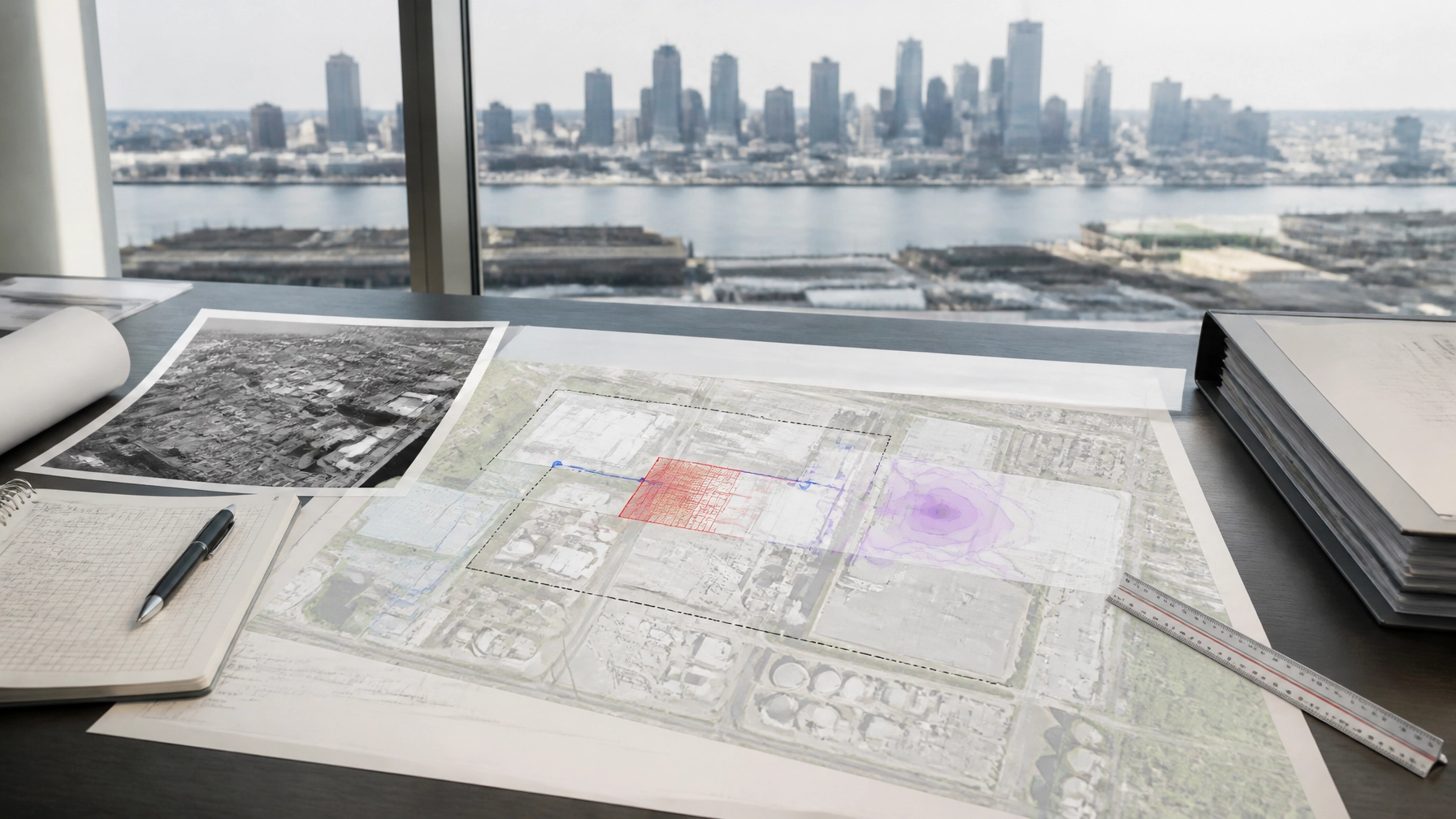
    3. Underground storage tanks

    Current or former underground storage tanks, commonly called USTs, are a major cost and transaction driver.

    The Phase I review may identify:

    • Current or former gasoline or heating-oil tanks
    • Tank removal or closure records
    • NJDEP spill cases
    • Petroleum discharge reports
    • Abandoned fill ports or vent pipes
    • Historical fuel dispensing operations
    • Tank farms or bulk storage areas on adjoining parcels

    A Phase I ESA does not remove a tank or determine the full extent of a release. It identifies the potential environmental condition and recommends the next step when evidence supports further investigation.

    4. Dry cleaners and vapor encroachment

    Former dry cleaners can raise concerns about chlorinated solvents, including tetrachloroethylene, often called PCE. Nearby industrial users, degreasing operations, gas stations, and petroleum releases can also create potential vapor concerns.

    A Phase I may identify a need for a vapor encroachment screen or a more targeted investigation. Sampling is not normally part of a standard Phase I ESA.

    If soil gas, sub-slab, indoor air, soil, or groundwater testing becomes necessary, that work belongs in a Phase II or a separate vapor intrusion assessment.

    Field reconnaissance scene with a capped monitoring well, industrial loading area, site checklist, and visual indicators of former fuel and fill conditions

    5. Regulatory records

    Regulatory records help determine whether a property or nearby site has a history of spills, violations, remediation, permitted operations, or unresolved cases.

    For a Jersey City or Newark property, the review may involve:

    • NJDEP records and databases
    • Federal environmental databases
    • Local property and building records
    • Historical aerial photographs
    • Sanborn fire insurance maps
    • City directories
    • Prior environmental reports
    • Spill and tank records
    • Known engineering controls or institutional controls

    A property with multiple case numbers, prior investigations, or an active remediation program may require more time to interpret than a site with a clean and simple record.

    6. Property size, access, and site logistics

    A single commercial building with clear access is different from a multi-building industrial parcel with secured areas, tenants, equipment, and restricted interiors.

    Pricing can increase when:

    • The property includes multiple tax lots
    • Several buildings require inspection
    • Tenants limit interior access
    • The site is fenced, vacant, or partially abandoned
    • Roofs, basements, tanks, or utility areas are inaccessible
    • The property includes a large outdoor storage or staging area

    The site reconnaissance should reflect actual conditions. A rushed walk around the front entrance is not equivalent to a complete property inspection.

    7. Lender scope and turnaround

    Lender requirements can affect the fee before fieldwork begins.

    Your lender may require:

    • ASTM E1527-21 conformance
    • All Appropriate Inquiries documentation
    • A specific reliance letter
    • Environmental database documentation
    • A vapor encroachment evaluation
    • A review of environmental liens or activity and use limitations
    • A current report close to the acquisition date
    • A defined turnaround date

    If you need a lender-approved Phase I ESA in Jersey City, provide the lender’s scope at kickoff. That prevents a second review, avoidable revisions, and closing delays.

    Rush service also requires immediate coordination of records, site access, interviews, and technical review. The earlier you engage the consultant, the more options you have.

    What a standard Phase I ESA includes

    An ASTM E1527-21 environmental due diligence NJ engagement generally includes:

    • Historical records review
    • Federal and state environmental database review
    • Site reconnaissance by an Environmental Professional
    • Review of adjoining and nearby properties
    • Interviews with owners, occupants, operators, or other knowledgeable parties
    • Evaluation of current and historical site uses
    • Identification of recognized environmental conditions, historical recognized environmental conditions, controlled recognized environmental conditions, and de minimis conditions
    • Documentation of significant data gaps
    • A written report signed by the Environmental Professional
    • Recommendations for additional investigation when warranted

    The EPA’s All Appropriate Inquiries guidance identifies ASTM E1527-21 as consistent with the AAI requirements. The governing federal regulation is 40 CFR Part 312.

    A Phase I ESA supports environmental due diligence and potential CERCLA liability protections. It does not guarantee that a property has no contamination.

    What a Phase I ESA excludes

    A standard Phase I ESA usually does not include:

    • Soil sampling
    • Groundwater sampling
    • Soil vapor or indoor air sampling
    • Sub-slab testing
    • Tank removal or closure
    • Remediation
    • Asbestos, lead paint, mold, or radon surveys
    • Building condition assessment
    • Structural inspection
    • Geotechnical borings
    • Title review or legal opinion
    • Full NJ ISRA applicability analysis unless specifically included

    If your transaction requires these services, scope them early. Envicon can coordinate the Phase I with Phase II environmental investigation, UST services, vapor assessment, or NJ ISRA compliance support.

    GIS-style aerial parcel analysis showing historical industrial land uses, property boundaries, monitoring points, and potential vapor migration pathways

    When is a Phase II ESA warranted?

    A Phase II ESA may be warranted when the Phase I identifies a recognized environmental condition or another condition that requires physical data.

    Common triggers include:

    • A documented spill or discharge
    • Current or former USTs with uncertain status
    • Dry-cleaning or solvent use
    • Petroleum storage or dispensing
    • Industrial operations with chemical handling
    • Soil staining, odors, stressed vegetation, or distressed pavement
    • Known contamination on the property or an adjoining parcel
    • Vapor encroachment concerns
    • Incomplete or contradictory regulatory records
    • A lender or attorney condition requiring sampling

    The Phase II scope should answer a specific question. That may involve soil borings, groundwater monitoring wells, soil gas points, or targeted sampling near a suspected source.

    We don’t recommend sampling simply because a property is old. We recommend it when the available evidence supports a defensible investigation plan.

    Transaction timeline for a Jersey City or Newark Phase I ESA

    Before authorization

    Send the property address, tax lot information, current use, proposed use, closing date, lender requirements, and any prior reports.

    Within one business day

    The consultant should confirm the scope, identify obvious cost drivers, and provide a fee and delivery date.

    Days 1 to 3

    The team conducts the records review, requests available documents, schedules site access, and prepares for reconnaissance.

    Days 2 to 5

    The Environmental Professional completes the site visit and interviews. Restricted access should be resolved quickly.

    Days 5 to 10 or longer

    The team analyzes the findings, documents data gaps, classifies environmental conditions, and prepares the report.

    Before closing

    Your lender, attorney, and acquisition team review the report. If a REC is identified, you decide whether to renegotiate, obtain a Phase II, revise the purchase agreement, or proceed with defined controls.

    AAI timing matters. The EPA explains that the inquiry must be conducted or updated within one year before acquisition, while certain components must be completed or updated within 180 days before acquisition. Your lender may apply a shorter reliance period.

    Decision-ready environmental due diligence report and lender review folder on a commercial transaction table with an understated Newark or Jersey City streetscape in the background

    Why transaction teams use Envicon for local Phase I work

    A national firm may assign your Jersey City or Newark transaction to a team that has limited familiarity with Hudson County or Essex County records and agency expectations.

    Envicon takes a different approach:

    • Direct access to the professionals managing the work
    • Same-business-day scoping for many inquiries
    • Standard and rush scheduling options
    • Fixed-fee pricing before authorization
    • Lender-ready ASTM E1527-21 deliverables
    • Local knowledge of Jersey City, Newark, Hudson County, and Northern New Jersey
    • Clear recommendations when a Phase II is or is not justified
    • Coordination with lenders, attorneys, brokers, architects, and acquisition teams

    You don’t need a bloated report. You need a clear answer that helps you decide what happens next.

    Frequently asked questions

    How much does a Phase I ESA cost in Jersey City?

    A standard commercial Phase I ESA in Jersey City typically falls between $2,200 and $4,500 as a 2026 planning range. A rush Phase I ESA typically falls between $3,000 and $5,500. Property conditions and lender requirements control the final price.

    What is the typical Phase I ESA cost in Newark, NJ?

    The typical Phase I ESA cost in Newark NJ falls within the same general planning ranges. Former industrial use, USTs, fill, dry cleaners, complex records, and restricted access can increase the fee.

    How long does a Phase I ESA take?

    A standard assessment commonly takes about 10 business days to 2 to 3 weeks. Rush service may be available in approximately 5 to 7 business days when records and site access cooperate.

    Does a Phase I ESA include sampling?

    No. A standard Phase I ESA is primarily a records review, site reconnaissance, interviews, and professional opinion. Soil, groundwater, soil vapor, and indoor air sampling generally require a Phase II or separate targeted scope.

    Will my lender accept the report?

    Acceptance depends on the lender’s requirements. Give those requirements to the consultant before authorization. Envicon’s Phase I ESA service is designed for lender and counsel review and reports a 100% lender approval rate for its Phase I ESAs.

    Should I order a Phase I before signing a purchase agreement?

    Ideally, environmental due diligence begins early in the negotiation period. Early review gives you time to identify RECs, request records, negotiate access, and decide whether a Phase II is needed before closing.

    Plan your Phase I ESA budget before the closing clock gets tight

    For a commercial property in Jersey City, Newark, or elsewhere in Hudson County, plan on $2,200 to $4,500 for a standard Phase I ESA and $3,000 to $5,500 for rush service.

    Those ranges are useful for budgeting. They are not a substitute for property-specific scoping.

    The best report is not the longest report. It’s the one that identifies the real environmental issues, explains the business impact, and gives your team a defensible path forward.

    Request a Jersey City or Newark Phase I ESA quote