Category: Industry Insight

  • Reserve Study HOA New Jersey: 30-Year Funding Plans for Condo Boards in Jersey City and Newark

    Reserve Study HOA New Jersey: 30-Year Funding Plans for Condo Boards in Jersey City and Newark

    For condo and HOA boards across Jersey City, Newark, Hoboken, Bayonne, Bergen County, Hudson County, and Essex County, reserve planning is no longer something to revisit only after a major roof leak or façade repair.

    New Jersey’s capital reserve requirements now place greater responsibility on associations to understand their common-area assets, anticipate repair costs, and maintain a defensible funding plan. In September 2026, boards should be asking a direct question:

    Can our current reserve plan support the building we actually own and maintain?

    A proper reserve study HOA New Jersey engagement connects engineering conditions to financial decisions. It gives the board a practical 30-year view of upcoming capital work, funding needs, and special-assessment exposure.

    What a New Jersey reserve study should include

    A reserve study has two connected parts.

    1. The physical analysis

    The physical component documents the common-area assets the association must maintain. That usually includes:

    • Roofing systems and waterproofing
    • Exterior façades and masonry
    • Balconies, terraces, and decks
    • Windows and doors maintained by the association
    • Elevators and major mechanical systems
    • Parking garages, podium decks, and paved areas
    • Drainage, site utilities, and stormwater infrastructure
    • Domestic water, sanitary, and fire protection systems
    • Heating, ventilation, and air-conditioning equipment
    • Pool, clubhouse, fitness, and recreation facilities
    • Site lighting, fencing, retaining walls, and landscaping systems

    The engineer evaluates current condition, estimated remaining useful life, maintenance needs, and replacement timing. A component inventory that misses a major asset produces a funding plan that looks precise but is incomplete.

    2. The financial analysis

    The financial component uses the physical findings to model future reserve needs. It typically considers:

    • Current reserve fund balance
    • Annual reserve contributions
    • Anticipated capital expenditures
    • Inflation and construction-cost escalation
    • Interest earned on reserve funds
    • Replacement timing
    • Funding levels over a 30-year period
    • Percent-funded or cash-flow results
    • Alternative contribution scenarios
    • Potential special assessments or loans

    A board should not receive only one number labeled “recommended annual contribution.” It should see how the plan performs under realistic conditions.

    For example, a funding plan may compare:

    • A stable annual contribution
    • Gradual increases tied to inflation
    • A front-loaded funding strategy
    • A lower contribution plan with a projected special assessment
    • A phased capital program that coordinates multiple projects

    That information gives owners context. It also gives the board a better basis for budgeting, communicating, and making decisions before a capital project becomes urgent.

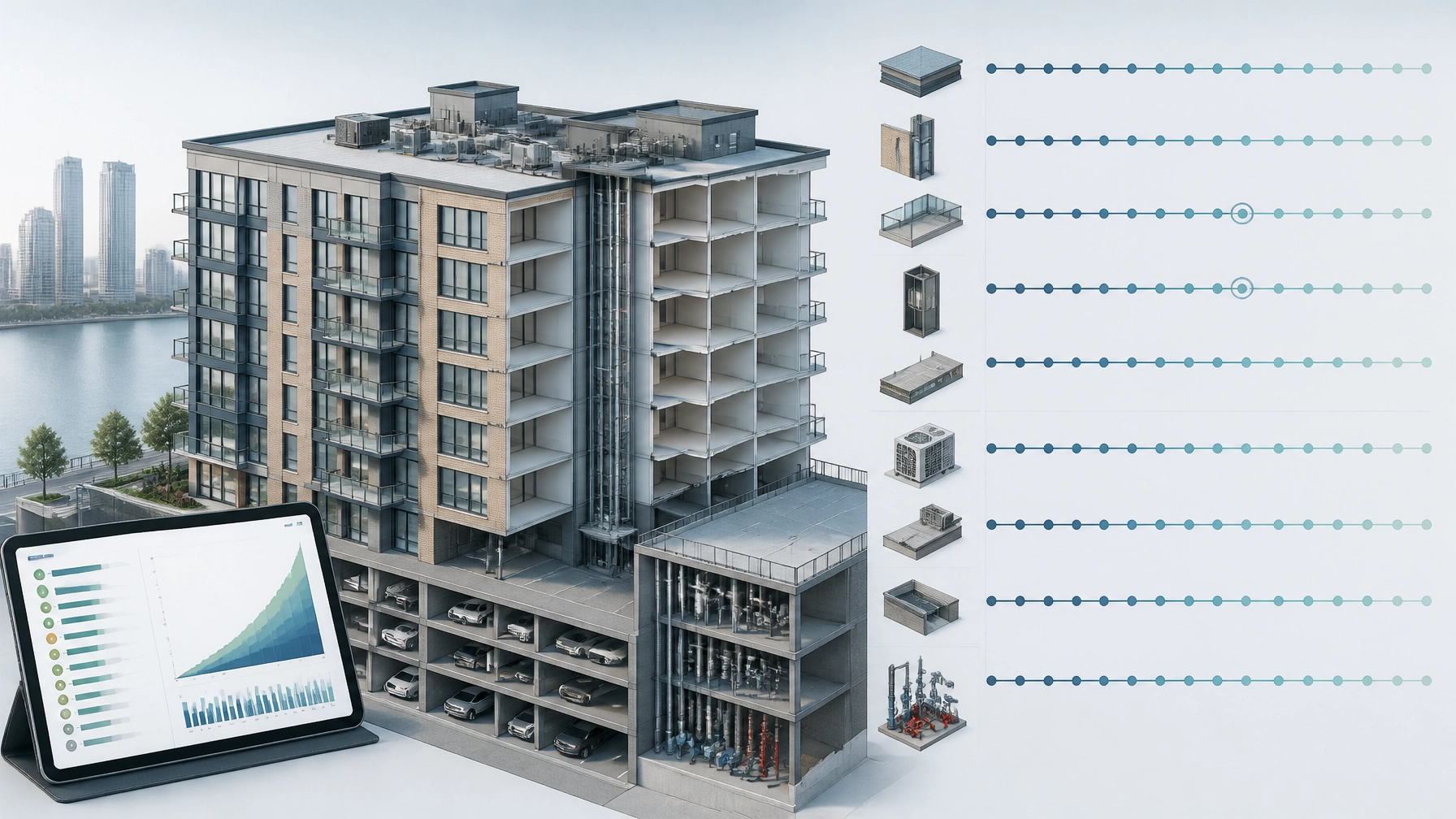
    New Jersey condo common-area component inventory and field assessment visualization

    What P.L. 2023, c. 214 means for associations

    New Jersey’s Structural Integrity Law, enacted as P.L. 2023, c. 214, amended the Planned Real Estate Development Full Disclosure Act and created related structural inspection requirements for certain residential condominium and cooperative buildings.

    The New Jersey Department of Community Affairs explains that the capital reserve provisions apply to planned real estate development associations, including associations that may not qualify as “covered buildings” for structural inspection purposes. The DCA’s official FAQ is available here.

    Under N.J.S.A. 45:22A-44.2, a qualifying association must undertake and fund a capital reserve study. The study must be prepared in accordance with the latest National Reserve Study Standards of the Community Associations Institute, or similar recognized standards, and must be performed or overseen by a credentialed reserve specialist or a New Jersey-licensed engineer or architect.

    The statute identifies a 30-year funding plan as a required part of the reserve study.

    Associations that did not complete a reserve study within the five years before the law’s effective date generally faced an initial study deadline of January 8, 2025. The study must then be conducted and reviewed at least once every five years. Associations with less than $25,000 in total common-area capital assets may fall within the statutory exemption, but that determination depends on the association’s actual assets and governing facts.

    The law is specific. The application is not always simple.

    A Jersey City high-rise with a concrete podium, an older Newark condominium conversion, and a wood-frame community in Bergen County may have different obligations. Legal compliance depends on the association’s structure, asset inventory, governing documents, building history, and current counsel guidance.

    Reserve study Jersey City condo boards should coordinate with structural inspections

    A reserve study Jersey City condo board commissions is not the same thing as a mandatory structural integrity inspection.

    The two services can and should inform each other, but they answer different questions.

    A reserve study asks:

    • What common-area components does the association maintain?
    • What condition are those components in?
    • When will repair or replacement likely occur?
    • What will that work cost?
    • How much should the association contribute over 30 years?

    A structural integrity inspection asks:

    • Does the building’s primary load-bearing system show deterioration or deficiencies?
    • Are columns, beams, slabs, bracing, foundations, balconies, or related structural elements performing as intended?
    • Is corrective maintenance required?
    • When must the next structural inspection occur?

    The structural inspection requirement under P.L. 2023, c. 214 applies to certain “covered buildings.” These generally include residential condominium or cooperative buildings with primary load-bearing systems made of concrete, masonry, steel, or a hybrid structure. Podium-deck buildings may qualify. Some frame-built structures, primarily rental buildings, and single-family dwellings are excluded by the statutory definitions.

    For older covered buildings, the first inspection deadline may already have passed. The law establishes age-based timing tied to the certificate of occupancy, including a two-year period for buildings that were at least 15 years old when the law took effect on January 8, 2024.

    The structural inspector’s report must identify required maintenance or repairs and be provided to the applicable municipal officials and enforcing agency. The report must also be retained by the association and made available to residents upon request.

    A structural inspection does not replace a reserve study. It does not create the financial model needed to fund roofing, paving, elevators, mechanical systems, drainage, or other common elements. Conversely, a reserve study does not replace an engineering evaluation of the primary load-bearing system.

    Integrated structural inspection and reserve funding planning visualization

    How to reduce special-assessment risk

    A reserve study cannot guarantee that an association will never need a special assessment. Building components can fail earlier than expected. Storm damage, hidden deterioration, supply-chain constraints, and changing construction costs can affect any 30-year projection.

    A good plan reduces avoidable surprises by making assumptions visible.

    Boards should review:

    1. Component condition
      Does the study reflect current site conditions, or does it rely on an outdated walkthrough?

    2. Useful-life assumptions
      Is the roof listed for replacement based on actual age and condition? Are façade repairs timed realistically?

    3. Local construction costs
      Does the model reflect current pricing in Jersey City, Newark, Hoboken, and the surrounding metro market?

    4. Inflation assumptions
      Does the plan account for construction escalation without overstating certainty?

    5. Reserve balance
      Is the current balance sufficient for near-term work already identified?

    6. Funding scenarios
      Does the board understand the difference between the recommended plan and a reduced-contribution plan?

    7. Structural findings
      Have inspection findings been incorporated into the component inventory and capital schedule?

    8. Maintenance responsibilities
      Do the study and governing documents agree on who maintains balconies, windows, drainage, parking areas, and other shared or exclusive-use elements?

    A lower annual contribution may appear attractive in the current budget. If it shifts a known capital need into a large future assessment, the association has not eliminated the cost. It has delayed it.

    Under the current statutory framework, associations should review funding decisions with their community-association attorney, accountant, property manager, and qualified reserve professional or engineer. The board should document why it selected a particular funding scenario and how it plans to address identified deficiencies.

    What boards should prepare before commissioning a study

    A faster, more useful engagement starts with complete records. Before the site visit, gather:

    • Prior reserve studies and updates
    • Current operating and reserve budgets
    • Recent financial statements
    • Reserve account balance
    • Master deed, bylaws, and maintenance responsibilities
    • Certificate of occupancy information
    • Structural inspection reports
    • Façade, balcony, roof, or garage repair records
    • Capital project contracts and warranties
    • Preventive maintenance schedules
    • Insurance inspection reports
    • Open violation notices or municipal correspondence

    This preparation helps the engineer distinguish known conditions from assumptions. It also reduces the risk of paying for a generic report that does not reflect the actual property.

    For a reserve study Newark HOA, the same principle applies even when the community does not have a covered condominium building. The association still needs to identify its common-area capital assets and determine whether its funding plan supports long-term maintenance.

    In Hoboken, Bayonne, and older parts of Bergen and Essex County, dense construction, coastal exposure, aging infrastructure, and high contractor pricing make local engineering judgment especially important. A capital reserve study Hudson County should not read like a national template with the property name changed on the cover.

    Engineer reviewing reserve funding scenarios and building component condition data

    How Envicon helps New Jersey boards make the numbers usable

    Envicon prepares board-ready reserve studies for condos, co-ops, and HOAs across New York and New Jersey. Our reserve study service combines on-site component assessment, useful-life analysis, local replacement-cost research, and 30-year funding scenarios.

    When structural concerns exist, we can coordinate the reserve study with NJ structural integrity inspections so the funding plan reflects the engineering findings. Our broader civil and geotechnical engineering team supports related site, drainage, paving, utility, and structural coordination needs.

    We work directly with boards, property managers, attorneys, accountants, and contractors. You receive a clear explanation of what the study found, what the numbers mean, and what decisions come next.

    That is the difference between receiving a report and having a plan.

    Takeaway for New Jersey condo and HOA boards

    A 30-year reserve study New Jersey association can defend should do more than satisfy a deadline. It should help the board understand the property’s physical condition, forecast capital work, communicate with owners, and reduce the chance of avoidable special assessments.

    For boards in Jersey City, Newark, Hoboken, Bayonne, Hudson County, Bergen County, and Essex County, the right time to update the plan is before the next roof, façade, garage, balcony, or mechanical emergency forces the issue.

    Start with a board consultation

    Tell us your building type, location, current reserve balance, last study date, and any known structural concerns. We’ll help you determine whether you need a new study, a five-year update, a structural inspection, or coordinated support.

    A clear reserve plan protects more than a balance sheet. It gives owners confidence that the association is managing the building before the building manages the board.


    Envicon corporate branding banner

  • ASTM E1527-21 Phase I ESA in New York and New Jersey: 180-Day Timing and Lender Approval

    ASTM E1527-21 Phase I ESA in New York and New Jersey: 180-Day Timing and Lender Approval

    A Phase I Environmental Site Assessment can protect a transaction or create a closing problem. The difference usually comes down to timing, scope, documentation, and whether the report answers the lender’s actual questions.

    For commercial property transactions in New York and New Jersey, ASTM E1527-21 is the current benchmark for Phase I ESAs used to support All Appropriate Inquiries, or AAI, under CERCLA. It helps buyers evaluate environmental risk and supports potential innocent landowner, contiguous property owner, and bona fide prospective purchaser protections.

    It does not eliminate uncertainty. It identifies the conditions that require a business decision.

    “No environmental site assessment can wholly eliminate uncertainty.”
    ASTM E1527-21, Section 4.5.1

    The 180-day rule is not based only on the report date

    A Phase I ESA is generally presumed viable for AAI when it is completed within 180 days before the acquisition or other covered transaction. The transaction may involve a purchase, lease, refinance, or another lender-defined event.

    The important detail is that the 180-day period does not necessarily run from the date printed on the cover of the report.

    ASTM E1527-21 requires the report to identify the dates of key assessment components. Under the standard and EPA’s AAI rule, the following items must be completed or updated within 180 days before closing:

    • Interviews with current owners, operators, and occupants
    • Searches for recorded environmental cleanup liens
    • Reviews of federal, state, tribal, and local government records
    • Visual inspection of the property and adjoining properties
    • The Environmental Professional’s declaration

    All other AAI components must generally be completed within one year before acquisition. The one-year option only works when the five items above are current within the 180-day window.

    The practical rule is simple:

    • Less than 180 days old: Usually current for AAI and lender review, assuming the report meets ASTM E1527-21.
    • Between 180 days and one year old: May remain usable if the required components are formally updated.
    • More than one year old: A new Phase I ESA is usually required.

    EPA explains these requirements in its All Appropriate Inquiries resources. The governing federal regulation is 40 CFR Part 312.

    Closing date planning matters

    If your closing date moves, your Phase I ESA may move outside the lender’s acceptance window. A report that was acceptable during underwriting may need a reliance update before funding.

    Ask your consultant for a date table showing:

    1. The date of the site reconnaissance.
    2. The date of interviews.
    3. The date of the records review.
    4. The date of the lien search.
    5. The date of the Environmental Professional’s declaration.
    6. The final date by which the report can be relied upon without an update.

    That table gives your attorney, lender, and acquisition team one version of the truth.

    What a lender-ready Phase I ESA should contain

    ASTM E1527-21 is not a short database search. It is a documented investigation based on historical research, current conditions, interviews, regulatory records, professional judgment, and a site visit.

    A lender-ready report should clearly document:

    • The property address and legal description
    • Current and historical property uses
    • Adjoining and nearby property uses
    • Aerial photographs and historical maps
    • Sanborn fire insurance maps, where available
    • City directories and other historical sources
    • Federal, state, and local environmental databases
    • Regulatory files, spills, permits, tanks, and cleanup cases
    • Site photographs
    • Site and vicinity maps
    • Interviews with relevant owners, operators, and occupants
    • Significant data gaps
    • The Environmental Professional’s opinion
    • Conclusions using the correct REC terminology

    For New York and New Jersey properties, the review may also need to account for historic fill, former manufacturing, manufactured gas plant operations, dry cleaners, petroleum storage, rail corridors, waterfront uses, brownfield sites, NYC E-Designations, NYSDEC records, and NJDEP databases.

    Our Phase I and Phase II environmental assessment service is structured around four tracked stages, from scope and kickoff through findings, escalation, and final delivery.

    Historical aerial photographs, maps, and property research materials arranged for environmental due diligence

    REC, CREC, and HREC are not interchangeable

    The conclusion section of a Phase I ESA must distinguish among different environmental conditions. This affects lender underwriting, purchase negotiations, remediation planning, and future property use.

    Recognized Environmental Condition

    A Recognized Environmental Condition, or REC, generally involves the presence or likely presence of hazardous substances or petroleum products due to a release, likely release, or material threat of a future release.

    Examples may include:

    • A former dry cleaner with potential solvent impacts
    • An active or abandoned underground storage tank
    • Soil staining near historical chemical storage
    • A documented spill or unresolved regulatory case
    • Contamination migrating from an adjoining property

    A REC does not automatically mean the transaction must stop. It means the condition needs further evaluation, risk allocation, or both.

    Controlled Recognized Environmental Condition

    A Controlled Recognized Environmental Condition, or CREC, is a past release that has been addressed to the satisfaction of the applicable regulatory authority, but contamination remains subject to controls.

    Controls may include:

    • Environmental easements
    • Deed notices
    • Soil caps
    • Groundwater use restrictions
    • Vapor mitigation systems
    • Soil management plans
    • Institutional or engineering controls

    Lenders often focus on whether these controls are current, enforceable, properly maintained, and compatible with the proposed redevelopment.

    Historical Recognized Environmental Condition

    A Historical Recognized Environmental Condition, or HREC, involves a past release that has been addressed to regulatory satisfaction and meets current unrestricted-use criteria without controls.

    The classification depends on the evidence. A former release should not be labeled an HREC simply because a case was closed years ago. The Environmental Professional must consider whether current standards, property use, and regulatory requirements support that conclusion.

    Vapor migration is now a central due diligence question

    ASTM E1527-21 specifically addresses the importance of vapor migration. Contamination does not need to be directly beneath a building to create a potential concern.

    Volatile organic compounds can migrate through soil and groundwater and enter buildings through:

    • Cracks in slabs
    • Utility penetrations
    • Floor drains
    • Sumps
    • Foundation walls
    • Crawl spaces
    • Building depressurization

    This issue is common in dense parts of NYC, Hudson County, Newark, Jersey City, and other areas with historic industrial and commercial uses.

    A Phase I ESA may identify a potential vapor concern based on historical records, adjoining property conditions, regulatory files, or the presence of volatile contaminants. The Phase I does not usually include sampling. A vapor intrusion assessment or Phase II investigation may be the appropriate next step.

    Technical cutaway showing vapor migration from a subsurface source toward a commercial building foundation

    Significant data gaps can affect lender approval

    A data gap is not automatically a REC. But a significant data gap can limit the Environmental Professional’s ability to identify releases or threatened releases.

    Common examples include:

    • No access to the interior of a building
    • Missing historical records for a key period
    • Inaccessible portions of the property
    • Snow, standing water, or debris limiting visual inspection
    • Incomplete owner or occupant interviews
    • Unavailable regulatory files
    • Unclear property boundaries
    • A former use that cannot be adequately documented

    A defensible report explains what information was unavailable, why it matters, and whether additional investigation is recommended.

    That explanation is critical for lenders. A vague statement that records were “not available” leaves the underwriter with an unanswered question. A clear explanation gives the lender a defined risk decision.

    PFAS: not an automatic broad-scope Phase I requirement

    PFAS requires careful treatment in 2026.

    ASTM E1527-21 was written around CERCLA hazardous substances and petroleum products. Broad PFAS evaluation and PFAS sampling are not automatically required in every Phase I ESA.

    However, PFOA and PFOS have been designated as CERCLA hazardous substances by EPA. Where site history, operations, regulatory files, or nearby conditions indicate that PFOA or PFOS may be relevant, the Environmental Professional should address them within the appropriate hazardous-substance analysis.

    Other PFAS compounds may remain non-scope or emerging contaminant considerations under the engagement. They may still matter because:

    • New York and New Jersey have active PFAS programs.
    • Remediation programs may require PFAS sampling.
    • Industrial, airport, firefighting, plating, textile, landfill, and wastewater uses can create a stronger basis for review.
    • Lenders may request a PFAS discussion even when broad PFAS sampling is outside the Phase I scope.

    The correct approach is not to add blanket PFAS testing to every Phase I. It is to identify whether PFAS presents a reasonable site-specific concern, document the scope clearly, and add a PFAS records review or sampling program when warranted.

    What does a Phase I ESA cost in New York and New Jersey?

    A typical Phase I ESA for a commercial property may cost approximately $2,200 to $4,500, based on Envicon’s published service information. That is a planning range, not a fixed quote.

    Cost drivers include:

    • Property size and number of parcels
    • Current and historical industrial use
    • Number of adjoining properties requiring review
    • Availability of historical maps and records
    • Regulatory complexity
    • Multiple buildings or tenants
    • Lender-specific forms and reliance requirements
    • Rush delivery
    • Portfolio or multi-site work
    • Additional lien, transfer, PFAS, or state-program review

    A simple commercial property with clear records may move quickly. A former industrial site in Newark, Brooklyn, or Jersey City may require more historical research and regulator-facing analysis.

    Envicon can evaluate priority requests, including potential 48-hour delivery, when site access, records availability, property complexity, and lender requirements permit. That is not a promise that every Phase I can be completed in 48 hours. It is a scope and schedule decision made at kickoff.

    Our team also uses technology-enabled status reporting so clients can see schedule, deliverable status, open information requests, and next steps without waiting for a monthly update. Senior professionals stay involved from scope through report delivery.

    Environmental professional reviewing a Phase I ESA package, property plan, and real-time project status dashboard

    When should you order a Phase II?

    A Phase I may recommend a Phase II when a REC, vapor concern, significant data gap, or other condition cannot be resolved through records and professional judgment.

    A targeted Phase II may include:

    • Soil borings
    • Groundwater sampling
    • Soil vapor sampling
    • Indoor air testing
    • UST investigation
    • Geophysical surveying
    • Petroleum fingerprinting
    • PFAS analysis where justified
    • Delineation of a known release

    The goal is not to collect data for its own sake. The goal is to answer the lender’s and buyer’s actual questions before closing, construction, or remediation decisions become more expensive.

    Final checklist for closing readiness

    Before relying on a Phase I ESA in New York or New Jersey, confirm that:

    • The report states ASTM E1527-21 compliance.
    • The Environmental Professional is qualified and has signed the report.
    • The five 180-day components are current.
    • The one-year AAI window is satisfied.
    • The report explains REC, CREC, and HREC findings.
    • Vapor migration has been considered where relevant.
    • Historical research includes appropriate maps, photographs, and records.
    • Significant data gaps are identified and explained.
    • PFAS scope is clearly stated.
    • The lender has reviewed the report or confirmed its requirements.
    • Any Phase II, lien search, transfer screen, NJ Preliminary Assessment, or regulatory follow-up is assigned before closing.

    A Phase I ESA should not be a document that sits in a deal file. It should give you a clear path to closing, negotiation, investigation, or exit.

    Ready to make your next closing more defensible?

    Envicon Group provides ASTM E1527-21 Phase I ESAs, Phase II investigations, vapor assessments, and environmental due diligence across NYC and New Jersey. We bring direct senior involvement, regional regulatory knowledge, and clear reporting to transactions where timing matters.

    Envicon Group logo

  • Brownfield Remediation Jersey City and Newark: Environmental Due Diligence for 2026 Acquisitions

    Brownfield Remediation Jersey City and Newark: Environmental Due Diligence for 2026 Acquisitions

    A 2026 acquisition in Jersey City, Newark, Hoboken, Bayonne, or another Northern New Jersey industrial corridor cannot rely on a high-level desktop review alone.

    Historic manufacturing, rail operations, bulk storage, metal finishing, dry cleaning, landfilling, and waterfront filling have left many properties with environmental conditions that affect price, financing, construction, and closing timelines.

    For buyers, the issue is not simply whether contamination exists. The issue is whether you understand the condition well enough to price it, structure the transaction, satisfy the lender, and move toward redevelopment without losing months to avoidable surprises.

    That is the purpose of transaction-focused brownfield remediation in Jersey City and throughout Hudson, Essex, Bergen, and Northern New Jersey.

    Why environmental due diligence matters before you sign

    A property can appear ready for redevelopment while still carrying significant environmental risk below grade.

    A former warehouse in Jersey City may have buried tanks, historic fill, chlorinated solvents, or vapor intrusion concerns. A Newark industrial parcel may have decades of petroleum handling, waste storage, or manufacturing activity that does not appear in the current building condition.

    Those conditions can affect:

    • Purchase price and environmental escrows
    • Lender approval
    • Construction budgets
    • Excavation and disposal requirements
    • Dewatering and discharge planning
    • Building design and vapor controls
    • NJDEP reporting obligations
    • ISRA compliance
    • Tax credit and grant readiness
    • The date you can start construction

    A report that identifies a problem without explaining the path forward does not protect the transaction. You need a defensible scope, realistic cost assumptions, and a clear sequence from investigation through regulatory closure.

    Start with the property history, not the asking price

    The first step in environmental due diligence for a brownfield acquisition is a disciplined review of property history.

    We examine current and historical sources that may reveal past operations and potential Areas of Concern, including:

    • Historic Sanborn maps and city directories
    • Aerial photographs and topographic maps
    • NJDEP site remediation records
    • UST registrations and closure documentation
    • Prior environmental reports
    • Fire insurance maps
    • Industrial permits and discharge records
    • Interviews with owners, operators, tenants, and municipal officials
    • Adjoining and nearby properties with potential off-site impacts

    For a property in the Hudson County industrial corridor, the surrounding parcels matter as much as the subject site. A groundwater plume, former dry cleaner, plating operation, fuel terminal, or rail yard may affect the property even when the current owner never used hazardous substances.

    That is why environmental due diligence for a brownfield in Hudson County must look beyond the tax lot boundary.

    Phase I ESA and NJDEP Preliminary Assessment

    Most commercial and industrial acquisitions begin with an ASTM-compliant Phase I Environmental Site Assessment. The Phase I evaluates the site history, regulatory databases, current conditions, and potential Recognized Environmental Conditions under ASTM E1527-21.

    For a New Jersey transaction, buyers should also evaluate whether a NJDEP Preliminary Assessment is needed. The Preliminary Assessment focuses on site-specific Areas of Concern and helps determine whether additional investigation is required under New Jersey’s Site Remediation Program.

    Envicon’s Phase I Environmental Site Assessment service is built around the transaction, not just the report. We connect findings to the next decision:

    • Can the acquisition proceed as structured?
    • Does the lender need a Phase II?
    • Should the buyer request an environmental escrow?
    • Is an LSRP needed before closing?
    • Could the intended redevelopment trigger vapor or soil management controls?
    • Does the site history create an ISRA concern?

    A Phase I should help you decide what to do next. It should not leave your attorney, lender, and development team interpreting risk on their own.

    When a Phase II investigation becomes necessary

    A Phase II Environmental Site Assessment uses field sampling to evaluate suspected contamination. Depending on the property history and proposed use, the investigation may include:

    • Soil borings
    • Groundwater monitoring wells
    • Soil vapor sampling
    • Sub-slab sampling
    • UST geophysics and test pits
    • Petroleum and VOC analysis
    • PAHs and metals associated with historic fill
    • PCBs and site-specific constituents
    • PFAS where historical operations support the concern

    The right scope depends on the property. A former machine shop in Newark does not present the same risk profile as a waterfront terminal in Jersey City or a former dry cleaner in Hoboken.

    This is also why brownfield investigation cost in NJ varies widely. Cost depends on site size, access, number of Areas of Concern, depth to groundwater, laboratory parameters, drilling conditions, utility congestion, traffic control, and the level of reporting required.

    A lower initial scope may not be cheaper if it misses the source area and forces a second mobilization. We design investigations to answer the questions that affect your acquisition and construction plan.

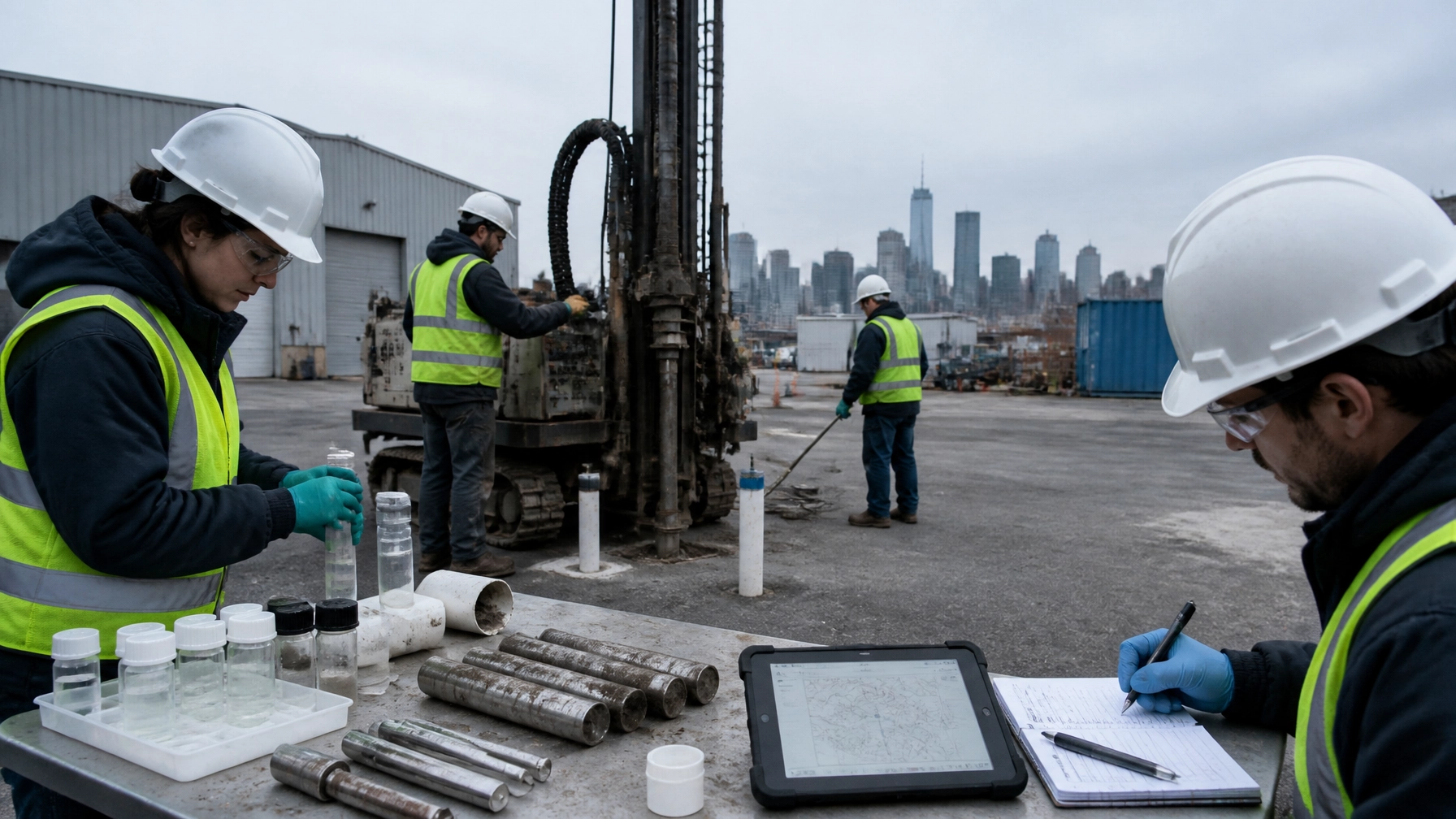
    Environmental professional collecting soil core samples beside a drilling rig at a Northern New Jersey industrial property

    The recurring issues on Jersey City and Newark brownfields

    Historic fill

    Historic fill is common across urban and waterfront areas of Northern New Jersey. Fill may contain ash, brick, glass, concrete, metals, PAHs, and other materials associated with past placement and development.

    The investigation must consider the horizontal and vertical extent of the fill, its physical characteristics, groundwater conditions, and the proposed exposure scenario.

    In many cases, the practical remedy does not require removing every cubic yard of fill. A properly designed cap, deed notice, soil management plan, and long-term permit obligations may provide a more efficient path. That decision must be based on adequate delineation and regulatory requirements.

    Underground storage tanks

    USTs remain a common transaction risk at former service stations, industrial properties, trucking facilities, heating oil sites, and manufacturing operations.

    Our review looks for both registered and unregistered tanks, abandoned product lines, historic tank farms, fill ports, dispensers, and evidence of prior releases. If a tank is found, the acquisition team needs to understand closure requirements, soil impacts, groundwater impacts, disposal classification, and possible funding options.

    PFAS

    PFAS should not be added automatically to every sampling program, but it should not be ignored where site history indicates possible use.

    Potential triggers include certain manufacturing operations, fire-training areas, facilities with aqueous film-forming foam, landfills, waste handling, and specific industrial processes. New Jersey’s remediation framework continues to evolve, and current standards and guidance must be checked when the sampling plan is prepared.

    Vapor intrusion

    Vapor intrusion is a major concern when volatile chemicals migrate from soil or groundwater into buildings. It becomes especially important when an industrial property will be converted to housing, offices, schools, or other occupied uses.

    A proper evaluation may require soil gas, sub-slab soil gas, indoor air, or outdoor air sampling. The redevelopment design may also need vapor barriers, sub-slab depressurization, passive venting, or building use restrictions.

    Technical cutaway visualization showing historic fill, an underground storage tank, groundwater, vapor migration, and a proposed building control system

    LSRP, ISRA, and the acquisition timeline

    If the property is an industrial establishment subject to the New Jersey Industrial Site Recovery Act, the transaction may require specific notification and remediation steps.

    The timing matters. Buyers should evaluate ISRA applicability during the letter-of-intent or contract stage, not immediately before closing.

    An LSRP can help coordinate:

    1. Preliminary Assessment and site history review
    2. Site Investigation and Remedial Investigation
    3. NJDEP submissions and required certifications
    4. Remedial alternatives evaluation
    5. Remedial Design and implementation oversight
    6. Soil, groundwater, and indoor air controls
    7. Remedial Action Permit requirements
    8. Response Action Outcome planning

    Envicon’s NJ LSRP services give the buyer, seller, counsel, lender, architect, and contractor one technical path to follow.

    The goal is not to make the property look risk-free. The goal is to define the risk honestly and manage it so the project can move.

    Remedial design, soil management, and dewatering

    Investigation results must connect directly to the construction plan.

    For a new building, garage, utility corridor, or public-realm improvement, the remedial strategy may include:

    • Excavation and off-site disposal
    • Clean fill placement
    • Engineered caps
    • Soil reuse protocols
    • Vapor mitigation systems
    • Groundwater treatment
    • In-situ treatment
    • UST removal and release response
    • Dewatering and discharge controls
    • Construction air monitoring
    • Soil stockpile management
    • Import and export documentation

    A soil management plan should account for excavation limits, soil classification, staging space, trucking routes, disposal facilities, worker protection, stormwater controls, and field documentation.

    Dewatering can create a separate schedule and permitting issue. Groundwater encountered during excavation may require treatment, discharge authorization, or disposal. These costs need to appear in the development budget before the contractor mobilizes.

    NJEDA incentive readiness while applications are closed

    As of September 2026, the NJEDA Brownfields Redevelopment Incentive Program is not currently accepting applications while NJEDA develops rules associated with the 2024 program amendments. NJEDA states that a new application will be posted after the rules are issued.

    That does not mean buyers should wait to prepare.

    An acquisition team can use this period to organize:

    • Eligible investigation and remediation costs
    • Preliminary remediation budgets
    • Project financing assumptions
    • Municipal support requirements
    • Prevailing wage considerations
    • Developer equity requirements
    • Green remediation commitments
    • Site access documentation
    • LSRP reports and cost records

    Incentive readiness should support the transaction without becoming the only reason the transaction works. Confirm current eligibility and timing directly with NJEDA before relying on any potential tax credit.

    NJDEP’s Contaminated Site Remediation and Redevelopment Program and Brownfields Program provide additional guidance, funding information, mapping resources, and regulatory materials.

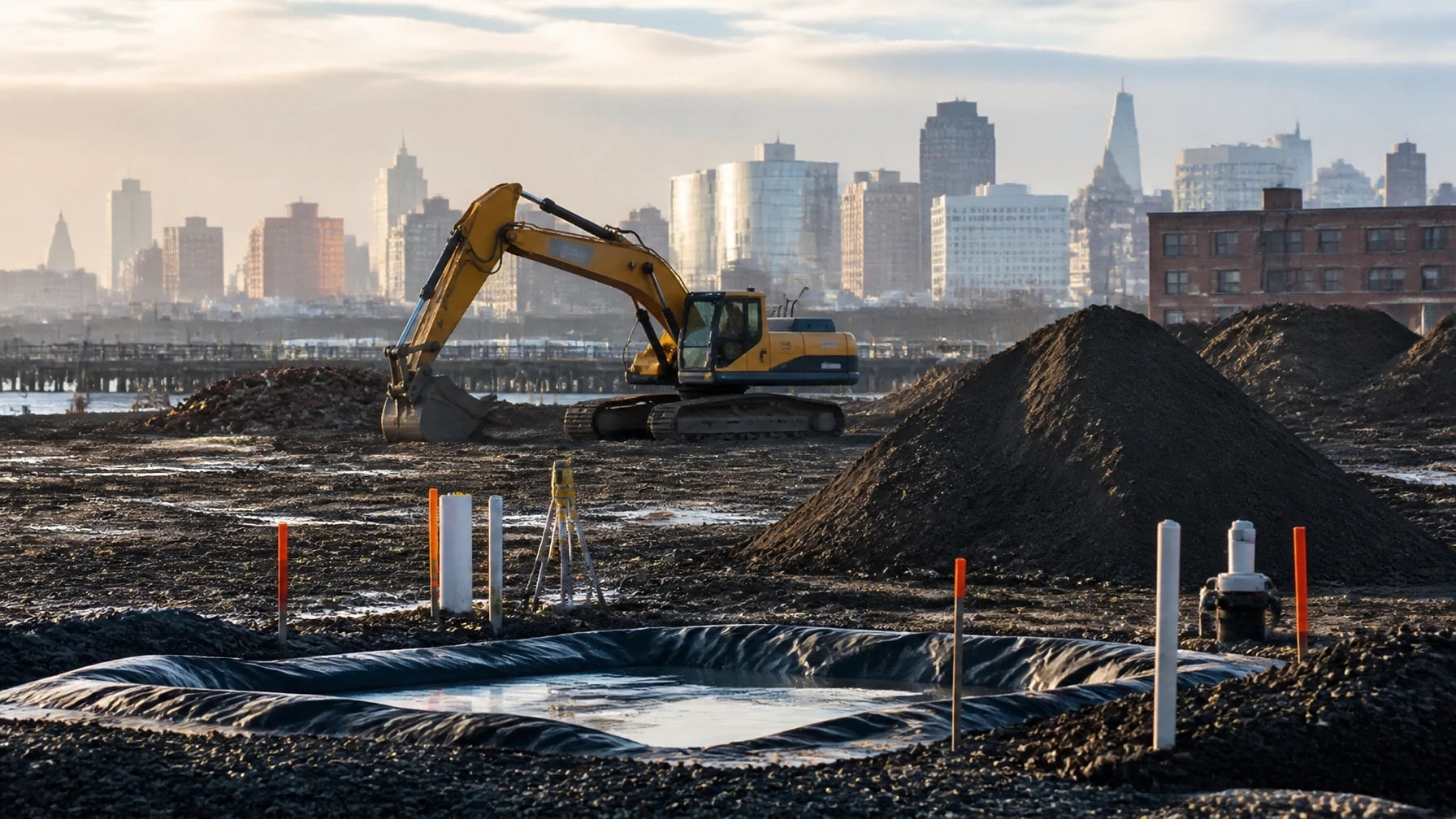
    Active brownfield remediation execution with lined soil stockpiles, dewatering treatment equipment, and field coordination

    Brownfield acquisition checklist for Northern New Jersey

    Before closing on an industrial or underutilized property in Jersey City, Newark, Hoboken, Bayonne, Bergen County, Hudson County, or Essex County, confirm that you have:

    • Completed an ASTM Phase I ESA
    • Evaluated the need for an NJDEP Preliminary Assessment
    • Reviewed historic operations and adjoining properties
    • Checked NJDEP records and available GIS data
    • Investigated USTs and former product lines
    • Evaluated historic fill conditions
    • Considered PFAS based on site history
    • Screened for vapor intrusion pathways
    • Determined whether ISRA applies
    • Engaged an LSRP when required
    • Prepared a Phase II or SI/RI scope
    • Estimated investigation and remediation costs
    • Planned for soil disposal, reuse, and dewatering
    • Reviewed potential engineering and institutional controls
    • Documented NJEDA incentive readiness without assuming approval
    • Addressed environmental escrows, indemnities, and access rights
    • Built investigation and remediation milestones into the closing schedule

    The Envicon approach

    Large consulting firms often separate the report, the regulatory work, and the construction response among different teams. That can leave the buyer with three opinions and no accountable path.

    At Envicon, our environmental professionals stay close to the transaction and the field. We coordinate with attorneys, lenders, developers, architects, contractors, municipalities, and regulators from the first review through remediation implementation.

    You get direct answers, clean documentation, and a scope tied to the way you intend to build.

    That is the difference between buying an environmental report and buying confidence in the next decision.

    Plan your brownfield transaction review

    If you are evaluating an industrial or underutilized property in Jersey City, Newark, Hoboken, Bayonne, Bergen County, Hudson County, Essex County, or another Northern New Jersey market, bring the environmental questions forward before they become closing conditions.

    Start with a brownfield transaction review:

    A complicated site is not automatically a bad acquisition. It is a site that requires facts, sequence, and ownership.

    Envicon helps turn environmental uncertainty into a clear path toward a clean, buildable, and compliant asset.

  • SWPPP Services Jersey City and Newark: NJPDES Construction Stormwater Compliance Before Groundbreaking

    SWPPP Services Jersey City and Newark: NJPDES Construction Stormwater Compliance Before Groundbreaking

    A construction site in Jersey City, Newark, Hoboken, Bayonne, Hudson County, Bergen County, or Essex County can lose time before the first excavation if stormwater obligations are treated as a late permitting task.

    For qualifying projects, the NJPDES 5G3 construction stormwater permit, Soil Erosion and Sediment Control approval, Stormwater Pollution Prevention Plan, and Request for Authorization must align before land disturbance begins. The details depend on the project, site conditions, municipality, county Soil Conservation District, and NJDEP review.

    Envicon provides SWPPP services in Jersey City and Newark for developers, contractors, architects, municipalities, and property owners who need a clear path from approved plans to compliant construction.

    When NJPDES 5G3 coverage applies

    New Jersey generally requires construction stormwater authorization when construction activity disturbs:

    • One acre or more of land
    • Less than one acre as part of a larger common plan of development or sale that will disturb one acre or more
    • Soil through clearing, grading, excavation, demolition, utility installation, or related construction activity

    The one-acre threshold is not limited to the first phase of work. A phased project, adjacent parcel, shared infrastructure plan, or later construction phase may be part of the same common plan.

    That matters in dense markets such as Jersey City, Newark, Hoboken, and Bayonne. A project may have a small active work area but still fall under the threshold because the full development plan includes future buildings, parking areas, utilities, access roads, or public improvements.

    The first step is a documented applicability review. Do not assume that a small parcel is exempt without reviewing the full project limits and development sequence.

    See the NJDEP Bureau of NJPDES Stormwater Permitting for the state’s stormwater permitting framework and links to current program materials.

    Soil Erosion and Sediment Control approval comes first

    Before filing the NJPDES 5G3 Request for Authorization, the project typically needs an approved Soil Erosion and Sediment Control Plan through the applicable county Soil Conservation District.

    The plan addresses how the project will control soil loss and sediment migration during construction. Depending on the site, it may include:

    • Stabilized construction entrances
    • Silt fencing and perimeter controls
    • Sediment basins, traps, and temporary settling areas
    • Inlet protection
    • Temporary diversion swales
    • Dust and tracking controls
    • Stockpile protection
    • Slope stabilization
    • Construction sequencing
    • Permanent stabilization measures

    The approved plan and supporting codes become part of the authorization process. A missing certification, incorrect project boundary, or mismatch between the civil drawings and erosion control plan can create avoidable review comments.

    For an erosion and sediment control plan in Newark, NJ, the plan must reflect actual grading, drainage, access, and construction sequencing. A generic detail sheet does not tell the contractor what to install first, where runoff will go during a storm, or how the site will remain compliant while work progresses.

    Request for Authorization under NJPDES 5G3

    New Jersey uses a Request for Authorization, or RFA, for coverage under its construction stormwater general permit. The RFA is not a substitute for the technical plan. It is the administrative request that connects the project, owner, operator, Soil Conservation District approval, and NJPDES permit coverage.

    A typical process includes:

    1. Confirming whether 5G3 coverage applies.
    2. Defining the project area and common-plan limits.
    3. Preparing the Soil Erosion and Sediment Control Plan.
    4. Obtaining county Soil Conservation District approval and required identification information.
    5. Preparing the SWPPP or SPPP components.
    6. Submitting the RFA through the NJDEP process.
    7. Addressing agency comments or deficiencies.
    8. Keeping the approved plans and inspection records current throughout construction.

    Current permit status, agency procedures, fees, and lead times can change. The applicable schedule also depends on project facts, completeness of the submittal, county review, municipal requirements, and NJDEP agency review. Confirm the current requirements before setting a groundbreaking date.

    NJDEP’s stormwater program operates under the state’s NJPDES rules at N.J.A.C. 7:14A. Stormwater management design requirements are addressed separately through N.J.A.C. 7:8.

    What belongs in a construction SWPPP

    A construction SWPPP, also called an SPPP in New Jersey materials, should be site-specific. It should connect the regulatory requirements to the way the contractor will actually build the project.

    Core components commonly include:

    • Project description and limits of disturbance
    • Existing site conditions and drainage patterns
    • Construction sequence and schedule
    • Soil types, slopes, receiving waters, and discharge points
    • Erosion and sediment control measures
    • Stormwater best management practices
    • Construction material and waste controls
    • Concrete washout procedures
    • Fuel, chemical, and spill controls
    • Soil stockpile management
    • Dewatering procedures where applicable
    • Inspection forms and corrective action procedures
    • Stabilization requirements
    • Rain-event response procedures
    • Roles for the owner, operator, contractor, and inspector

    The plan should not sit in a binder while field conditions move in another direction. If the contractor changes the access road, expands the laydown area, relocates a stockpile, changes the grading sequence, or installs temporary drainage differently, the plan may need to be reviewed and updated.

    Protected storm drain inlet with sediment controls during a construction site inspection

    Grading and drainage must match the SWPPP

    Stormwater compliance is not separate from civil design. The grading plan determines where water flows. The drainage plan determines how that water is collected, conveyed, detained, treated, or discharged. The SWPPP determines how the site remains protected while those systems are being built.

    Coordination should address:

    • Temporary and permanent drainage routes
    • Low points and ponding areas
    • Inlet protection during installation
    • Discharge locations
    • Sediment basin sizing and access
    • Utility trench crossings
    • Construction entrances
    • Soil stockpile locations
    • Dewatering discharge points
    • Final stabilization and landscaping sequence

    This is why civil and geotechnical engineering support should be coordinated with the SWPPP before groundbreaking. A plan that looks complete on paper can fail in the field if it ignores the actual grade, groundwater, utility layout, or available construction access.

    Envicon brings civil, environmental, and field oversight into the same project conversation. That reduces the coordination gap between the engineer preparing the drawings and the contractor responsible for maintaining the controls.

    Inspections, stabilization, and rain-event response

    Permit coverage does not end when the RFA is approved. Construction-phase compliance requires ongoing inspection, maintenance, documentation, and corrective action.

    The responsible team should inspect:

    • Perimeter sediment controls
    • Storm drain and inlet protection
    • Construction entrances and tracking
    • Sediment basins and outlet structures
    • Exposed slopes
    • Stockpiles and soil covers
    • Temporary channels and swales
    • Concrete washout areas
    • Material storage and waste controls
    • Areas disturbed by recent work or rainfall

    After a significant rain event, the inspection should focus on displaced controls, channel erosion, overtopping, sediment accumulation, muddy discharge, damaged inlet protection, and areas where runoff bypassed the planned BMPs.

    Stabilization also needs to follow the construction sequence. Exposed soil should not remain unprotected while the project waits for the next trade. Temporary stabilization may include mulch, erosion control blankets, seed, stone, paving, concrete, or another approved measure appropriate to the area and schedule.

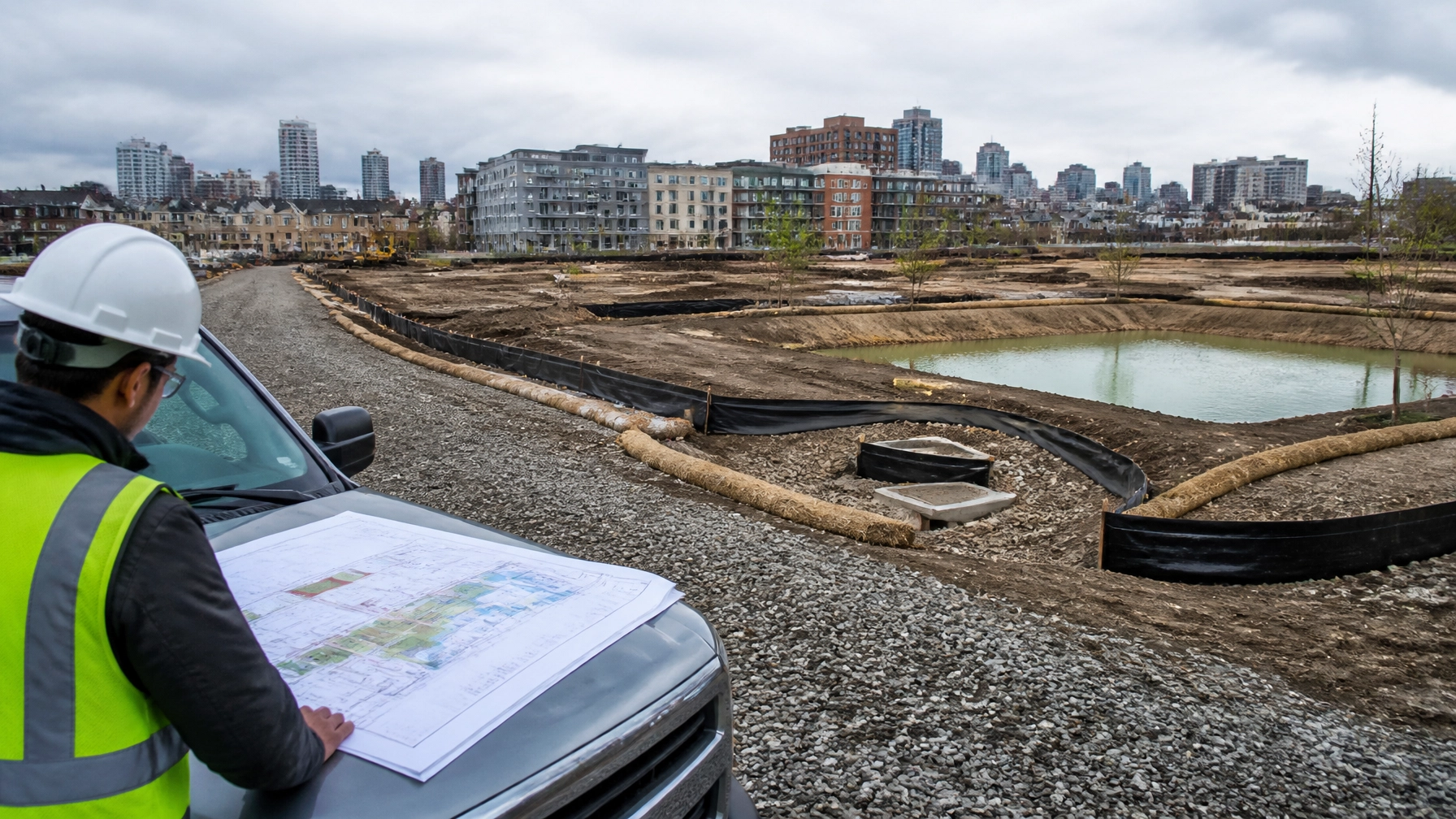
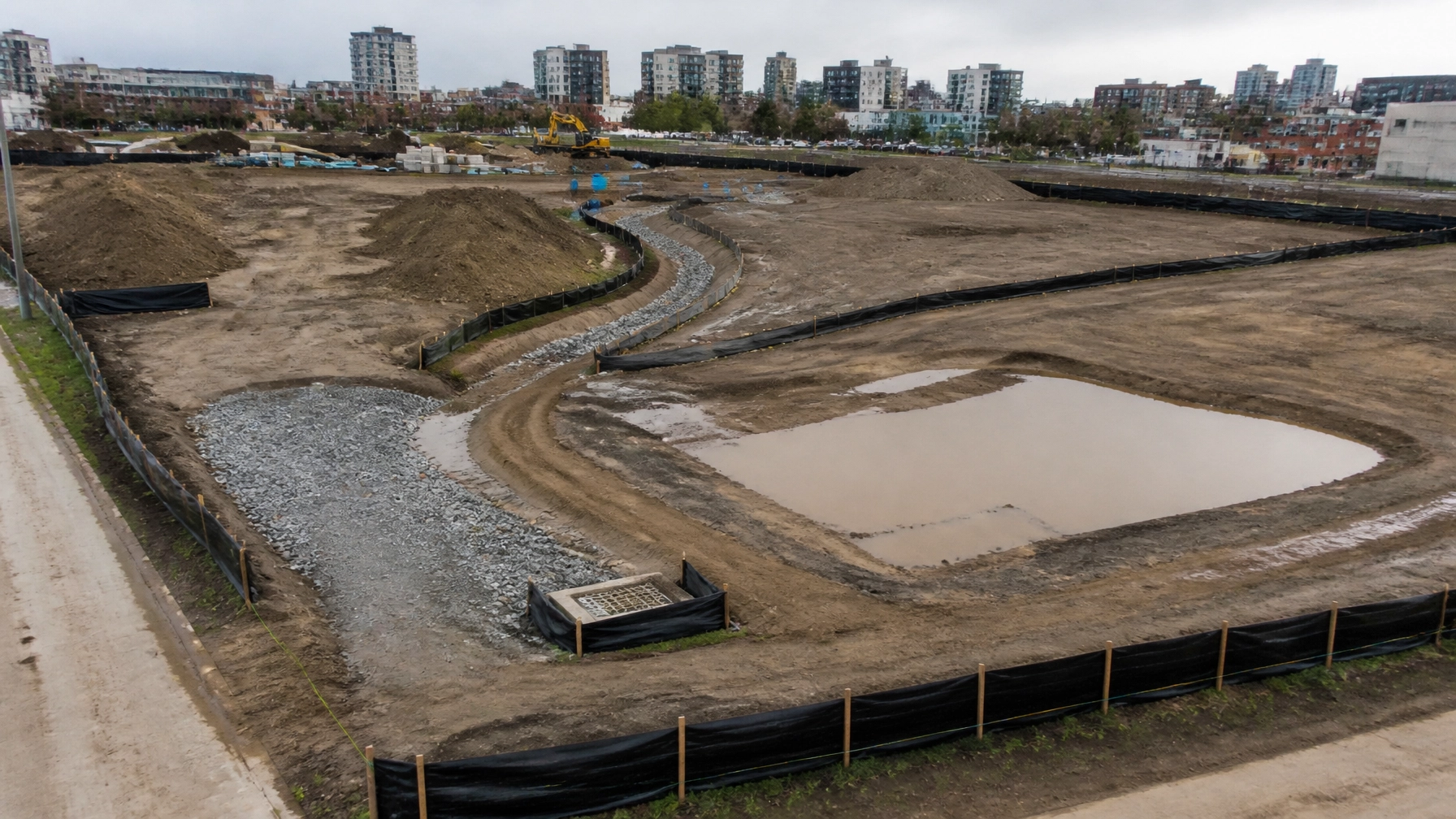
    Aerial view of an urban construction site showing temporary swales, sediment basin, silt fencing, and stabilized access

    Contractor responsibilities under the SWPPP

    Contractors need clear direction before mobilization. Their responsibilities may include:

    • Installing BMPs before disturbing soil
    • Keeping controls in working condition
    • Following the approved construction sequence
    • Protecting storm drains and discharge points
    • Covering or securing stockpiled materials
    • Maintaining stabilized entrances
    • Managing concrete washout and construction waste
    • Reporting damage, bypasses, spills, or unauthorized discharges
    • Cooperating with scheduled and post-rain inspections
    • Correcting deficiencies promptly
    • Keeping required records available on site

    The owner or developer should identify who has authority to stop work or direct corrective action. A SWPPP consultant should not be expected to solve a field problem that the contractor refuses to report or correct.

    Clear accountability protects the project. It also prevents a minor BMP failure from becoming a larger discharge, inspection issue, neighbor complaint, or agency deficiency.

    Field checklist before groundbreaking

    Use this checklist during your pre-construction SWPPP review:

    • Confirm the total disturbance area.
    • Review whether the work is part of a common plan.
    • Identify the applicable county Soil Conservation District.
    • Confirm Soil Erosion and Sediment Control approval status.
    • Confirm required certification and identification information.
    • Prepare and submit the NJPDES 5G3 RFA.
    • Confirm the current permit version and agency filing requirements.
    • Match grading, drainage, and utility plans to the SWPPP.
    • Identify temporary discharge and dewatering points.
    • Confirm BMP locations in the field.
    • Assign inspection and maintenance responsibilities.
    • Train the superintendent and relevant subcontractors.
    • Establish rain-event response procedures.
    • Confirm stabilization materials and sequencing.
    • Keep approved plans, permits, inspection forms, and contact information available on site.

    Local SWPPP support for Hudson and northern New Jersey

    Jersey City and Newark projects face tight sites, active streets, dense utilities, constrained staging, and fast construction schedules. Hoboken and Bayonne projects may add waterfront, flood, tidal, or redevelopment constraints. Projects across Hudson County, Bergen County, and Essex County also move through different municipal and county review environments.

    Envicon’s Jersey City environmental consulting team supports developers and contractors across the region with permit-ready SWPPP preparation, civil coordination, inspections, field documentation, and regulatory communication.

    We do more than deliver a plan. We help make sure the plan works when the excavator arrives.

    Request a pre-construction SWPPP review

    Before groundbreaking, ask Envicon to review your disturbance limits, grading and drainage plans, Soil Erosion and Sediment Control status, NJPDES 5G3 RFA path, inspection responsibilities, and construction sequencing.

    Request a site-specific scope through Envicon’s contact page, or call (917) 764-2171.

    Our team will review the project facts, identify the applicable scope, and outline the next steps. Current permit status and lead times depend on the project and agency review, so early coordination matters.

    The goal is simple: protect the site, satisfy the permit, and keep construction moving.

  • Local Law 97: The August 2026 REC Option and What It Means for NYC Building Owners

    Local Law 97: The August 2026 REC Option and What It Means for NYC Building Owners

    As of August 31, 2026, New York City building owners are dealing with two separate Local Law 97 issues.

    First, the extended filing deadline for the 2026 reporting cycle passed on August 29. That deadline applied to owners who requested an extension by June 30.

    Second, NYC building owners can now access a new renewable energy credit option, commonly called the NYC LL97 REC option. The credits may help offset electricity-related emissions, but they don't eliminate the need for building upgrades, accurate reporting, or a long-term decarbonization plan.

    For landlords, property investors, and asset managers, the distinction matters. A REC can address part of an emissions calculation. It doesn't fix an inefficient boiler, correct missing energy data, or protect a project from a poorly coordinated retrofit.

    The 2026 Local Law 97 compliance timeline

    Most buildings over 25,000 gross square feet must meet annual greenhouse gas emissions limits under Local Law 97. The law may also apply when multiple buildings on one tax lot exceed the applicable combined square footage threshold.

    The 2026 reporting cycle covers emissions from calendar year 2025. The key dates were:

    • May 1, 2026: Standard deadline for the annual LL97 report.
    • June 30, 2026: Grace period deadline and last day to apply for an extension.
    • August 29, 2026: Extended filing deadline for owners who applied by June 30 and received approval.

    The August 29 deadline did not change a building's emissions limit. It only extended the time to file the report.

    If your building had an approved extension, confirm that the report was submitted through the NYC Department of Buildings LL97 reporting system. If you did not apply for an extension by June 30, August 29 did not create a new filing window.

    DOB's guidance is direct:

    “Building owners are responsible for verifying the accuracy of all information used for compliance and reporting.”

    That includes the building's Covered Buildings List status, gross floor area, BIN and BBL information, occupancy classification, energy use, and compliance pathway.

    What happens when an Article 320 building misses the filing deadline?

    For buildings covered under Article 320, the penalty structure has two separate parts.

    Late filing

    The late-filing penalty is:

    $0.50 per square foot per month

    The penalty can continue to accrue until the required report is filed. For a 100,000-square-foot building, that equals $50,000 per month before considering any other penalty exposure.

    Exceeding the annual emissions limit

    The overage penalty is:

    $268 per metric ton of CO2e above the annual limit

    These penalties are calculated separately. Filing a report does not automatically mean the building meets its emissions limit. Likewise, purchasing an eligible REC does not excuse a missed filing.

    DOB lists the Article 320 penalty formula and related enforcement information on its LL97 GHG Emissions Violations page.

    Owners should not wait for a Notice of Violation before reviewing their exposure. The practical first step is to determine:

    • Whether the building filed on time or under an approved extension.
    • Whether the reported energy data is complete.
    • Whether the building exceeds its annual emissions limit.
    • Which portion of the emissions comes from electricity.
    • Which portion comes from onsite fossil fuel combustion.
    • Whether the building has a viable compliance pathway beyond paying penalties.

    How the new NYC LL97 REC option works

    A renewable energy credit represents the environmental attributes of one megawatt-hour of renewable electricity.

    Under current DOB policy, qualifying RECs may be used to deduct emissions associated with utility-supplied electricity. The eligible renewable resource must meet specific requirements, including delivery into or direct sinking into New York City's electrical grid, also known as Zone J.

    As reported by Gothamist and The Real Deal, NYSERDA opened the first sale of LL97-eligible Tier 4 RECs on August 19, 2026.

    The first sale included:

    • Approximately 50,000 Tier 4 RECs.
    • A price of $35.52 per REC.
    • A minimum purchase of 1,000 RECs.
    • A minimum purchase cost of approximately $35,520.
    • A sale window running through September 2, 2026.
    • Credits associated with renewable power delivered into NYC, including power connected to the Champlain Hudson Power Express.

    These credits are intended for the 2027 compliance year. In practical terms, owners purchasing credits in this initial sale would use them in a future filing covering 2027 emissions, not to retroactively solve the 2025 emissions report due in 2026.

    RECs must be properly documented, owned and retired by or on behalf of the building owner, and tied to the applicable reporting year. The building owner must also avoid double-counting the environmental attributes.

    What RECs can and cannot offset

    This is the most important point for NYC building owners.

    RECs can address electricity-related emissions

    A building with a significant electricity-related overage may be able to use qualifying RECs to reduce the emissions counted against its annual limit under the current standard compliance pathway.

    This could be relevant for properties with:

    • High electricity consumption.
    • Efficient or recently upgraded heating systems.
    • Limited short-term capital available for additional improvements.
    • A modest overage driven primarily by grid electricity.
    • A need for a bridge while larger capital work moves through design and permitting.

    At the current price, RECs may appear less expensive than the $268 per metric ton LL97 penalty. But the comparison requires a proper emissions calculation. One REC equals one megawatt-hour, while the penalty is calculated by metric ton of CO2e. Those are different units.

    RECs cannot offset onsite fossil fuel emissions

    RECs cannot be used to erase emissions from onsite gas or oil combustion.

    They do not replace:

    • Boiler upgrades.
    • Heat pump installation.
    • Building envelope improvements.
    • Steam distribution improvements.
    • Domestic hot water conversion.
    • Fuel switching.
    • Controls and commissioning.
    • Physical reductions in onsite emissions.

    A building that exceeds its limit because of gas-fired boilers will not solve the problem by purchasing electricity-related RECs.

    The DOB REC Frequently Asked Questions and LL97 REC Policy explain the electricity-only limitation and the Zone J requirements.

    Technical visualization of renewable power entering NYC Zone J and being tracked through REC accounting

    The current REC flexibility may not last

    As of August 2026, current rules allow broader use of qualifying RECs for electricity emissions under the standard compliance pathway. That does not mean owners should build a long-term asset strategy around unlimited REC purchases.

    The policy is under active debate.

    City Council legislation, including Intro 0159-2026, would limit how much of an emissions overage a building could address through RECs. The NYC Comptroller has also recommended a cap.

    Those proposals are not the same as current law. Owners should not treat a proposed 10% or 30% cap as an active requirement unless and until the applicable legislation or DOB rule takes effect.

    The signal is still clear. NYC policymakers want RECs to support decarbonization, not replace it.

    There is also a major restriction for owners using the Decarbonization Plan pathway. Under current DOB guidance, owners using that pathway cannot rely on RECs to achieve emissions reductions through 2029. The pathway requires building-level work and documented good-faith efforts.

    That distinction makes compliance pathway selection a technical and financial decision. It should not be made by a broker, property manager, or energy vendor working without the full building record.

    How LL97 decisions interact with construction and environmental work

    Energy upgrades rarely happen in isolation.

    A boiler replacement, heat pump installation, electrical service upgrade, rooftop equipment installation, or building envelope project may require:

    • NYC Department of Buildings coordination.
    • Electrical and mechanical design.
    • Roof or structural review.
    • Utility coordination.
    • Construction sequencing.
    • Tenant and occupant planning.
    • Asbestos or lead review.
    • Soil and groundwater assessment for excavation.
    • Stormwater controls.
    • Air monitoring and construction environmental oversight.

    If a project includes trenching, excavation, demolition, tank removal, soil handling, or work at a historically industrial property, the energy scope can also trigger environmental obligations.

    That is where Envicon's NYC environmental consulting team and regulatory compliance and permitting services fit into the process. We help coordinate the regulatory path, field conditions, documentation, and agency requirements before construction creates avoidable delays.

    Environmental monitoring also matters during active work. Dust, odors, impacted soil, dewatering, vapor concerns, and contractor changes can affect both compliance and schedule. A retrofit that looks simple on paper can become a field problem if nobody is tracking what is actually happening onsite.

    This is why compliance should be managed as a program, not as a stack of disconnected reports.

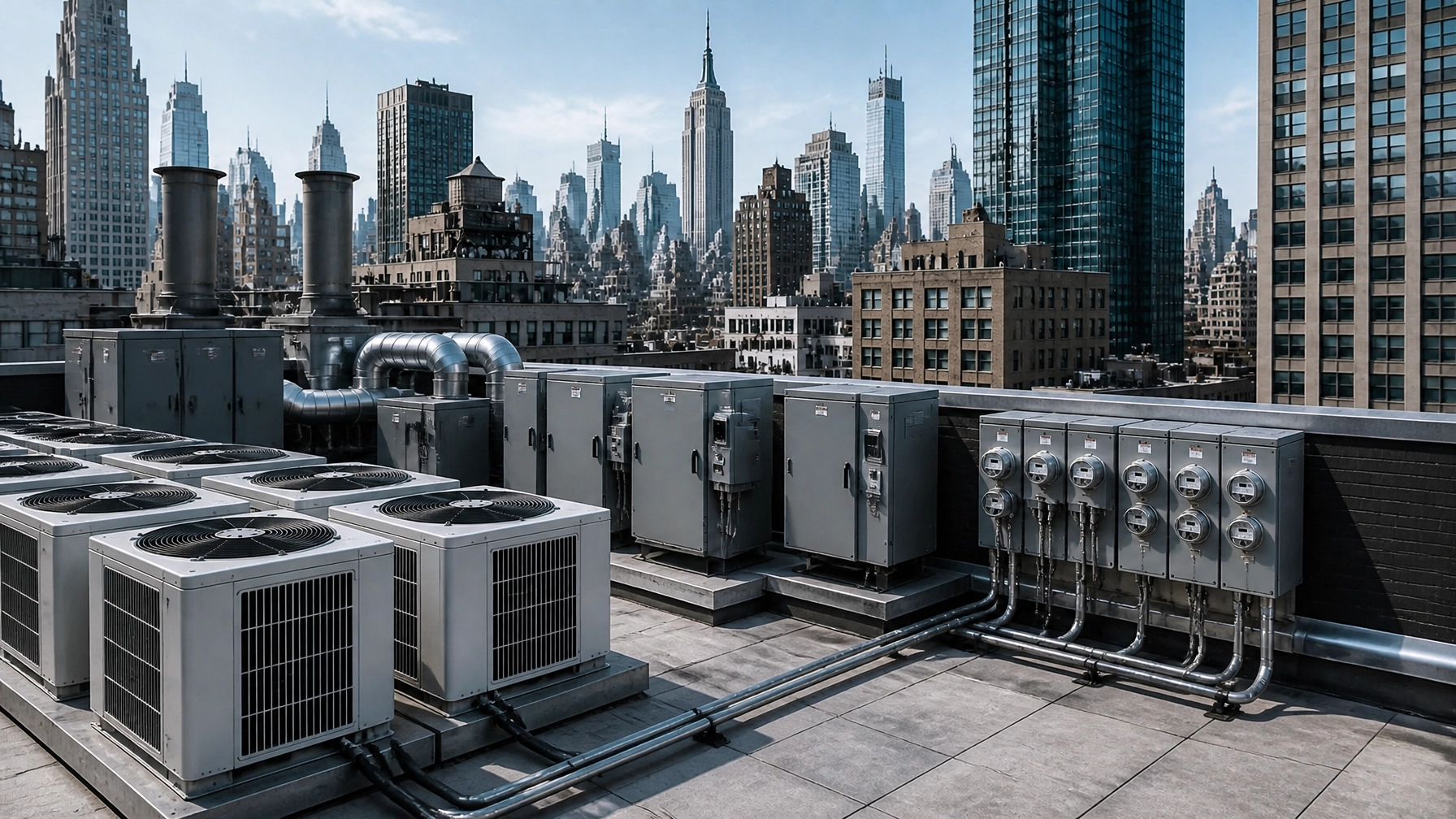
    Commercial building mechanical room showing legacy gas equipment alongside electrification and submetering systems

    What NYC building owners should do now

    Whether or not you purchased RECs, review your LL97 position before the next filing cycle.

    1. Confirm filing status

    Check the BEAM Portal and retain confirmation of submission. If the report was not filed, identify the reason and address it immediately.

    2. Verify the building record

    Review the 2026 Covered Buildings List, gross square footage, BIN, BBL, occupancy, and compliance pathway. DOB states that the CBL is a reference tool. Owners remain responsible for verifying their own information.

    3. Separate electricity from onsite fuel

    Do not evaluate REC eligibility using a single total emissions number. Break out grid electricity, natural gas, fuel oil, steam, and other applicable sources.

    4. Model multiple scenarios

    Compare:

    • Physical energy upgrades.
    • REC purchases.
    • Penalty exposure.
    • Financing and incentive programs.
    • The cost of delay.
    • Future emissions limits.
    • The possibility of tighter REC rules.

    5. Connect compliance to capital planning

    A REC may be a short-term bridge for electricity-related emissions. It should not delay work that the property will need to meet tighter limits in 2030 and beyond.

    6. Coordinate construction impacts early

    If the project involves excavation, soil disturbance, demolition, tanks, groundwater, or vapor concerns, include environmental review and monitoring in the schedule before contractors mobilize.

    The bottom line for Local Law 97 compliance 2026

    The August 29 extension deadline was a filing deadline, not a penalty waiver. Owners who received an extension needed to file by that date. Owners who missed the applicable deadline may face a monthly filing penalty of $0.50 per square foot.

    The new NYC LL97 REC option gives eligible building owners another tool. Qualifying Tier 4 RECs can address electricity-related emissions. They cannot offset onsite gas or oil combustion. They also do not replace accurate reporting, capital planning, or physical decarbonization.

    The right strategy depends on the building's actual emissions profile, compliance pathway, operating systems, capital plan, and construction schedule.

    At Envicon, collaboration is not a buzzword. It's how we work. We bring licensed professionals, field oversight, regulatory coordination, and direct accountability to the same table.

    We don't just deliver reports. We help clear the path from compliance risk to a buildable, investable, and resilient asset.

    Take the next step with Envicon

    Envicon Group logo

  • Phase II ESA Cost Jersey City and Newark: Sampling Scope for NJ Commercial Acquisitions

    Phase II ESA Cost Jersey City and Newark: Sampling Scope for NJ Commercial Acquisitions

    If you’re searching for Phase II ESA cost Jersey City Newark, the first thing to understand is that a responsible scope does not come from a universal price sheet.

    A Phase II Environmental Site Assessment can involve a few targeted soil borings. It can also require groundwater wells, soil vapor testing, PFAS analysis, traffic control, regulatory coordination, and LSRP involvement. The difference comes from the property’s history, the findings in the Phase I, lender requirements, site access, and the level of certainty needed before closing.

    For commercial acquisitions in Jersey City, Newark, Hoboken, Bayonne, Hudson County, Essex County, and Bergen County, the right question is not simply, “What does a Phase II cost?”

    The better question is:

    What sampling scope will answer the environmental risk question without creating avoidable gaps, delays, or rework?

    Phase II ESA cost in Jersey City and Newark depends on the sampling scope

    The phrase “Phase II ESA” usually describes an intrusive environmental investigation. The work may include soil, groundwater, soil vapor, or a combination of media.

    New Jersey’s regulatory framework uses different terms. NJDEP generally refers to a sequence of Preliminary Assessment, Site Investigation, and Remedial Investigation under N.J.A.C. 7:26E. In a transaction, a consultant may still use “Phase II” to describe due diligence sampling intended to evaluate recognized environmental conditions identified during a Phase I ESA.

    That distinction matters. A transaction-focused investigation may answer whether a property appears acceptable for acquisition. A regulated Site Investigation or Remedial Investigation may require broader characterization, additional reporting, and an LSRP-led process.

    The scope should be clear before fieldwork begins.

    How the Phase I ESA shapes your Phase II budget

    A Phase I ESA should identify recognized environmental conditions, historical uses, adjoining property concerns, and potential areas of concern. Those findings determine where and how the Phase II investigation should begin.

    For example, a former:

    • Gas station may require petroleum-focused soil and groundwater sampling.
    • Dry cleaner may justify volatile organic compound testing and vapor evaluation.
    • Manufacturing facility may require VOCs, SVOCs, metals, PCBs, and other site-specific analytes.
    • Metal-plating operation may raise concerns about metals, chlorinated solvents, and process chemicals.
    • Rail yard or industrial waterfront parcel may involve historic fill, petroleum, metals, and groundwater impacts.
    • Firefighting foam storage or use area may justify PFAS consideration.

    The Phase I does not automatically dictate every sample location. It provides the factual basis for a sampling plan. A strong Phase II scope connects each boring, well, and laboratory analysis to a specific environmental question.

    Our Phase I ESA service helps establish that connection before you commit to intrusive work.

    The main cost drivers for a Phase II environmental site assessment in NJ

    1. Number and depth of soil borings

    The number of borings depends on the size of the property, the number of recognized conditions, the building footprint, historical operations, and the need to evaluate both source areas and likely migration pathways.

    Depth also affects cost. A boring that stops above shallow fill is not equivalent to one advanced through fill to groundwater. Deeper work requires more drilling time, additional soil handling, more samples, and potentially greater utility and access planning.

    Urban properties in Jersey City, Newark, Hoboken, and Bayonne often contain pavement, concrete slabs, historic fill, buried utilities, and limited staging areas. Those conditions can increase mobilization and field time.

    2. Monitoring wells and groundwater depth

    Groundwater sampling may be appropriate when:

    • The Phase I identifies a likely release that could affect groundwater.
    • Soil results indicate contamination near or below the water table.
    • A petroleum, dry-cleaning, industrial, or solvent-related use occurred onsite or nearby.
    • The lender requires groundwater data.
    • Groundwater flow direction is needed to evaluate off-site migration.
    • The site lies near a waterfront, tidal influence, or shallow groundwater setting.

    A temporary well point may be sufficient for a focused transaction investigation in some cases. Permanent monitoring wells may be more appropriate when repeated sampling, plume delineation, or regulatory follow-up is likely.

    Groundwater depth affects drilling time, well construction, purge and sampling procedures, laboratory analysis, and reporting. It also affects whether a single round of samples provides enough information for the transaction decision.

    3. Soil vapor and vapor intrusion

    Soil vapor testing is not automatically required at every commercial property. It becomes more relevant when volatile contaminants are present or suspected and occupied or planned buildings could be affected.

    A vapor scope may involve:

    • Exterior soil gas points.
    • Near-slab sampling.
    • Sub-slab sampling.
    • Indoor air sampling.
    • Groundwater evaluation near a structure.
    • Multiple sampling events or seasonal considerations.

    NJDEP’s Vapor Intrusion Technical Guidance and Vapor Intrusion Screening Levels provide the technical framework for evaluating this pathway.

    Under N.J.A.C. 7:26E-1.15, vapor intrusion evaluation can be triggered when volatile contaminants in groundwater, soil gas, or indoor air meet applicable conditions. The exact scope depends on the contaminant, distance to the building, building use, and available lines of evidence.

    A vapor investigation can add meaningful cost, but skipping a justified vapor evaluation can create a larger problem during lender review, design, permitting, or occupancy.

    Soil core liners, groundwater well components, sampling bottles, and field documentation used during a New Jersey environmental investigation

    4. Contaminant history and laboratory methods

    Laboratory analysis is one of the most important cost variables.

    A limited petroleum panel is not priced like a broad suite covering VOCs, SVOCs, pesticides, PCBs, metals, emerging contaminants, and PFAS. The required laboratory method also matters. PFAS analysis requires specialized procedures, quality controls, sample handling, and laboratory capabilities.

    The analytical plan should reflect the property’s history. It should not be selected by default from a generic checklist.

    The wrong laboratory scope creates two risks:

    1. You pay for unnecessary testing.
    2. You miss an analyte that a lender, regulator, or future buyer expects to see.

    5. PFAS Phase II ESA Newark and other New Jersey sites

    PFAS deserves careful treatment. A property does not automatically require PFAS sampling simply because it is in Newark, Jersey City, or another New Jersey municipality.

    PFAS may be relevant when:

    • Historical operations involved metal plating, manufacturing, coatings, textiles, firefighting foam, or related activities.
    • The Phase I identifies a known or suspected PFAS source.
    • The property is connected to a regulated remediation case.
    • An AOC is unknown or not well documented.
    • NJDEP requirements, lender conditions, or project-specific risk decisions support testing.

    NJDEP lists groundwater quality standards of 0.014 micrograms per liter for PFOA, 0.013 micrograms per liter for PFOS, and 0.013 micrograms per liter for PFNA. See NJDEP’s Ground Water Quality Standards and PFAS program resources.

    NJDEP also adopted PFAS-related changes affecting remediation standards and technical requirements in 2026. Where potential contaminants in an AOC are unknown or not well documented, the applicable regulatory investigation may require broader analyte coverage. That does not mean every transactional Phase II ESA requires the same PFAS scope. The trigger, site status, regulatory pathway, and purpose of the investigation must be evaluated.

    6. Access, traffic control, and urban conditions

    A boring in an open gravel lot is different from a boring in an active parking facility, roadway, loading dock, or occupied commercial building.

    Cost can increase when the project requires:

    • Concrete or asphalt coring.
    • Utility mark-outs and clearance procedures.
    • Night or off-hours work.
    • Traffic control in Newark or Jersey City.
    • Coordination with tenants and property managers.
    • Limited drill-rig access.
    • Indoor sampling.
    • Restoration of paved surfaces.
    • Soil cuttings or investigation-derived waste management.
    • Coordination with construction or demolition activities.

    These are not administrative details. They determine how efficiently the field team can work and whether the sampling locations actually answer the environmental questions.

    Decision table: when is expanded sampling justified?

    Site condition or transaction concern Sampling approach that may be justified Why it matters
    One well-documented source area with limited historical use Targeted soil borings and focused laboratory analysis Efficiently tests the known concern without overbuilding the scope
    Former petroleum use with shallow groundwater Soil borings plus groundwater sampling Evaluates source impacts and potential migration
    Dry cleaner, solvent use, or VOC history near a building Soil, groundwater, and potentially soil vapor Addresses the vapor intrusion pathway
    Suspected PFAS source or regulated NJDEP site PFAS analysis in applicable media Evaluates contaminants with very low applicable standards
    Unknown or poorly documented AOC Broader sampling and analytical suite Reduces the chance of missing an unexpected contaminant
    Historic fill across a large urban parcel Multiple biased borings at varied depths Characterizes fill, underlying soil, and potential migration
    Lender requires regulatory closure or a clear pathway Expanded documentation and possible LSRP review Aligns the report with financing and future liability concerns
    Initial results exceed applicable standards Additional delineation and regulated investigation planning Determines whether the matter has moved beyond transaction screening

    The table is a planning tool, not a substitute for a site-specific work plan. A sampling program should be adjusted to the property and the transaction deadline.

    Environmental consultant collecting samples beside a compact drill rig with temporary well and traffic control at an urban New Jersey redevelopment site

    Lender requirements can change the answer

    A lender may accept a focused investigation for one transaction and require additional work for another. The difference may involve loan size, property use, environmental insurance, historical operations, or the lender’s internal risk policy.

    Common lender questions include:

    • Were all recognized environmental conditions addressed?
    • Were samples collected from the likely source areas?
    • Was groundwater evaluated where appropriate?
    • Was vapor considered for occupied or planned buildings?
    • Were the laboratory methods appropriate?
    • Do the findings support a recognized environmental condition, controlled REC, or other conclusion?
    • Is an LSRP involved or needed?
    • Does the report provide a clear recommendation for closing?

    This is why “Phase II ESA lender requirements Hudson County” should not be treated as a single checklist. Requirements vary by lender and property. We recommend obtaining the lender’s environmental conditions early, then comparing them with the Phase I findings and proposed sampling scope.

    When LSRP involvement becomes important

    An LSRP is not automatically required for every Phase II ESA performed as private transaction due diligence. However, the work may enter a different regulatory framework if sampling identifies contamination above applicable standards, a discharge requires reporting, or the buyer intends to pursue NJDEP remediation, a Response Action Outcome, or another regulatory endpoint.

    At that point, the project may require:

    • Formal PA, SI, or RI documentation.
    • Expanded delineation.
    • NJDEP submissions.
    • Remedial alternatives analysis.
    • Groundwater or vapor mitigation.
    • Soil management planning.
    • LSRP oversight and certification.

    Our NJ LSRP services support clients when a transaction concern becomes a regulatory project. The earlier that transition is recognized, the easier it is to control schedule and cost.

    A better way to evaluate Phase II ESA cost in Jersey City and Newark

    At Envicon, we do not start with a generic package and add change orders after mobilization.

    We review:

    • The Phase I findings.
    • Historical site operations.
    • Existing reports and regulatory records.
    • Building and utility constraints.
    • Groundwater and vapor conditions.
    • Lender requirements.
    • The acquisition schedule.
    • The likely NJDEP pathway.
    • Whether the investigation needs to support a transaction decision, financing, design, or regulatory closure.

    Then we build a scope that is technically defensible and commercially useful.

    That means targeted sampling when targeted sampling is enough. It means expanded investigation when the site history or data requires it. Our environmental assessment services are designed to give you a clear path from findings to action.

    Takeaway for NJ commercial acquisitions

    There is no responsible universal price for a Phase II ESA in Jersey City, Newark, Hoboken, Bayonne, Bergen County, Hudson County, or Essex County.

    The cost depends on the questions the investigation must answer:

    • How many borings are needed?
    • How deep must they go?
    • Is groundwater present or potentially impacted?
    • Does the building create a vapor concern?
    • Do PFAS or other emerging contaminants require evaluation?
    • Is the AOC well documented?
    • What does the lender require?
    • Will an LSRP or NJDEP involvement be necessary?
    • Can the work be completed without disrupting active operations?

    A well-designed scope controls cost by reducing uncertainty before the drill rig arrives. It also protects the transaction from the more expensive outcome: incomplete data, lender rejection, re-mobilization, or a regulatory issue discovered after closing.

    CTA: Review your Phase II scope before you mobilize

    Have a Phase I with RECs? Buying a commercial property in Jersey City, Newark, Hoboken, Bayonne, Bergen County, Hudson County, or Essex County?

    Request a Phase II ESA scope review before you authorize fieldwork.

    You can also use our project risk screener to identify potential environmental and project risks, or call Envicon at (917) 764-2171.

    The right investigation does more than produce samples. It gives you a defensible decision and a clearer path to closing.

  • RGGI Final Rules Take Effect January 2027: What the Stricter CO2 Cap Means for NY and NJ Facilities

    RGGI Final Rules Take Effect January 2027: What the Stricter CO2 Cap Means for NY and NJ Facilities

    Published August 31, 2026 at 2:00 PM ET

    The Regional Greenhouse Gas Initiative is tightening its rules.

    On August 5, 2026, the New York State Department of Environmental Conservation and NYSERDA finalized amendments implementing the Third Program Review. The updated rules take effect January 1, 2027. New Jersey has also moved to align its CO2 Budget Trading Program with the updated RGGI model rule.

    The central change is the NYSDEC RGGI cap. The regional CO2 allowance budget will fall to 69,806,919 tons in 2027, or approximately 69.8 million tons. The cap then declines by approximately 8.5 million tons per year through 2033, equal to about 10.5% of the 2025 budget annually. From 2034 through 2037, the cap declines by approximately 2.4 million tons per year, or roughly 3% of the 2025 budget.

    For power generators, industrial operators, large energy users, utilities, and developers, this is not a future policy issue. It affects 2027 operating budgets, energy procurement, facility planning, permitting, and project risk today.

    What the RGGI 2027 regulations change

    RGGI requires covered power plants to obtain one allowance for each short ton of CO2 emitted. The program operates across participating states, so the 69.8 million-ton figure is a regional cap. Each state receives a portion of that budget.

    The new rules reduce the 2027 budget from the previously planned 75,717,784 tons to 69,806,919 tons. That is a reduction of approximately 5.9 million allowances before the scheduled annual reductions continue.

    The updated framework also changes the market’s cost-containment tools:

    • Two Cost Containment Reserve tiers begin in 2027.
    • Tier 1 has a 2027 trigger price of $19.50.
    • Tier 2 has a 2027 trigger price of $29.25.
    • Each tier can provide approximately 11.75 million additional allowances per year.
    • The Emissions Containment Reserve is removed.
    • The 2027 auction reserve price increases to $9 and rises by 7% annually.
    • New offset project categories are eliminated, although previously issued offset allowances remain valid for compliance.

    These mechanisms can add supply if allowance prices reach established trigger levels. They do not remove the underlying pressure created by a declining cap.

    The NYSDEC RGGI program page and the agency’s August 5 final rule announcement provide the controlling New York information.

    Emissions monitoring equipment and industrial analyzer system representing facility-level RGGI compliance

    Who faces direct compliance obligations?

    RGGI applies directly to covered fossil-fueled electric generating units. That means power generators must evaluate their allowance position, emissions forecasting, monitoring systems, reporting procedures, and procurement strategy before the 2027 compliance year begins.

    The analysis is more nuanced for other facilities.

    Power generators

    Generators should model compliance under several operating scenarios. A unit that runs more hours, burns a different fuel, or supports increased regional demand may create a larger allowance obligation.

    The 2027 cap also changes the value of operational improvements. Heat-rate efficiency, fuel switching, dispatch planning, controls, renewable integration, and retirement decisions can affect both emissions and allowance exposure.

    Industrial facilities and large energy users

    A manufacturing plant, refinery, data center, hospital, or logistics facility may not face a direct RGGI obligation simply because it consumes significant electricity. However, the facility can still experience indirect effects through:

    • Higher or more volatile electricity costs.
    • Utility procurement and rate structures.
    • On-site generation decisions.
    • Backup generation and fuel storage planning.
    • Electrification and energy-efficiency investments.
    • Interconnection requirements for new load.
    • Capital planning for low-carbon energy systems.

    Facilities with their own generating units need a specific applicability review. Do not assume that a behind-the-meter generator, cogeneration system, or expansion falls outside the program. The unit’s design, fuel, capacity, operating profile, and regulatory status matter.

    Developers and infrastructure owners

    Developers often encounter RGGI through the infrastructure around a project rather than through the building itself.

    A new industrial, commercial, residential, or mixed-use project may require:

    • Utility upgrades or new substations.
    • Backup generation.
    • Natural gas service extensions.
    • Renewable generation or battery storage.
    • District energy systems.
    • Electrical service increases.
    • New access roads, equipment yards, or transmission corridors.

    Each decision can affect environmental review, air permitting, stormwater design, site layout, construction sequencing, and long-term operating costs.

    That is why energy infrastructure should be evaluated during site due diligence, not after the civil plans are substantially complete.

    Allowance costs are already a planning concern

    The allowance market has been under pressure. ClearBlue Markets reported that RGGI allowance prices were trading around $40 per short ton in August 2026, with the June 2026 auction clearing at approximately $35. Those figures are market observations, not guaranteed future prices, but they show why facilities should not build a 2027 budget around the reserve price alone.

    Allowance cost exposure depends on several factors:

    • Annual CO2 emissions.
    • The facility’s existing allowance bank.
    • Future dispatch or production levels.
    • Procurement timing.
    • Auction and secondary-market conditions.
    • Availability of Cost Containment Reserve allowances.
    • The ability to reduce emissions through operational or capital improvements.

    A generator emitting 500,000 tons of CO2 annually could face a material compliance obligation even before considering market volatility. For a large industrial user, the indirect effect may appear through energy pricing, demand charges, or the cost of new generation capacity.

    The practical response is scenario planning. Model a base case, a high-demand case, and a reduced-emissions case. Then connect each scenario to a capital plan.

    RGGI allowance cost planning setup with emissions trajectory analysis and utility infrastructure context

    How RGGI interacts with site development in NY and NJ

    The RGGI cap does not replace traditional environmental permitting. It adds another planning variable.

    For a project in New York or New Jersey, an energy infrastructure decision may trigger overlapping reviews involving NYSDEC, NJDEP, local agencies, utilities, air permitting authorities, and construction regulators.

    For example, a developer planning a new facility in Hudson County may need to coordinate:

    • Utility capacity and interconnection requirements.
    • Air permits for emergency or prime generators.
    • Fuel storage and spill-prevention obligations.
    • Stormwater controls and SWPPP requirements.
    • Soil and groundwater management.
    • Construction air monitoring.
    • Environmental due diligence on former industrial land.
    • Easements for electrical or gas infrastructure.
    • Long-term restrictions or site management plans.

    A project team that evaluates these issues separately can lose months resolving conflicts between the energy plan, civil design, environmental report, and permit package.

    A coordinated review identifies the constraints before they become redesigns.

    Our compliance and permitting team works across NJDEP, NYSDEC, utility, air quality, stormwater, and construction requirements. Our environmental assessment services help developers and owners identify site conditions, regulatory obligations, and infrastructure risks early.

    Industrial redevelopment parcel with transmission infrastructure, substation, utilities, and planned building footprint

    What facilities should do before January 1, 2027

    The deadline is close enough that compliance planning should already be underway.

    For covered generators

    • Confirm applicability under the amended state rules.
    • Reconcile historical emissions, allowance holdings, and projected generation.
    • Review monitoring, recordkeeping, and reporting procedures.
    • Model allowance needs under multiple dispatch scenarios.
    • Evaluate efficiency, fuel, controls, storage, and retirement options.
    • Review contracts and responsibilities with energy managers and vendors.

    For industrial facilities and large energy users

    • Identify whether any on-site generation could create a direct RGGI obligation.
    • Quantify exposure to electricity price and capacity changes.
    • Review planned electrification, battery, solar, cogeneration, or backup systems.
    • Confirm air permitting and fuel-storage requirements.
    • Include energy infrastructure in environmental due diligence and capital planning.

    For developers

    • Add energy infrastructure to the early site constraint review.
    • Coordinate utility requirements with civil and environmental plans.
    • Evaluate air, stormwater, soil, groundwater, and construction impacts together.
    • Confirm whether the project may require agency coordination beyond the local building permit.
    • Build allowance and energy assumptions into feasibility models.

    New York has completed its rulemaking. New Jersey agencies filed proposed amendments on August 7, 2026, to align the state program with the 2025 RGGI model rule. The New Jersey filing and regulatory update should remain part of every NJ facility’s compliance watch list.

    The EDF Climate 411 analysis provides additional context on the regional cap trajectory, energy investments, and the expected 2027 implementation timeline. ClearBlue Markets’ analysis provides market perspective on allowance prices, the expanded Cost Containment Reserve, and supply-demand conditions.

    A tighter cap requires a better project process

    RGGI compliance is not only an emissions accounting issue. It is a project execution issue.

    A facility may have the right engineer but the wrong sequence. A developer may have a viable energy concept but discover too late that the utility upgrade conflicts with stormwater design or site access. A generator may understand its emissions but lack a defensible allowance forecast tied to actual operations.

    Envicon brings environmental assessment, regulatory compliance, civil engineering, and field oversight into one coordinated process. We work directly with owners, developers, attorneys, utilities, architects, contractors, and agencies across New York and New Jersey.

    As DEC Commissioner Amanda Lefton stated, “RGGI is a longstanding and successful example of multi-state collaboration that delivers real benefits to New Yorkers, including affordability, decreased emissions and improved public health.” Read the full agency announcement.

    The point for facility owners and project teams is simple. Do not wait for the first 2027 allowance cycle to identify your exposure. Review the operating data, site plans, permits, and infrastructure decisions now.

    Key takeaway

    The RGGI 2027 regulations establish a 69.8 million-ton regional CO2 cap beginning January 1, 2027. The cap declines sharply through 2033 and continues to tighten through 2037.

    For NY and NJ facilities, the right response is not speculation. It is a documented compliance plan connected to real operating conditions and real site decisions.

    The sooner you understand the obligation, the more options you have to control cost, protect schedule, and keep your project moving.

    Plan for 2027 with Envicon Group

  • NYSDEC Extends Part 253 GHG Reporting Deadlines: The New Compliance Calendar for 2026-2028

    NYSDEC Extends Part 253 GHG Reporting Deadlines: The New Compliance Calendar for 2026-2028

    On July 31, 2026, the New York State Department of Environmental Conservation issued an enforcement discretion letter affecting several early deadlines under 6 NYCRR Part 253, Mandatory Greenhouse Gas Reporting.

    The change follows legislative amendments to the Climate Leadership and Community Protection Act, or CLCPA. It gives regulated entities more time to submit emissions reports, verification statements, monitoring plans, and certain registrations.

    It does not eliminate the underlying obligations.

    For New York facilities, fuel suppliers, electric power entities, and waste operators, this is breathing room. It is not a pass.

    NYSDEC anticipates “full compliance no later than the extended dates” identified in the enforcement discretion letter.
    Read NYSDEC’s Mandatory Greenhouse Gas Reporting guidance

    What changed under NYSDEC Part 253?

    Part 253 became effective on December 25, 2025. The rule establishes registration, monitoring, annual reporting, and third-party verification requirements for covered greenhouse gas sources and suppliers in New York.

    The July 31 letter does not rewrite the regulation. It changes when NYSDEC will begin enforcing six specific deadlines while the Department works through the effect of the May 26, 2026 CLCPA amendments.

    That distinction matters.

    A statutory or regulatory deadline and an enforcement discretion date are not always the same thing. Your compliance plan should track both.

    The extended dates apply to:

    • Emissions data reports for the 2026 and 2027 reporting years
    • Verification statements for 2026 emissions
    • Large Emission Source GHG monitoring plans
    • Emissions Monitoring and Measurement Plans for certain waste facilities
    • Registrations for specified facilities or units using imported or exported electricity

    All other Part 253 requirements remain in effect unless NYSDEC provides additional guidance or formally amends the rule.

    The new 6 NYCRR Part 253 compliance deadlines

    The following calendar compares the underlying Part 253 deadline with the date through which NYSDEC has indicated it will exercise enforcement discretion.

    Regulatory calendar and emissions reporting timeline for a New York facility

    Obligation Original Part 253 deadline Extended NYSDEC enforcement date
    Emissions Monitoring and Measurement Plan for applicable solid or liquid waste management facilities September 1, 2026 March 1, 2027
    GHG monitoring plan for Large Emission Sources December 31, 2026 June 30, 2027
    Registration of anticipated sources for specified facilities or units using imported or exported electricity February 1, 2027 August 31, 2027
    2026 Emissions Data Report June 1, 2027 December 31, 2027
    Verification statement for the 2026 reporting year December 1, 2027 April 1, 2028
    2027 Emissions Data Report June 1, 2028 September 1, 2028

    The extended dates are the practical compliance calendar for the first Part 253 reporting cycle. However, regulated entities should not treat the original dates as irrelevant. They remain part of the current regulatory framework until NYSDEC formally amends Part 253.

    The Trinity Consultants update and Barton & Loguidice summary both emphasize the same point: the Department has delayed enforcement timing, not the work itself.

    What this means for New York facilities

    Large emission sources should use the additional time to build a defensible monitoring and reporting system.

    That includes confirming covered emission units, identifying required calculation methods, organizing fuel and operating data, and documenting the procedures used to develop the emissions inventory.

    A monitoring plan written at the last minute creates avoidable problems. It can leave gaps between facility operations, engineering records, meter data, and the final report.

    Large sources should address the following now:

    • Confirm whether the facility meets the Part 253 definition of a Large Emission Source.
    • Identify all covered emission units and applicable source categories.
    • Establish data owners for fuel use, process activity, electricity, and operating hours.
    • Document calculation methods and emission factors.
    • Create a quality assurance and quality control process.
    • Coordinate early with an independent verifier.
    • Preserve records in a format that supports future review.

    The June 30, 2027 extended date for the Large Emission Source monitoring plan may feel distant. It is not. The plan supports the first emissions data report and the verification process. Delaying the plan delays the entire reporting workflow.

    Fuel suppliers and electric power entities need a separate review

    Part 253 is not limited to traditional industrial facilities.

    Fuel suppliers and certain electric power entities may have registration or reporting obligations based on the products they supply, the electricity they import or export, and the thresholds established under the rule.

    For electric power entities, the key extended date is August 31, 2027 for registration of anticipated sources associated with specified facilities or units using imported or exported electricity.

    The first step is applicability. Do not assume that an entity falls outside the rule because it does not operate a conventional smokestack. Review the business structure, supply activities, electricity transactions, and facility relationships together.

    A useful internal screening should answer:

    • Does the entity supply covered fossil fuels or other regulated products?
    • Does it operate or control a facility subject to Part 253?
    • Does it use imported or exported electricity in a way that triggers registration?
    • Which entity owns the data needed for the registration?
    • Are corporate, facility, and reporting boundaries consistent?

    This is where a clear compliance matrix saves time. It also gives lenders, investors, counsel, and transaction teams a reliable record of what applies and what does not.

    Waste operators should not ignore the March 1, 2027 date

    The original September 1, 2026 EMMP deadline was one of the earliest Part 253 implementation dates. NYSDEC has extended enforcement for applicable Emissions Monitoring and Measurement Plans until March 1, 2027.

    This requirement affects certain solid or liquid waste management facilities, including facilities that meet the applicability thresholds identified in Part 253.

    Waste operators should use the extension to verify the monitoring approach, not to postpone the analysis.

    The EMMP should connect facility conditions to the measurements and records used in the emissions report. That may require coordination between operations personnel, environmental staff, maintenance teams, and outside consultants.

    A practical review should include:

    • Facility type and applicability threshold
    • Waste streams and handling methods
    • Methane or other relevant emissions sources
    • Monitoring equipment and measurement frequency
    • Data management and retention procedures
    • Reporting responsibilities
    • Verification support documentation

    A plan that exists only to satisfy a filing deadline will not provide much protection during an inspection or data review.

    Why the extension matters for NYC closings and financing

    For property investors and developers, Part 253 can affect more than facility operations. It can become part of environmental due diligence, financing review, acquisition underwriting, and closing coordination.

    A lender or investor may ask whether a facility has reporting obligations, whether emissions data is complete, and whether the property has any unresolved compliance exposure.

    For a New York City industrial or infrastructure asset, the review may need to sit alongside:

    • Phase I and Phase II Environmental Site Assessments
    • NYSDEC and NYC agency file reviews
    • Air permitting and emissions records
    • Environmental compliance audits
    • Brownfield or remediation obligations
    • Construction and operating permits
    • Utility and facility ownership records

    The extended reporting dates can help a transaction team sequence this work. They do not remove the need to identify the obligation before closing.

    If your acquisition depends on a clean environmental file, waiting for the final reporting deadline may create unnecessary uncertainty. A better approach is to identify the reporting position early, document the basis for the conclusion, and disclose open items before they become lender conditions.

    Envicon supports this work through regulatory compliance and permitting services, including compliance planning, air quality reporting, agency coordination, audit-ready documentation, and enforcement support.

    Our Phase I Environmental Site Assessment service can also help transaction teams evaluate environmental conditions, regulatory records, and reporting risks within a lender-ready due diligence process.

    What owners and operators should do now

    The extended dates should create a controlled work plan, not a new reason to wait.

    Start with these actions:

    1. Determine applicability. Identify whether the entity is a large emission source, fuel supplier, electric power entity, waste operator, or another covered reporting entity.

    2. Map the data. Identify where fuel, process, electricity, waste, and operating records reside.

    3. Build the calendar. Track both the original Part 253 deadlines and the extended enforcement dates.

    4. Assign responsibility. Establish one accountable owner for the reporting program and specific data owners for each source category.

    5. Review transaction impacts. If the facility is being acquired, refinanced, leased, or redeveloped, include Part 253 in the environmental due diligence scope.

    6. Engage technical support early. Monitoring plans, emissions calculations, and verification require time to review and correct.

    7. Watch for future rule amendments. NYSDEC is expected to continue addressing Part 253 in response to the CLCPA amendments.

    For NYC owners and developers, Envicon’s New York City environmental consulting team works across Manhattan, Brooklyn, Queens, the Bronx, and Staten Island. We coordinate environmental, civil, regulatory, and construction requirements under one accountable team.

    The bottom line

    The July 31, 2026 NYSDEC letter changes the immediate compliance calendar under Part 253:

    • Waste facility EMMPs move from September 1, 2026 to March 1, 2027.
    • Large Emission Source monitoring plans move from December 31, 2026 to June 30, 2027.
    • Electricity source registrations move to August 31, 2027.
    • The 2026 emissions report moves to December 31, 2027.
    • Verification statements for 2026 move to April 1, 2028.
    • The 2027 emissions report moves to September 1, 2028.

    The extension gives regulated entities time to prepare accurate systems, not permission to disregard the rule.

    For facilities and transaction teams, the right question is not simply, “When is the report due?” The right question is, “Can we prove that our reporting position is complete, accurate, and ready for the next lender, agency, verifier, or buyer who asks?”

    That is the standard that protects a project.

    Need help with NYSDEC Part 253 compliance?

    Envicon Group helps New York and New Jersey owners, operators, developers, and transaction teams solve environmental and engineering challenges with precision, speed, and trust.

    Envicon Group logo

  • Environmental Consultant Newark NJ: Coordinating Phase I ESA, LSRP, Asbestos, and Site Engineering

    Status: DRAFT

    A Newark acquisition rarely turns on one report. A commercial property in the Ironbound, Downtown Newark, the North Ward, or near the Passaic River may require environmental due diligence, NJDEP coordination, building-material surveys, civil design, and construction oversight before the project is ready to close or build.

    That is why choosing an environmental consultant Newark NJ developers can reach directly matters. The right team connects the findings, the regulatory path, and the construction plan before separate scopes create gaps.

    Envicon Group supports Newark and Essex County projects with coordinated environmental consulting, NJDEP LSRP services, brownfield redevelopment support, civil and geotechnical engineering, permitting, and field oversight.

    “Our mission” at New Jersey’s Contaminated Site Remediation & Redevelopment Program is “to reduce the number of contaminated sites in New Jersey to ensure the protection of public health and the environment and ready sites for redevelopment.” NJDEP CSRR

    Why Newark environmental due diligence requires coordination

    A Phase I ESA can identify historical and current environmental concerns. It does not, by itself, resolve subsurface contamination, confirm the condition of a UST, clear a vapor intrusion pathway, or determine whether a building contains asbestos or lead.

    For Newark commercial property, the acquisition team may need to evaluate:

    • Historic industrial and commercial uses
    • Historic fill and urban redevelopment conditions
    • Former dry cleaners, auto uses, rail operations, and manufacturing
    • Underground storage tanks and petroleum releases
    • Soil, groundwater, and soil vapor conditions
    • NJDEP case status and potential ISRA obligations
    • Asbestos and lead before renovation or demolition
    • Grading, drainage, utilities, foundations, and dewatering
    • Construction stormwater and SWPPP requirements

    A report that identifies a concern without explaining the next action leaves the buyer, lender, attorney, and contractor to solve the problem separately. That creates delay.

    Our approach is different. We define the transaction or redevelopment objective first, then build a scope that supports the closing date, permit date, and intended site use.

    Environmental engineer reviewing soil samples and groundwater sampling equipment

    Environmental scope: Phase I ESA, Phase II, historic fill, and USTs

    Phase I ESA Newark NJ

    A Phase I Environmental Site Assessment generally reviews property history, regulatory databases, aerial photographs, Sanborn maps, interviews, and current site conditions under ASTM E1527-21.

    The goal is to identify recognized environmental conditions, historical recognized environmental conditions, controlled recognized environmental conditions, and other areas that may require additional investigation.

    For a Newark property, the review should consider the site’s relationship to surrounding industrial parcels, former petroleum uses, rail corridors, waterfront operations, and older commercial buildings. A Phase I ESA is also commonly required by lenders before acquisition or refinancing.

    A Phase I ESA does not include soil, groundwater, or vapor sampling. If the assessment identifies a recognized environmental condition, a Phase II ESA may be appropriate.

    New Jersey transactions may also require a Preliminary Assessment that follows NJDEP requirements. A Phase I ESA and an NJDEP-focused Preliminary Assessment serve related but distinct purposes. The correct scope depends on the property history, transaction structure, regulatory status, and intended use.

    Phase II investigation and soil management

    A Phase II ESA may include:

    • Soil borings and laboratory analysis
    • Groundwater monitoring wells and sampling
    • Soil vapor or sub-slab vapor evaluation
    • Petroleum hydrocarbon testing
    • Metals and polycyclic aromatic hydrocarbon analysis
    • Data validation and comparison to applicable NJDEP standards

    Historic fill deserves special attention in Newark and throughout older urban areas of Essex County, Hudson County, and Bergen County. NJDEP defines historic fill as non-indigenous material placed to raise site elevation. It may include construction debris, ash, demolition material, dredge spoils, or other materials.

    NJDEP’s Historic Fill Material Technical Guidance explains that historic fill can be addressed through investigation, sampling, assumption, engineering controls, institutional controls, or other approved remedial strategies depending on the site conditions.

    The practical issue is not simply whether fill exists. The project team needs to know how it affects excavation, soil disposal, cap design, deed notices, groundwater, and the final site use.

    UST closure and vapor intrusion

    Former service stations, industrial facilities, and older commercial properties may contain current or abandoned underground storage tanks. A UST closure scope can include tank removal or closure-in-place, soil screening, confirmatory sampling, waste characterization, and NJDEP documentation.

    Vapor intrusion also matters when volatile chemicals are present in soil or groundwater beneath occupied or proposed buildings. Depending on the pathway, the evaluation may include soil gas, sub-slab vapor, indoor air, or mitigation design. Envicon provides vapor intrusion assessment and related mitigation support.

    Regulatory scope: NJDEP LSRP, ISRA, and case closure

    NJDEP LSRP Newark

    If contamination or a regulatory obligation requires formal remediation, an NJDEP LSRP in Newark can manage the case under New Jersey’s Site Remediation Reform Act framework.

    The LSRP may coordinate:

    • Preliminary Assessment and Site Investigation
    • Remedial Investigation and Feasibility Study
    • Remedial Action Work Plan preparation
    • NJDEP correspondence and submissions
    • Vapor intrusion investigation and mitigation
    • Soil and groundwater management
    • Engineering and institutional controls
    • Deed notices and site management plans
    • Response Action Outcome documentation

    The LSRP should be involved early when the property has an active NJDEP case, a known discharge, an ISRA trigger, a prior deed notice, or contamination that may affect the proposed redevelopment.

    ISRA review

    The Industrial Site Recovery Act can affect certain industrial establishments when ownership, operations, or other triggering events change. ISRA applicability depends on the facility’s operations and regulatory facts. It should not be assumed based only on the property’s current appearance.

    For an industrial acquisition in Newark or a nearby Hudson or Bergen County municipality, the due diligence team should review historical operations, applicable industrial classifications, NJDEP records, and the proposed transaction structure. Envicon’s complete services hub includes NJ ISRA compliance, LSRP oversight, and environmental assessment support.

    Building scope: asbestos and lead before renovation

    A Phase I ESA is not an asbestos survey. Older Newark commercial buildings, warehouses, multifamily properties, and mixed-use structures may require separate building-material evaluations before renovation or demolition.

    An asbestos and lead survey can help identify suspect materials before contractors disturb walls, flooring, roofing, insulation, fireproofing, or mechanical systems.

    For regulated facilities, federal Asbestos NESHAP requirements under 40 CFR Part 61, Subpart M may require a thorough inspection and advance notification. Renovation thresholds and demolition notification requirements depend on the facility and the quantity of regulated asbestos-containing material.

    The survey should be completed before the renovation schedule is locked. Discovering asbestos after mobilization can create abatement costs, rework, and permit delays.

    Environmental professionals coordinating renovation work inside an older Newark commercial building

    Engineering scope: civil, geotechnical, dewatering, and SWPPP

    Environmental findings must connect to the design.

    A Newark redevelopment may require:

    • Geotechnical borings and foundation recommendations
    • Grading and drainage design
    • Utility coordination
    • Excavation support and underpinning coordination
    • Construction dewatering design
    • Soil reuse, export, and disposal planning
    • Erosion and sediment control
    • Stormwater management
    • Construction monitoring and field QA/QC

    Envicon’s civil and geotechnical engineering team coordinates these needs with environmental data rather than treating them as separate files.

    If construction disturbs one acre or more, or is part of a larger common plan of development, NJPDES construction stormwater requirements may apply. A project-specific SWPPP and stormwater scope should be developed before soil disturbance begins. NJDEP construction stormwater resources are available through the NJPDES stormwater program.

    Civil and environmental engineers reviewing excavation, dewatering, and stormwater controls at a Newark redevelopment site

    A practical Newark project decision workflow

    1. Confirm the property and deadline

    Provide the street address, municipality, current use, proposed use, closing date, permit date, and lender or agency requirements.

    2. Complete the records and site review

    Start with Phase I ESA and NJDEP records. Review historical uses, UST records, known contamination, historic fill indicators, and building age.

    3. Decide whether sampling is needed

    If the review identifies a REC, AOC, potential vapor pathway, UST concern, or other exposure risk, define a Phase II or targeted investigation.

    4. Determine the regulatory path

    Evaluate NJDEP case status, LSRP retention, ISRA applicability, deed notices, engineering controls, and potential RAO requirements.

    5. Coordinate building surveys and design

    Complete asbestos and lead surveys before renovation. Align environmental findings with geotechnical design, excavation, dewatering, soil disposal, grading, and stormwater plans.

    6. Carry the scope into construction

    Field oversight confirms that contractors follow the approved plans, soil handling procedures, air monitoring requirements, stormwater controls, and regulatory commitments.

    This sequence gives the owner and project team a clear path from acquisition risk to buildable conditions.

    FAQ: Environmental consultant Newark NJ

    Do I need a Phase I ESA for a Newark commercial property?

    Most commercial acquisitions and many refinancing transactions require environmental due diligence for lender, investor, or liability purposes. The exact scope depends on the property, lender, transaction, and intended use.

    Is a Phase I ESA the same as an NJDEP Preliminary Assessment?

    No. A Phase I ESA follows ASTM and federal All Appropriate Inquiries expectations. An NJDEP Preliminary Assessment follows New Jersey requirements. Some Newark transactions need one, while others require a coordinated scope that addresses both.

    When should I retain an NJDEP LSRP in Newark?

    Bring in an LSRP early if the property has known contamination, an active NJDEP case, an ISRA question, a discharge, a deed notice, or a remediation obligation connected to the transaction or redevelopment.

    Does a Phase I ESA include asbestos or lead?

    No. Asbestos and lead surveys are separate building-material scopes. They should be scheduled before renovation, demolition, or contractor mobilization.

    Can the same consultant coordinate environmental and engineering work?

    Yes. A coordinated team can connect sampling, regulatory requirements, soil management, dewatering, civil design, SWPPP preparation, and construction oversight under one project plan.

    Move your Newark project forward

    Tell our team the property address, current project stage, and closing or permit date. We’ll help identify the right environmental, regulatory, engineering, and construction scopes before the next deadline.

    The objective is not another report. It is a cleared path from Newark property risk to a buildable, compliant asset.

  • NJPDES Construction Stormwater Permit Deadline: What NJ Developers Must File Before Breaking Ground

    NJPDES Construction Stormwater Permit Deadline: What NJ Developers Must File Before Breaking Ground

    Status: DRAFT. Not scheduled or published.

    For developers planning a September 2026 or fall 2026 construction start in Jersey City, Newark, Bergen County, Hudson County, Essex County, or elsewhere in Northern New Jersey, stormwater permitting needs to be part of the pre-construction schedule.

    The key issue is not simply whether your project has a SWPPP. You need to confirm the disturbance threshold, obtain Soil Erosion and Sediment Control Plan certification, submit the correct Request for Authorization through NJDEP E-Permitting, and receive authorization before regulated land disturbance begins.

    The NJPDES construction stormwater permit deadline is therefore a project milestone, not an administrative detail.

    When does NJPDES 5G3 apply?

    New Jersey’s Construction Activity Stormwater General Permit, commonly called 5G3, is identified as NJPDES Permit No. NJ0088323.

    The permit generally applies when construction activity will disturb:

    • One acre or more of land.
    • Less than one acre as part of a larger common plan of development or sale that will ultimately disturb one acre or more.
    • Soil through clearing, grading, excavation, demolition-related site work, utility installation, or similar activities.

    A small phase does not automatically avoid permitting. For example, a 0.6-acre building pad in Newark may still fall under 5G3 if it forms part of a broader redevelopment plan that includes additional roads, parking, utility corridors, or future phases.

    The one-acre calculation should be reviewed against the full common plan. Do not rely only on the limits shown on a single contractor mobilization plan.

    Projects disturbing more than 5,000 square feet may also require a certified Soil Erosion and Sediment Control Plan under New Jersey’s Soil Erosion and Sediment Control Act, commonly referred to as Chapter 251. That requirement is separate from the one-acre NJPDES threshold.

    Review the NJ Department of Agriculture’s Chapter 251 resources and the NJDEP stormwater general permit resources before finalizing your construction schedule.

    The filing sequence matters

    For a typical 5G3 project, the process follows a defined order.

    1. Confirm the disturbance area and permit pathway

    Start with a civil site plan showing:

    • Existing and proposed grading.
    • Limits of disturbance.
    • Access drives and construction entrances.
    • Utility work.
    • Soil stockpile areas.
    • Temporary and permanent drainage features.
    • Off-site improvements connected to the project.

    This review should identify whether the project falls under the 5G3 general permit, needs an individual NJPDES permit, or requires another authorization because of site-specific conditions.

    A project with wetlands, flood hazard areas, dewatering, contaminated soil, waterfront work, or a sensitive receiving water may require additional permits or coordination.

    2. Obtain Soil Conservation District certification

    Before filing the 5G3 Request for Authorization, submit the Soil Erosion and Sediment Control Plan to the appropriate county Soil Conservation District.

    For projects in the target market, that may involve the district serving:

    • Hudson County.
    • Essex County.
    • Bergen County.
    • Newark and surrounding municipalities.
    • Other Northern New Jersey jurisdictions based on the property location.

    The certified plan typically addresses erosion and sediment controls, construction sequencing, stabilization, drainage, and maintenance requirements. The Soil Conservation District certification information is then used in the NJDEP authorization filing.

    This is where many construction schedules lose time. A developer may have a building permit target and a contractor ready to mobilize, but the stormwater sequence cannot move forward if the certified erosion and sediment control plan is still pending.

    3. Prepare the SWPPP or SPPP

    New Jersey materials may refer to the plan as a Stormwater Pollution Prevention Plan, or SPPP. The market commonly uses the term SWPPP.

    For a 5G3 project, the plan should connect the certified erosion and sediment control measures to the actual construction sequence. It should not be a generic document detached from the civil drawings.

    A project-ready SWPPP should address:

    • Limits of disturbance.
    • Existing and proposed drainage patterns.
    • Silt fence, inlet protection, diversion, and outlet controls.
    • Stabilized construction entrances.
    • Sediment basins or other sediment-trapping measures.
    • Soil stockpile controls.
    • Concrete washout and construction waste controls.
    • Fuel, chemical, and material storage.
    • Dewatering and discharge procedures, if applicable.
    • Inspection responsibilities and documentation.
    • Temporary and permanent stabilization.

    Close view of silt fence, straw wattles, inlet protection, and a stabilized drainage channel at an urban construction site

    The SWPPP must reflect the site in Jersey City, Newark, or another Northern New Jersey municipality. A flat suburban template will not adequately address a constrained urban site with adjacent sidewalks, combined sewer infrastructure, neighboring buildings, and limited staging space.

    What is the NJPDES 5G3 permit application timeline?

    For new construction under the 5G3 general permit, NJDEP guidance identifies a minimum filing requirement of at least 30 days before land disturbance.

    That is the minimum RFA lead time. It is not a complete project schedule.

    The actual timeline depends on:

    • Soil Conservation District review.
    • Municipal engineering and site plan approvals.
    • The completeness of the RFA.
    • The selected permit pathway.
    • Whether NJDEP requests additional information.
    • Whether dewatering, wetlands, flood hazard, or other permits are involved.
    • The location and complexity of the receiving water system.
    • Whether the project is part of a larger common plan.

    If NJDEP requires an individual permit rather than general permit coverage, the application timeline can be longer. NJDEP materials identify a longer lead time for individual permit applications.

    The practical rule for a developer is simple:

    “The RFA cannot be filed until the Soil Erosion and Sediment Control Plan certification has been completed.”

    Do not back into the 30-day filing period from the date your contractor wants to mobilize. Start with the intended disturbance date, then work backward through civil design, Soil Conservation District review, municipal coordination, RFA preparation, NJDEP submission, and authorization.

    How to file the Request for Authorization

    The 5G3 Request for Authorization is submitted through the NJDEP online permitting system using the Stormwater Construction General Authorization service.

    The filing generally requires:

    • Owner and project information.
    • Site location and receiving waters.
    • Total area of disturbance.
    • Common-plan information, when applicable.
    • Soil Conservation District certification details.
    • Required certifications.
    • Supporting stormwater and erosion control information.
    • Permit fee payment, when applicable.

    Civil site plan showing drainage flow paths, grading contours, stormwater structures, and an electronic permitting workspace

    The person certifying the application must have authority to sign environmental permit documents for the owner or responsible entity. The developer, owner’s representative, civil engineer, or environmental consultant may prepare the technical package, but the certification authority needs to be handled correctly.

    Keep the authorization documentation with the project records and on site as required. The contractor, superintendent, inspector, and subcontractors should know where the current SWPPP, certified plan, authorization, and inspection forms are located.

    Municipal and MS4 coordination is a separate workstream

    NJPDES coverage does not replace local approvals.

    A project may also need coordination with:

    • The municipal engineer.
    • The local construction official.
    • The planning or zoning department.
    • The county engineering department.
    • The municipality’s MS4 program.
    • The local Soil Conservation District.
    • The utility authority or sewer authority.
    • NJDEP program staff.

    Municipal MS4 requirements can affect drainage connections, outfalls, construction site controls, post-construction stormwater measures, and inspection expectations. A municipality may also require documentation before issuing or maintaining local approvals.

    For a Jersey City project, stormwater planning may need to account for dense urban drainage networks, constrained outfalls, redevelopment conditions, and municipal coordination. In Newark or Essex County, industrial history, fill materials, existing infrastructure, and phased redevelopment may affect both the drainage design and the construction sequencing.

    This is why SWPPP preparation should run with civil and site engineering, not after it.

    Envicon’s Stormwater and SWPPP services connect permit-ready plans with grading, drainage, erosion control, inspection templates, and agency coordination. Our civil and geotechnical engineering team can carry those requirements into the site design and construction phase.

    Stabilization and inspection obligations continue after authorization

    A permit authorization is not the end of the stormwater work.

    During construction, the permittee must implement the certified controls and maintain them as site conditions change. The inspection program should verify that controls are installed correctly, functioning, and repaired when necessary.

    Typical obligations include:

    • Routine inspections at the frequency required by the permit and approved plan.
    • Inspection after qualifying rainfall events.
    • Documentation of sediment accumulation, erosion, tracking, ponding, and discharge conditions.
    • Prompt corrective action.
    • Maintenance of inspection reports and compliance records.
    • Temporary stabilization of inactive or completed areas.
    • Permanent stabilization as grading and construction phases are completed.
    • Protection of stormwater inlets, channels, basins, and outlets.

    NJDEP’s 5G3 guidance identifies weekly inspections and inspections within 24 hours after a rainfall event of 0.5 inches or more. Confirm the current permit language and project-specific requirements before relying on any inspection frequency.

    Environmental inspector reviewing stormwater controls after rainfall at a Northern New Jersey construction site

    Stabilization is especially important during the fall and winter construction season. Open soil, steep grades, stockpiles, and incomplete drainage systems can create immediate compliance problems after a major storm.

    Your SWPPP should identify who makes the field decision when weather, sequencing, or contractor activity changes the approved control strategy. A written plan without field ownership will not protect the schedule.

    A pre-construction readiness checklist for NJ developers

    Before authorizing ground disturbance, confirm that you have:

    • Calculated the total area of disturbance.
    • Evaluated the common plan of development or sale.
    • Determined whether Chapter 251 certification is required.
    • Submitted and obtained Soil Conservation District certification.
    • Prepared a site-specific SWPPP or SPPP.
    • Coordinated grading, drainage, erosion controls, and post-construction stormwater measures.
    • Confirmed municipal and MS4 requirements.
    • Submitted the 5G3 RFA through NJDEP E-Permitting.
    • Allowed the required filing period for the selected permit pathway.
    • Received authorization before regulated disturbance begins.
    • Assigned inspection responsibility to qualified personnel.
    • Established stabilization and corrective-action procedures.
    • Put the current permit documents and inspection forms on site.

    The takeaway

    The NJPDES construction stormwater permit deadline is not simply “file something 30 days before construction.” The 30-day period applies to the RFA filing for new 5G3 construction coverage, but the full schedule starts earlier with disturbance calculations, civil design, Soil Conservation District certification, SWPPP preparation, municipal coordination, and agency review.

    For developers in Jersey City, Newark, Bergen County, Hudson County, Essex County, and Northern New Jersey, early permit readiness protects the construction start and prevents avoidable rework.

    Envicon brings civil engineering, stormwater permitting, SWPPP preparation, and construction oversight into one accountable process. We do not hand you a plan and leave you to manage the gaps. We help move the project from design to authorization to field compliance.

    Sources

    Ready Before the Excavator Arrives?

    If your project is approaching site disturbance, do not wait for the contractor’s mobilization date to begin the stormwater review.

    Envicon Group logo