Category: Industry Insight

  • NJDEP LSRP Services for ISRA Compliance: From the Five-Day GIN to No Further Action

    NJDEP LSRP Services for ISRA Compliance: From the Five-Day GIN to No Further Action

    An industrial property sale, closure, lease assignment, or operational change can create more than a transaction deadline. It can create an ISRA triggering event under New Jersey law.

    When that happens, the clock starts quickly. The owner or operator may need to file a General Information Notice within five calendar days, retain a Licensed Site Remediation Professional, investigate Areas of Concern, and establish a defensible path to an RAO or other applicable closure outcome.

    For owners, developers, attorneys, and lenders in Jersey City, Newark, Bergen County, Hudson County, Essex County, and Northern New Jersey, early planning matters. NJDEP rules establish the requirements. Transaction planning determines whether those requirements derail your closing or fit into the project schedule.

    What Is ISRA and When Does It Apply?

    The Industrial Site Recovery Act, or ISRA, applies to certain New Jersey industrial establishments. Applicability generally depends on factors such as:

    • The facility’s primary NAICS code
    • Whether the operation handled hazardous substances or hazardous waste
    • Whether the establishment operated in New Jersey on or after December 31, 1983
    • Whether the facility is closing, changing ownership, or transferring operations

    The implementing rules appear in N.J.A.C. 7:26B.

    A property does not become subject to ISRA simply because it has an industrial-looking building. The analysis requires a review of the actual operation, historical use, ownership structure, hazardous materials, and transaction documents.

    Common triggering events include:

    • Sale or conveyance of the industrial establishment or its real property
    • Transfer of business ownership or operations
    • Closure or public release of a decision to close
    • A lease of 99 years or longer
    • Certain corporate dissolutions, bankruptcies, and reorganizations
    • A change in operations that changes the primary NAICS classification

    The transaction date is not always the closing date. An agreement of sale, public announcement, lease execution, or other defined event may start the compliance timeline earlier.

    That is why an NJ ISRA triggering event environmental consultant should be involved before the purchase agreement is signed whenever possible.

    The Five-Day GIN Deadline

    The General Information Notice, or GIN, notifies NJDEP that an ISRA triggering event occurred.

    NJDEP’s official GIN instructions state:

    “Notification to the NJDEP must occur within 5 calendar days after the ISRA triggering event.”

    The five-day period means calendar days, not business days. A weekend or holiday does not automatically extend the deadline.

    The GIN typically identifies:

    • The industrial establishment
    • Current owners and operators
    • The applicable NAICS code
    • The type and date of the triggering event
    • The proposed transaction or operational change
    • Authorized representatives
    • The parties responsible for conducting remediation

    The owner or operator may file the GIN without being an LSRP. However, filing the notice is only the first compliance step. It does not complete the remediation, resolve liability, or establish case closure.

    ISRA Triggering Event Timeline

    Timing Typical action Practical objective
    Before the transaction Confirm ISRA applicability and review historical operations Identify the compliance path before documents are signed
    Trigger date Sale, closure, transfer, qualifying lease, or other event occurs Establish the legal start date
    Within 5 calendar days Submit the GIN to NJDEP Satisfy the initial notification requirement
    Within 45 days Retain an LSRP and submit the retention notification Put a licensed professional in control of the remediation
    Early remediation Complete PA/SI and evaluate Areas of Concern Establish site conditions and data gaps
    Investigation phase Conduct RI and define nature and extent of contamination Support remedy selection and cost planning
    Remedial action Excavate, treat, contain, monitor, or control contamination Achieve applicable remediation standards
    Closure phase Obtain required RAPs and issue the appropriate closure document Establish regulatory completion and ongoing obligations

    The exact sequence depends on the site, the triggering event, prior case history, and whether contamination or existing controls are present.

    Retaining an LSRP for ISRA Compliance

    A Licensed Site Remediation Professional is authorized under New Jersey’s Site Remediation Reform Act to oversee and certify remediation work.

    For an ISRA case, the LSRP may manage:

    • NJDEP case initiation and correspondence
    • Preliminary Assessment and Site Investigation
    • Sampling plans and field investigations
    • Remedial Investigation and Feasibility Study
    • Remedial Action Work Plans
    • Remedial action implementation
    • Deed notices and Site Management Plans
    • Engineering and institutional controls
    • Remedial Action Permits
    • Response Action Outcome certification

    Envicon’s NJDEP LSRP services are structured around one point of responsibility from investigation through case closure.

    That matters during a sale. Your attorney needs accurate environmental representations. Your lender needs a defensible risk position. Your contractor needs clear soil, groundwater, vapor, and disposal requirements. Your regulator needs complete and technically supportable submissions.

    A large consultant may divide those responsibilities among multiple departments. An effective regional team keeps the technical work, regulatory communication, and transaction schedule connected.

    PA/SI Comes Before the Full Remedial Investigation

    The Preliminary Assessment and Site Investigation establish the initial understanding of the property.

    The Preliminary Assessment reviews historical records, site operations, regulatory files, aerial photographs, permits, waste handling, tanks, spills, and Areas of Concern.

    The Site Investigation then tests those concerns through field work such as:

    • Soil borings
    • Groundwater monitoring wells
    • Soil gas or sub-slab vapor sampling
    • Surface water or sediment sampling
    • Building inspections
    • Laboratory analysis using applicable NJDEP methods

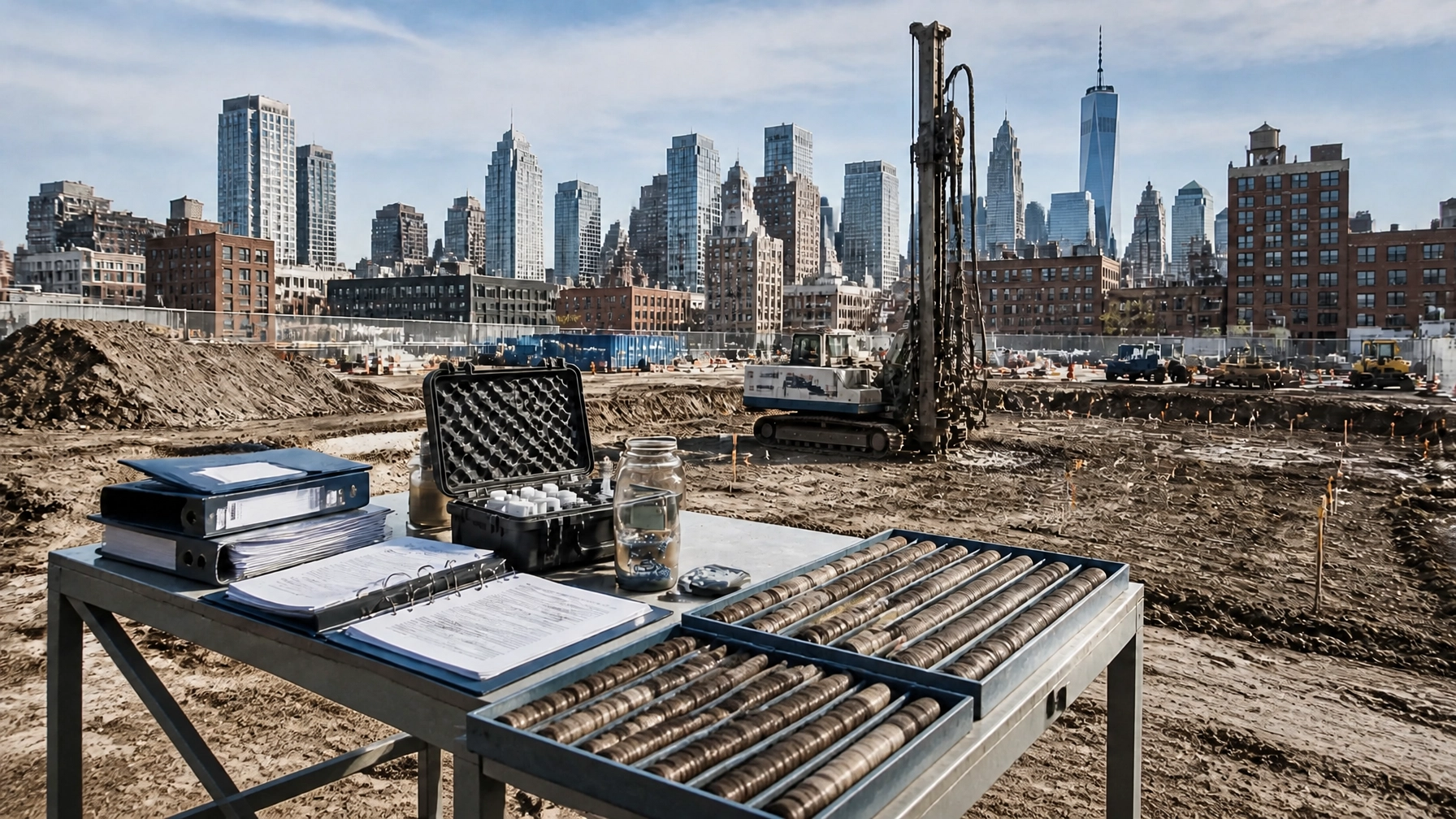
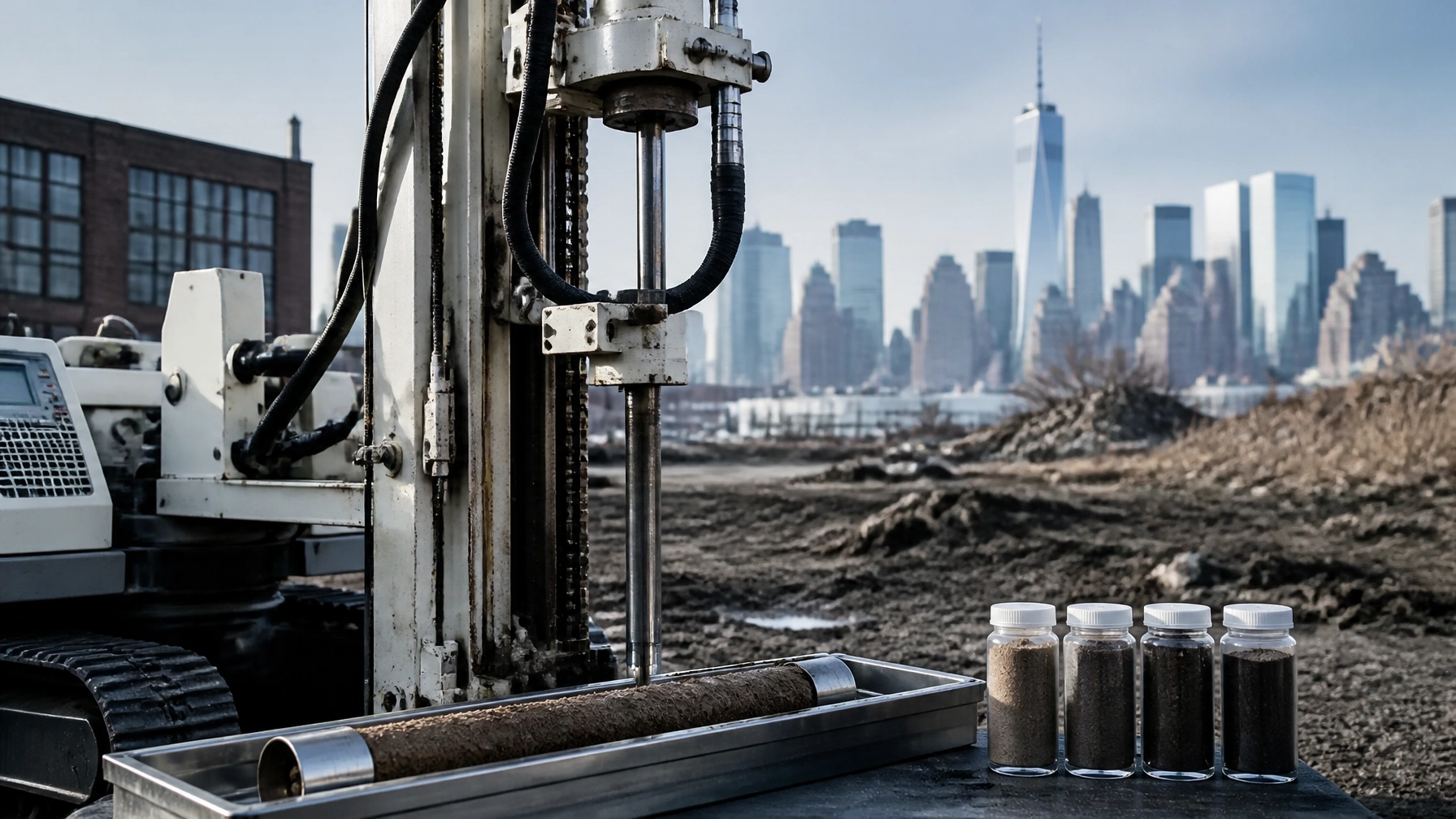
    Soil boring cores, groundwater monitoring equipment, and subsurface contamination mapping for an NJDEP investigation

    The objective is not to collect data for its own sake. The objective is to determine whether contamination exists, where it is located, how it may move, and whether people or environmental receptors could be exposed.

    If the PA/SI identifies contamination, the LSRP typically advances the case into a Remedial Investigation. The RI defines the horizontal and vertical extent of contamination and evaluates exposure pathways. It also provides the technical basis for selecting a remedy that fits the site’s future use.

    Remedial Action and Long-Term Controls

    Remedial action may involve:

    • Excavation and off-site disposal
    • Soil treatment or stabilization
    • Groundwater treatment
    • Monitored natural attenuation
    • Vapor mitigation
    • Capping or paving
    • Deed restrictions
    • Institutional controls
    • Engineering controls
    • Long-term groundwater monitoring

    The right remedy depends on the contaminants, media, geology, receptors, redevelopment plan, and applicable standards.

    For a dense urban site in Jersey City or Newark, excavation may need to coordinate with shoring, utilities, dewatering, vapor controls, and building foundations. For an industrial property in Bergen or Essex County, the solution may depend on historic fill, former tanks, manufacturing chemicals, or groundwater impacts extending beyond the parcel.

    Technical cutaway showing soil caps, vapor barriers, monitoring wells, institutional controls, and remedial action oversight

    An engineering control, such as a cap or vapor barrier, physically prevents exposure. An institutional control, such as a deed notice or land use restriction, legally or administratively limits how the property may be used.

    Controls can support closure, but they create continuing obligations.

    Remedial Action Permits and Biennial Certifications

    When contamination remains in place under an engineering or institutional control, NJDEP may require a Remedial Action Permit, commonly called a RAP.

    A RAP may address:

    • Soil controls
    • Groundwater controls
    • Classification Exception Areas
    • Monitoring and maintenance obligations
    • Site access and reporting requirements

    The LSRP must account for required RAPs before issuing an RAO. The permit is not a paperwork detail. It defines what the property owner must inspect, maintain, monitor, and certify after the transaction closes.

    Biennial certifications generally document that the remedy remains protective. Depending on the permit, requirements may include:

    • Inspection of caps, barriers, or other engineering controls
    • Groundwater monitoring results
    • Maintenance records
    • Site photographs
    • Evaluation of changing standards
    • Confirmation that institutional controls remain effective
    • Certification using NJDEP-required forms

    The owner should assign these responsibilities before closing. A property can be technically remediated and still fall out of compliance if the permit obligations are ignored.

    RAO Versus No Further Action

    For current LSRP-led remediation, the primary closure document is generally the Response Action Outcome, or RAO. The LSRP issues and certifies the RAO after completing the required investigation and remedial action, addressing applicable controls, and satisfying the requirements for the selected outcome.

    An RAO may address:

    • Unrestricted use
    • Restricted use
    • Limited restricted use
    • A specific Area of Concern
    • The entire site

    A site with remaining contamination may still reach closure through a restricted or limited restricted use RAO if the controls and long-term obligations are properly established.

    A No Further Action, or NFA, letter is more commonly associated with legacy NJDEP cases or earlier regulatory frameworks. It may still appear in historical files and transaction records. The correct interpretation depends on when it was issued, what areas it covered, whether conditions changed, and whether ongoing permits or controls remain active.

    NJDEP’s RAO guidance and SRP forms page provide the official documents and submission pathways.

    The practical point is simple: do not treat “NFA” or “RAO” as a standalone comfort letter. Review the underlying scope, conditions, deed notice, RAPs, monitoring obligations, and current property use.

    NJDEP Rules Versus Transaction Planning

    NJDEP rules tell you what must happen. They do not tell you how to protect your closing date, negotiate responsibility, or align remediation with construction.

    That is where planning creates value.

    Before a Jersey City, Newark, or Northern New Jersey transaction, we recommend that you:

    • Confirm whether the property is an ISRA-subject industrial establishment
    • Identify the earliest possible triggering event
    • Prepare the GIN information before the trigger occurs
    • Retain the LSRP early
    • Review existing NJDEP cases, RAOs, NFAs, RAPs, and deed notices
    • Build investigation and remediation costs into the purchase model
    • Coordinate environmental obligations with the site civil and construction schedule
    • Assign post-closing permit and biennial certification duties
    • Define responsibility for unknown contamination in the transaction documents

    Envicon combines NJDEP LSRP oversight, remediation planning, brownfield support, field investigation, and construction coordination. See our remediation and brownfield services.

    From our Jersey City headquarters, we support projects across Hudson County and the surrounding Northern New Jersey market, including Newark, Bergen County, and Essex County.

    Frequently Asked Questions

    Does every industrial property sale trigger ISRA?

    No. ISRA applies only when the establishment meets the applicable statutory and regulatory criteria. The facility’s operations, NAICS classification, hazardous substance history, and transaction structure all matter.

    Can the owner file the five-day GIN without an LSRP?

    Yes. NJDEP’s online instructions indicate that the GIN filer does not have to be an LSRP. The owner or operator still needs to meet the separate obligation to retain an LSRP when required.

    What does an LSRP do for a property sale?

    An LSRP evaluates the site, directs investigation and remediation, communicates with NJDEP, prepares required submissions, manages controls and permits, and certifies the appropriate closure outcome.

    Is an RAO the same as an NJDEP approval letter?

    No. An RAO is certified by the retained LSRP and submitted to NJDEP. NJDEP may audit the work. Required RAPs and other regulatory conditions must be addressed before the RAO is issued.

    How long does ISRA compliance take?

    The schedule depends on the site history, contamination, access, laboratory data, remedy, agency requirements, and transaction structure. A straightforward PA/SI may take weeks. A complex RI and remedial action may take months or longer.

    Does an NJDEP case end when an RAO is issued?

    Not always. If the RAO relies on a RAP, deed notice, engineering control, or groundwater monitoring, ongoing obligations continue after the RAO.

    Start Before the Five-Day Clock Starts

    If you are selling, acquiring, closing, leasing, or redeveloping an industrial property in Jersey City, Newark, Bergen County, Hudson County, Essex County, or Northern New Jersey, confirm the ISRA position before signing transaction documents.

    The five-day GIN deadline is manageable when the facts are organized and the responsible team is already in place. It becomes a problem when the trigger date is disputed, the facility history is incomplete, or the consultant is brought in after the closing schedule has already been set.

    We do not sell reports. We create a cleared path from triggering event to closure.

    Talk With Envicon

    Envicon Group logo

  • NYSDEC Part 375 Six Months In: QEP Certification, Field Deviations, and What It Takes to Keep a COC

    NYSDEC Part 375 Six Months In: QEP Certification, Field Deviations, and What It Takes to Keep a COC

    Published August 31, 2026 at 2:00 PM ET

    Effective December 31, 2025, NYSDEC amended 6 NYCRR Part 375, the framework governing New York’s Environmental Remediation Programs.

    Six months into implementation, the practical message for developers is straightforward:

    A brownfield project now needs better field control, stronger documentation, and a QEP who can stand behind every major technical conclusion.

    The revised framework affects how teams collect and certify environmental data, manage deviations from approved plans, document remedial work, and maintain the engineering and institutional controls tied to a Certificate of Completion.

    For NYC developers pursuing a brownfield cleanup program NY COC, these are not paperwork issues. They directly affect schedule, budget, financing, tax credit strategy, and the ability to move from remediation to construction.

    What changed under the NYSDEC Part 375 amendments?

    The revised NYSDEC Part 375 amendments apply across the Brownfield Cleanup Program, State Superfund Program, and Environmental Restoration Program.

    They also update soil cleanup objectives, clarify program requirements, and increase expectations around professional oversight and remedial documentation.

    The most important operational changes for project teams are:

    • QEP certification must address the completeness and accuracy of submitted environmental information.
    • Remedial work must follow approved work plans, remedial designs, and agency-approved modifications.
    • Field deviations must be identified, evaluated, documented, and justified in real time.
    • Final documentation supporting a COC must be accurate, complete, and defensible.
    • Engineering controls, institutional controls, and site management obligations require ongoing documentation after the COC is issued.

    NYSDEC’s environmental remediation revisions page provides the adopted rulemaking materials. The final Part 375 text should be reviewed alongside the applicable program guidance and project-specific work plans.

    QEP certification is now a project control, not a signature

    A QEP certification is not simply an administrative step at the end of a report.

    The QEP must be able to support the underlying environmental data and confirm that the work was completed in accordance with the approved remedial program. That includes the investigation, sampling, laboratory data, field observations, construction records, and closeout documentation that support the project’s path to a COC.

    In practical terms, the QEP should be able to answer:

    • Was the sampling program completed as approved?
    • Are the data complete and representative?
    • Were chain-of-custody and quality assurance procedures followed?
    • Did the remedial contractor follow the approved RAWP or remedial design?
    • Were field changes reviewed before implementation?
    • Do the as-built conditions match the approved remedy?
    • Does the final report accurately describe what happened in the field?

    The QEP’s certification now carries more weight because NYSDEC can evaluate not only the final report, but also the quality and reliability of the project record supporting it.

    This raises the bar on who you hire. A consultant who prepares reports remotely and relies on contractor notes may not have enough direct knowledge to certify the work confidently.

    A strong team needs field presence, technical judgment, and a defined chain of responsibility from the first boring through the Final Engineering Report.

    QEP certification also does not replace a New York-licensed Professional Engineer where engineering documents require PE certification under New York law. The right project team understands the distinction and coordinates both responsibilities instead of treating them as interchangeable.

    Field deviations must be managed when they happen

    Field conditions rarely follow the plan perfectly.

    An excavation may encounter a different soil layer. A utility may limit the planned boring location. Groundwater may enter an excavation earlier than expected. A vapor barrier detail may need to change because of actual foundation conditions.

    These situations are manageable. Undocumented changes are not.

    The amended expectations require project teams to treat a deviation as a controlled technical decision, not a field footnote. When conditions change, the team should:

    1. Stop and identify the difference from the approved plan.
    2. Evaluate whether the change affects the remedy, exposure pathways, cleanup objectives, or engineering controls.
    3. Document the condition with photographs, field notes, survey data, drawings, and sampling results.
    4. Obtain QEP or PE review, as applicable, before proceeding.
    5. Notify NYSDEC when the change is material or requires agency approval.
    6. Incorporate the approved change into the daily reports, as-built drawings, and final report.

    The NYSDEC Final Engineering Report template includes a section for describing deviations from the approved Remedial Action Work Plan. That closeout requirement reinforces the correct approach: the project team should not wait until the FER to reconstruct what happened.

    A deviation documented six months later is weaker than a deviation evaluated and approved six hours after it occurred.

    Environmental professional reviewing a remediation submittal package, field tablet, site plans, and soil sample vials

    How the new standard affects schedule and budget

    The revised requirements may add steps to the project schedule. They can also reduce avoidable delays when the team uses them correctly.

    Schedule impact

    Developers should account for additional review points during:

    • Pre-construction planning
    • Contractor submittal review
    • Daily field reporting
    • Confirmation sampling
    • Engineering control installation
    • As-built documentation
    • FER preparation and agency review
    • Site management plan updates

    The goal is not to create unnecessary meetings. The goal is to identify problems before they become a rejected submittal, failed confirmation sample, or incomplete FER.

    An undocumented field change discovered during closeout can trigger additional sampling, contractor remobilization, design revisions, and another round of agency comments. That delay is usually more expensive than resolving the issue in the field.

    Budget impact

    A realistic budget should include:

    • Senior QEP or PE oversight
    • Daily field reporting and quality control
    • Survey and as-built documentation
    • Additional confirmation samples where conditions warrant them
    • Engineering control inspection and testing
    • Site management plan updates
    • Agency coordination and comment responses
    • A reasonable contingency for changed subsurface conditions

    This is where low-fee consulting scopes can become expensive. A narrow proposal may exclude the field coordination and documentation needed to secure closure. The cost then returns later as a change order, re-mobilization, or delayed construction start.

    Envicon’s approach is to define the closure path before field work begins. Our brownfield redevelopment and remediation team coordinates investigation, remedial design, construction oversight, soil management, confirmation sampling, and regulatory closeout around the actual project objective.

    We do not sell a report. We sell a cleared path.

    What it takes to obtain and maintain a COC

    Under Part 375, NYSDEC issues a COC after approving the applicable Final Engineering Report and determining that the remedial requirements have been satisfied or will be satisfied within the approved timeframes.

    That makes the FER the bridge between completed field work and regulatory closure.

    A defensible FER should clearly show:

    • What the approved remedy required
    • What work the contractor completed
    • Where conditions differed from the approved plan
    • Why each deviation occurred
    • How each deviation affected the remedy
    • What sampling and laboratory data demonstrate
    • How engineering controls were installed and verified
    • What institutional controls and site management obligations remain
    • Who reviewed and certified the supporting information

    The COC is not the end of the project. It creates continuing obligations.

    Owners must maintain required engineering controls, follow institutional controls, perform inspections and monitoring, preserve records, and submit required periodic documentation. A change in ownership, site use, building footprint, utility work, or subsurface disturbance may require advance notice and technical review.

    NYSDEC’s guidance on initial notice and transfer of a Certificate of Completion should be part of every owner’s post-COC compliance file.

    A COC protects value only when the controls supporting it remain effective.

    NYC brownfield excavation with engineered vapor barrier, monitoring equipment, survey stakes, and field oversight

    Why the consultant you hire matters more now

    The new requirements expose the weakness in a common consulting model.

    A large firm may present a senior partner during the proposal stage, assign junior staff to the field, and route regulatory questions through several layers of project management. That structure creates distance between the person signing the report and the conditions that actually occurred on site.

    For a New York brownfield project, you need a team that can:

    • Put qualified technical leadership in the field
    • Coordinate directly with NYSDEC, NYC OER, attorneys, architects, contractors, and lenders
    • Identify deviations before they become closeout problems
    • Keep data, field records, drawings, and reports aligned
    • Explain technical decisions in clear business terms
    • Track schedule, budget, deliverables, and open issues in real time
    • Take responsibility for the outcome

    Envicon is a New York and New Jersey firm with 20 years of field-first environmental and engineering experience. Our NYC environmental consulting team works across Manhattan, Brooklyn, Queens, the Bronx, and Staten Island.

    Collaboration is not a buzzword. It is how the work gets done.

    A six-month action plan for NYC brownfield teams

    If your site is active under Part 375, review the following now:

    • Confirm that the responsible QEP and PE roles are clearly assigned.
    • Reconcile the approved RAWP, remedial design, SMP, and construction documents.
    • Create a written field deviation protocol.
    • Require daily reports that capture work completed, conditions observed, samples collected, and decisions made.
    • Review contractor submittals before materials or methods are installed.
    • Maintain a live register of open technical decisions and agency communications.
    • Verify that as-built drawings reflect actual field conditions.
    • Recalculate schedule and budget assumptions for confirmation sampling and closeout.
    • Review engineering and institutional control obligations with the property owner.
    • Confirm that future construction or changes in use will not conflict with the COC or SMP.

    The NYSDEC BCP document certification guidance is a useful reference for project teams and counsel.

    Additional industry context is available through NYREJ’s brownfield coverage and archives and the FBT Gibbons Part 375 regulatory update materials.

    The takeaway

    The NYSDEC Part 375 amendments make one point clear: regulatory closure depends on the quality of the entire project record.

    QEP certification, field deviation documentation, remedial design oversight, and long-term control management all connect to the same outcome. A defensible COC requires a defensible process.

    For developers in New York City, the best time to strengthen that process is before the next field change, sampling event, agency comment, or construction decision.

    We solve environmental and engineering challenges with precision, speed, and trust. If your project needs a clearer path to a COC, start with the team that will own the work from the field through closeout.

    Talk to Envicon

    Envicon Group logo

  • NJ Property Transaction Due Diligence: When a Phase II ESA Is Needed After the Phase I

    NJ Property Transaction Due Diligence: When a Phase II ESA Is Needed After the Phase I

    DRAFT | September 2026

    A Phase I ESA does not tell you exactly what is in the soil or groundwater. It tells you whether the property history and current conditions create enough environmental concern to justify intrusive investigation.

    That distinction matters in 2026. Buyers, lenders, attorneys, and developers evaluating property in Jersey City, Newark, Hoboken, Bayonne, Bergen County, Hudson County, and Essex County are dealing with tighter underwriting, more scrutiny around PFAS, and construction schedules that leave little room for surprises.

    The practical question is straightforward:

    When is a Phase II ESA needed in New Jersey?

    Usually, a Phase II ESA is appropriate when a Phase I ESA identifies a Recognized Environmental Condition, or REC, that could affect the property’s value, financing, redevelopment, or regulatory obligations.

    What a Phase I ESA identifies under ASTM E1527-21

    A Phase I Environmental Site Assessment performed under ASTM E1527-21 is a non-intrusive review. It includes records research, regulatory database review, interviews, site reconnaissance, and an Environmental Professional’s conclusions.

    It does not include soil, groundwater, soil vapor, or building material sampling.

    The purpose is to identify environmental conditions that may create liability or require further evaluation. Under ASTM E1527-21, a REC generally involves:

    • The presence of hazardous substances or petroleum products caused by a release.
    • The likely presence of hazardous substances or petroleum products caused by a release or likely release.
    • Conditions that pose a material threat of a future release.

    A Phase I can identify a current REC, historical REC, controlled REC, or de minimis condition. Those classifications matter. Not every environmental finding requires a Phase II, but a vague recommendation to “conduct additional assessment” should not be the end of the analysis.

    Your consultant should explain:

    1. What condition created the REC.
    2. Where the potential source is located.
    3. Which environmental media could be affected.
    4. What investigation would resolve the uncertainty.
    5. How the finding could affect closing, financing, or construction.

    Learn more about Envicon’s Phase I ESA services.

    When is a Phase II ESA needed in New Jersey?

    A Phase II is typically justified when the Phase I identifies a credible potential release and the parties need site-specific data before making a transaction or redevelopment decision.

    Common triggers include:

    1. Former industrial or manufacturing use

    Former metal plating, chemical manufacturing, printing, dry cleaning, coating, auto repair, and petroleum operations can create soil, groundwater, or vapor concerns.

    This is common across older industrial corridors in Newark, Bayonne, Jersey City, and Hudson County. A former warehouse may look clean today while buried tanks, historic fill, or solvent use remains relevant below grade.

    2. Underground storage tanks or petroleum equipment

    A current or former UST, dispenser, hydraulic lift, waste-oil tank, or loading area may justify targeted soil and groundwater sampling.

    If the Phase I identifies a suspected tank but records do not establish closure or release status, a Phase II may include geophysical clearance, soil borings, field screening, and laboratory analysis.

    3. Historical fill and urban redevelopment

    Urban fill can contain petroleum-related compounds, metals, ash, coal residue, and other contaminants. Development plans that involve excavation, foundation work, utility installation, or dewatering increase the importance of understanding fill quality before closing.

    A Phase II can help determine whether soil will require:

    • Off-site disposal.
    • Reuse under a soil management plan.
    • Segregation and characterization.
    • Clean cover or cap systems.
    • Special handling during excavation.

    4. Vapor intrusion concerns

    A dry cleaner, former industrial building, petroleum release, or chlorinated solvent use may create a vapor intrusion concern.

    The investigation may require soil vapor, sub-slab vapor, indoor air, or groundwater sampling. The appropriate scope depends on the building configuration, depth to groundwater, contaminant type, preferential pathways, and future building plans.

    5. Lender or investor requirements

    A lender may require Phase II data even when the Phase I recommendation is conditional or limited.

    The lender may want a defined answer before approving:

    • Acquisition financing.
    • Construction financing.
    • Refinancing.
    • Portfolio acquisition.
    • Brownfield redevelopment funding.
    • A loan secured by a property with a known environmental condition.

    A report that is technically acceptable but does not answer the lender’s underwriting questions can still delay the transaction.

    What a Phase II ESA investigates

    A strong Phase II is not a random collection of borings. It is a targeted investigation designed around the RECs and the decisions the transaction team needs to make.

    Subsurface investigation showing soil borings, groundwater monitoring wells, and soil vapor sampling points

    Soil borings

    Direct-push or hollow-stem auger borings can characterize shallow fill, native soil, source areas, and deeper intervals. Field staff may use photoionization detector screening to identify zones that warrant closer attention.

    Boring locations should reflect the suspected source and the proposed development footprint. A grid that misses the former tank area does not resolve the REC.

    Groundwater monitoring wells

    Temporary or permanent wells may be installed when groundwater is a potential migration pathway or when the Phase I identifies a known or suspected release.

    Groundwater work may evaluate:

    • Contaminant concentrations.
    • Groundwater flow direction.
    • Whether impacts extend beyond the source area.
    • Potential impacts to nearby properties or surface water.
    • Whether dewatering could mobilize contaminants during construction.

    Soil vapor and sub-slab sampling

    Vapor sampling may be appropriate where volatile organic compounds, petroleum hydrocarbons, or chlorinated solvents are present or suspected.

    The future use of the building matters. A proposed residential building with a parking level and occupied basement requires a different risk evaluation than an open industrial warehouse.

    PFAS sampling

    New Jersey’s June 15, 2026 rule adoption made PFNA, PFOA, PFOS, and GenX enforceable considerations within the state’s remediation framework. The amendments also expanded required analytical parameters under N.J.A.C. 7:26E-2.1(c) when contaminants at an Area of Concern are unknown or poorly documented.

    That does not mean every private, transaction-only Phase II ESA automatically requires PFAS sampling. It does mean PFAS should receive deliberate consideration when:

    • Site history is incomplete.
    • Firefighting foam or fire training may have occurred.
    • The property involved metal plating, textiles, paper, packaging, or certain manufacturing.
    • The site is already subject to NJDEP oversight.
    • The transaction may lead to an LSRP-managed investigation.
    • A lender, purchaser, or regulator requires PFAS evaluation.

    For a regulated site, the investigation must follow the applicable NJDEP requirements. For a private transaction, the sampling scope should be documented clearly so the buyer understands what was tested and what was not.

    See NJDEP’s PFAS program resources and the 2026 regulatory discussion from Day Pitney.

    Sampling plans and laboratory QA/QC

    A Phase II should begin with a written Sampling and Analysis Plan, or SAP. The plan should identify:

    • The REC or data gap being investigated.
    • Proposed boring, well, and vapor locations.
    • Sample depths and collection methods.
    • Analytical parameters.
    • Detection limits.
    • Decontamination procedures.
    • Quality assurance and quality control samples.
    • Investigation-derived waste handling.
    • Data validation requirements.
    • Decision criteria and applicable standards.

    Laboratory quality is just as important as field work. The project team should document chain of custody, sample preservation, holding times, cooler temperature, trip blanks, equipment blanks, duplicates, and laboratory reporting limits.

    For PFAS work, field procedures require particular care because PFAS can occur in common sampling materials and personal protective equipment. The SAP should address potential cross-contamination before the crew arrives on site.

    Environmental laboratory sample handling with sealed soil and groundwater vials for QA/QC review

    A practical Phase II decision tree

    Use this framework during acquisition review:

    Did the Phase I identify a REC?
    |
    |-- No
    |   |-- No Phase II may be needed.
    |   |-- Confirm lender, counsel, and redevelopment requirements.
    |
    |-- Yes
        |
        |-- Is the REC adequately resolved by existing reliable data?
        |      |
        |      |-- Yes
        |      |   |-- Document the conclusion.
        |      |   |-- Confirm data age, quality, and regulatory status.
        |      |
        |      |-- No
        |          |
        |          |-- Could contamination affect price, financing, or construction?
        |                 |
        |                 |-- No
        |                 |   |-- Obtain written risk acceptance from the decision-maker.
        |                 |
        |                 |-- Yes
        |                     |-- Scope a targeted Phase II.
        |                     |-- Add PFAS, vapor, or other analytes where justified.
        |                     |-- Determine whether an NJDEP or LSRP pathway applies.
    

    The right answer is not always “sample everything.” It is to collect enough defensible data to make the next decision.

    How much does a Phase II ESA cost in New Jersey?

    There is no universal Phase II ESA cost in New Jersey. A small commercial parcel with one suspected UST is not comparable to a multi-acre former manufacturing property in Newark or Bayonne.

    Primary cost drivers include:

    • Property size and accessibility.
    • Number and depth of borings.
    • Need for permanent monitoring wells.
    • Soil, groundwater, soil vapor, or indoor air scope.
    • PFAS or other specialized laboratory analysis.
    • Utility clearance and GPR.
    • Traffic control or restricted-access work.
    • Geology and depth to groundwater.
    • Number of Areas of Concern.
    • Laboratory turnaround time.
    • Data validation requirements.
    • Investigation-derived waste management.
    • Whether the work must support NJDEP or LSRP requirements.

    A targeted transaction Phase II may be less expensive than a full remedial investigation, but it should not be designed so narrowly that it leaves the central REC unresolved.

    Connecting Phase II work to NJDEP, ISRA, and construction

    A transaction Phase II can identify a problem before it becomes a construction claim. It can also show that additional regulatory coordination is necessary.

    If the property is subject to the Industrial Site Recovery Act, an open NJDEP case, a prior discharge, or a known contaminated-site obligation, involve a New Jersey Licensed Site Remediation Professional early.

    An LSRP may need to evaluate:

    • Preliminary Assessment and Site Investigation requirements.
    • Remedial Investigation needs.
    • NJDEP reporting and case status.
    • Response Action Outcome strategy.
    • Engineering and institutional controls.
    • Deed notices and Site Management Plans.
    • Brownfield redevelopment options.
    • Soil and groundwater management during construction.

    Urban New Jersey brownfield parcel with environmental investigation points and redevelopment planning overlay

    The Phase II findings should also reach the civil engineer, architect, construction manager, and attorney. Contamination can affect excavation limits, shoring, dewatering, utility routing, foundation design, soil export, vapor mitigation, and the construction schedule.

    That is where a report-only approach breaks down. The value is not just the laboratory table. The value is a clear path from finding to action.

    How Envicon approaches NJ real estate environmental due diligence

    Envicon combines Phase I and Phase II environmental due diligence with NJDEP LSRP coordination, regulatory strategy, and construction-focused planning.

    Our team works across Jersey City, Newark, Hoboken, Bayonne, Bergen County, Hudson County, and Essex County. We coordinate directly with acquisition teams, lenders, attorneys, architects, contractors, and public agencies.

    You get:

    • A Phase II scope tied to the actual REC.
    • Direct access to senior technical staff.
    • Clear sampling and analysis plans.
    • NJDEP and LSRP coordination when required.
    • Laboratory QA/QC review.
    • Practical cost and schedule implications.
    • Soil and groundwater management planning.
    • A defined next step instead of an open-ended recommendation.

    We do not treat every property as if it needs the same investigation. We identify the risk, test the right locations, and explain what the results mean for your deal.

    Takeaway

    A Phase I ESA identifies potential environmental liability. A Phase II ESA determines whether that concern is supported by site-specific data.

    You should consider a Phase II when a REC remains unresolved, the lender needs quantified risk, the project will disturb subsurface materials, or the property’s history creates a credible concern involving soil, groundwater, vapor, petroleum, solvents, metals, or PFAS.

    The earlier you make that decision, the more options you have. You can adjust price, negotiate access and indemnity terms, plan remediation, apply for brownfield support, or redesign construction before the closing deadline controls the project.

    Start with a transaction risk screen

    If you’re evaluating a property in Jersey City, Newark, Hoboken, Bayonne, Bergen County, Hudson County, or Essex County, use Envicon’s proprietary project risk screener to identify the likely environmental diligence path.

    You can also:

    Draft only. Not scheduled or published. This article is for general information and does not replace project-specific advice from a qualified Environmental Professional, engineer, attorney, or NJDEP-licensed LSRP.

    Sources

    Envicon Group logo

  • NYC Brownfield Incentive Grant Deadline: How Developers Should Plan Around the Six-Month OER Window

    NYC Brownfield Incentive Grant Deadline: How Developers Should Plan Around the Six-Month OER Window

    Status: DRAFT

    As of September 2026, NYC brownfield developers have a project-specific grant deadline to manage. The NYC Office of Environmental Remediation (OER) requires a BIG enrollment grant application to be submitted no later than six months after OER issues the project’s Notice of Completion.

    That is not a single citywide 2026 deadline. It is a rolling deadline tied to each project.

    Funding also remains subject to availability within the applicable fiscal year. Developers should not wait until the six-month window is closing to assemble invoices, manifests, remedial records, and community benefit information.

    For brownfield sites in Brooklyn, the Bronx, Queens, and Staten Island, grant planning should begin before remediation closes out.

    The NYC Brownfield Incentive Grant deadline is tied to your project

    OER states:

    “BIG enrollment grant applications must be submitted no later than 6 months after OER issues the project’s Notice of Completion.”

    The relevant date is the date OER issues the Notice of Completion. It is not necessarily:

    • The date field remediation ended
    • The date confirmation samples were collected
    • The date the remedial report was submitted
    • The date the developer received final contractor invoices
    • The end of the calendar year
    • A fixed 2026 citywide grant deadline

    Your team should preserve the official OER correspondence that identifies the Notice of Completion and use that document to calculate the submission window.

    The practical rule is simple:

    1. Confirm the date OER issued the Notice of Completion.
    2. Count six months forward.
    3. Prepare a complete application before that date.
    4. Confirm that program funding remains available for the applicable fiscal year.
    5. Submit the application and retain proof of submission.

    A late or incomplete filing can create a funding problem even when the cleanup itself was eligible.

    Do not confuse grant eligibility with VCP enrollment

    Developers often use “brownfield grant eligibility” as a general term. OER’s program structure is more specific.

    Grant eligibility

    Grant eligibility depends on the project category, property location, program status, eligible activities, qualified vendors, documentation, and applicable grant limits.

    The OER BIG program generally supports:

    • Qualifying Brownfield Projects
    • Preferred Community Development Projects
    • Bonus grants connected to qualifying NYC Voluntary Cleanup Program projects

    Eligibility does not mean that every project cost will be reimbursed. OER evaluates the application against program requirements, eligible activities, reimbursement limits, required documentation, and available funding.

    NYC VCP enrollment

    The NYC Voluntary Cleanup Program, or VCP, is the regulatory pathway for eligible brownfield projects seeking OER oversight and closure.

    A project may need an OER-approved Remedial Action Work Plan and other program documents before remedial work proceeds. VCP enrollment is a program status. It is not the same as grant approval.

    A developer can be enrolled in the VCP and still need to submit a separate BIG grant application.

    Remediation completion

    Remediation completion means the planned remedial work has been performed and documented. Depending on site conditions, that work may include:

    • Soil excavation and disposal
    • Clean fill placement
    • Engineering controls
    • Vapor mitigation
    • Groundwater treatment
    • Confirmation sampling
    • Institutional controls
    • Environmental monitoring
    • Preparation of a Remedial Action Report

    Completion of field work does not automatically start or satisfy the grant application process.

    Notice of Completion

    The Notice of Completion is an OER project milestone. It confirms that OER has reached a defined point in the VCP process.

    For the BIG enrollment grant, it also triggers the six-month application window. Developers should treat the notice as both a regulatory milestone and a financial deadline.

    Application submission

    The application must be assembled with the required supporting materials. A developer should plan for a complete submission, not a last-minute form delivery.

    The six-month window is short when multiple parties must provide invoices, manifests, insurance records, contractor documentation, and professional certifications.

    Technical project timeline showing brownfield enrollment, remediation completion, Notice of Completion, and grant application planning

    What NYC BIG grants can support

    The current OER BIG program supports eligible work at different stages of brownfield redevelopment.

    For qualifying brownfield projects, OER identifies grants for:

    • Pre-development activities
    • Environmental investigations
    • Cleanup work
    • Certain environmental insurance costs
    • Qualified professional services
    • Remedial reports and grant project reporting

    OER also identifies Preferred Community Development Projects, including affordable housing and other community-supported projects. These projects may qualify for different grant limits and technical assistance opportunities.

    The official BIG program page currently describes maximum grant amounts that vary by project category. Qualifying Brownfield Projects may have a maximum grant of up to $25,000, while qualifying Preferred Community Development Projects may have higher limits depending on the project type and affordability structure.

    Bonus grants may also apply in certain circumstances, including:

    • Sites achieving unrestricted use soil standards
    • Projects in designated coastal flood zones
    • Community-directed strategic sites

    The available amount depends on the applicable program rules and the project’s eligibility. Developers should not build a project pro forma around the maximum amount before confirming the category, eligible costs, reimbursement limits, and funding availability.

    Review the official NYC OER BIG Grants page and the current application materials before authorizing work that will be submitted for reimbursement.

    Build a grant-readiness file before the Notice of Completion

    A grant-ready file should exist before remediation closes. Waiting until after OER issues the Notice of Completion creates avoidable risk.

    For Brooklyn, Bronx, Queens, and Staten Island projects, we recommend maintaining one controlled digital file with the following sections.

    1. OER correspondence

    Include:

    • VCP enrollment materials
    • OER approval letters
    • Approved Remedial Action Work Plan
    • Agency comments and responses
    • Site meeting records
    • Notice of Completion
    • Any Notice of Satisfaction or related closure correspondence

    The Notice of Completion should be clearly labeled with the date OER issued it.

    2. Remedial work plan and closeout records

    Maintain the approved remedial documents and records showing what actually occurred in the field.

    Include:

    • Remedial Action Work Plan
    • Remedial Investigation reports
    • Remedial Action Report
    • Site Management Plan, if applicable
    • Confirmation sampling results
    • Soil disposal records
    • Waste characterization data
    • Backfill and clean fill certifications
    • Vapor barrier or sub-slab system documentation
    • Daily field reports
    • Environmental monitoring records

    The application file should tell a consistent story from approved scope to completed work.

    3. Cost records and invoices

    Organize costs by eligible activity, not only by vendor.

    Maintain:

    • Executed proposals
    • Invoices
    • Proof of payment
    • Purchase orders
    • Contractor change documentation
    • Laboratory invoices
    • Disposal bills
    • Weight tickets
    • Transportation records
    • Equipment and mobilization records
    • Professional service invoices

    OER’s technical specifications identify specific deliverables for many eligible activities. A single invoice without supporting records may not be enough to demonstrate an eligible expense.

    4. Environmental insurance records

    The BIG program identifies certain environmental insurance costs as potentially eligible. The policy must match the project and the covered activity.

    Keep:

    • Insurance quote
    • Binder or policy
    • Premium invoice
    • Coverage summary
    • Named insured information
    • Policy period
    • Proof of payment

    Review the OER BIG insurance materials before assuming a policy cost qualifies.

    5. Community benefit details

    Preferred Community Development Projects should document the project’s community purpose throughout planning and construction.

    Depending on the project, useful records may include:

    • Affordable housing commitments
    • Nonprofit developer information
    • Community facility components
    • Public access or open space benefits
    • Community outreach records
    • Local hiring or workforce commitments
    • Community Brownfield Planning documentation
    • Project descriptions used in public approvals

    Community benefit information should align with the project’s applications, zoning materials, financing documents, and public statements.

    Grant-ready brownfield documentation with invoices, environmental reports, disposal manifests, and field records

    A practical six-month planning schedule

    Do not begin grant preparation in month five. Use the following approach.

    Before the Notice of Completion

    • Confirm the project’s BIG category.
    • Review the current application.
    • Confirm whether the work was performed by qualified vendors.
    • Organize invoices and proof of payment.
    • Reconcile contractor costs with field records.
    • Confirm insurance documentation.
    • Prepare the community benefit narrative.
    • Identify missing reports, manifests, or certifications.

    Within 30 days after the Notice of Completion

    • Save the official notice and record the issue date.
    • Calculate the six-month submission date.
    • Request any missing vendor documents.
    • Map project expenses to eligible BIG activities.
    • Review the application with the environmental consultant and developer’s counsel.
    • Confirm fiscal-year funding considerations with the BIG Program Administrator.

    Within 60 to 90 days

    • Complete the draft application.
    • Check invoices against reimbursement limits.
    • Verify that reports and deliverables support each requested cost.
    • Resolve inconsistencies between the remedial file and the cost file.
    • Obtain required certifications and signatures.

    Before the six-month deadline

    • Submit the complete application through the OER process.
    • Retain the final application package.
    • Save the email transmission or other proof of delivery.
    • Track follow-up questions and responses.
    • Keep the project file available for additional review.

    What this means for NYC developers in 2026

    The current pipeline includes redevelopment sites across the five boroughs, but the grant planning issues are especially relevant to former industrial and underused properties in:

    • Brooklyn, including waterfront, Navy Yard, Gowanus, and mixed-use conversion sites
    • The Bronx, including South Bronx industrial corridors and Hunts Point area properties
    • Queens, including Long Island City, western Queens, and industrial business zones
    • Staten Island, including North Shore redevelopment and coastal properties

    Each market brings different site histories, community priorities, construction schedules, and agency coordination requirements. The grant rules do not eliminate the need for site-specific planning.

    A developer working on a former manufacturing property in Brooklyn may need to coordinate soil disposal, vapor controls, and construction sequencing. A Bronx affordable housing project may need to document nonprofit status and community benefits. A Queens industrial conversion may need a clear environmental investigation record before financing closes. A Staten Island waterfront project may need to account for resilience and flood-zone considerations.

    The right grant strategy starts with the project record, not a generic checklist.

    Why grant readiness is an engineering issue

    Grant applications depend on documentation created during environmental and construction work. If the remedial scope, field oversight, invoices, laboratory records, and agency correspondence do not align, the application becomes harder to defend.

    Envicon integrates remediation planning, field oversight, cost tracking, and regulatory coordination. Our brownfield remediation and redevelopment service supports projects from investigation through agency closure.

    We also provide NYC-specific environmental consulting for developers, owners, attorneys, and public agencies across all five boroughs. Our NYC environmental consultant team coordinates with OER, NYSDEC, NYC Department of Buildings, NYCDEP, and other project stakeholders.

    The advantage is direct accountability. The engineer reviewing the remedial file understands the field conditions, the agency path, and the development schedule. You receive more than a report. You receive a clear path from project records to a defensible grant submission.

    Takeaway

    The NYC Brownfield Incentive Grant deadline is not a fixed date on the 2026 calendar. It is a six-month window tied to the date OER issues your project’s Notice of Completion.

    For a stronger application:

    • Confirm the project’s BIG category early.
    • Keep VCP and grant status separate.
    • Track remediation completion and the Notice of Completion as different milestones.
    • Build the grant-readiness file before closeout.
    • Organize invoices, manifests, reports, insurance records, and community benefit details.
    • Do not assume funding remains available without confirming with OER.
    • Submit a complete application before the six-month window closes.

    If your project is approaching OER closure, now is the time to review the file.

    Request a Grant-Readiness Review

    Envicon can review your project timeline, OER correspondence, remedial records, eligible costs, and application package before the deadline becomes a problem.

    Sources

    Envicon Group logo

  • EPA’s PFAS Drinking Water Compliance Extension: How the 2031 Option Affects NY and NJ Water Systems

    EPA’s PFAS Drinking Water Compliance Extension: How the 2031 Option Affects NY and NJ Water Systems

    As of August 2026, the federal PFAS compliance picture has two important dates: April 26, 2029, and a possible extension to April 26, 2031.

    The EPA’s May 2026 proposal would allow eligible public water systems to request two additional years to comply with the federal 4.0 parts per trillion, or ppt, Maximum Contaminant Levels for PFOA and PFOS. The proposal does not remove those limits. It also does not suspend monitoring or reporting.

    For water systems, developers, utilities, and owners of environmentally challenged properties across New York and New Jersey, the practical message is simple:

    The 2031 option may create additional implementation time. It does not create permission to stop investigating, reporting, designing, or managing PFAS risks.

    What the 2026 EPA proposal actually changes

    The EPA’s April 2024 National Primary Drinking Water Regulation established enforceable MCLs of:

    • 4.0 ppt for PFOA
    • 4.0 ppt for PFOS

    The May 2026 proposal would create an optional federal exemption framework. Eligible public water systems could request up to two additional years to meet those federal limits, moving the potential compliance date to April 26, 2031.

    The proposal remains a proposal as of August 31, 2026. It is not an automatic extension for every water system.

    The EPA states that:

    “The proposed mechanism does not change the PFOA and PFOS MCLs established in the 2024 PFAS NPDWR which remain 4.0 parts per trillion (ppt) each.”
    EPA proposed PFOA and PFOS Compliance Extension Rule

    The proposed extension also preserves monitoring and reporting obligations. Systems granted an exemption would still need to collect and report sample results under the April 2024 rule.

    Systems with PFOA or PFOS results at or above 12 ppt would also face proposed short-term mitigation requirements during the extension period. Those measures could include certified filters, alternative water supplies, customer notifications, or other controls.

    The 2031 date is therefore not a pause. It is a limited planning window for systems that need more time to finance, design, construct, and validate treatment.

    New York: a federal extension does not erase the state MCL

    New York continues to enforce state-level drinking water MCLs of:

    • 10 ppt for PFOA
    • 10 ppt for PFOS

    The federal 4 ppt limits are more stringent. That creates a layered compliance structure for New York public water systems.

    A system cannot assume that an EPA extension automatically extends every state obligation. The system must confirm how the final federal rule will interact with New York’s primacy and enforcement framework. State monitoring, notification, treatment, and reporting requirements may continue on their own schedule.

    The New York State Department of Health PFAS drinking water guidance confirms that New York’s state standards remain part of the compliance picture during the federal transition.

    For a New York system, the right questions include:

    • Is the system subject to the federal PFOA and PFOS NPDWR?
    • Does the system qualify for the proposed exemption?
    • Has the system applied for and received the extension?
    • Which requirements remain enforceable under New York law?
    • Will the system’s treatment design target 4 ppt, 10 ppt, or a more protective site-specific objective?
    • Are groundwater, source water, and discharge obligations being evaluated separately?

    The answer should not come from a generic national compliance memo. It should come from a New York-specific regulatory review supported by current sampling data.

    New Jersey: drinking water compliance and cleanup standards are separate issues

    New Jersey adds another layer. On June 15, 2026, NJDEP adopted final PFAS remediation standards that include the following groundwater quality standards:

    PFAS compound NJDEP groundwater quality standard
    PFOA 14 ppt
    PFOS 13 ppt
    PFNA 13 ppt
    GenX, also known as HFPO-DA 20 ppt

    These are groundwater remediation standards. They are not the same thing as the federal drinking water MCLs.

    A public water system evaluating finished drinking water may be working toward the federal 4 ppt PFOA and PFOS limits. A property owner investigating a contaminated site may need to evaluate groundwater against NJDEP’s applicable remediation standards. A facility discharging treated groundwater may face additional permit conditions.

    One standard does not replace the others.

    NJDEP’s PFAS program resources explain the state’s scientific and regulatory work on PFAS occurrence, fate and transport, standards, and environmental cleanup.

    For a former industrial property in Jersey City, Newark, Hudson County, or another New Jersey redevelopment market, the groundwater investigation should account for:

    • The current and reasonably foreseeable groundwater use
    • Whether groundwater can affect a potable source
    • The horizontal and vertical extent of PFAS
    • Potential source areas, including historical industrial operations
    • PFAS concentrations in soil, groundwater, surface water, and treatment influent
    • NJDEP remediation standards and discharge requirements
    • The relationship between the remedy and the proposed site end use

    The federal compliance extension does not give a contaminated property additional time to ignore New Jersey remediation obligations.

    What this means for Phase II investigations

    PFAS changes the way a Phase II ESA and site investigation should be scoped.

    A records review may identify historical uses that warrant PFAS consideration, including:

    • Firefighting foam storage or training
    • Airports and transportation facilities
    • Metal finishing and plating
    • Textile and carpet manufacturing
    • Paper and packaging operations
    • Landfills and waste transfer facilities
    • Industrial process areas
    • Wastewater treatment or biosolids handling
    • Facilities with known PFAS-containing products

    Field work then needs to answer practical questions. Where is the source? Which media are affected? Is the plume stable or migrating? Does groundwater flow toward a municipal well, surface water body, excavation, or proposed dewatering area?

    Environmental field engineer collecting a groundwater sample from a monitoring well for PFAS analysis

    PFAS sampling also requires disciplined field procedures. Small errors can overwhelm results at the ppt scale. The sampling plan should address equipment materials, decontamination, field blanks, laboratory reporting limits, chain of custody, and potential cross-contamination.

    A useful investigation program may include:

    1. Historical and regulatory records review.
    2. Source-area screening.
    3. Monitoring well installation or conversion where appropriate.
    4. Groundwater elevation and flow evaluation.
    5. PFAS sampling from selected wells and potential receptors.
    6. Soil sampling where source persistence or handling decisions require it.
    7. Data validation and trend analysis.
    8. A remedy evaluation tied to the applicable cleanup endpoints.

    A Phase II report should not simply list PFAS detections. It should explain what the data means for acquisition, construction, treatment, disposal, and regulatory closure.

    That distinction matters to lenders and developers. A report that identifies PFAS without describing the next decision leaves the project owner with the hardest part still to solve.

    Treatment decisions: GAC, ion exchange, and foam fractionation

    The 2031 option may give some public water systems more time to choose and implement treatment. It does not make treatment selection easier.

    Three technologies commonly enter the discussion.

    Granular activated carbon

    Granular activated carbon, or GAC, can remove PFOA and PFOS from water. Performance depends on the carbon type, empty bed contact time, influent concentrations, competing organic matter, pH, and other water chemistry.

    GAC requires a replacement and disposal strategy. Breakthrough monitoring is essential. A system that designs only for initial removal performance may face avoidable operational problems later.

    Ion exchange

    Ion exchange, or IX, can provide strong removal performance and may require a smaller footprint than GAC. Selectivity, resin type, water chemistry, regeneration, and spent-resin management all affect lifecycle cost.

    IX can be attractive where space is constrained or where the system needs a high degree of treatment reliability. The decision must include residuals management and long-term operating requirements, not only capital cost.

    Foam fractionation

    Foam fractionation separates PFAS from water by concentrating surfactant-like compounds in a foam phase. It may be useful for certain source waters, industrial streams, or as part of a treatment train.

    It does not eliminate the PFAS mass. It concentrates it into a residual stream that still requires appropriate management. Its suitability depends heavily on water chemistry, PFAS composition, concentration, and system design.

    Pilot-scale PFAS treatment skid with granular activated carbon and ion exchange vessels in a municipal utility room

    Treatment selection should be based on verified influent data, pilot testing where warranted, residuals planning, operations capacity, and the required endpoint.

    We would not recommend choosing GAC, IX, or foam fractionation from a product brochure. The right technology depends on the water, the PFAS profile, the discharge pathway, and the standard the system must meet.

    Groundwater cleanup endpoints need a separate analysis

    The federal drinking water MCL is an important benchmark. It is not automatically the cleanup endpoint for every soil or groundwater project.

    In New Jersey, the adopted groundwater standards provide specific remediation criteria for PFOA, PFOS, PFNA, and GenX. In New York, the state’s 10 ppt drinking water MCLs for PFOA and PFOS remain relevant, while site-specific cleanup decisions may also involve NYSDEC programs, source control, exposure pathways, and institutional or engineering controls.

    Technical subsurface visualization showing PFAS groundwater plume, soil strata, monitoring wells, and an engineered treatment zone at an urban waterfront redevelopment site

    A defensible cleanup strategy should establish:

    • Which agency has jurisdiction.
    • Which standards apply to each environmental medium.
    • Whether the site presents a current or future potable exposure pathway.
    • Whether source removal is feasible.
    • Whether groundwater treatment is required.
    • How excavated soil and treatment residuals will be characterized and managed.
    • What monitoring will demonstrate progress and closure.
    • How the remedy fits the construction schedule and intended redevelopment.

    This is where soil and groundwater management, Phase II ESA work, and PFAS remediation planning need to operate as one program.

    What NY and NJ water systems should do now

    The proposed extension may help with schedule pressure, financing, procurement, and workforce constraints. It should not delay the work that determines whether a system can comply.

    Water systems and property stakeholders should:

    • Track the final EPA rule and confirm whether an exemption is available.
    • Continue monitoring and reporting under the current requirements.
    • Map PFOA and PFOS results against both federal and state standards.
    • Review source water, groundwater, and treatment influent data together.
    • Begin treatment pilot testing if capital improvements may be necessary.
    • Build a residuals and disposal plan before selecting treatment equipment.
    • Coordinate with EPA, NYSDOH, NYSDEC, or NJDEP as applicable.
    • Update Phase II ESA scopes and remediation cost estimates.
    • Document decisions in a way that lenders, regulators, counsel, and community stakeholders can understand.

    The regulatory landscape remains fragmented. The IHMM status summary correctly emphasizes that federal requirements do not necessarily replace stricter state obligations.

    For owners and developers, the practical takeaway is even more direct:

    A compliance extension is not a cleanup strategy.

    How Envicon helps keep PFAS projects moving

    Envicon Group supports public agencies, utilities, developers, attorneys, and contractors with PFAS assessment, soil and groundwater management, Phase II investigations, treatment planning, and remediation oversight across New York and New Jersey.

    We connect field data to the decision in front of you. That may mean defining a plume before a transaction, selecting groundwater treatment before excavation, managing PFAS-impacted soil, or coordinating with the agency reviewer responsible for project closure.

    Our PFAS assessment and environmental investigation services are built around clear scope, defensible data, and actionable next steps. For brownfield sites, our remediation and brownfield redevelopment team carries the work from delineation through remedial design, field oversight, documentation, and regulatory closeout.

    From our Jersey City headquarters, we work throughout Hudson County, New York City, and the broader NY/NJ metro market.

    The standard may change. The need for accurate data, direct accountability, and a clear path to closure does not.

    Sources

    Talk with an Envicon Engineer

    PFAS decisions affect compliance, construction, financing, and long-term site value. Get the technical and regulatory picture before the next sampling event or capital decision.

    Envicon Group logo

  • Vapor Intrusion Mitigation Systems in NYC and NJ: Design, Installation, and Long-Term Monitoring

    Vapor Intrusion Mitigation Systems in NYC and NJ: Design, Installation, and Long-Term Monitoring

    Vapor intrusion mitigation systems protect occupied buildings from volatile organic compounds, or VOCs, migrating from contaminated soil or groundwater into indoor air. In New York City and New Jersey, the right system must do more than reduce vapor concentrations. It must satisfy agency requirements, support the construction schedule, and remain functional after the building opens.

    The design begins with site-specific data. The installation ends with verification, operation, maintenance, and documentation.

    For a broader overview of the pathway and available remedies, read Envicon’s vapor intrusion mitigation guide.

    When vapor intrusion mitigation is needed

    Vapor intrusion risk typically enters a project through a Phase I ESA, historical site review, Phase II investigation, lender request, or regulatory process.

    Common sources include former dry cleaners, manufacturing facilities, auto repair shops, bulk storage properties, landfills, and sites with petroleum or chlorinated solvent impacts. VOCs can move through soil gas and enter buildings through:

    • Foundation cracks and slab joints
    • Utility penetrations
    • Floor drains and sumps
    • Elevator pits
    • Crawlspaces
    • Unsealed wall and slab interfaces
    • Permeable concrete or masonry

    A proper evaluation considers both the contaminant source and the building. A site with elevated soil gas may not have a complete exposure pathway if the building is well sealed and indoor air remains below applicable criteria. Conversely, a modest subsurface concentration can create a concern when a slab is cracked, a crawlspace is open, or the building operates under negative pressure.

    Screening comes before system design

    A vapor intrusion mitigation system should not be selected from a template. The design should follow a documented screening and investigation process.

    The assessment may include:

    1. Historical and regulatory review
      Review former site uses, spills, underground storage tanks, groundwater data, and nearby sources.

    2. Sub-slab soil gas sampling
      Install temporary or permanent probes beneath the slab to measure VOC concentrations in soil gas.

    3. Indoor and outdoor air sampling
      Collect indoor air samples in occupied areas and outdoor ambient samples to identify background conditions and indoor sources.

    4. Crawlspace sampling
      Evaluate crawlspaces, dirt floors, sumps, and other areas where soil gas can enter directly.

    5. Building and foundation review
      Document slab condition, utility penetrations, HVAC operation, floor elevations, and occupied spaces.

    6. Regulatory comparison
      Compare results with the applicable NJDEP, NYSDEC, NYSDOH, NYC OER, or project-specific requirements.

    Envicon’s vapor intrusion assessment service covers screening, sub-slab sampling, indoor air testing, laboratory coordination, and mitigation recommendations. The company page identifies typical assessment turnarounds of one to three weeks, depending on scope and site conditions.

    Environmental technician collecting a sub-slab soil gas sample and indoor air sample in an urban commercial building

    NJDEP screening levels and New Jersey requirements

    New Jersey projects should use the current NJDEP Vapor Intrusion Technical Guidance and the associated Vapor Intrusion Screening Levels tables.

    NJDEP evaluates several data types, including:

    • Groundwater screening levels
    • Soil gas screening levels
    • Indoor air screening levels
    • Rapid action levels

    These values vary by contaminant and land-use scenario. They also change as NJDEP updates toxicity values and technical standards. Always use the current table for the project rather than relying on an older report.

    Under New Jersey’s vapor intrusion framework, an indoor air result above the applicable screening level can require additional evaluation or mitigation. Higher results can create more urgent response obligations. A mitigation plan and response action report may also be required within specified timeframes.

    The Licensed Site Remediation Professional, or LSRP, should establish the regulatory pathway early. That prevents a common failure point: installing a technically sound system that does not satisfy the documentation or reporting requirements tied to the site.

    NYC OER E-Designation implications

    In New York City, vapor intrusion work often connects to an E-Designation, a zoning-related environmental requirement, or an OER-managed remediation process.

    The NYC Office of Environmental Remediation explains that an E-Designation means environmental requirements must be investigated and addressed before an owner can obtain a building permit for redevelopment.

    For hazardous-materials E-Designations, the project may require:

    • Phase I and Phase II environmental investigations
    • Soil, groundwater, soil vapor, sub-slab, or indoor air sampling
    • An OER-approved Remedial Action Plan
    • Construction Health and Safety Plan requirements
    • Vapor mitigation or engineering controls
    • Construction completion documentation
    • Long-term Site Management Plan obligations

    NYC projects should also follow applicable NYSDEC and NYSDOH vapor intrusion guidance. OER requirements are site-specific. The CEQR document, restrictive declaration, E-Designation language, and OER correspondence control the actual scope.

    That matters during a real estate closing. A vapor concern discovered after design begins can affect the building section, mechanical plans, foundation details, agency review, and Certificate of Occupancy timeline.

    System comparison

    System Typical application Strengths Limitations
    Active sub-slab depressurization Existing or new buildings with slabs Reliable negative pressure and adaptable design Requires power, maintenance, and monitoring
    Passive sub-slab venting New construction with suitable sub-slab aggregate Lower operating cost and easy integration during construction May require conversion to an active system
    Vapor barrier system New slabs, crawlspaces, and major slab replacement Reduces vapor entry across large areas Seams and penetrations must be sealed and protected
    Sub-membrane depressurization Crawlspaces and dirt-floor areas Controls vapor beneath a sealed membrane Requires careful membrane detailing
    Building pressurization Controlled commercial or industrial buildings Can reduce entry through pressure control HVAC changes alone may not address the source
    Combined barrier and SSDS Higher-risk sites and sensitive uses Provides layered protection and redundancy Higher design, installation, and O&M requirements

    No single system is correct for every NYC or New Jersey property. New construction creates opportunities to install a vapor barrier and passive venting layer before the slab is placed. Existing buildings often require core drilling, suction points, piping, sealing, and an active fan.

    How vapor intrusion mitigation system installation works

    A clear installation workflow helps keep the environmental scope aligned with construction.

    1. Confirm the design basis

    The engineer reviews sampling results, building plans, slab conditions, soil permeability, groundwater depth, contaminant properties, and the required regulatory endpoint.

    2. Complete communication testing

    Communication testing measures how pressure moves beneath the slab. It helps determine suction-point spacing and confirms whether one point can influence the intended area.

    3. Size the blower

    Blower sizing depends on the pressure and flow required to create a negative pressure field. Square footage alone is not enough.

    The design should consider:

    • Slab area and foundation configuration
    • Sub-slab permeability
    • Aggregate thickness
    • Cracks and construction joints
    • Utility penetrations and sumps
    • Piping length and elbows
    • Fan operating curve
    • Expected leakage and system resistance
    • Need for redundancy or alarms

    A fan that is too small may not establish adequate pressure. A fan that is too large can create unnecessary noise, energy use, and discharge concerns.

    4. Install suction points and piping

    For an existing building, contractors typically core through the slab, create a small collection cavity beneath the slab, install PVC piping, and connect the points to a manifold. Penetrations must be sealed with compatible materials.

    Permanent monitoring ports or manometers should be installed so building operators can verify system performance.

    5. Install vapor barriers where required

    A vapor barrier must cover the intended area continuously. The membrane should be sealed at seams, foundation walls, penetrations, sumps, and columns. Damaged sections must be repaired before the slab or finished floor is installed.

    6. Route and treat the discharge

    Exhaust piping should be located to prevent re-entry into windows, doors, outdoor air intakes, and neighboring occupied areas. Roof discharge is common, subject to project-specific design and agency requirements.

    If contaminant concentrations or agency conditions warrant it, the discharge may require treatment, such as granular activated carbon, commonly called GAC. Treatment selection should account for contaminant type, concentration, flow rate, breakthrough potential, and replacement requirements.

    Cutaway engineering illustration of active sub-slab depressurization installation with suction point, sealed PVC piping, manifold, fan, and vapor barrier

    Verification after installation

    Installation is not the finish line. The system must be commissioned and tested.

    Verification commonly includes:

    • Fan startup and operating readings
    • Pressure measurements at permanent monitoring points
    • Pressure field extension testing
    • Inspection of seals and penetrations
    • Indoor and outdoor air sampling
    • Sub-slab sampling where required
    • Confirmation that alarms and indicators function
    • Documentation of fan model, flow, vacuum, and discharge configuration

    In New Jersey, confirmation sampling is often performed after the system has operated for a defined period. In New York, the sampling schedule and reporting requirements depend on NYSDEC, NYSDOH, NYC OER, or project-specific documents.

    If pressure does not extend across the slab, the engineer may need to add suction points, adjust the fan, improve sealing, or modify the piping network.

    Long-term O&M protects the investment

    Vapor intrusion mitigation systems require operation and maintenance for as long as the exposure pathway remains a concern.

    An O&M program should address:

    • Routine fan and alarm inspections
    • Manometer or pressure readings
    • Exhaust and roof penetration checks
    • Membrane and slab condition
    • Indoor air or sub-slab sampling
    • Carbon treatment replacement, if applicable
    • Repair procedures
    • Recordkeeping and annual reporting
    • Notification requirements for system failure or building alterations

    Building owners also need a management plan for future renovations. New utility penetrations, slab cuts, sump installation, or HVAC changes can compromise the original design.

    Engineer reviewing vapor mitigation pressure readings and long-term monitoring data near a building exhaust system

    Protect the closing timeline

    Vapor intrusion mitigation is easiest to manage when it starts during due diligence. Waiting until construction documents are complete can force redesign and delay agency approvals.

    Bring the environmental engineer into the project before:

    • A purchase agreement becomes non-contingent
    • The lender completes environmental underwriting
    • Foundation plans are finalized
    • An NYC OER submission is prepared
    • An NJDEP mitigation deadline approaches
    • A Certificate of Occupancy depends on environmental sign-off

    Envicon coordinates assessment, design, construction oversight, verification, and long-term monitoring through one senior-led team. That direct accountability matters when a lender, regulator, attorney, architect, and contractor all need the same answer at the same time.

    Frequently asked questions

    What is the most common vapor intrusion mitigation system?

    Active sub-slab depressurization is one of the most common systems for existing buildings. It uses a fan to create negative pressure beneath the slab and route vapors to a controlled discharge point.

    Is a vapor barrier enough by itself?

    Sometimes, particularly in new construction with careful detailing and appropriate site conditions. Higher-risk sites may require a vapor barrier combined with passive or active depressurization.

    How long does installation take?

    The schedule depends on building size, occupancy, slab access, agency review, and whether construction is new or existing. Design and approval should begin well before the closing or construction milestone that depends on completion.

    Does a mitigation system eliminate the need for monitoring?

    No. Monitoring confirms that the system continues to operate and that indoor air remains protective. The required frequency depends on the regulator, contaminant, building use, and site management plan.

    The takeaway

    Vapor intrusion mitigation systems are engineered controls, not off-the-shelf equipment. Effective projects connect the data, design, installation, verification, and long-term obligations from the beginning.

    In NYC and NJ, the best system is the one that protects occupants, satisfies the applicable agency, fits the building, and keeps the transaction moving.

    Solve environmental and engineering challenges with precision, speed, and trust.

    Start with Envicon Group

    Envicon Group logo

  • New York Asbestos Notification Deadline: The 10-Working-Day Rule for 2026 Renovation and Demolition Projects

    New York Asbestos Notification Deadline: The 10-Working-Day Rule for 2026 Renovation and Demolition Projects

    Status: DRAFT. Not scheduled or published.

    For 2026 renovation, demolition, and property acquisition schedules, the New York asbestos notification deadline needs to be analyzed before you set a construction start date.

    There is an important distinction that causes frequent project delays:

    • NYSDOL Industrial Code Rule 56 generally requires at least 10 calendar days of advance notice for applicable asbestos projects.
    • Federal EPA NESHAP rules require 10 working days of advance notice for applicable demolition and renovation projects.
    • NYC DEP generally requires an ACP-7 filing at least one week before qualifying asbestos work begins.

    These are separate requirements. Filing one notification does not automatically satisfy the others.

    For a New York City or Westchester County project, the safest approach is to build the longest applicable review and notification period into the schedule. A late asbestos determination can delay permits, closing conditions, abatement mobilization, and demolition.

    The New York asbestos notification deadline in plain English

    The phrase “10-working-day asbestos notification” often appears in construction schedules. It usually refers to the federal National Emission Standards for Hazardous Air Pollutants, or NESHAP, requirements under 40 CFR Part 61, Subpart M.

    The NYSDOL requirement under 12 NYCRR Part 56 uses a different clock. For applicable large asbestos projects, the notification must generally be received by the NYSDOL Asbestos Control Bureau at least 10 calendar days before the start of Phase II A work, unless the Commissioner grants a written waiver or emergency procedures apply.

    The notification clock also depends on receipt and payment. A submission that remains incomplete or unpaid may not start the waiting period.

    Before scheduling work, confirm:

    • Whether the project is regulated under NYSDOL Industrial Code Rule 56
    • Whether federal NESHAP notification applies
    • Whether NYC DEP filing through ARTS is required
    • Whether the work requires an ACP-5, ACP-7, ACP-20, ACP-21, or A-TRU review
    • Whether NYSDEC or another local authority requires a separate demolition filing
    • Whether the work affects occupied areas, public spaces, fire protection, or means of egress

    Review the current NYSDOL Industrial Code Rule 56 requirements and the NYSDOL Asbestos Control Bureau guidance for the project-specific rule.

    Start with a pre-renovation or pre-demolition asbestos survey

    An asbestos survey is not the same thing as an asbestos project notification.

    A qualified and appropriately certified asbestos inspector evaluates the building materials that the planned work may disturb. The inspection should reflect the actual demolition or renovation drawings, not just the building address.

    A proper survey may include:

    • Review of available building records and prior surveys
    • A room-by-room visual inspection
    • Identification of suspect asbestos-containing materials
    • Bulk sampling of representative materials
    • Laboratory analysis by an accredited laboratory
    • Mapping of material locations and quantities
    • Evaluation of the proposed disturbance area
    • A written report suitable for the owner, design team, contractor, lender, and permitting authority

    For NYC projects, the building owner must use a NYC DEP Certified Asbestos Investigator, or CAI, when an asbestos assessment is required. NYC DOB explains that asbestos certification must be addressed before a DOB permit can be issued for applicable renovation, alteration, or demolition work.

    Read the NYC DOB project requirements for asbestos and the NYC DEP asbestos filing instructions.

    Why bulk sampling matters

    A visual inspection alone cannot confirm whether a material contains asbestos. Common suspect materials include:

    • Pipe and boiler insulation
    • Floor tile and associated mastic
    • Transite panels
    • Roofing materials
    • Ceiling tile and plaster
    • Window caulk and glazing compound
    • Fireproofing
    • Spray-applied insulation
    • Joint compound
    • Electrical and mechanical insulation

    Sampling locations should correspond to the construction scope. If the contractor later opens a wall, ceiling, chase, or floor area that was not adequately surveyed, the project may face a stop-work condition, additional notification, re-mobilization, and a change order.

    ACP-5, ACP-7, ACP-20, and ACP-21 are not interchangeable

    NYC projects require careful coordination between the asbestos survey, DEP filing, and DOB permit package.

    ACP-5

    An ACP-5 Asbestos Assessment Report is used when the CAI determines that:

    • No asbestos-containing material will be disturbed
    • The affected area is free of asbestos-containing material
    • The work is exempt
    • The quantity of friable material falls within the minor project threshold
    • Identified asbestos-containing material will remain undisturbed

    For a full building demolition application, NYC DOB requires an ACP-5 with the appropriate certification that the entire building is free of asbestos-containing material, subject to limited exceptions.

    ACP-7

    An ACP-7 Asbestos Project Notification is used when the proposed work is an asbestos project. NYC DEP defines an asbestos project as work disturbing more than 25 linear feet or more than 10 square feet of asbestos-containing material.

    The ACP-7 generally must be filed through the NYC Asbestos Reporting and Tracking System at least one week before work begins. Applicable federal and NYSDOL notification periods may be longer.

    ACP-20 and ACP-21

    An ACP-21 documents asbestos project completion. An ACP-20 addresses conditional completion in circumstances allowed by NYC rules and project phasing.

    Neither form replaces the initial survey or project notification. They also do not automatically authorize construction work in every area. The design team and owner must coordinate the forms with DOB applications, DEP requirements, project phasing, and any required A-TRU review.

    The NYC DOB asbestos permit page explains how these forms fit into the permit process.

    NYC renovation permit coordination desk with asbestos survey plans and technical drawings

    Five documents that should not be confused

    A clean project file distinguishes these documents and activities:

    1. Asbestos inspection
      A certified professional evaluates suspect materials and collects samples.

    2. Project notification
      The owner or contractor notifies the applicable agency before regulated work begins.

    3. Abatement
      A licensed asbestos abatement contractor removes, encloses, encapsulates, or otherwise manages asbestos-containing material under an approved work plan.

    4. Air monitoring
      An independent air-monitoring firm evaluates airborne fiber conditions during and after abatement.

    5. Clearance
      The project monitor performs final inspections and clearance air monitoring to determine whether the work area meets the applicable completion standard.

    An inspection does not remove asbestos. A notification does not authorize unsafe work. Air monitoring does not replace clearance. Each step has a separate purpose.

    How asbestos conditions affect acquisitions and lender diligence

    A buyer may search for “asbestos survey for commercial property sale NYC” because asbestos creates both physical and transaction risk.

    A sale itself may not trigger the same requirements as demolition or renovation. However, lenders, investors, insurers, and attorneys frequently request hazardous building materials information before closing, particularly for older commercial properties.

    Asbestos findings can affect:

    • Purchase price and escrow negotiations
    • Representations and indemnities
    • Capital improvement budgets
    • Construction loan conditions
    • Demolition and renovation schedules
    • Tenant protection planning
    • Contractor pricing
    • Insurance and risk allocation
    • Closing certainty

    The most useful report does more than say “asbestos present.” It identifies where the material is, whether the planned scope will disturb it, what notification and abatement steps may apply, and how the condition affects the project schedule.

    Envicon integrates asbestos and lead surveys with broader environmental assessment services, including Phase I and Phase II due diligence for commercial real estate transactions.

    Local planning by market

    Manhattan

    For Manhattan office conversions, tenant improvements, hotel renovations, and full or partial demolitions, the survey must track the DOB work area and building occupancy plan. Work involving corridors, stairways, fire doors, risers, elevators, or other life-safety systems may require additional A-TRU review.

    See Envicon’s Manhattan project coverage.

    Brooklyn

    Brooklyn projects often combine adaptive reuse, residential conversion, industrial redevelopment, and phased demolition. In older buildings, floor tile, pipe insulation, roofing, and plaster can create scope gaps if the survey only covers visible areas.

    See asbestos and environmental support in Brooklyn.

    Queens

    Queens commercial properties and industrial conversions frequently involve multiple structures, additions, and undocumented renovations. Confirm that the survey covers every building and each proposed demolition or renovation area before the contractor prices the work.

    See Envicon’s Queens services.

    Bronx

    South Bronx and Hunts Point projects may involve occupied buildings, public-facing facilities, and complex construction sequencing. Abatement, air monitoring, tenant protection, and contractor access should be coordinated before the permit package is finalized.

    See environmental consulting in the Bronx.

    Staten Island

    Staten Island redevelopment schedules can be affected by mobilization, weather, and multi-structure site conditions. A complete pre-demolition survey helps prevent the discovery of undocumented asbestos during structural removal.

    See Envicon’s Staten Island coverage.

    Westchester County

    In Westchester, older commercial buildings, schools, medical facilities, warehouses, and former industrial properties require careful review before renovation or demolition. Municipal building departments may have their own permit submittal procedures, while NYSDOL, EPA, and other agencies may impose separate notification requirements.

    For a Westchester project, confirm:

    • The local building department’s asbestos documentation requirements
    • Whether the work qualifies as a demolition or renovation under NESHAP
    • NYSDOL notification timing under Part 56
    • Occupant notification requirements
    • The abatement contractor’s license and schedule
    • Independent air-monitoring coverage
    • Final clearance and closeout documentation

    See Envicon’s Westchester County location services.

    Westchester commercial building interior prepared for renovation with asbestos survey equipment

    A permit-readiness checklist for 2026

    Before setting a demolition or renovation start date, confirm that:

    • The survey covers the actual proposed work areas
    • The inspector is certified for the applicable jurisdiction
    • Bulk samples were collected and analyzed appropriately
    • Material quantities are documented in square feet or linear feet
    • The project is classified correctly
    • ACP-5 or ACP-7 requirements are addressed
    • NYSDOL notification timing is confirmed
    • EPA NESHAP notification timing is confirmed when applicable
    • The abatement contractor is selected and coordinated
    • Independent air monitoring is scheduled
    • A-TRU review is evaluated for trigger conditions
    • Occupant and tenant protection requirements are addressed
    • Clearance and closeout forms are included in the schedule
    • The lender, attorney, architect, and general contractor have the same project information

    The cost of a survey is usually small compared with the cost of an avoidable shutdown, re-sampling, emergency notification, or demolition change order.

    The practical takeaway

    The New York asbestos notification deadline is not one universal clock.

    For 2026 projects, treat the schedule as a coordinated set of requirements:

    • NYSDOL Part 56: generally 10 calendar days for applicable asbestos project notification
    • EPA NESHAP: 10 working days for applicable demolition and renovation notification
    • NYC DEP: generally one week for ACP-7 filing, with additional review time for complex work
    • NYC DOB: asbestos documentation must support the permit and project closeout path

    Start with the survey. Map the findings to the construction scope. Confirm the agency requirements. Then schedule abatement, air monitoring, clearance, and permit readiness as one process.

    Envicon provides certified asbestos and lead survey support, environmental due diligence, and direct project coordination across NYC and Westchester County. We do not hand you a report and leave you to interpret it. We help turn the findings into a clear path to closing, permitting, and construction.

    Sources

    Request a permit-readiness review

    If your NYC or Westchester County project has a renovation, demolition, acquisition, lender, or closing deadline, send us the address, scope, and target start date.

    Envicon Group official logo

  • NJ REAL Rules Legacy Deadline July 20, 2027: A Permit Readiness Plan for Hudson County Developers

    NJ REAL Rules Legacy Deadline July 20, 2027: A Permit Readiness Plan for Hudson County Developers

    Status: DRAFT. Not scheduled or published.
    Current as of September 3, 2026

    For developers planning projects in Jersey City, Hoboken, Bayonne, Newark, and the broader Hudson County waterfront market, the NJ REAL rules legacy deadline may create an important permitting opportunity.

    The New Jersey Department of Environmental Protection, or NJDEP, has proposed extending the legacy period for eligible applications through July 20, 2027. If the proposal becomes effective as written, qualifying applications that are administratively and technically complete by that date may be reviewed under certain pre-REAL regulatory standards.

    That does not mean every project receives legacy treatment. It does not mean a preliminary filing protects your project. It does not eliminate the need for flood, wetlands, stormwater, coastal, or environmental analysis.

    The deadline is useful only if your permit strategy, technical documents, and submittal package are ready.

    What the NJ REAL rules July 20 2027 proposal means

    NJDEP adopted the Resilient Environments and Landscapes, or REAL, rule amendments on January 20, 2026. The amendments significantly changed elements of the:

    • Coastal Zone Management rules under N.J.A.C. 7:7
    • Freshwater Wetlands Protection Act rules under N.J.A.C. 7:7A
    • Stormwater Management rules under N.J.A.C. 7:8
    • Flood Hazard Area Control Act rules under N.J.A.C. 7:13

    The original legacy period was scheduled to expire on July 20, 2026.

    On June 1, 2026, NJDEP proposed extending that period by one year. Under the proposal, qualifying applications would have to be declared administratively and technically complete, or complete for the applicable CAFRA public hearing or public comment stage, before July 20, 2027.

    NJDEP’s current REAL resources page states that the Department intends to continue applying legacy provisions to eligible applications received on or after the original July 20, 2026 date while the rulemaking proceeds.

    However, the proposal and the final agency position are not the same thing.

    “Until that time, the Department will continue to apply the legacy provisions in the REAL rule to review eligible applications received on or after the initial legacy period end-date of July 20, 2026.”

    Developers should verify the current status directly with NJDEP’s REAL resources before relying on legacy treatment in a purchase agreement, financing model, design schedule, or closing timeline.

    Which applications may qualify for legacy treatment?

    The proposed extension applies to qualifying applications in several permit and authorization categories. The application must still satisfy NJDEP’s completeness requirements.

    Potentially eligible categories include:

    • Individual permits
    • General permits submitted as full applications
    • Flood hazard area verifications
    • Freshwater wetlands Letters of Interpretation
    • Transition area waivers
    • Water quality certificates
    • Major development stormwater applications
    • Certain CAFRA individual permit applications that reach the applicable public hearing or public comment completeness stage

    The proposal would allow qualifying applications to use specified pre-REAL standards, including standards in effect before the January 20, 2026 REAL adoption.

    For some programs, the applicable prior rule date differs. The proposal references earlier standards for coastal, wetlands, stormwater, and flood hazard reviews. That means your team needs to identify the specific rule set that applies to the site and permit pathway.

    A general assumption that “the old rules apply” is not enough.

    What does administratively and technically complete mean?

    A permit application is not protected simply because someone uploaded a form or opened an NJDEP file.

    Administrative completeness generally involves the procedural elements NJDEP needs to accept and process the application, including:

    • Correct application forms
    • Required signatures and certifications
    • Appropriate fees
    • Applicant and property information
    • Ownership and authorization documents
    • Required municipal or professional certifications
    • Correct permit category and filing pathway

    Technical completeness concerns whether the submission contains enough reliable information for NJDEP to evaluate the proposed activity.

    For a Hudson County waterfront development, that may include:

    • Current boundary and topographic survey
    • Flood elevations and flood hazard area analysis
    • Wetlands delineation or verification
    • Coastal and tidal resource mapping
    • Existing and proposed grading
    • Drainage calculations
    • Stormwater management design
    • Soil and groundwater information
    • Environmental constraints mapping
    • Wetland transition area information
    • Utility and infrastructure plans
    • Construction sequencing
    • Erosion and sediment control measures
    • Avoidance, minimization, and mitigation documentation
    • Signed engineering drawings and technical reports

    NJDEP may identify deficiencies after the original submission. If the application ultimately fails the completeness test and must be substantially corrected after the deadline, the project may lose eligibility for legacy treatment.

    That is why permit readiness must start before the filing date.

    Survey equipment and flood-elevation field controls on a New Jersey waterfront development site

    The Hudson County permit-readiness problem

    Jersey City, Hoboken, Bayonne, and Newark waterfront projects rarely involve one isolated environmental issue.

    A single redevelopment parcel may involve:

    • Tidal or fluvial flood hazard areas
    • Former industrial uses
    • Bulkheads and waterfront structures
    • Filled wetlands or mapped wetlands
    • Combined sewer and drainage constraints
    • Brownfield or site remediation obligations
    • Dense urban construction limits
    • Municipal stormwater requirements
    • Soil export and disposal requirements
    • Adjacent transportation, utility, or public infrastructure

    For a developer, these issues affect more than permitting. They affect acquisition risk, lender conditions, construction pricing, insurance assumptions, entitlement schedules, and projected delivery dates.

    A permit package that does not align the survey, flood analysis, civil design, environmental constraints, and stormwater strategy creates avoidable review comments.

    In practical terms, a Jersey City flood hazard permit consultant should be reviewing more than the flood map. The team should understand how flood elevations affect grading, finished floors, access, drainage, utility connections, construction sequencing, and the broader NJDEP submission.

    The same applies to projects in Hoboken, Bayonne, and Newark waterfront districts. A strong filing is coordinated across disciplines before it reaches the agency.

    Permit-by-registration and certification pathways are excluded

    The proposed extension does not cover every REAL-related authorization.

    The following are excluded from the proposed legacy extension:

    • New permits-by-registration
    • General permits-by-certification

    These pathways became subject to the REAL rules when the amendments took effect on January 20, 2026.

    That distinction matters. A developer cannot select a streamlined filing path and then assume the project receives the same legacy opportunity available to a qualifying full permit application.

    Before choosing a pathway, confirm:

    1. Which agency authorization the project actually requires.
    2. Whether the filing is an individual permit, general permit, verification, or another covered instrument.
    3. Whether the project qualifies for a permit-by-registration or general-permit-by-certification pathway.
    4. Which rule version NJDEP will apply.
    5. What completeness standard controls the deadline.
    6. Whether municipal approvals or other prerequisite documents must be in place.

    Build the package now, not in July 2027

    July 20, 2027 is not a reasonable target date for starting technical work.

    A responsible schedule should allow time for field investigations, design coordination, agency questions, revisions, and resubmission risk.

    Hudson County permit-readiness checklist

    Use this checklist to identify gaps before committing to a legacy strategy:

    • Confirm the exact property limits and tax lots.
    • Obtain a current boundary and topographic survey.
    • Establish applicable flood elevations and flood hazard areas.
    • Review FEMA mapping and NJDEP flood hazard requirements separately.
    • Complete or update wetlands delineation.
    • Identify tidal waters, riparian areas, transition areas, and coastal constraints.
    • Prepare existing and proposed grading plans.
    • Coordinate drainage and stormwater calculations with the civil design.
    • Identify soil, groundwater, vapor, and historical industrial concerns.
    • Review remediation obligations, engineering controls, and institutional controls.
    • Map utilities, outfalls, bulkheads, access points, and public infrastructure.
    • Confirm whether CAFRA, FHACA, FWPA, stormwater, or water quality approvals apply.
    • Select the correct permit pathway.
    • Prepare signed forms, fees, certifications, drawings, reports, and attachments.
    • Create a completeness tracker for every required submission item.
    • Establish an internal filing deadline well before July 20, 2027.
    • Verify the agency’s current position immediately before relying on legacy treatment.

    Unlabelled civil permit plan set showing survey layers, wetlands boundaries, flood contours, drainage design, and environmental constraints

    Proposal, legacy treatment, and final agency determination are different

    These three concepts should remain separate in every development schedule.

    Proposal

    The June 1, 2026 NJDEP rulemaking proposed extending the legacy period through July 20, 2027. A proposal is not the same as an adopted rule.

    Legacy treatment

    Legacy treatment is the potential application of specified pre-REAL standards to an eligible, complete application. It depends on the permit category, filing date, completeness determination, and applicable rule provisions.

    Final agency determination

    NJDEP makes the final determination about whether the application is complete and which standards apply. A consultant can prepare a defensible package and advise on risk, but no consultant should promise legacy treatment before NJDEP confirms the applicable status.

    For transaction teams, this distinction belongs in the diligence file. For lenders, it belongs in the permitting risk narrative. For attorneys, it belongs in the conditions precedent and closing analysis.

    How Envicon helps keep the path clear

    Envicon combines environmental permitting, civil and geotechnical engineering, flood resilience, stormwater planning, and field-level coordination under one senior-led team.

    Our NJDEP and environmental permitting services address permit applicability, application preparation, agency coordination, deficiency responses, and compliance strategy.

    Our civil and geotechnical engineering team coordinates surveys, grading, drainage, stormwater, flood resilience, subsurface conditions, and permit-ready design.

    From our Jersey City office, we support projects throughout Hudson County and the New Jersey waterfront, including Jersey City, Hoboken, Bayonne, and Newark.

    We do not hand you a report and leave you to reconcile the gaps. We connect the field conditions, drawings, environmental constraints, and agency requirements into one practical path forward.

    Takeaway for Hudson County developers

    The NJ REAL rules legacy deadline may provide additional time for eligible projects, but it does not remove the need for disciplined permitting.

    As of September 2026, the July 20, 2027 extension remains subject to the rulemaking process and current NJDEP implementation guidance. Verify the agency position before relying on it.

    If your project may benefit from legacy treatment:

    • Confirm the correct permit pathway.
    • Start the survey and technical studies now.
    • Coordinate flood, wetlands, grading, drainage, stormwater, and environmental constraints.
    • Build a complete submittal package before the deadline.
    • Leave time for agency questions and corrections.
    • Document the difference between proposed treatment and final agency determination.

    In Hudson County, the best permitting strategy is not the one that starts closest to the deadline. It is the one that gives NJDEP a complete, coordinated, technically defensible package while your project still has room to respond.

    Sources

    Talk with an Envicon engineer before the deadline becomes your schedule

    If you need a direct review of a Jersey City, Hoboken, Bayonne, Newark, or Hudson County waterfront project, start with the permit facts, not a generic checklist.

    Envicon Group official logo

  • NYC OER VCP and Brownfield Funding: A 2026 Pre-Application Checklist for Developers

    NYC OER VCP and Brownfield Funding: A 2026 Pre-Application Checklist for Developers

    DRAFT. Prepared for review. Not scheduled or published.

    For developers and attorneys working on contaminated or underused property in Manhattan, Brooklyn, Queens, the Bronx, and Staten Island, the cleanup path affects more than environmental compliance. It affects acquisition timing, lender confidence, construction financing, affordable housing commitments, and the value of the finished asset.

    The NYC Office of Environmental Remediation’s Voluntary Cleanup Program, or VCP, can provide a structured path from investigation to regulatory closure. It can also open access to Brownfield Incentive Grants, the NYC Clean Soil Bank, and hazardous-waste fee benefits.

    The important point for 2026 is timing. You should assemble the project record before the OER pre-application meeting, not after a financing deadline or closing condition exposes missing information.

    This NYC OER VCP developer checklist covers the documents and decisions your team should prepare now.

    Why the NYC OER VCP matters in the 2026 transaction market

    A property with an E-designation, historic industrial use, petroleum impacts, contaminated fill, or an unresolved environmental condition can remain technically developable while still creating a transaction problem.

    A lender may require:

    • A defensible environmental investigation
    • A clear remedial strategy
    • A realistic cost and schedule
    • Evidence of agency coordination
    • A path to a Notice of Completion or Notice of Satisfaction
    • Documentation supporting construction and occupancy approvals

    The VCP gives eligible NYC properties a formal process under OER oversight. OER states that a developer seeking to move promptly can often receive an approved remedy and enroll a property within approximately 45 days of the first meeting with OER, depending on project conditions and agency review.

    Enrollment also creates important protections. According to OER, NYSDEC generally does not plan to require more work at an enrolled site beyond implementation of the OER-approved remedy, provided the project complies with the City cleanup agreement.

    That is the difference between having an environmental report and having a cleanup path that a lender, investor, attorney, and construction team can understand.

    “We do not just deliver services. We help transform underused and contaminated properties into thriving assets.”

    Step 1: Confirm VCP eligibility before spending money on the application

    Any real property in New York City may be eligible for the VCP, subject to exclusions.

    OER identifies the following exclusions:

    • Properties already enrolled in the New York State Brownfield Cleanup Program
    • Sites subject to a cleanup order under the Navigation Law or Environmental Conservation Law
    • Sites designated by New York State as inactive hazardous waste sites
    • Sites listed on the federal National Priorities List

    Review the property’s regulatory history before you select the cleanup program. A site may have NYSDEC spill numbers, prior consent orders, petroleum records, or existing remedial obligations that affect eligibility.

    Start with:

    • Borough, block, and lot information
    • Current deed and title report
    • Prior ownership records
    • Existing E-designations or restrictive declarations
    • NYSDEC spill numbers
    • Prior Phase I and Phase II ESAs
    • Former site uses and tenant history
    • Existing agency correspondence
    • Current zoning and proposed zoning
    • Known groundwater, soil, vapor, or hazardous-material concerns

    Envicon’s brownfield remediation and cleanup services are designed to connect this early review with the investigation, remedial design, and closeout work that follows.

    Step 2: Build the pre-application file

    A strong NYC OER VCP pre-application package answers three questions:

    1. What is at the site?
    2. What will be built there?
    3. What does the project need from OER to reach construction and occupancy?

    Title and ownership

    Prepare documentation showing ownership, site control, or the applicant’s right to pursue enrollment.

    Include:

    • Recorded deed
    • Current title report
    • Purchase and sale agreement, if applicable
    • Development agreement or access agreement
    • Names of all entities with ownership or control
    • Authorized project representative
    • Contact information for counsel, lender, architect, and consultant

    If the property is under contract, clarify who will sign the VCP agreement and who will be responsible for remediation. The cleanup obligation should match the transaction documents.

    Current environmental records

    Do not rely on a ten-year-old Phase I ESA without checking whether site conditions, ownership, or the proposed development have changed.

    Collect:

    • Current Phase I ESA
    • Phase II ESA and sampling data
    • Soil, groundwater, and vapor laboratory reports
    • Tank removal or closure records
    • Waste profiles and disposal manifests
    • Prior remedial investigation reports
    • Existing site management plans
    • E-designation documentation
    • OER or NYSDEC letters and comments
    • Construction records that may have exposed or moved impacted soil

    A consultant should reconcile the historical records with current field conditions. That often prevents a remediation work plan from being built on incomplete assumptions.

    AI-generated field-office view of an NYC environmental project file with site plans, sample containers, and GIS mapping

    Step 3: Define the proposed end use and community benefit

    OER and BIG applications require more than a contamination summary. The proposed redevelopment matters because cleanup standards, engineering controls, soil management, and public participation must align with the future use.

    Document:

    • Residential, commercial, industrial, institutional, or mixed-use end use
    • Gross square footage
    • Number and type of residential units
    • Affordable or supportive housing component
    • Community facility space
    • Open space or public-realm improvements
    • Proposed basement and foundation depths
    • Utility corridors and planned excavation
    • Construction phasing
    • Anticipated soil export and import volumes

    Affordable housing and other community-supported projects may qualify for enhanced BIG grant treatment as Preferred Community Development Projects. OER’s current BIG materials identify affordable housing, Brownfield Opportunity Area-compliant developments, and community facility developments as categories that may receive larger grant limits when the required documentation is provided.

    Do not assume eligibility based only on a project description. Prepare the supporting material, which may include:

    • Evidence of affordable housing status
    • A redevelopment proposal
    • A letter of interest from a housing subsidy program
    • Documentation from a community planning organization
    • A BOA or community brownfield planning letter
    • A description of the community facility benefit

    Step 4: Prepare for EPIC and the VCP application

    OER requires project teams to submit a new project application through EPIC Environment. The applicant must create an EPIC account before submitting the project.

    The enrollment file generally includes:

    • VCP application
    • Remedial Investigation Report
    • Remedial Action Work Plan
    • VCP agreement
    • Proposed redevelopment information
    • Site ownership or control information
    • Existing environmental records
    • Applicable E-designation information
    • $1,000 VCP enrollment fee

    The RI should define the nature and extent of contamination. The RAWP should then explain the selected remedy, cleanup objectives, engineering controls, soil management, community protection measures, confirmation sampling, and closure documentation.

    OER’s VCP enrollment instructions should control the current submission process. Templates and technical requirements can change, so use the current EPIC materials rather than an old consultant template.

    Step 5: Account for public participation and the project schedule

    VCP projects include a public participation process. OER establishes a site contact list that may include adjacent property owners, schools, hospitals, day care centers, the local Community Board, and elected officials.

    The RAWP is generally subject to a 30-day public comment period. OER reviews comments before approving the RAWP and completing enrollment.

    Build this period into:

    • Purchase and sale agreement conditions
    • Construction loan closing
    • Remedial contractor procurement
    • Demolition and excavation
    • Foundation work
    • Affordable housing subsidy schedules
    • Lease-up and occupancy projections

    A consultant who treats public participation as an administrative step can create avoidable schedule risk. The community protection statement, site logistics, dust controls, truck routing, noise controls, and communication plan should be practical and consistent with the construction plan.

    Step 6: Plan BIG funding before the work is complete

    The NYC Brownfield Incentive Grant program can support eligible investigation, remediation, pre-development, insurance, and technical assistance costs, depending on project type and program rules.

    For Qualifying Brownfield Projects, OER’s current BIG materials identify:

    • Up to $5,000 for a pre-development grant
    • Up to $10,000 for an environmental investigation grant
    • Up to $25,000 for a cleanup grant
    • Potential bonus grants for qualifying Track One, strategic-site, or resilience projects

    Preferred Community Development Projects may qualify for higher limits, including projects involving affordable housing, nonprofit development, BOA consistency, or community facilities.

    The 2026 BIG deadline

    There is no universal citywide “2026 BIG deadline” that applies to every project.

    The current OER BIG application materials state that an enrollment grant application must be submitted no later than six months after OER issues the project’s Notice of Completion. Awards are also subject to program rules, available appropriations, and the applicable application process.

    That means your project has a deadline tied to its own NOC date. Do not wait until the six-month period is nearly over.

    Track:

    • OER Decision Document or NOC
    • RAWP approval date
    • Remediation completion date
    • Grant-eligible invoices
    • Vendor qualifications
    • Insurance certificates
    • Manifests and weight tickets
    • Project questionnaire
    • Applicant and co-applicant information
    • Required affordable housing or community documentation

    The official NYC BIG Grants page should be checked for current forms, funding status, eligible activities, and submission instructions.

    Step 7: Document insurance and costs before mobilization

    BIG reimbursement depends on documentation. Before field work begins, confirm that the consultant, contractors, subcontractors, truckers, and other qualified vendors carry the coverage required for the requested activities.

    Maintain:

    • Professional liability certificates
    • Commercial general liability certificates
    • Coverage dates matching field work and manifests
    • Vendor invoices on company letterhead
    • Written scopes and change orders
    • Disposal manifests
    • Weight tickets
    • Laboratory invoices
    • Field oversight records
    • Payment records

    A project may perform eligible work and still lose reimbursement value if the records do not demonstrate who performed the work, when it occurred, what it cost, and whether the required insurance was active.

    Step 8: Include the Clean Soil Bank in the soil-management plan

    The NYC Clean Soil Bank may allow eligible clean native soil from one project to be reused at another NYC project.

    OER states that generating sites pay for trucking but not disposal, while receiving sites may obtain qualifying soil from the City stockpile at no soil cost and pay for trucking.

    For a Manhattan, Brooklyn, Queens, Bronx, or Staten Island project, evaluate the Clean Soil Bank before excavation begins. The schedule may affect whether soil can be matched to a receiving site.

    Confirm:

    • Soil characterization
    • Applicable cleanup standards
    • Sampling data
    • Volume and availability dates
    • Receiving-site needs
    • Trucking logistics
    • OER notification and manifest procedures
    • Beneficial Use Determination requirements

    Use the official Clean Soil Bank guidance rather than treating clean soil as ordinary surplus material.

    AI-generated NYC remediation site showing organized clean-fill placement and engineered soil-cap construction

    Step 9: Capture hazardous-waste fee benefits correctly

    A VCP project that excavates and disposes of qualifying hazardous waste off site may be eligible for an exemption from certain New York State hazardous-waste fees.

    OER currently identifies savings of $130 per ton for the Hazardous Waste Program Fee and up to $27 per ton for the Special Assessment, subject to program requirements and agency determinations.

    The project must generally:

    • Be enrolled in the VCP
    • Have an OER-approved RAWP authorizing hazardous-waste removal
    • Have OER oversee the removal
    • Submit required information before shipment
    • Maintain generator, quantity, date, manifest, and disposal records

    Review the OER hazardous-waste fee exemption requirements before soil leaves the property. A late certification or incomplete manifest record can affect the exemption.

    Step 10: Plan the closeout and E-designation path

    The cleanup is not finished when excavation ends. The team must complete confirmation sampling, remedial action documentation, final reporting, and agency review.

    For VCP projects, the target is generally an OER Notice of Completion and associated Green Property Certification. The NOC can support regulatory closure and transfer of applicable protections to successors and assigns that comply with VCP requirements.

    For an E-designation, OER must approve the required environmental work before the project can obtain the applicable building or occupancy approvals. An E-designation may involve hazardous materials, air quality, or noise requirements.

    Review the property’s E-designation and restrictive declaration early. Confirm:

    • The exact E-designation type
    • Required investigation
    • Remedial plan approval
    • Construction-phase obligations
    • Required monitoring
    • Documentation needed for closeout
    • Whether a Notice of Satisfaction is required
    • Coordination with DOB and the project architect

    Envicon’s NYC environmental consulting team works across all five boroughs, including Manhattan E-designation projects, Brooklyn and Queens industrial redevelopment, Bronx manufacturing corridors, and Staten Island waterfront and North Shore sites.

    Final NYC OER VCP developer checklist

    Before the pre-application meeting, confirm that your team has:

    • Title, ownership, and site-control documents
    • Borough, block, lot, zoning, and E-designation information
    • Current Phase I and Phase II environmental records
    • NYSDEC spill and regulatory history
    • Proposed end use and construction phasing
    • Affordable housing or community-benefit documentation
    • Preliminary remedial investigation scope
    • Preliminary remedial action strategy
    • Soil export, import, and hazardous-waste assumptions
    • Clean Soil Bank opportunity review
    • BIG grant category and funding review
    • Insurance requirements
    • Cost records and vendor documentation plan
    • Agency correspondence and meeting history
    • Target dates for financing, construction, NOC, and grant submission

    The best time to test fundability is before enrollment. The best time to test the cleanup path is before closing.

    Sources and related resources

    CTA: Review your cleanup path and funding position before you apply

    If you’re acquiring, financing, or repositioning a contaminated property in Manhattan, Brooklyn, Queens, the Bronx, or Staten Island, Envicon can review the environmental record, proposed end use, OER pathway, BIG funding position, and project schedule.

    The objective is not another report. It is a fundable, buildable, regulator-ready path forward.

    Envicon Group logo

  • New York Asbestos Survey Before Closing: A Transaction Checklist for Commercial Property Buyers

    New York Asbestos Survey Before Closing: A Transaction Checklist for Commercial Property Buyers

    DRAFT

    Buying a commercial property in New York involves more than confirming title, rent rolls, and financing. If the building will be renovated, partially demolished, or repositioned after closing, asbestos can become a schedule and budget issue before construction starts.

    The practical question is not whether a building “looks old.” It is whether suspect building materials will be disturbed, whether the survey covers the planned work, and whether the transaction documents account for the result.

    This guide explains what buyers, lenders, attorneys, and developers should know about an asbestos survey for commercial property in New York, including Manhattan, Brooklyn, Queens, the Bronx, Staten Island, and Westchester County.

    Why order an asbestos survey before closing?

    Buyers typically order an asbestos survey for four reasons:

    • Renovation planning: Interior demolition, wall removal, mechanical upgrades, roofing work, and utility modifications may disturb asbestos-containing materials.
    • Lender due diligence: A lender may require a hazardous materials assessment, especially when the property needs substantial capital improvements.
    • Construction budgeting: Confirmed asbestos can affect abatement, air monitoring, waste handling, contractor sequencing, and project duration.
    • Risk allocation: The buyer needs clear transaction language addressing known materials, access limitations, seller disclosures, and post-closing obligations.

    An asbestos survey can also identify issues that affect the purchase price or closing conditions. A buyer may negotiate a credit, escrow, seller remediation, or a revised construction budget before committing to the property.

    The objective is simple: prevent a post-closing surprise from becoming a stop-work order, change order, or financing problem.

    An ASTM Phase I ESA does not replace an asbestos survey

    An ASTM E1527-21 Phase I Environmental Site Assessment and an asbestos survey answer different questions.

    A Phase I ESA evaluates environmental conditions involving hazardous substances and petroleum products through records review, site reconnaissance, interviews, and regulatory database research. ASTM E1527-21 does not include bulk sampling of building materials, and asbestos is treated as a non-scope consideration.

    That means a buyer can receive an ASTM-compliant Phase I ESA without receiving a formal asbestos assessment.

    For a complete transaction review, buyers often pair:

    • An ASTM E1527-21 Phase I ESA
    • A dedicated asbestos survey
    • A lead-based paint survey where appropriate
    • A property condition assessment
    • Targeted Phase II investigation when the Phase I identifies a recognized environmental condition

    See Envicon’s broader environmental assessment services for a coordinated due diligence scope.

    What New York Rule 56 means for commercial buyers

    New York State Department of Labor Industrial Code Rule 56, codified at 12 NYCRR Part 56, governs asbestos work in New York.

    For commercial properties, the owner or owner’s agent must arrange for an asbestos survey before renovation, demolition, remodeling, or repair work that may disturb building materials. Current NYSDOL guidance does not provide a broad exemption based only on a building’s construction date. If the required survey is not performed, affected materials may need to be presumed to contain asbestos and handled under the applicable asbestos project requirements.

    The survey should be performed by an appropriately New York State-certified asbestos inspector. It should address the areas affected by the proposed work. For full demolition, the survey scope generally needs to address the entire structure.

    Review the NYSDOL asbestos survey requirements and Industrial Code Rule 56 before finalizing a demolition or renovation schedule.

    NYC adds a DOB and DEP filing layer

    In New York City, asbestos compliance also connects to the Department of Buildings and Department of Environmental Protection.

    Depending on the scope and findings:

    • ACP-5 may document that planned work is not an asbestos project.
    • ACP-7 may be required when planned work meets the definition of an asbestos project.
    • ACP-21 and other closeout documentation may be needed after abatement.
    • The project may require coordination through DEP’s Asbestos Reporting and Tracking System.

    NYC DOB will not treat asbestos documentation as an afterthought when it is tied to a construction, alteration, or demolition permit. Review the current NYC DOB asbestos project requirements, asbestos abatement permit guidance, and NYC DEP asbestos forms.

    Building age is a screening factor, not a complete answer

    Building age helps the consultant identify likely materials and construction systems. Older commercial buildings may contain asbestos in:

    • Floor tile and associated mastic
    • Sheet flooring
    • Pipe, boiler, and duct insulation
    • Spray-applied fireproofing
    • Plaster and joint compound
    • Roofing felts and mastics
    • Exterior caulking and glazing compounds
    • Transite panels
    • Elevator components
    • Electrical equipment and fire doors

    But age alone does not determine whether a survey is required. A newer building can contain asbestos-containing materials, and a renovated older building may still contain original materials in concealed areas.

    The survey should include a material inventory that identifies:

    • Material description
    • Location
    • Approximate quantity
    • Condition
    • Homogeneous area
    • Sample identification
    • Laboratory result
    • Whether the material will be disturbed by the planned work

    Gloved technician collecting a bulk sample from layered commercial building materials

    Bulk sampling and laboratory analysis

    Visual observations are useful, but they do not confirm whether a suspect material contains asbestos.

    A proper survey typically uses representative bulk samples from homogeneous materials. Samples are documented, packaged, transported under chain-of-custody procedures, and analyzed by an accredited laboratory using appropriate methods such as polarized light microscopy. Additional transmission electron microscopy may be appropriate in certain circumstances.

    Sampling should be coordinated with the design documents. If the buyer plans to remove a ceiling, relocate a restroom, replace a roof, or open a chase, the survey must account for the materials that construction will actually disturb.

    A report that samples only visible flooring while ignoring mastic, wall systems, pipe insulation, or concealed fireproofing may not provide enough information for bidding or permitting.

    Inaccessible areas require clear assumptions

    No building survey can inspect areas that cannot be safely or reasonably accessed. Locked rooms, occupied tenant spaces, concealed wall cavities, active mechanical systems, fragile ceilings, and areas blocked by stored materials can limit the inspection.

    That limitation should appear clearly in the report.

    Ask the consultant to identify:

    • Areas not accessed
    • Why access was unavailable
    • Materials presumed to contain asbestos
    • Additional sampling needed before construction
    • Whether destructive access is recommended
    • How the limitation affects the budget and schedule

    Environmental inspector examining an inaccessible pipe chase and suspended ceiling cavity

    For a buyer, this distinction matters. “No asbestos observed” is not the same as “all affected materials were inspected and sampled.”

    Project notifications, abatement, and air monitoring

    If the survey identifies asbestos-containing material that planned work will disturb, the next step is not simply to tell the general contractor to “be careful.”

    The project may require:

    • A regulated asbestos abatement contractor
    • Certified asbestos workers and supervisors
    • A written work plan
    • NYSDOL or NYC DEP project notification
    • Occupant notification
    • Containment and negative-pressure controls
    • Waste packaging and disposal documentation
    • Personal or area air monitoring
    • Final visual inspection and clearance
    • Agency closeout documentation before general construction proceeds

    In NYC, DEP guidance generally treats work disturbing more than 10 square feet or 25 linear feet of asbestos-containing material as an asbestos project. The exact classification depends on the applicable rules and project conditions.

    Notification deadlines also affect a transaction schedule. NYSDOL project notifications commonly require advance filing, and NYC project notifications may require filing through ARTS before work begins. Do not set a demolition date until the survey, abatement scope, contractor licensing, notification timing, and clearance requirements are confirmed.

    How asbestos affects the acquisition budget

    A survey should do more than identify positive and negative samples. It should help the acquisition team understand the next financial decision.

    Budget categories may include:

    • Supplemental destructive sampling
    • Abatement design and contractor pricing
    • Containment and air monitoring
    • General contractor coordination
    • Waste transportation and disposal
    • Tenant protection measures
    • Temporary relocation
    • Permit and notification costs
    • Clearance testing
    • Schedule contingency

    Do not treat an asbestos allowance as a generic percentage of construction cost. The quantity, material type, access conditions, work method, occupancy, and regulatory classification all influence the actual cost.

    Envicon’s asbestos and lead survey service provides certified inspection, bulk sampling, laboratory analysis, and project documentation for commercial properties.

    Transaction documents buyers should request

    Before closing, request and review:

    • Prior asbestos surveys
    • Abatement specifications and work plans
    • Laboratory reports
    • ACP-5, ACP-7, ACP-21, or related NYC records
    • NYSDOL project notifications
    • Air monitoring and clearance results
    • Waste manifests
    • Open permit records
    • Contractor invoices and warranties
    • Tenant notices
    • Capital improvement plans
    • Architectural and mechanical drawings
    • Seller representations regarding hazardous materials

    The buyer’s attorney should decide how survey findings appear in the purchase and sale agreement. The environmental consultant should provide the technical facts, limitations, and recommended next steps.

    Commercial transaction due diligence materials, sampling map, plans, and sealed sample containers

    Step-by-step buyer checklist

    Use this checklist for an asbestos inspection before buying commercial property in NYC or Westchester:

    1. Confirm the intended post-closing work. Obtain demolition, renovation, mechanical, roofing, and utility plans.
    2. Order the Phase I ESA and asbestos survey early. Do not wait until the construction permit process.
    3. Confirm inspector qualifications. Use a properly certified asbestos professional for the required survey.
    4. Review building age and past renovations. Original materials may remain behind newer finishes.
    5. Map suspect materials to the work area. The survey must address materials that contractors will disturb.
    6. Document inaccessible areas. Establish assumptions and identify supplemental sampling needs.
    7. Obtain laboratory results and the material inventory. Keep the technical record with the transaction file.
    8. Price abatement before closing. Get enough information for a realistic allowance or contractor bid.
    9. Confirm notification and clearance requirements. Coordinate NYSDOL, NYC DEP, NYC DOB, and local building requirements.
    10. Put findings into the deal documents. Address credits, escrow, access, responsibility, and post-closing obligations.

    Local considerations across New York’s commercial markets

    Manhattan

    Manhattan office, retail, hotel, multifamily, and adaptive reuse projects often involve dense tenant occupancy and complicated mechanical systems. Coordinate asbestos sampling with existing conditions, DOB filings, and phased construction plans. See Envicon’s Manhattan environmental assessment coverage.

    Brooklyn

    Warehouse conversions, industrial properties, and redevelopment sites in Brooklyn may contain layered flooring, fireproofing, roofing materials, and older utility systems. Historic building conditions can make inaccessible areas and selective demolition especially important. See Brooklyn environmental services.

    Queens

    Commercial and industrial properties in Queens frequently combine older structures with additions and partial renovations. Survey each planned work area instead of relying on one building-wide visual review. See Queens environmental services.

    The Bronx

    South Bronx industrial corridors and mixed-use redevelopment projects may require close coordination between environmental due diligence, demolition planning, and construction oversight. See Bronx environmental services.

    Staten Island

    North Shore redevelopment and commercial properties on Staten Island may involve older structures, additions, and phased site work. Confirm the survey scope against the full construction plan. See Staten Island environmental services.

    Westchester County

    Westchester commercial properties include suburban offices, medical facilities, warehouses, schools, and mixed-use buildings with varied construction histories. Rule 56 applies to commercial renovation and demolition work in Westchester, just as it does elsewhere in New York State. See Westchester County environmental services.

    Prevent the post-closing surprise

    An asbestos survey is not a substitute for a Phase I ESA, and a Phase I ESA is not an asbestos survey. They are separate tools that protect different parts of the transaction.

    The right survey gives you more than a list of laboratory results. It gives your lender, attorney, architect, contractor, and investment committee a shared understanding of what the building contains, what the work will disturb, and what must happen next.

    Envicon works directly with buyers, lenders, attorneys, architects, and contractors across New York. Our team combines transaction due diligence with field-level technical review, clear documentation, and practical next steps.

    Sources

    Stop before you close. Know what the building contains.

    If you’re buying a commercial property in Manhattan, Brooklyn, Queens, the Bronx, Staten Island, or Westchester, send Envicon the property address, building age, transaction date, and planned work. We’ll help you determine whether you need an asbestos survey, a Phase I ESA, or both.

    Envicon Group logo