If you’re operating an industrial facility in New Jersey, you already know the acronym: ISRA. The Industrial Site Recovery Act is the regulatory gatekeeper that stands between you and your next transaction, whether that’s a property sale, a business merger, or even just a change in leadership.
But here’s the problem: most firms treat ISRA like a paperwork exercise. They file the General Information Notice (GIN), perform a cookie-cutter Preliminary Assessment (PA), and then hand you a report that lists more questions than answers. At Envicon Group, we look at it differently. We don’t just sell reports; we sell a cleared path to a Response Action Outcome (RAO).
To get there, you need to look beyond the initial assessment and understand the technical mechanics that actually move the needle on NJDEP compliance.
The ISRA Trigger: When the Clock Starts
ISRA isn't a constant state of being: it’s triggered by specific events. Selling a property, transferring a majority of assets, or closing operations are the common culprits. The moment one of these occurs, you have five days to file your GIN with the NJDEP.
Once that GIN is filed, the regulatory clock starts ticking. This is where most projects stall. If your consultant doesn't understand the ISRA NJ compliance timelines in the context of a real-world deal, you’re going to hit a wall. Every week of delay doesn’t just mean more paperwork; it means carrying costs, lender frustration, and a potential deal-breaker at the closing table.
The Preliminary Assessment is Just the Floor
A Preliminary Assessment is the first technical step. It’s a historical review and site inspection to identify Areas of Concern (AOCs). Big-box firms love PAs because they are easy to scale and write defensively. They’ll flag every floor drain, every former underground storage tank (UST), and every historical spill, then tell you they need "further investigation."
At Envicon, we use the PA to set the strategy, not just the scope. We dig into the data: using historical GIS mapping and advanced soil modeling: to determine which AOCs are actual liabilities and which can be dismissed through technical justification. The goal isn’t to find more work; it’s to find the most direct route to compliance.

Navigating NJDEP LSRP Rules: The Power of Authority
Since the Site Remediation Reform Act (SRRA) was passed, the power shifted from the NJDEP directly to the Licensed Site Remediation Professional (LSRP). This is a game-changer for property owners: if you hire the right person.
Under NJDEP LSRP rules, the LSRP is the final word on whether your site meets state standards. They issue the RAO, which is the equivalent of a "Clean Bill of Health" for your property.
The difference between Envicon and a national firm is direct access. When you hire a massive firm, you talk to a junior project manager who reads notes from a field tech and sends them to a partner you’ve never met for a signature. At Envicon, our leadership is on your site. We coordinate directly with the NJDEP and local officials to ensure your LSRP services in NJ are proactive, not reactive. We know who is reviewing your file and we know how to answer their questions before they ask them.
Precision in the Site Investigation (SI) Phase
If the PA identifies AOCs, you move into the Site Investigation (SI). This is where the technical "heavy lifting" happens. You aren't just taking soil samples; you’re performing a surgical strike on your property’s liabilities.
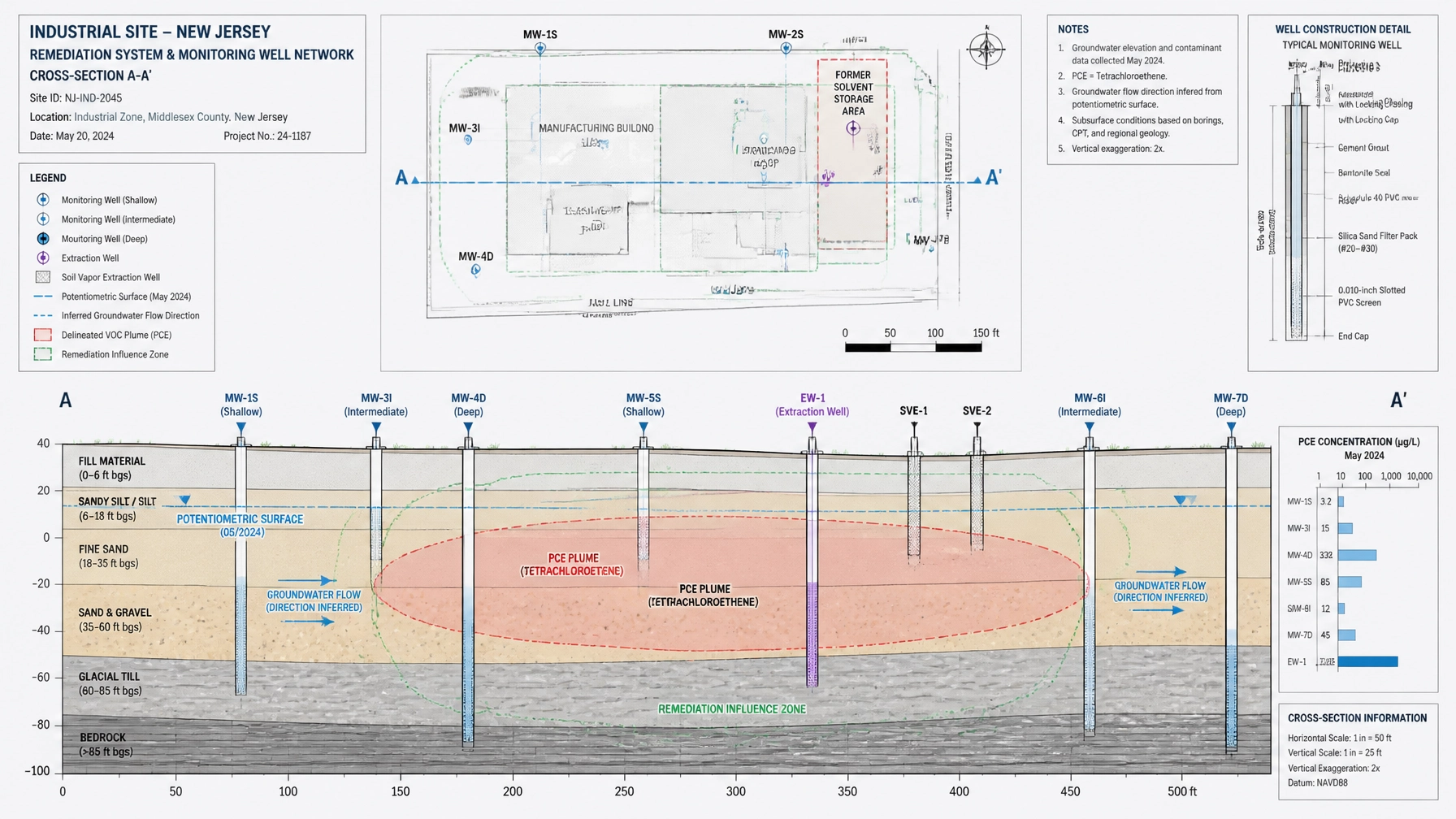
Typical NJDEP Site Investigation requirements involve soil borings, groundwater sampling, and sometimes vapor intrusion monitoring. Large firms often take a "carpet bombing" approach: drilling holes everywhere and hoping to hit something. We use technical modeling to target the sampling. By understanding the local geology: whether we’re dealing with the red shale of the Brunswick Formation or the sands of the Coastal Plain: we can predict where contaminants travel.
This precision saves you from the "fishing expedition" that leads to endless change orders and scope creep.

Tech-Enabled Compliance: The Envicon Advantage
Why do so many ISRA cases drag on for years? Because the data is siloed. Your consultant has the data, the lab has the data, and the NJDEP has the rules. You just have a monthly PDF that’s already out of date.
We’ve solved this through our digital solutions platform. Our clients get real-time project reporting dashboards. You can see your sample results, your schedule, and your budget in one view. If a sample comes back high, you know it the same day we do. This transparency changes the dynamic of a project. Instead of wondering why your site is still "in investigation," you can see the 3D plume model we’re building to justify a surgical remediation plan.
The Path to the Response Action Outcome (RAO)
The end game of every ISRA case is the Response Action Outcome (RAO). This is the document that tells your lender, your buyer, and the state that you have fulfilled your obligations under the Industrial Site Recovery Act.
Achieving an RAO doesn't always mean digging up every ounce of dirt. In many cases, we can use Remedial Action Permits (RAPs) for soil or groundwater. This allows you to leave certain levels of contamination in place, provided they are managed with institutional controls (like a Deed Notice) or engineering controls (like a cap or a vapor barrier).
This is where the distinction between a "consultant" and an "engineer" becomes clear. A consultant tells you what’s there; an engineer tells you how to manage it so you can build on it. Whether it's remediating a brownfield or managing complex site-civil engineering, we focus on the buildable asset, not just the compliance report.
Why Switching to Envicon Makes Sense
If your current consultant is treating your ISRA case like a black box, you’re losing value. Most big firms are built for the consultant's protection, not the client's progress. They write 500-page reports to cover their backs, while your project sits in a queue.
The Envicon Point of Difference:
- Direct Leadership: You talk to the people doing the work and signing the forms. No "partner-pitch, junior-execution" bait-and-switch.
- Technical Fluency: 20 years of direct experience with NJDEP, NYC OER, and the NYC Parks Department. We speak their language.
- Zero-Fluff Reporting: We deliver clean, actionable documentation that passes regulatory scrutiny without the bloat.
- Machine-Like Reliability: Our technology-driven workflow means we hit ISRA NJ compliance timelines with precision.
Summary: Focus on the Outcome
ISRA NJ compliance isn't just about finishing a Preliminary Assessment. It’s about navigating a technical and regulatory path that leads to a Response Action Outcome (RAO). Don't let your project get bogged down in the administrative black box of a national firm. You need a team that is PE-led, field-first, and regulator-facing.

Ready to clear the path for your next project? At Envicon Group, we don’t just deliver reports: we deliver outcomes. Contact us today to discuss your site’s specific challenges.
Leave a Reply